
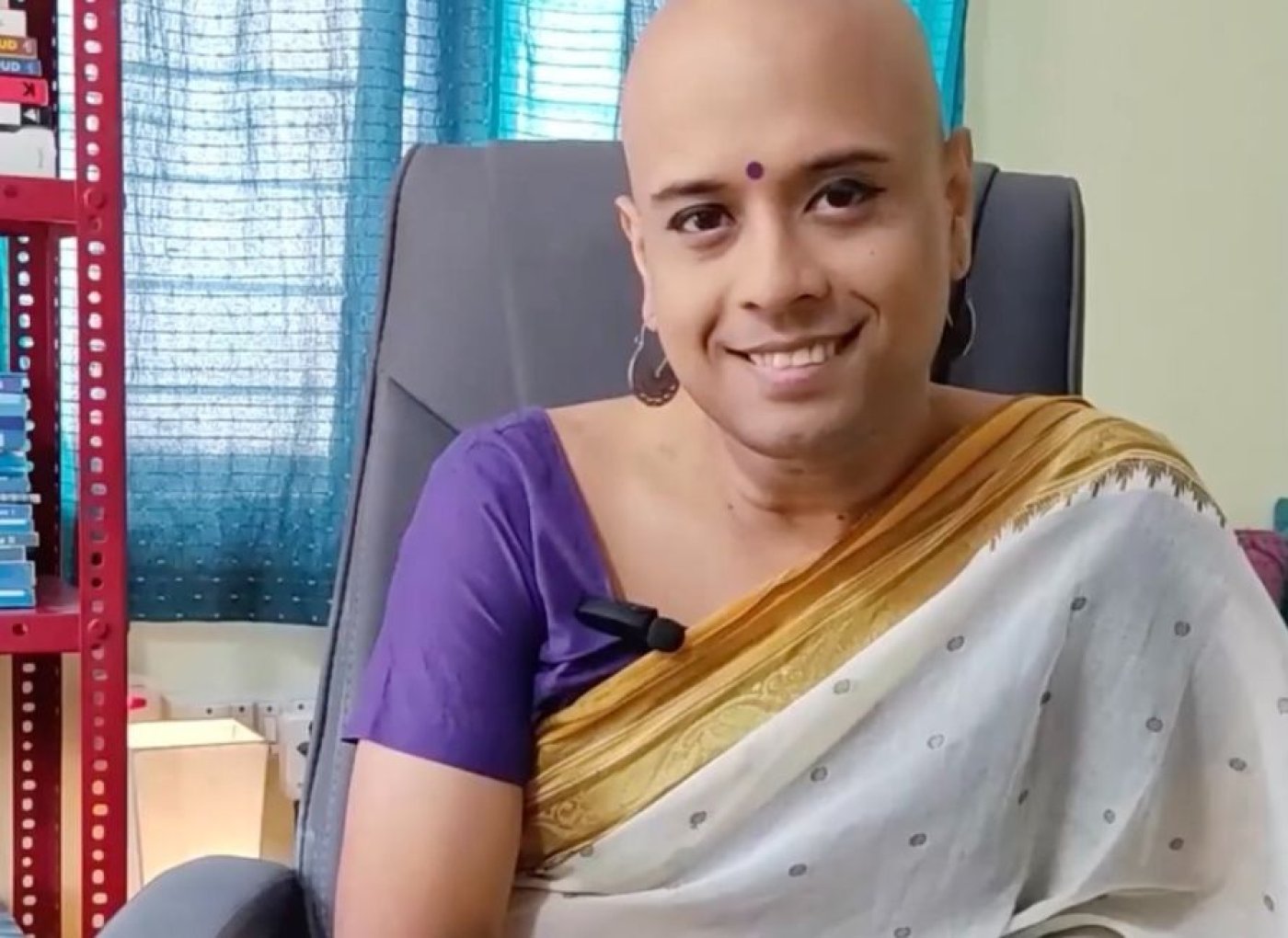
Mumbai: “Everyone recognises me from the meme. The stares are now either painted with a smirk or angry intolerance.”
It’s been nearly two months since Shubnam, 38, a graphic illustrator and artist from Delhi, found their life upended after becoming the subject of a meme at a protest for trans rights: unwelcome recognition in the neighbourhood, ongoing memes, and an unresponsive global social media corporation.
With head shorn and dressed in a turquoise-green saree, Shubnam—who identifies as transfeminine and uses they/them pronouns—was recorded without consent by a social media content creator named Parley (@parley.96) using the Meta Ray-Ban smart glasses, powered by artificial intelligence (AI).
Within hours, Instagram’s algorithm propelled Parley’s post, triggering a wave of transphobic abuse and AI-generated memes (here, here, here and here), including AI-generated images likening Shubnam to a Hindi animated cartoon named ‘Ganji Chudail’ or bald witch. Copies of the video migrated to X and YouTube, where it remained available for weeks despite repeated complaints.
When several Instagram users in India reported the video, the platform initially said it did not violate its Community Standards, contradicting its own guidelines on bullying and harassment.
A video of the fleeting exchange where Shubnam told Parley to “f*** off” after sensing they were being recorded spread across the internet, making them fodder for online trolls. As Instagram’s algorithm catapulted the video, it brought Parley notoriety through millions of views and thousands of comments.
India has almost no legal or regulatory framework governing AI wearables, such as Meta’s smart glasses, which it is pushing in one of its fastest-growing markets, raising questions about privacy, consent, surveillance and even the right to protest. Shubnam’s experience illustrates how powerful AI systems embedded in wearable tech can enable tech-facilitated violence against vulnerable groups.
Lawyers offered to help file a cyberbullying complaint, but Shubnam, already wary of the police after past, hostile experiences as a trans person, said they “gave up” considering that option.
“I did not want them to have any excuse to summon me in lieu of the complaint,” Shubnam said in an e-mail interview. “Filing an anonymous complaint wasn't an option either, because the categories are only meant for sexual harassment, sexual assault, etc.”
Apar Gupta, founder of the Internet Freedom Foundation (IFF), a think tank based in New Delhi, said the argument that Shubnam was filmed in a public place does not hold.
“Being visible in public means accepting a stranger's glance,” said Gupta. “It does not mean consenting to be covertly filmed through someone's glasses, baited with hostile questions and broadcast to millions on Instagram.”
Already exhausted after weeks of searching for accommodation in Delhi—a process they said was especially difficult as a transfeminine person—Shubnam suddenly found themselves at the centre of a viral storm.
Gupta said India's privacy jurisprudence, particularly the Supreme Court's landmark 2017 Puttaswamy judgment recognising privacy as a fundamental right, does not distinguish between private and public spaces as many people assume.
“Privacy attaches to the person, not the place,” he said. “The Constitution protects dignity and autonomy even when someone is in a public setting.”
In the aftermath, Shubnam posted their own video spelling out how their privacy was violated. In a separate Instagram post, they likened Meta’s wearable tech to “pervert glasses”. They’ve spent the last several weeks being advised by a lawyer and working with a civil society organisation to take down the video across platforms even as new posts keep cropping up.
How are you, Shubnam? Are you in a good place, mentally?
I'm doing okay now. I was in the middle of shifting homes when this entire sh*t show went down. Househunting for trans people is, as it is, quite a challenging task. It's like finding a needle in a haystack. I must have seen 40 flats between April and May, finalised 14 flats, the deals for which fell flat at the very last minute. I finally found a small place, where the landlords have been very respectful and polite. I was packing a giant carton when I got a text about that video on 26 May, and then it just kept growing. I was already quite mentally drained from the whole hunting and shifting, and this whole episode of virality just overloaded my brain at a time it really needed some rest… So yeah, I feel rested now.
It’s exactly a month since the video was posted; has the social media sh*t storm died down? Or do you hold your breath every time you get on to Instagram or any other platform?
I don't know if it has died down. Some Insta influencer just uploaded a re-enactment video of that episode, which is going mildly viral again, last I checked. The depiction completely contorts and misrepresents my identity and what happened that day. I mean, it's not ridiculing me for a change, instead trying to garner sympathy for trans people, which, I don't know, I comparatively appreciate, I guess? But still, the actor with a shaved head, green saree, and red blouse, depicted crying on the floor, scrolling through their phone, and then hanging themselves from a ceiling fan—it's still an objectification of my identity nonetheless. The conceptual image of me is still being used as a narrative device.
You said going to the police or the government or the courts was not an option for many trans individuals like yourself. Have you changed your opinion about that? Have you lodged a complaint with the cyber cell?
I tried but gave up. There was an organisation and some lawyer friends who offered help with it, including my friend who was also recorded without their consent in the same video. Filing a cyberbullying complaint would mean I would have to visit the police station to complete it. Being transfeminine, I have not had great experience with some cops in the past, and I avoid meeting cops in general as much as I can. Most cops mind their own business, but the ones who don't I do not wish to engage with, and there's no way to find out which one is which. So, I did not want them to have any excuse to summon me in lieu of the complaint. Filing an anonymous complaint wasn't an option either, because the categories are only meant for sexual harassment, sexual assault, etc. If I were a ciswoman, it would have been much easier.
I got a sense of a lot of rage watching your video (rightly so). I thought it was extremely brave to come out and address it head-on. Did you feel some tiny bit of catharsis after posting your own video? What has the reaction been to it?
Trans realities are built upon foundational systemic disenfranchisement, which is not a transitory and temporal emotional experience like ‘rage’. The kind of society we live in only grants cis men the right to experience and express rage in its rawest forms. For everyone else, we must modulate our anger into constructive articulations, because raw expressions of our rage itself always backfire on us. Which is basically what happened in the original video—all it took was a simple "f*** off" as a spontaneous reaction to the invasion of my privacy, to trigger the collective male ego of the internet. Lol. So what you saw in my response video then was not rage. It was an articulation of my disenfranchisement.
And it wasn't cathartic. Because it was strategic. But there was indeed relief in having said what I said. That I didn't heed my earlier plan of letting it die down and not engage the trolls. And you can see the comments on the video for the reactions. I was actually surprised that so many people also shared the same sense of relief that I did eventually respond, and not go silent and disappear.
In your video, you mentioned that you have spent the last 10 years living a very private life. Did the original video create any issues for you at work or with family and friends? I also noticed your Instagram account was created a couple of years ago, but you didn't post anything until this whole thing blew up.
I'm being clocked everywhere now. Everyone recognises me from the meme. The stares are now either painted with a smirk or angry intolerance. The reach of my own response video was obviously a fraction of the reach of the original unconsented reel. Many people haven't seen my side of the story (not that they care for it either). Random strangers are saying “tum to wahi CJP waale ho na”, and I never even went to any CJP (Cockroach Janta Party) protest. Just within my neighbourhood, some man passed a comment after I passed them, “Inko badi azaadi azaadi chahiye (what great freedom do they want)”. And all this is happening while I'm wearing a T-shirt and shorts, which is what I wear when I step out to go to the nearby Mother Dairy. I haven't even stepped out wearing a saree yet.
Yeah, that's an old art account that got hacked, so I moved to a different one because this one was still being shadowbanned even after being restored. I use it for anonymity now.
Instagram deleted the video after three weeks. But it is still up on other platforms like X, YouTube, Reddit, etc. Do you feel angry and resigned to the fact that there is no recourse? What about Meta specifically? In this case, they are not just the developer of the technology but also the distribution platform—Instagram.
I want to sue Meta for damages. Please let me know if any lawyer has ideas on how to go about it.
I wanted to ask you about your thoughts on smart glasses and on AI (you said you had never uploaded your photo to any generative AI application/chatbot before this). Do you think this tech (smart glasses) is easy to abuse, puts too much power in the wearer's hands, and will ultimately be used for various forms of surveillance? You also called it 'pervert glasses' in the illustration that you posted.
That's a much deeper subject matter. I'm still thinking about it. So far, where my thought process is at, is that the perversion of pervert glasses is not just that it perverts our mutual constructs of privacy. It perverts the fundamental social ethos of what's shared and what's individual ownership. No public space belongs to any one individual just because they have the freedom to be there. It belongs to everyone. One person cannot have the right to randomly record images of people without their consent and use them, or feed those unconsented images into any kind of database (AI in this case). If we, as a society, do not uphold the ethos of shared ownership of collective resources, we allow ourselves to spiral into a dark path of individual self-centrism that will be hard to return from.
Has this incident made you self-censor or cautious about speaking up or stepping out and going for other such protests for trans rights? I can't imagine how emotionally draining this whole experience has been.
Being recognised, and my inability to tell if any of it can cause me more harm, is what has upended my ability to be outside... It's too soon to tell, though. I have been avoiding stepping outside my neighbourhood so far. Let's see...
Lastly, you said you enjoyed playing video games. Can I ask which ones are your favourites?
Haha. Oh, I play different kinds of games. One game I have been regularly playing for the last ten years is Hearthstone Battlegrounds. It's like my daily Sudoku. It's a card-based auto-battler (somewhat like Teamfight Tactics and Autochess). A friend of mine also got me into another recently released roguelite card game, Slay the Spire 2. Apart from this, when I have more mental bandwidth and time between design projects, I like drowning my days in masochistic platformers like Hollow Knight and Silksong. Other times I love relaxing colony sims (simulators) like Oxygen Not Included and Against the Storm.
(Karen Rebelo is a Mumbai-based independent journalist whose work focuses on algorithmic accountability.)
Get exclusive access to new databases, expert analyses, weekly newsletters, book excerpts and new ideas on democracy, law and society in India. Subscribe to Article 14.