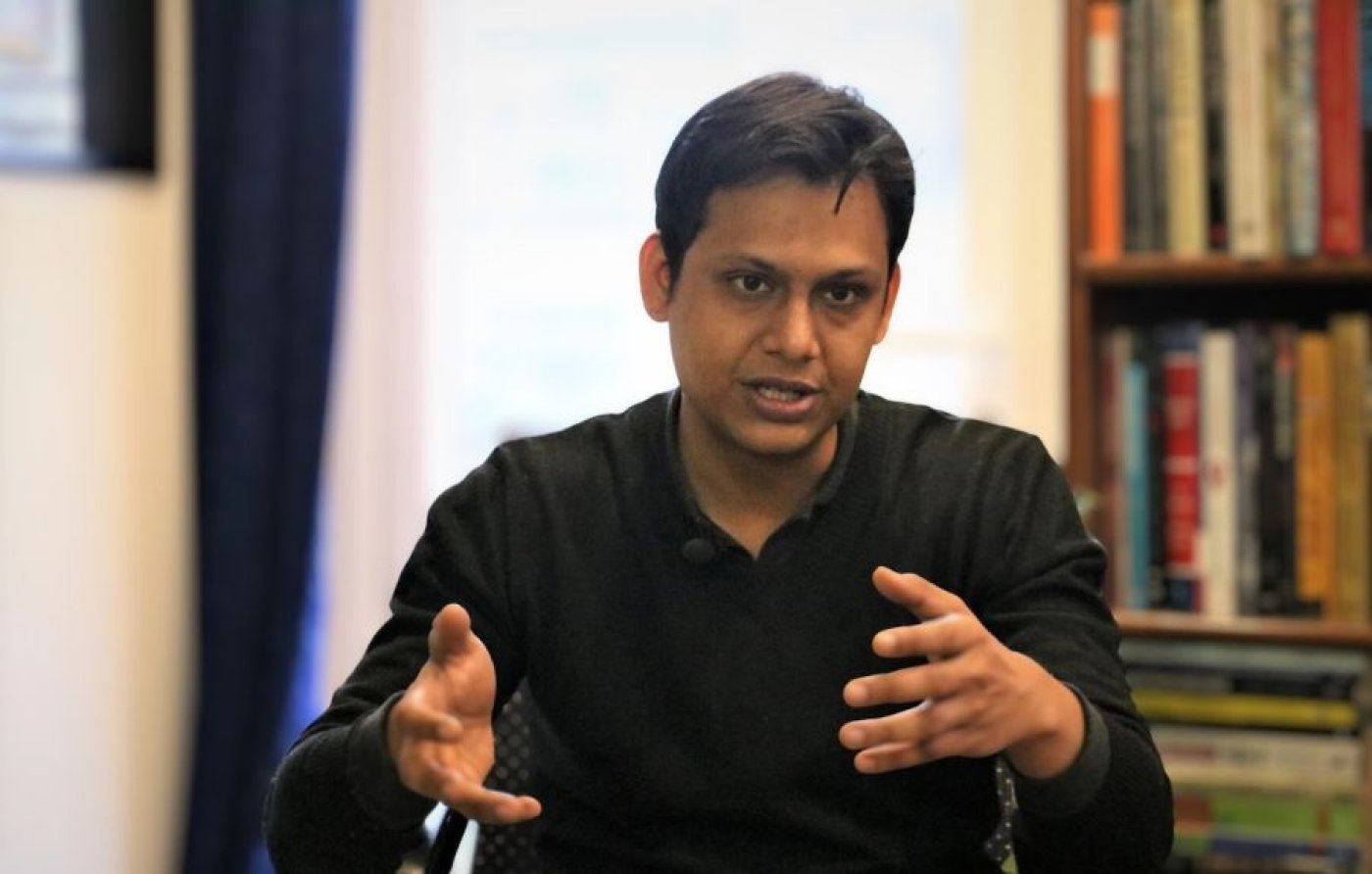
New Delhi: After fake takedown requests in the Delhi Police’s name targeted his organisation, Apar Gupta, founder-director of the Internet Freedom Foundation (IFF), had a warning. India’s censorship system, he told Article 14, is “built for speed and secrecy”, and “I would not be surprised if false legal notices and court orders are being used for takedowns”.
Days later, Reuters found that they were. On 11 November, the news agency reported that the union government had ordered internet service providers to block 129 illegal betting websites this year, citing two high court orders that turned out to be fake. The Department of Telecommunications issued the blocking directions on 21 July and 2 September, and posted them on its website with the purported orders attached.
Neither order appears in the courts’ records. The Rajasthan High Court’s registrar said its purported order “appears to be fraudulent”, and the Allahabad High Court filed a police complaint on 6 November, prompted by Reuters’ findings. Police are investigating unknown persons for forgery and cheating. The telecom department did not respond to Reuters.
The requests targeting the IFF looked real enough. They carried the name of a serving Delhi Police officer, his correct rank and his email address, and asked X to withhold the accounts of the IFF, the Software Freedom Law Centre, India (SFLC.in), and @geoblockedindia, three groups that document online censorship in India. X forwarded them to the groups.
On 6 November, X told the Delhi High Court that its internal investigation showed the email used to submit the requests “appears to be fake”, that it had filed a complaint with the Delhi Police, and that it was “not likely to take action on the reports at this stage”, the IFF said. The court disposed of the IFF’s and SFLC.in’s petitions, recording X’s statement and allowing them to return if any action is taken.
A Delhi Police official said a letter purportedly from the special commissioner of police (crime) was “fabricated”, The News Minute reported, citing Scroll. Who sent the requests remains unknown.
The requests, filed with X on 31 October and 2 November 2026, first sought the removal of posts by the IFF and SFLC.in, then the withholding of all three accounts and 37 posts by 16 other users. They claimed the posts defamed the Rashtriya Swayamsevak Sangh (RSS) under section 356 of the Bharatiya Nyaya Sanhita (BNS), left the court order fields blank, and demanded action within three hours under the amended IT Rules.
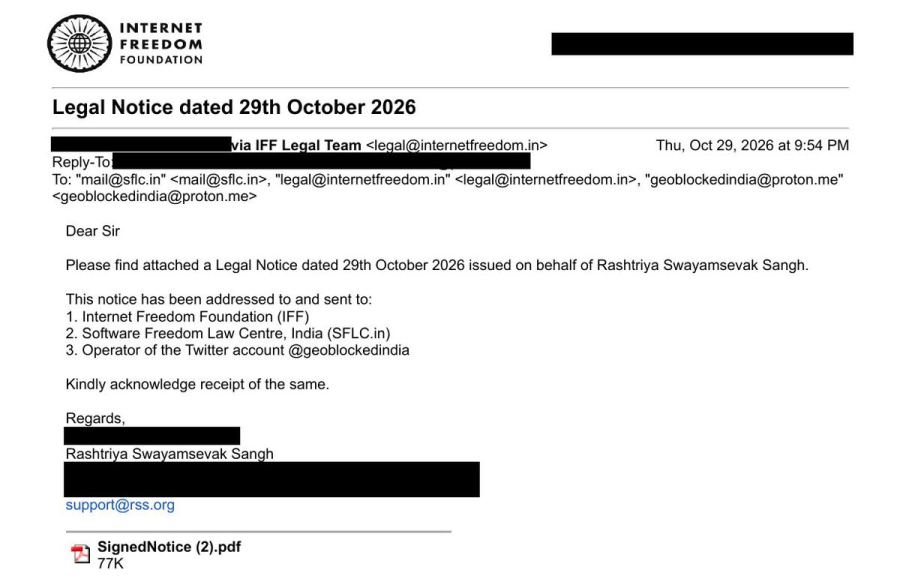
They followed a “legal notice” in the RSS’s name, emailed on 29 October from a free Proton Mail address and signed by an unnamed “authorised signatory”, which asked the three to stop documenting the government’s blocking orders. It claimed that SFLC.in’s Free Speech Tracker, a public log of online restrictions, guides people to blocked content. The IFF published the notice with a detailed statement on 30 October. Several RSS office-bearers said on X that it was not theirs, and the IFF has urged the RSS to say publicly whether it authorised it.
A second notice, on 1 November, claimed that the Akhil Bharatiya Adhivakta Parishad, which SFLC.in describes as the RSS’s “legal and advocacy wing”, had taken up the matter. SFLC.in questioned the authenticity of the requests and asked X to disclose who sent them. It later said that an email to the address listed for the officer had bounced, and that X’s law enforcement request form had accepted a test request it filed using a fictitious email address, a gap it said was later fixed.
Requests against @geoblockedindia from the Uttar Pradesh Police, the Telangana Police’s intelligence department and the Delhi Police’s cyber crime unit, including one for the entire account, are still pending, according to the IFF.
All this has played out amid growing pressure on online speech. The Hindu reported that the Delhi Police had sent around 300 takedown requests in three months. The IFF had demanded that the ministry of electronics and information technology (MeitY) withdraw its October advisories to Meta on protest-related content. The union government is also considering withdrawing the “safe harbour”, or legal immunity, that shields platforms such as Facebook, Instagram, YouTube and X from liability for what their users post, according to reports on 5 November.
As the IFF pressed the Delhi Police to say publicly who sent the requests, Article 14 spoke to Gupta about what the hoax reveals.
The interview:
What was the background to the Delhi Police’s requests to take down your account, and those of others?
Late on the night of 29 October, the IFF, SFLC.in, and the person who runs @geoblockedindia received a two-page “legal notice” claiming to be issued on behalf of the RSS. It was signed by an unnamed “authorised signatory”, asked for replies to be sent to a free Proton Mail address, and asked the three of us to stop documenting blocking orders and to confirm within seven days that we would comply.
We published the notice and replied that it disclosed no illegality and cited no law. We also wrote to the RSS at its official address, asking whether it had authorised the notice. After that, several RSS office-bearers said on X that the notice was not theirs.
On 31 October and again on 2 November, the special commissioner of police (crime) filed reports [Editor’s note: we now know he did not] with X describing our posts about this notice as defamatory under section 356 of the Bharatiya Nyaya Sanhita. They asked X to withhold our entire account, the accounts of SFLC.in and @geoblockedindia, and posts by 16 other users who had commented on the episode. We learned of all this only because X forwarded the reports to us on the morning of 3 November.
While this incident turned out to be an elaborate hoax, is such arbitrary censorship and police action, even against watchdog organisations like yours, very real? How often has X’s lack of verification been exploited—or weaponised—in this manner?
Over the past year, IFF’s staff have been doxxed, and the one or two organisational grants we had ourselves publicly disclosed have led to reputational attacks on our funders. The doxxing went so far as to pull out the names of each staff member and circulate them in Telegram groups, essentially labelling our work as inimical to the national interest.
However, this recent attack was very sophisticated and goes far beyond what is typically considered a hoax. The false Delhi Police notice to X was preceded by a false notice that was purportedly issued by the RSS, which has since denied it. It basically asked us to stop our work completely, and the second notice stated that complaints against us had been forwarded to the ABVP [Akhil Bharatiya Adhivakta Parishad] for filing legal cases with the Delhi Police.
It’s in this context that the false Delhi Police notice must be viewed, [since] it includes the name of a serving police officer, their correct rank, and their email ID. This seems real enough for X to forward the notice to us, and since the Delhi Police does not respond to our lawyer’s legal notice, we have to go to court. Now, the entire censorship regime in India is built for speed and secrecy, and I would not be surprised if false legal notices and court orders are being used for takedowns.
Last week, news broke that the government is mulling the removal of the “safe harbour” for platforms like X and Meta. How would this move further affect users’ free speech and their ability to criticise the government on these platforms?
There are legitimate policy objectives in reviewing the intermediary liability framework under the IT Act; however, the objectives of the present proposal are tied to the BJP’s political survival and dominance. It has been known for some time that the popularity of the Prime Minister and of its Hindutva project has been under challenge in the wider digital ecology. The Lokniti-CSDS post-poll surveys of 2024 provide evidence for the significant use of digital platforms as the basis for the electoral choices in the last general election.
Around that time, the government was toying with the idea of the Broadcasting Bill, 2024 [the Broadcasting Services (Regulation) Bill, 2024], which had similar objectives for licensing online creators and making platforms liable for enforcing this licensing. Now, even with changes to the IT Rules, 2021, it has been able to achieve expedited takedowns through Meta's automated system. So now it does not need to issue orders, and the job of censorship has been completely outsourced.
In addition, it now wants to remove the “safe harbour”, which is not about making platforms more responsible but about having more censorship against people who are challenging the cultural and political project of Hindutva. Now, child sexual abuse material, hate speech and gendered online violence exist and are poorly implemented by online platforms, but all these provide opportunistic hedges for the government to justify the change in regulation. I have written more about this in Tech Policy Press.
On 1 November 2026, The Hindu reported that the Delhi Police had sent around 300 takedown requests in the past three months, most of which the platforms acted on. How do you see the action against the IFF, given this climate of digital censorship and the wave of protests documented online since July?
The Hindu’s figure of about 300 requests in three months matches what we see at our end. In the three weeks before this notice, the IFF assisted 86 people whose accounts were suspended or whose posts were withheld, and SFLC.in’s tracker counted 268 content restrictions and 83 account restrictions in October alone.
Since July, the sequence has repeated itself each time: a protest, then reels and posts documenting it, and then a Delhi Police monitoring team sending platforms requests that nobody publishes and that users learn about, if at all, after the content is gone.
The reports against us are the next step in that sequence: the police move from the people posting about protests to the people keeping count of what is being removed. When a police force asks a platform to delete criticism of an anonymous legal notice, on defamation grounds that the law leaves to the person defamed and to a court, the process stops having anything to do with law enforcement.
The IT Rules, amended this year, now give platforms three hours to act on takedown requests, and many protest-related reels have disappeared. How much do platforms push back? Can the government’s censorship be stopped?
X forwarded the reports to us and told us we could challenge them in court. That is the most transparency we have had from any platform in this episode, though it still falls short of a refusal to act.
Meta’s users, by contrast, receive a one-line message from a no-reply address citing the IT Rules as a whole, and their accounts come back only after a legal notice. MeitY tells reporters to “ask Meta”, and Meta points to a “legal requirement”, so nobody owns the decision.
The February amendment cut the compliance window to three hours, which is enough time to comply and not nearly enough to ask a question—and that is the point. Censorship can stop, but only if platforms treat a web form as the informal request it is, tell users before they act on it, and courts enforce the safeguards they wrote down years ago.
(Sabah Gurmat is an independent reporter based in Delhi.)
Get exclusive access to new databases, expert analyses, weekly newsletters, book excerpts and new ideas on democracy, law and society in India. Subscribe to Article 14.