
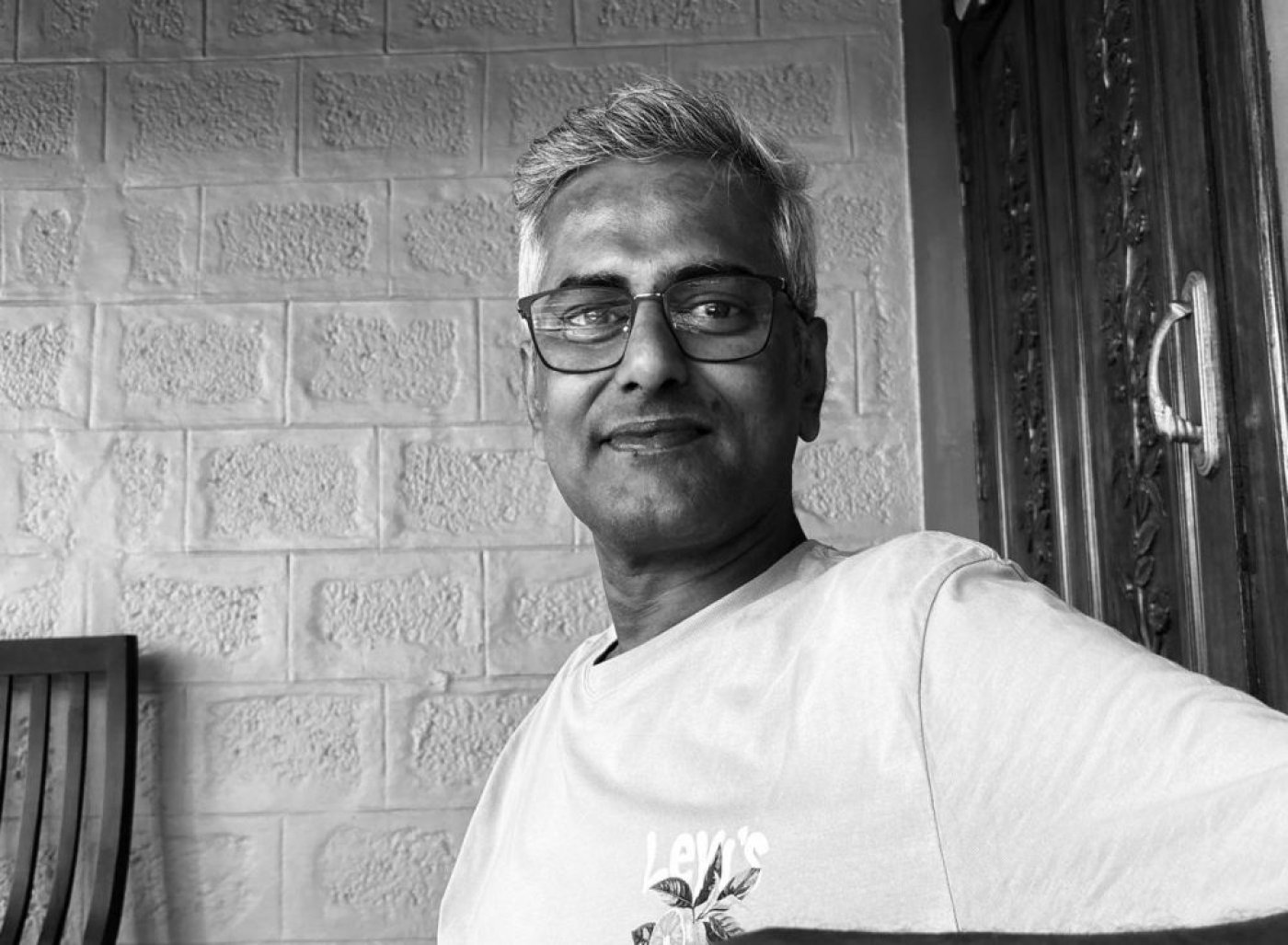
New Delhi: “Corporates believe that this kind of intimidation will silence us,” investigative journalist Ravi Nair told Article 14 after his release on bail from Ahmedabad Central Jail on 29 September 2026.
A trial court in Mansa, Gujarat, convicted him of criminally defaming the Adani Group on 10 February 2026 and sentenced him to a year in prison and a Rs 5,000 fine.
The case was based on a series of tweets Nair posted from his Twitter (now X) account from October 2020 to July 2021 that the Adani Group said were ‘scandalous’, ‘false’, ‘misleading’, ‘derogatory’ and ‘defamatory’.
Nair’s lawyers argued that the tweets were based on articles already in the public domain and he merely shared the links to those articles. He had been granted bail pending his appeal and was not taken into custody at the time of the conviction.
Nair was then remanded to judicial custody on 17 September by a sessions court after he missed a hearing in the case. He spent eight days in prison before being released on bail on 29 of September.
Both his original conviction and subsequent arrest drew widespread condemnation from press freedom groups and journalists. In a statement, the Committee to Protect Journalists described the conviction as a “dangerous precedent for press freedom and free speech in India”.
Speaking to Article 14 after his release, Nair said large corporate houses used such lawfare to drain journalists of their time, energy and money, hoping they would eventually give up.
According to Reporters Without Borders (RSF), the Adani Group has filed civil and criminal defamation lawsuits against 15 journalists since 2017.
RSF also named the Adani Group on its 2026 Press Freedom Predators List for its attempts to “criminalise journalism via abusive legal proceedings”.
Nair said he had no intention of backing down and would continue his work.
In 2015, after nearly three decades as a business developer in the corporate sector, he turned to a childhood passion: journalism.
Since then, he has investigated some of India's biggest stories, including impropriety in the Rafale defence deal and investments in the Adani Group.
In this interview, Nair discusses his transition from the corporate world to journalism, how he broke some of his biggest investigative stories, his experience in prison, the defamation case filed by the Adani Group, and why he believes investigating powerful institutions and corporations is essential in a democracy.
You had a well-paying corporate career a decade ago. What made you leave it to become a journalist?
Since my childhood, I have been passionate about becoming a journalist. Thirty years ago, I even spent a few months as a trainee journalist, but what took me away from the field was the work culture and the organisation I was part of. Initially, I got the impression that unless you had a godfather in a big newsroom, you wouldn't survive.
So, I left the field and started my career in the corporate world, where I was doing well and had a well-paying job. This continued until 2015, when, over the years, we had grown enough to feel that we should start something of our own. So, a few of my colleagues and I started our own consultancy.
This decision not only brought business success but also opened a few more doors for me. First, I had a lot of free time, which I hadn't had in my previous job. Secondly, I had the freedom to think and comment on political issues, whereas, in a corporate job, it is usually a contractual requirement not to make political endorsements or statements.
At the same time, the Indian media landscape also started to change. Unlike in previous years, the mainstream media started praising the government, especially one particular leader. This made me uncomfortable.
All these factors made me think that I should return to journalism.
I made my debut in the field by writing articles. During my previous decades in the corporate world, I had followed the political economy very closely. I started noticing that the current government was claiming to launch new schemes when, in fact, many of them were old schemes being repackaged under new names
—the same old wine in new bottles.
So, I started writing about this. From then on, I kept writing about different schemes and how the government's claims did not match its own statistics.
You had just returned to journalism. How did you move from writing about political economy to investigating powerful institutions, particularly the defence sector, the Rafale deal and the Adani Group?
I had never thought that something was wrong with the Rafale deal while it was going on. I was aware of the deal because I had been reading about it in newspapers, but I hadn't followed it closely.
One day, during that period, I was travelling to Mumbai. At the airport, I picked up a copy of The Economic Times. I was reading it on the plane when, out of the blue, the person sitting next to me looked at my newspaper and said, ‘Yeh Modi ji ne bahut badhiya kiya (What Modi has done is great),’ referring to an article about the Rafale deal.
This caught my attention because I realised that the deal was being discussed among ordinary people as well. I came back home and started reading extensively about it. I found a lot of interesting things. After some time, through my sources, I got hold of a bunch of documents. That's how I broke those stories.
As for the Adani Group, it was in late 2018. I was again contacted by one of my sources, who told me that the government was privatising six Airports Authority of India-controlled airports and handing them over to the Adani Group. I asked him if he was sure, and he said he was 100% certain.
He gave me a pen drive that contained everything: minutes of meetings, background reports, meeting records of the Group of Empowered Ministers and secretaries, how they had behaved, what objections had been raised and how those objections had been overruled. It also contained details of how the terms of the tender had been tweaked.
But that was not enough for me to write about the group. So, I waited until towards the end of 2019, when the bids were opened. All six airports went to the Adani Group, just as my source had predicted and the documents had indicated. I then published a long piece in NewsClick.
After that, I started researching Adani's business growth more closely, and it was really intriguing. A business group that had a total market capitalisation of $7–8 billion in September 2013 was growing at an extraordinary pace.
Having worked in senior corporate positions, I understood how businesses function and what their growth trajectories usually look like. So, I started focusing more on the group. And that's how I began writing about them.
More recently, you spent some time in prison. What was that experience like?
I was kept inside a barrack. I had previously seen lock-ups during my visits to different police stations in Kerala for a study, but this was my first time being in custody myself.
We would start our day around 6:30 am, when the jail staff would open the barrack doors and begin counting the prisoners. They would instruct everyone to sit in a row. Since I was suffering from back pain, I would take support from a nearby wall. After that, we would have breakfast. The doors would remain open until 10:30 am, after which they would be closed again.
Inside the jail, I kept thinking about my children and wife, who were outside running from pillar to post to seek legal help. Apart from that, since I was not allowed to bring my books inside, I spent hours talking with many of my fellow inmates.
During these conversations, I noticed a few things. Many of my fellow inmates were either local youngsters or foreign nationals, such as Pakistani sailors who had crossed the maritime boundary and were inside without any legal assistance.
I met several youngsters who told me they were facing sexual abuse cases and, according to them, had been framed by the girls' families. Since these youngsters came from low-income families, they claimed they would remain in jail for years, after which the girls' families would offer to reach a compromise in exchange for money.
I also came across cases of drug smuggling in which people told me they had been asked to deliver something from point A to point B, without knowing what they were carrying. They were caught along the way and labelled as drug traffickers.
All these people were struggling to get any kind of legal assistance inside the jail.
There is a legal aid cell, but, first, the people working there are overwhelmed with cases. Secondly, they are not competent enough. As a result, many of these people have remained in jail for years simply because they cannot afford proper legal representation.
After seeing their conditions, my own problems, including the back pain I was experiencing, seemed much smaller.
There are no beds or stools inside the barracks, so you have to sleep on the floor. The food is of very poor quality, the washrooms are unhygienic, and access to water is also a problem.
You were convicted in a defamation case filed by the Adani Group, and the matter is still sub judice pending the appeal. What can you tell us about the case?
As of now, I am facing five cases from the same business group.
Before they first filed the first case against me in 2021, they called me to their office and told me not to write or tweet about them, or say anything publicly about the group.
They told me, 'You aren't even a journalist. The problem is that when you write, people like Prashant Bhushan retweet it, and it attracts a lot of negative attention for us.'
In response, I told them that whenever I write anything against them, I do reach out to them and give them ample time to respond, but they never reply.
After they realised that they could neither buy me off through bribes nor silence me, they told me very clearly and categorically that they would file legal cases against me. This happened in June 2021. I knew this would happen.
They filed a case, and in their initial petition, they cited around 25 tweets, all based on articles published in different publications, including The Guardian, The Washington Post, ABC, The Hindu and The Economic Times, among others. By the time the case reached its final hearing, the number had come down to around 15 tweets.
I was subsequently convicted, and I filed an appeal, which is still pending.
These are essentially SLAPP (Strategic Lawsuits Against Public Participation, a form of legal intimidation). The motive is to make you waste a lot of time, energy, and money.
Corporates believe this kind of intimidation will silence us, and many people do give up. But I am not going to stop. I will continue doing this for as long as possible.
You have faced legal pressure and financial uncertainty as an independent journalist. Who has supported you through these challenges, and how have these experiences affected your ability to sustain a career in journalism?
Since 2023, I have had some financial backing through a fellowship with OCCRP (Organized Crime and Corruption Reporting Project, a US-based organisation that fosters investigative journalism).
In addition, some of my friends in the profession, especially well-known investigative journalists, have helped me a lot. Paranjoy Guha Thakurta has also been a great support.
My parents have helped me as much as they could. Prashant Bhushan has provided me with legal assistance on a pro bono basis. Josy Joseph has also stood by me. All these people have helped me navigate these challenges. But these are mainly in relation to the legal cases.
Apart from that, in 2017, I was interviewed for a senior position at a big company and selected as its India head. I was waiting to hear back from them when I received a call saying during the background check, they had found that I had written extensively against the government. As a result, they decided not to hire me.
That was when I realised that I probably wouldn't be able to get another corporate job. I love journalism, and this is the only thing I can do.
Why do you believe investigative journalism and public scrutiny of large corporations are so important in a democracy?
In a democracy, the people are supreme. The voters are supreme. We elect politicians to represent us in Parliament. They are there to represent us and make laws that serve the public. They are answerable to us. We, the taxpayers, are supreme in a democracy, and people should have a say.
When things are not transparent in a democracy, that becomes a problem. When it comes to large corporations, these companies enjoy many tax benefits. In today's India, the tax rate for individuals is much higher than the tax rate corporations pay.
Secondly, most of these companies are listed on the stock exchange and are publicly traded, which means public money is involved. Banks also lend them tens of thousands of crores, and that is public money too.
What advice would you give to young journalists who want to pursue independent, fearless journalism at a time when corporate interests, political pressure and legal intimidation are increasingly shaping the media landscape? And do you remain optimistic about the future of journalism in India?
Find out the truth and stand by it. Before publishing anything, make sure that every fact you put into your story can be substantiated with documentary evidence.
It does not matter how powerful a corporate house or government institution is, or how hard it tries to suppress you. If your facts are right and you have the evidence to support them, you will have something to stand by, even when you have to defend your work in court.
Journalism, for most people, is not a highly paid profession. Perhaps a few executives in television studios earn well, but for most journalists, it is a profession that demands enormous patience, commitment, and sacrifice. Many people who genuinely wanted to practise independent journalism have eventually left the field because their employers would not allow them to do the kind of journalism they believed in.
Take my friend Rifat Jawaid, who ran Janta Ka Reporter. He eventually left India and is no longer actively practising journalism. These are some of the realities of the profession.
Ultimately, it is an individual's decision whether they want to stay in journalism and what kind of journalism they want to practise. But this is precisely the time when we need genuine, independent journalism more than ever.
I am, however, encouraged to see young people entering the space through YouTube and other digital platforms. Many YouTubers and independent content creators are doing commendable work, and I am glad to see them taking up issues that mainstream media often fails to address.
That gives me some hope for the future.
(Arsalan Bukhari and Mehrunissa Maryam are independent journalists.)
Get exclusive access to new databases, expert analyses, weekly newsletters, book excerpts and new ideas on democracy, law and society in India. Subscribe to Article 14.