
New Delhi: Burned into my family’s memory are the stories of Partition. My parents’ ancestral village was Kahuta, in what became Pakistan in 1947. Punjab, on both sides of the newly drawn border, was in flames. As murderous mobs roamed the countryside, the entire Sikh and Hindu population of our village took shelter in the gurudwara.
Soon, the mob closed in and began tearing down the gurudwara's tall, fortified walls.
Then the men of the village made a fateful decision. To “save” the honour of their women and girls, they would force them to jump into the well within the gurudwara and take their own lives. Those who refused were killed with daggers wielded by their own fathers, brothers, husbands and sons.
Variations of this gruesome theatre of “honour” played out across Punjab. Urvashi Butalia, India’s foremost chronicler of Partition, writes of meeting a Sikh man who had killed 18 women from his own family. Countless women and girls were abducted and raped, even as men sought to “cleanse” their lands of the offending “other”.
What unfolded in my parents’ village, at the very moment that India and Pakistan won their freedom, was the blood-soaked culmination of a much older idea: that women are the property of families, religious communities and nations.
In times of conflict, their bodies become battlefields on which men defend honour and assert power. Women are denied agency; they cannot be trusted to choose for themselves. Men alone claim the right to decide what women will do with their bodies and, indeed, with their lives. Women's desires, happiness, understanding of love, and, ultimately, even survival count for little when weighed against the supposedly higher claims of honour.
Many decades after Independence, these ideas have not faded. They survive in new forms and new vocabularies, continuing to shape social norms around romance, sexuality and marriage.
The man from the hated “other” community is still imagined as a sexual predator. “Your” women must be disciplined, monitored and controlled lest they fall prey to his supposedly sinister designs. If a woman transgresses the boundaries laid down by the men of her family or community, moral panic follows.
Blood must flow—of the alleged predator and, if necessary, of “your own” women. “Their” women, meanwhile, are viewed as the property of the hated other. To possess them is imagined as a triumphant assertion of power, a legitimate spoil of victory.
At the heart of this worldview lies a profound misogyny. Women cannot be left free to decide whom they befriend, whom they love, with whom they have sex, or whom they marry.
In this essay, I revisit the battles of Partition that were fought over women’s bodies. I return also to the remarkably prescient, though ultimately unsuccessful, debates in India’s Constituent Assembly that sought to recognise a woman’s freedom to choose her partner as a fundamental right.
Against this history of misogyny—and of the stigmatisation of men from oppressed and “othered” racial, caste and religious communities, not only in India but also in Jim Crow America, Nazi Germany and apartheid South Africa—I examine the social mobilisation, politics, laws and policies that today sustain claims of “love jihad” conspiracies and justify so-called “honour killings”.
Partition, Honour & Women’s Bodies
When men on both sides of the new border mobilised for murderous attacks against the religious “other” in 1947, women’s bodies became a central battlefield for family, community and national “honour”. There was little room for women’s agency, and none for their choices in love, sex or marriage.
As Sunny Hundal observes, the Partition of India was not only a struggle over territory. It was also a struggle over women’s bodies and the meaning of community honour. This conflict, he argues, continues to shape social relations in South Asia and its diaspora. “In patriarchal and feudal societies,” he writes, “women are almost always seen as the bearers of culture and ‘honour’.”
Traditional South Asian culture, he argues, “fetishises women to such an extent that, while the official line says they are held in high esteem and regard, in actual fact, they are treated simply as vessels of that honour.” Women are burdened with preserving these ideals; men enjoy far greater freedom.
Partition exposed this misogyny with extraordinary brutality. As Hundal writes, when Muslim, Hindu and Sikh men sought revenge for violence committed by the religious “other”, they often targeted women. Women were abducted, raped and forcibly converted. In villages surrounded by armed mobs, women were urged—or compelled—to end their lives by jumping into wells rather than risk capture.
Hundal points to the Pakistani film Khamosh Pani (Silent Waters) as a powerful portrayal of this history. The film is set in Kahuta, my parents’ ancestral village, from which they were forced to flee in 1947 after women were killed by male relatives or driven to suicide in the name of honour.
In Quarantined: Women and the Partition, Debali Mookerjea-Leonard examines the fate of women who were abducted, displaced or separated from their families during Partition. After 1947, both India and Pakistan launched large-scale recovery operations to “rescue” these women and return them to their original families and communities.
Yet many were rejected upon their return. Having been abducted or raped by men from the “other” community, they were viewed as “dishonoured” and therefore impure. Families and communities often blamed the survivors rather than the men who had violated them.
Mookerjea-Leonard shows that the concern of both states was less the welfare of these women than the restoration of communal honour and national identity. The women were treated almost as quarantined subjects—tracked, controlled and transferred across borders with little regard for their own wishes.
Through their experiences, she argues, we see how women became repositories of collective honour, their personal rights subordinated to the demands of family, community and nation.
Constituent Assembly Deliberations
In the shadow of the mass violence of Partition—when countless women were abducted, assaulted, exchanged and reclaimed in the name of honour, with little regard for their own wishes—two remarkable proposals emerged during the framing of India's Constitution. The Constituent Assembly's leading feminist voices, Hansa Mehta and Rajkumari Amrit Kaur, championed both.
Veteran filmmaker Shyam Benegal, in his television series Samvidhan, which recreates Constituent Assembly debates from archival records, depicts one such proposal. Mehta and Kaur sought to include in the chapter on fundamental rights a woman's right to consent to her choice of spouse. Only one male member of the Drafting Committee supported it.
The second proposal came from Minoo Masani, the Parsi socialist member elected from Bombay, as Article 14 has reported. Under the colonial-era Special Marriage Act III of 1872, people of different faiths could marry in India only if one partner renounced their religion. If neither was willing to do so, they had to marry outside India.
Masani proposed a simple but radical constitutional guarantee: “No impediments to marriages between citizens shall be based merely upon difference of religion.” The clause drew inspiration from Article 54 of the Swiss Constitution.
Masani's proposal was supported by Hansa Mehta, Rajkumari Amrit Kaur and B R Ambedkar. Yet when put to a vote, it was defeated by the narrowest of margins—five votes to four.
In their note of dissent, Masani, Kaur and Mehta lamented its exclusion. Such restrictions on marriage, they argued, sat uneasily with the very idea of a common Indian nationhood: “Such an impediment to marriage between two Indians is a reflection on our claim to common nationhood.”
They reminded fellow members that Mahatma Gandhi had, only months earlier, publicly endorsed marriages between people of different faiths, each retaining their own religion. Yet, they noted, “such marriages cannot be solemnized in India today”.
Historians rightly caution against counterfactuals. Yet it is hard not to wonder what India might look like if these proposals had been enshrined as fundamental rights.
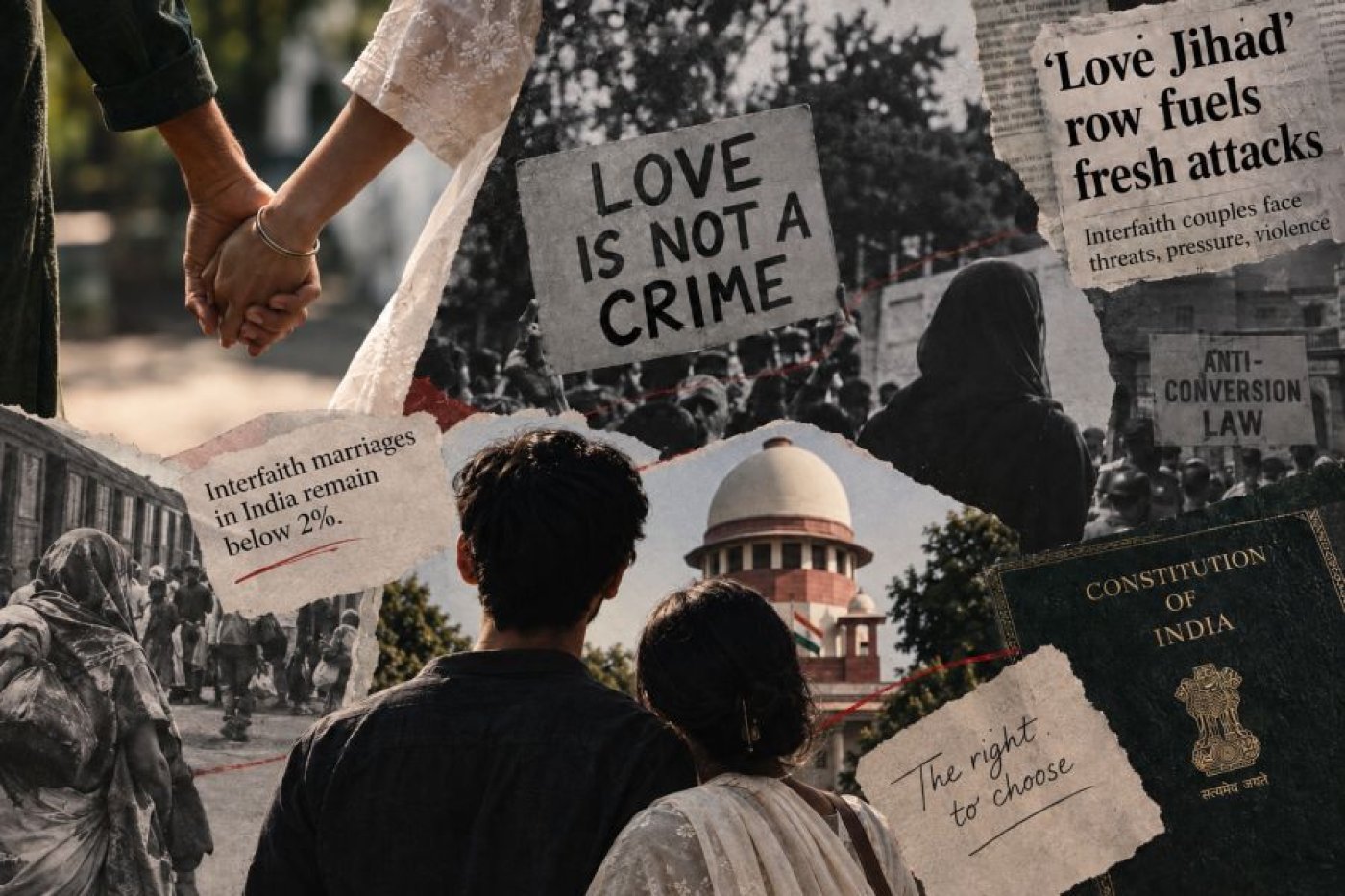
If the Constitution had explicitly guaranteed a woman's right to choose her spouse and protected marriages across religious boundaries, could the wave of laws enacted by BJP-ruled states under Prime Minister Narendra Modi—laws that place formidable legal obstacles before interfaith and, indirectly, intercaste marriages—have survived constitutional scrutiny?
Or would the framers' more expansive vision of liberty and individual choice have prevailed?
Love, Purity & The State
As the Indian state increasingly legislates on matters of love that transgress religion and caste, uncomfortable historical echoes emerge. The rhetoric and logic underlying these laws recall other projects that sought to regulate intimacy in the name of protecting a supposedly threatened social order: Nazi Germany, Jim Crow America and apartheid South Africa.
The most infamous example is Nazi Germany's Nuremberg Laws of 1935. Announced by Adolf Hitler after a party rally in Nuremberg, they both stripped Jews of citizenship rights and criminalised marriage and sexual relations between Jews and so-called Aryan Germans.
The Reich Citizenship Law restricted full citizenship to those deemed racially German. The Law for the Protection of German Blood and German Honour prohibited unions between Jews and Aryans and punished violators with imprisonment and, often, far worse.
Underlying these laws was the idea that German women needed protection from predatory Jewish men and that racial purity could be preserved only by preventing inter-community unions. Nazi propaganda relentlessly portrayed Jewish men as sexual threats while presenting restrictions on marriage and intimacy as measures of social protection.
Such anxieties were not unique to Germany. Across the American South, racial segregation rested in part on the myth of the Black male sexual predator. Historians have documented (here and here) how fears of interracial relationships, particularly involving white women, fuelled both the rhetoric and practice of lynching. The figure of the dangerous Black man became central to the justification of racial violence and exclusion.
Anti-miscegenation laws prohibiting marriages between white people and African Americans remained in force in many American states long after the defeat of Nazi Germany. Indeed, sixteen states still enforced such laws in 1945. It was only in 1967, in Loving vs Virginia, that the US Supreme Court struck them down, rejecting the pseudoscientific theories that underpinned racial segregation and affirming marriage as a fundamental right.
Apartheid South Africa similarly prohibited marriages and sexual relations across racial classifications. Trevor Noah titled his memoir Born a Crime because he was born to a Black mother and a white father at a time when such a union was itself a criminal offence.
The contexts differ, and historical analogies should not be stretched beyond their limits. Yet these regimes shared a common premise: that the state had a legitimate interest in regulating whom citizens could love and marry, and that women required protection from men belonging to a stigmatised community.
This premise should sound uncomfortably familiar today.
The Muslim Man As Sexual Predator
There are disturbing resonances between the Hindutva project in contemporary India and the racial and religious regimes of Nuremberg, Jim Crow America and apartheid South Africa. In each, men from a dominant group have portrayed men from an oppressed or stigmatised community as sexual predators, while women of the dominant group are cast as helpless victims in need of protection. Their agency—their right to choose their own partners—is denied.
Indian secularism was never perfect. Successive governments have compromised constitutional principles in many ways. But the years of Prime Minister Narendra Modi’s leadership have seen an unprecedented assault on the state's secular character.
Prominent among these is the campaign, amplified by RSS affiliates and BJP leaders, alleging that Muslim men wage a sinister “love jihad” to entrap Hindu women into sex, marriage and conversion. The premise is that adult women who consent to relationships with Muslims are gullible victims who must be rescued.
This is a striking claim in a country where less than 2% of marriages are interfaith, and where the overwhelming majority of such marriages are between consenting adults.
Yet opposition to interfaith marriage remains widespread. A 2019–20 Pew Research Centre survey found that 67% of Hindus believed women should be prevented from marrying outside their religion, and 65% said the same about Hindu men. Among Muslims, the figures were 80% and 76%. The survey also found that 84% of Indians considered respect for all religions important to being “truly Indian”.
A 2025 India Today survey similarly found that 61% of respondents opposed interfaith marriage and 56% opposed inter-caste marriage. Regional differences were stark: 94% of respondents in Kerala supported interfaith marriage, while 94% in Karnataka opposed it.
The construction of the Muslim man as a sexual predator is much older than the phrase “love jihad”. Historian Charu Gupta shows that campaigns in the 1920s alleged that Muslim men were abducting Hindu women, portraying Hindu women as passive victims and denying that they might have exercised choice. The term “love jihad” itself emerged only in the early 2000s. Pramod Muthalik of the Sri Rama Sene is said to have adopted it around 2005, after which it was taken up by other Hindutva organisations, including the Hindu Janajagruti Samiti, Bajrang Dal and RSS. The campaign spread rapidly.
Its mythology is elaborate: Muslim men are allegedly trained in madrassas to seduce Hindu women, supplied with motorcycles, smartphones and money, and instructed to conceal their identities. The conspiracy has spawned claims of “beauty parlour”, “mehndi” and “gym” jihad, and even allegations that women who convert to Islam are recruited as suicide bombers.
Betwa Sharma and Ahmer Khan document how such claims have extended into networks of surveillance and informers—in schools, colleges, workplaces, public transport, gyms and even within families—to identify interfaith relationships.
K B Nielsen and A G Nilsen argue that “love jihad” performs three political functions: it constructs women as subjects requiring protection by the state and nation; legitimises the transformation of vigilante violence into state-backed law enforcement; and portrays Muslims as enemies of the nation and its Hindu majority. K Frøystad similarly argues that the conspiracy fuses anxieties about daughters choosing partners against their parents’ wishes with fears of unfavourable religious demographic change.
The result is not merely a hateful stereotype of Muslim men. It is a political project that denies adult women the capacity to know what they want—and claims for families, communities and the state the right to decide for them.
While Hindutva formations and BJP governments have widely used “love jihad” to incite hostility, and sometimes violence, against Muslim men, the trope has also been embraced by Christian and Sikh religious and political formations. The common thread is the denial of women’s agency when they choose partners from another community.
It is contested, but some accounts trace the term to allegations by Christian groups in Kerala that Muslim men, enriched by Gulf money, were marrying Christian women. In January 2020, the Syro-Malabar Church alleged that 12 Christian women had been converted through “love jihad” and taken to Syria, claiming this was part of an Islamic State conspiracy. In March 2021, Article 14 reported that Kerala police investigated the allegations and found that the women were adults who had married voluntarily, with no force or coercion.
The same logic appeared in Kashmir in 2021, when Sikh political and religious leaders invoked “love jihad” after Sikh women chose to marry Muslim men. I wrote about the episode then.
One case involved 18-year-old Manmeet Kaur, who converted to Islam and married 29-year-old Shahid Bhat. Police traced the couple and brought them to a Srinagar court. An angry Sikh crowd gathered outside, with community leaders alleging that Kaur was being subjected to “love jihad” and demanding that she be returned to the community. Reports suggested that she told the court her conversion and marriage were voluntary, although there was no authoritative public record of her statement.
Three days later, Kaur was remarried to a Sikh man in a gurudwara in Pulwama. Manjinder Singh Sirsa, then a prominent Sikh political figure, celebrated the episode as a victory for the community and called for an anti-conversion law modelled on Uttar Pradesh.
Another Sikh woman, Danmeet Kaur, publicly rejected the claim that she had been abducted. She said she had voluntarily converted to Islam and married her Muslim husband years earlier, but that police had taken her from her home and returned her to her parents after they complained. She said organisations subsequently tried to pressure her into making a statement against her husband and warned her that she could face violence.
A third woman, Viran Pal Lour, approached the High Court after marrying a Muslim man voluntarily and facing harassment from her parents and the police. The court upheld the couple’s right to live together and directed the authorities to protect them.
Kashmiri women's response to these episodes was revealing. Navneet Kaur asked why a woman who had supposedly been “rescued” was immediately rushed into another arranged marriage: “Women are individuals too, they are not anyone’s commodity.” Ifra Jan similarly said that women were being treated as “community property”. She added that women’s constitutional rights were being subordinated to the wishes of men.
The larger lesson is uncomfortable. The language of “love jihad” may be most aggressively associated with Hindutva, but the impulse it expresses is wider: when a woman crosses religious boundaries in love or marriage, her own account of her life can be displaced by the claims of family, community and religious identity.
That is precisely why a group of writers, scholars, artists and cultural workers, including this writer, declared that the right to choose one’s friendships, love, marriage and religion belongs equally to women—and cannot be overridden by community leaders, families or the state.
The union government has itself acknowledged that ‘love jihad’ has no basis in law.
In a written reply to Parliament in February 2020, union minister of state for home, G Kishan Reddy, said the term was not defined under any law and that no such case had been reported by any Union agency. He also affirmed that Article 25 guarantees the freedom to profess, practise and propagate religion, subject to public order, morality and health.
“Various courts, including the Kerala High Court, have upheld this view,” Reddy said in his written reply.
Yet BJP leaders have repeatedly invoked ‘love jihad’ as a real and growing threat.
In Karnataka, chief minister B S Yediyurappa alleged that women were being lured with money and love and converted, declaring, “We are going to end this in Karnataka.” His home minister, Basavaraj Bommai, called “love jihad” a “social evil” requiring protection.
Uttar Pradesh Chief Minister Yogi Adityanath was more explicit. A month before his government introduced its anti-conversion law in November, 2021, he warned men who “conceal identity” and “play with our sisters’ respect”: “If you don’t mend your ways, your ‘Ram naam satya’ (a Hindu funeral dirge) journey will begin.” The phrase is commonly used during Hindu funeral processions.
Other BJP leaders have echoed the claim. Uttarakhand Chief Minister Pushkar Singh Dhami said in 2023 that “things like love jihad” would not be tolerated, ordering police to take “stern action” and conduct verification drives. Yet he disclosed no details of cases of ‘love jihad’ actually investigated and proved in court.
Gujarat deputy chief minister Harsh Sanghavi similarly told the state assembly in February 2026: “There is no objection to love. But if some Salim posing as Suresh traps a girl, we will not spare them.”
The same contradiction extended to the National Commission for Women. In January 2020, its then chairperson Rekha Sharma described ‘love jihad’ as a “ticking time bomb” and claimed that women were being forcibly converted and taken abroad. She said she had conducted a “detailed enquiry” into the phenomenon in Kerala.
But when Article 14 filed an RTI petition, the Commission admitted that it had no data from anywhere in India substantiating Sharma’s “ticking time bomb” of “love jihad” and forced conversions. Her “detailed enquiry” amounted to a three-day visit to Kerala in 2017, and the Commission refused to disclose its report.
The contradiction is clear: the union government says ‘love jihad’ is not a crime and has no reported cases; political leaders continue to speak of it as a grave and expanding threat; and the country’s women’s rights commission could produce no data to substantiate the claim.
‘Love jihad’ Laws In BJP States
India has not enacted laws explicitly prohibiting inter-religious unions, as Nazi Germany did in 1935 or apartheid-era South Africa and segregated US states once did. But several BJP-ruled states have enacted laws that, in practice, create a powerful chilling effect on inter-faith relationships. Colloquially described as “love jihad” laws, these are amendments to existing anti-conversion laws—usually styled as Freedom of Religion Acts—that criminalise religious conversion connected to marriage.
In principle, inter-faith couples can still marry under the Special Marriage Act, 1954. The law permits consenting adults of different faiths to marry without changing religion. But the Act requires couples to give a month’s public notice before marriage, during which they can raise objections. In practice, this can expose couples to family pressure, intimidation and violence. These difficulties have led some couples to convert and marry under religious personal laws simply to avoid the public-notice requirement.
BJP state governments have increasingly sought to close even this route by treating conversion for marriage as a form of fraud, coercion or inducement. As human-rights lawyer Mihir Desai observes, anti-conversion law has evolved from relatively narrow restrictions into a much more aggressive form of regulation.
Article 25(1) guarantees the right freely to “profess, practice and propagate” religion. Odisha enacted the first post-Independence anti-conversion law in 1967, followed by Madhya Pradesh in 1968 and later several other states. These laws prohibited conversion through force, fraud, inducement or allurement. The difficulty lies partly in their expansive definitions: “allurement”, for example, can include gifts, services, education or other benefits. Several laws also require people intending to convert to notify or seek permission from state authorities.
Under BJP governments, these laws have become significantly more restrictive. Uttarakhand’s 2018 law was the first to specifically bring conversion “by marriage” within its statutory prohibitions. It also shifted the burden of proof to the person who had converted, prescribed minimum prison terms and expanded the definition of “allurement”. Notably, returning to one’s “ancestral religion” was excluded from the definition of conversion. The law marked an important shift in the direction of these statutes.
Uttar Pradesh went further in 2020–21, criminalising conversion “by marriage” and even attempts to induce conversion, allowing such marriages to be declared void and making offences non-bailable. Its law also shifted the burden of proof and exempted conversion to a person’s “immediate prior religion”.
Other BJP-ruled states followed. Himachal Pradesh (2019), Madhya Pradesh (2021), Gujarat (2021), Karnataka (2022), Haryana (2022) and Maharashtra (2026) amended their anti-conversion laws. The effect has been to make conversion connected to inter-faith marriage increasingly vulnerable to criminal prosecution.
Maharashtra’s 2026 law adds a striking provision: where a marriage or “relationship in the nature of marriage” is unlawful under the statute, a child born from it is deemed to retain the mother’s pre-conversion religion. The provision appears to address the demographic anxieties embedded in the “love jihad” narrative.
The cumulative effect is to make inter-faith couples disclose their choices to the state, submit to police scrutiny and, in some cases, expose themselves to criminal proceedings. This sits uneasily with a series of Supreme Court judgments affirming the autonomy of consenting adults.
In Lata Singh vs State of UP, the Court held that once a person becomes an adult, “he or she can marry whosoever he/she likes”. In S. Khushboo vs Kanniammal, it held that a live-in relationship between consenting adults is not an offence. And in Shafin Jahan vs Ashokan K.M., the Hadiya case, the Court recognised the choice of a partner as part of individual liberty, holding that the choice of a partner lies within the exclusive domain of the individual.
Yet the gap between constitutional principle and state practice remains wide. Police and lower courts have sometimes failed to protect inter-faith couples—or have actively intervened against them.
The threat now extends beyond marriage. Uttarakhand’s 2024 Uniform Civil Code requires live-in couples to register with the state, with penalties for non-compliance. In Kiran Rawat vs State of UP, the Allahabad High Court denied protection to an inter-faith couple in a live-in relationship, observing controversially that the Supreme Court was merely “accepting a social reality” and had no intention of “unravelling the fabric of Indian family life”. The judgment illustrates the distance that can open up between the constitutional right to choose and the social and institutional pressures brought to bear on that choice.
When State & Vigilante Combine
Sarasu Esther Thomas, professor at National Law University, Bengaluru, observes that recent anti-conversion laws have made interfaith couples fear not only their families and communities but increasingly the State. Laws that once protected couples from violence and forced separation can now be used to challenge their marriages. If “marriages are no longer safe”, Thomas asks, “what of the unmarried, in live-in relationships?”
The laws have had a marked chilling effect. Couples who cross religious or caste boundaries increasingly face not only family opposition but, in some cases, the combined pressure of vigilantes, police and state authorities. Men can be criminalised while women are pressured or coerced into relationships within their own communities.
Investigations by Newslaundry into Haryana’s 2022 anti-conversion law found a sharp rise in complaints of forced conversion made by families of interfaith couples and vigilantes after the law came into force. Betwa Sharma and Ahmer Khan similarly documented and investigated how Uttar Pradesh’s anti-conversion law operated.
Their reporting shows how vigilantes can work with families and police to turn consensual relationships into criminal investigations. In one Haryana case, 22-year-old Sanskriti Shukla converted to Islam and married Javed Khan. Her father subsequently filed a complaint alleging forced conversion. Threats from Hindutva groups including the Bajrang Dal and the Bittu Bajrangi-led Gau Raksha Bajrang Force forced the couple into hiding. Newslaundry reported that the complaint was filed two months after the marriage.
The vigilantes themselves describe their intervention as “counselling”. It can involve threats of violence against women and their partners, emotional blackmail by families, and attempts to arrange alternative marriages. Photographs and personal details of women may be circulated in Hindutva WhatsApp groups.
The Special Marriage Act’s mandatory public notice provides another opening for such intervention. Newslaundry documented how Hindutva groups used notices to identify and disrupt interfaith couples. In one case, Abdul and Rishika had been together for four years when they gave notice of their intended marriage in Pune. Hindutva groups visited Rishika’s family and warned them that Abdul, because he was Muslim, had “wrong intentions”. Her family eventually called off the wedding despite initially consenting to it. The couple eventually married elsewhere but continued to face harassment. The investigation found similar instances elsewhere.
As lawyer Lara Jesani put it: “Why should adults go through such scrutiny for their personal choices?” The month-long notice, she argued, effectively gives the right wing a month to separate couples. In Kerala, the government went further by putting marriage notices online, making interfaith couples' identities accessible to anyone.
Another revealing feature of this system is its apparent selectivity. The law does not expressly prohibit Hindu men from marrying Muslim women. Yet in practice, the scrutiny, complaints and prosecutions associated with ‘love jihad’ overwhelmingly centre on Muslim men and Hindu women. As a result, the same interfaith relationship can be treated very differently depending on which partner is Muslim.
This selective enforcement exposes the deeper logic of the “love jihad” project. The concern is not simply religious conversion. It is the idea that Hindu women are community property whose intimate choices must be policed when they choose Muslim men. The law may not formally distinguish between the two kinds of interfaith relationship, but its political and institutional application can do so in practice.
The constitutional answer must be the opposite: an adult woman’s choice of whom to love and marry belongs to her—not to her family, community, political party, vigilante group or the State. It is time to complete the work envisaged by Constituent Assembly members such as Hansa Mehta and Rajkumari Amrit Kaur and defend that freedom as a fundamental right.
The Scourge Of ‘Honour Killings’
The cruellest expression of the idea that women embody the honour of their families and communities—and that men have the right to control their bodies and choices—is what is misnamed “honour killing”. A United Nations body defines it as the killing of a relative, especially a woman, perceived to have brought dishonour to the family. When women choose partners outside their caste or religion, family members, typically fathers and brothers, may kill them and sometimes their partners.
The scale is difficult to establish. Official figures on “honour killings” rarely cross two digits nationally in a year, although the National Crime Records Bureau identifies Jharkhand, Haryana, Madhya Pradesh, Punjab, Uttar Pradesh, Maharashtra, Bihar, Chhattisgarh and Karnataka among the states where such cases are reported.
Reports from 2025 give some indication of the violence that official statistics fail to capture.
- In Amreli, Gujarat, a Muslim father allegedly smothered his daughter because she loved a Hindu man.
- In Hardoi, Uttar Pradesh, a woman who had married outside her caste was shot by her brother.
- In Dumka, Jharkhand, a 17-year-old girl was allegedly killed by her father and cousins because she loved a boy from another caste. In Rohtak, a 23-year-old woman was shot dead by her brother after marrying outside her caste.
- In Dharwad, Karnataka, a six-month-pregnant woman was allegedly beaten to death by relatives over her inter-caste marriage. -
- And in Nanded, Maharashtra, a young woman’s brother allegedly killed her Dalit partner after the couple had been together for three years.
The Supreme Court recognised the constitutional stakes in Lata Singh vs State of Uttar Pradesh (2006). It affirmed that an adult woman is free to marry anyone of her choice and directed authorities to protect couples facing threats from relatives.
The case shows how little that right means without effective state protection. Lata Singh, born into a Rajput family in Uttar Pradesh, fell in love with and married a man from a Baniya family. Her brothers threatened her, her husband and his family. Her husband, parents, siblings and their families were forced to leave their village, home and property overnight. Her brothers filed criminal complaints accusing her husband and his family of kidnapping and rape. Some of his sisters and their husbands spent six months in jail.
Lata remained in hiding for years. When she eventually appeared in court to testify that she had freely chosen her husband, her brothers claimed that she was mentally ill. She was examined repeatedly at the Psychiatric Centre in Jaipur and certified mentally sound. Only after the intervention of National Human Rights Commission of India (NHRC) chairperson Justice J S Verma did her case reach the Supreme Court and result in an unequivocal affirmation of her right to choose her husband.
Years later, in 2026, speaking to Frontline, Lata described the continuing estrangement from her family and the irony of a society that treats a woman’s choice as a crime. She sees every day, she says, women returning from arranged marriages beaten, burned for dowry or barely alive.
“A girl choosing her own partner should not be treated as a crime,” she says. “What crime did I commit that I cannot even knock on the door of the house where I spent my entire childhood?”
Her experience captures the larger problem: the right to choose a partner remains treated as a social concession rather than a constitutional freedom. Families can invoke love, duty and honour to pressure women into returning; police can facilitate that pressure; and couples may have to flee, hide or spend years in court simply to exercise a right the Constitution already protects.
However, some states are beginning to recognise the need for stronger protection. On 12 March 2026, the Karnataka Cabinet approved the Freedom of Choice in Marriage and Prevention and Prohibition of Crimes in the Name of Honour and Tradition Bill, 2026, also referred to as Eva Nammava. The proposed law seeks to protect freedom of choice in marriage and prevent caste-based violence and discrimination. The New Indian Express reported that it would also establish a forum to solemnise inter-caste marriages.
The challenge is to make such protection real: not merely to punish killings after they occur, but to ensure that an adult woman’s decision about whom she loves and marries is treated from the outset as her constitutional right, not her family’s permission to grant or withdraw.
Epilogue
When I write this essay, I return again and again to the trauma of my extended family in 1947, burned into my soul.
Then, as now, a woman is treated as the property of her family and community, a trophy embodying their honour. In defending this “honour”, her wishes, happiness and choices can be sacrificed.
And, sometimes, even her life.
Let me end with three stories about this deadly amalgam of misogyny, communal hatred and caste prejudice.
I recall first an encounter during one of the Karwan e Mohabbat’s journeys to survivors of hate violence. In a small tenement in a Haryana village, a young man—I will call him Rohit—told us what had happened to his family.
His father, an Ambedkarite Dalit and junior government employee, had struggled to give his two sons the best education he could afford. After graduating from university in Rohtak, Rohit’s elder brother called to say that he had fallen in love with a Jat classmate and they had decided to marry.
“We understand how dangerous it is for a Jat to marry a Dalit man,” he told his parents. “We therefore will not tell you or the girl’s family where we live or what we do. You will not see us again. We do not want to put you in danger.”
For two years there was no word. Then his brother called again. They had a daughter; his wife, Sarita, was pregnant with their second child. Her family said they had accepted the marriage and wanted to meet their grandchildren. Rohit’s family was overjoyed. The family reunited.
One evening, the girl’s father, brothers and cousins arrived with rifles. They shot dead Rohit’s father, mother and brother. They also shot Sarita in the belly before fleeing. Rohit survived only because he happened not to be at home.
Sarita and the unborn child survived. But she was the sole witness to the murders. She eventually returned to her family home with her two children and refused to testify against her father and brothers. They were released on bail.
Rohit was left devastated, alone and in danger. We sheltered him in our Delhi office, where he lived for years. We are still fighting the criminal case. He is now married. We held his wedding in the courtyard of our office; his baraatis were my colleagues.
My second story is about a doctor working in the United Kingdom. I have changed some details to protect his identity.
After a failed marriage, he fell in love with a Muslim woman. His mother eventually accepted his decision. His Bengali caste-Hindu father did not. For years, the father called his son’s employers and the police in Britain, alleging that his daughter-in-law was a terrorist. He abused his son over the telephone and refused even to see his grandson.
Five years passed without communication.
Then the doctor learned that his father had cancer and wanted to speak to him. A friend arranged a Zoom call. The old man begged his son’s forgiveness and wept when, for the first time, he saw his grandson on the computer screen.
A few hours later, the doctor’s mother called in distress. His father had left home and disappeared. The police began a search.
They found him dead. He had taken his own life.
My third story came to me from the social psychologist Ashis Nandy, who was researching memories of Partition with Pakistani colleagues.
He came across the story of a Sikh father whose son had brought home a Muslim woman he had abducted. The father pleaded with his son to release her. When his son refused, the old man took out his rifle and shot him dead.
Nandy’s Pakistani colleagues said they had heard almost identical stories from the other side of the border. The religious identities were reversed. The fathers' actions were the same.
This too is part of our legacy from Partition in 1947.
The lesson of these three stories is not that families are inherently cruel, nor that love always triumphs over hatred. It is that when women and men are treated as bearers of family, caste or religious honour, their freedom to choose becomes conditional—and the consequences can be devastating.
This is the legacy we must break.
This too is burned into my soul.
I am grateful for research support from Syed Rubeel Haider Zaidi and Sumaiya Fatima.
(Harsh Mander is a peace and justice worker and writer.)
Get exclusive access to new databases, expert analyses, weekly newsletters, book excerpts and new ideas on democracy, law and society in India. Subscribe to Article 14.