
Mumbai, Maharashtra: On Sunday, 19 July 2026, here in India’s financial capital, a mob of about 20 members of the Bajrang Dal—the youth wing of the Hindu extremist organisation, the Vishwa Hindu Parishad—picketed a hotel hosting a prayer service of the Assembly of Believers Church.
Chanting “Jai shree Ram (Victory to Lord Ram)”, the mob demanded that policemen at the scene accompany them inside to stop the alleged conversion of Hindus.
“The police are not letting us enter…We want legal proceedings against the pastor,” one Bajrang Dal member said. “He should be taken down to the police station, otherwise the Bajrang Dal will protest here.”
“We are giving the police a chance, but they are not ready to listen,” said a second Bajrang Dal member in the same video. “If that is the case, we will respond in our own way.”
The standoff held up traffic in the congested lanes of Marol in west Mumbai. When the police tried moving the demonstrators, some allegedly attacked a passing biker, an autorickshaw and a pastor recording the events on his phone.
As news of the demonstration filtered into the hotel, anxiety spread through those attending the service.
“These people pose a threat to ladies, children, the elderly and pregnant women,” said Shalom Massey, the church pastor. “I was worried for their safety.”
After 45 minutes, the demonstration was quelled by the local police and a battalion of the State Reserve Police Force. A first information report (FIR) was registered against five members of the Bajrang Dal and 20-25 unidentified individuals for forming an unlawful assembly, rioting and assault.
“The police were there until every (church) member left,” said Massey.
That day’s events are ones that Mumbai’s small independent churches have become increasingly familiar with.
Article 14 identified—through FIRs, news reports (he re), and videos on social media (here, here and here)—at least 14 incidents between 29 March and 9 August where members of the Bajrang Dal and affiliated groups have interrupted, attempted to intimidate, or attacked small congregations in Mumbai.
Since April, the police in Mumbai and Vasai have registered four FIRs, which Article 14 has accessed, against church pastors and members of their congregations. At the same time, the police registered three FIRs against members of the Bajrang Dal.
However, as the Maharashtra Freedom of Religion Act, which punishes forceful religious conversion, only came into force on 30 July 2026, church pastors were curiously booked under the state’s 2013 anti-superstition and black magic law.
As a result, the Bajrang Dal interrupted prayer services, alleging the mass conversion of Hindu worshippers but later filed complaints accusing the church of propagating superstition through its healing prayers.
Healing Prayers
Independent churches in Mumbai and its neighbouring cities hold services in schools, colleges, or banquet halls, even in congregants' homes. Most rely on rented premises, and one even meets at a co-working space. With congregations ranging from just a few dozen people to several hundred, they hold services in almost every language spoken in Mumbai.
Mumbai-based pastor and lawyer Johnson Ebenezer said that some services include a general prayer to heal anyone who is burdened.
“There are verses in the Bible which say that he who hears the word of God is healed,” said Ebenezer. “So, when those in the service hear them, they feel their burdens lifting, they feel healed, they feel good. Some may faint upon hearing those verses. Some may not.”
These healing prayers have invited the ire of the Hindu extremist group, which has accused churches of ‘converting’ Hindus who attend the services by curing their illnesses through prayer.
The Dal has been disrupting Christian prayer services across Mumbai and neighbouring Vasai almost every Sunday since April. Using Instagram to identify the location of prayer services, the Bajrang Dal usually arrives accompanied by the police after contacting them with accusations of mass conversions.
Church pastors and civil society activists described an environment of fear and uncertainty. Ebenezer said that the disruptions are dissuading some worshippers from attending church.
“There is fear in the Christian community, especially older people, that something might happen to them,” he said.
Services Disrupted
19 July was the second time in two years that the Bajrang Dal attempted to disrupt Massey’s prayer service.
Massey is among the fortunate ones. Then, as now, the police found no substance in the Bajrang Dal’s claims. Others have not been so lucky.
On 12 April, the same group of Bajrang Dal activists, accompanied by a policeman, barged into a hall in Vasai where pastor Ravi Gupta of the Masih Ekta Foundation was leading prayers for over 100 people. A scuffle broke out, during which the church cook, Janak Auji, and some of the activists were injured.
Auji said that the Foundation had rented the hall for its service at the start of the year. “People from Vasai, Nallasopara and Vapi (Gujarat) used to come to pray. My job was to cook and serve the langar at the end of the prayers,” he said.
Auji told Article 14 that he was in the kitchen when he saw female worshippers caught in the melee. “I went to save them when suddenly, I got hit on my hand,” he said.
The police booked Gupta for allegedly insulting Hindu gods and claiming to cure illnesses by touching worshippers on their heads. The police also registered an FIR based on Auji’s complaint against two members of the Bajrang Dal and other unidentified individuals for forming an unlawful assembly, rioting, hurting him with a weapon and criminal intimidation.
When contacted via phone on 5 August, Gupta declined comment.
The Masih Ekta Foundation has since ceased prayers in Vasai, said Auji, who is recuperating at home from his injuries.
The next Sunday, the Bajrang Dal disrupted another prayer service at a school in Vasai. Accompanied by a policeman, the activists accused the organisers of converting “poor people by claiming to cure their illnesses.”
Just like the previous week, the attack was turned into an Instagram reel. At the end of the video, the Bajrang Dal’s Nilam Singh, who goes by the moniker ‘Hindu Sherni’ (tigress), warned churches that “the police will conduct an inquiry afterwards, but the Hindu community will not spare you.”
‘False Allegations’
On 10 May, the Bajrang Dal protested outside a school in Malad where a prayer service was underway.
The complainant was a 45-year-old housewife named Usha Upadhyay suffering from thyroid and blood pressure issues. According to an FIR based on her complaint, Upadhyay attended the service with her son after hearing claims that she would experience relief if she worshipped Jesus Christ and ceased idol worship.
The pastor and his assistants allegedly prevented Upadhyay’s son from recording part of the service where they “healed” worshippers by touching them on their heads, the FIR stated. He left the service and contacted the police. By then, however, the Bajrang Dal had also reached the school.
Based on Upadhyay’s complaint, the police booked pastor Ramesh Gupta, and three others under the Anti-Superstition and Black Magic Act.
However, during the July 2026 monsoon session of the state assembly, Maharashtra’s minister of state for home (rural), Pankaj Bhoyar, said that a police inquiry had found no evidence of forced religious conversion.
The same month, the Bajrang Dal disrupted a prayer service at Ashish Prarthana Ghar in Naigaon. A volunteer who asked not to be identified, said that the pastor was too scared to speak. “We have been forced to shut down after facing false allegations,” she said.
No FIR was registered.
Booked For ‘Propagating Superstition’
The Bajrang Dal next attacked the Immanuel Worship Ministry during its prayer service at a school in Ghatkopar on 7 June. The church conducts prayer services every Sunday in Mumbai, Thane and Nallasopara.
Bajrang Dal activist Ankit Yadav, who registered the complaint, received videos on WhatsApp which showed a pair of pastors call attendees on to a stage and ‘heal’ them by invoking God, the FIR stated. A woman attendee, Yadav claimed, fainted midway.
Upon reaching the school, Yadav and his colleagues contacted the police. Their reel shows them entering the prayer service along with the police. To the soundtrack of ‘Jai Shivrai’, a song from Ritesh Deshmukh’s Marathi film Raja Shivaji, the reel ends with the images of the FIR.
The police booked four people, including assistant pastor Arjun Chavan and his wife Vishalakshi, for allegedly propagating superstition.
Chavan told Article 14 that a woman who had recently joined the church alerted the Bajrang Dal.
“We do not turn anyone away, especially if they say that they are suffering,” Chavan said. “This woman recorded a video of our healing prayers. The person who fell down upon hearing the name of Jesus Christ immediately got back up. Those who look for God, God touches them. How do I explain that to anyone who accuses us of spreading superstition?”
Article 14 contacted Yadav by phone and text on 26 July to seek his comment, but he did not reply. We will update the story if he does.
Counter Allegations
The next Sunday, Yadav and his colleagues entered a banquet hall in Kandivali, where a prayer service organised by Ankit Sajwan Ministries was underway. Yadav’s colleague, Nilesh Singh, had found out about the prayer service on Instagram.
They attempted to enter the hall but were stopped by a church member. Singh alleged that the church member would let them in only if they renounced their gods. The church member was booked by the police for allegedly hurting Singh’s religious feelings and spreading superstitious beliefs.
Singh, 39, who runs an imitation jewellery business in Kandivali, told Article 14 that the Bajrang Dal uses Instagram to identify prayer services.
“There are so many handles which advertise prayer services and claim that diseases like cancer can be cured by praying,” he said. “We get to know the place and time from their ads.”
Since the BJP came to power at the centre and in Maharashtra in 2014, Singh claimed that the Bajrang Dal has adopted the legal route to complain about alleged religious conversion.
“Now the government listens to us,” he said.
A lifelong member of Vishwa Hindu Parishad, the Bajrang Dal’s parent organisation, Singh alleged that churches were demeaning Hinduism.
“The churches claim that there is no dum (power) in your religion. Propagate your religion, but why are you saying wrong things about our religion?” he said.
Massey denied the Bajrang Dal’s allegation.
“In our services, we do not demean other religions,” he said. “We have nothing to do with other religions.”
Targeting Christians
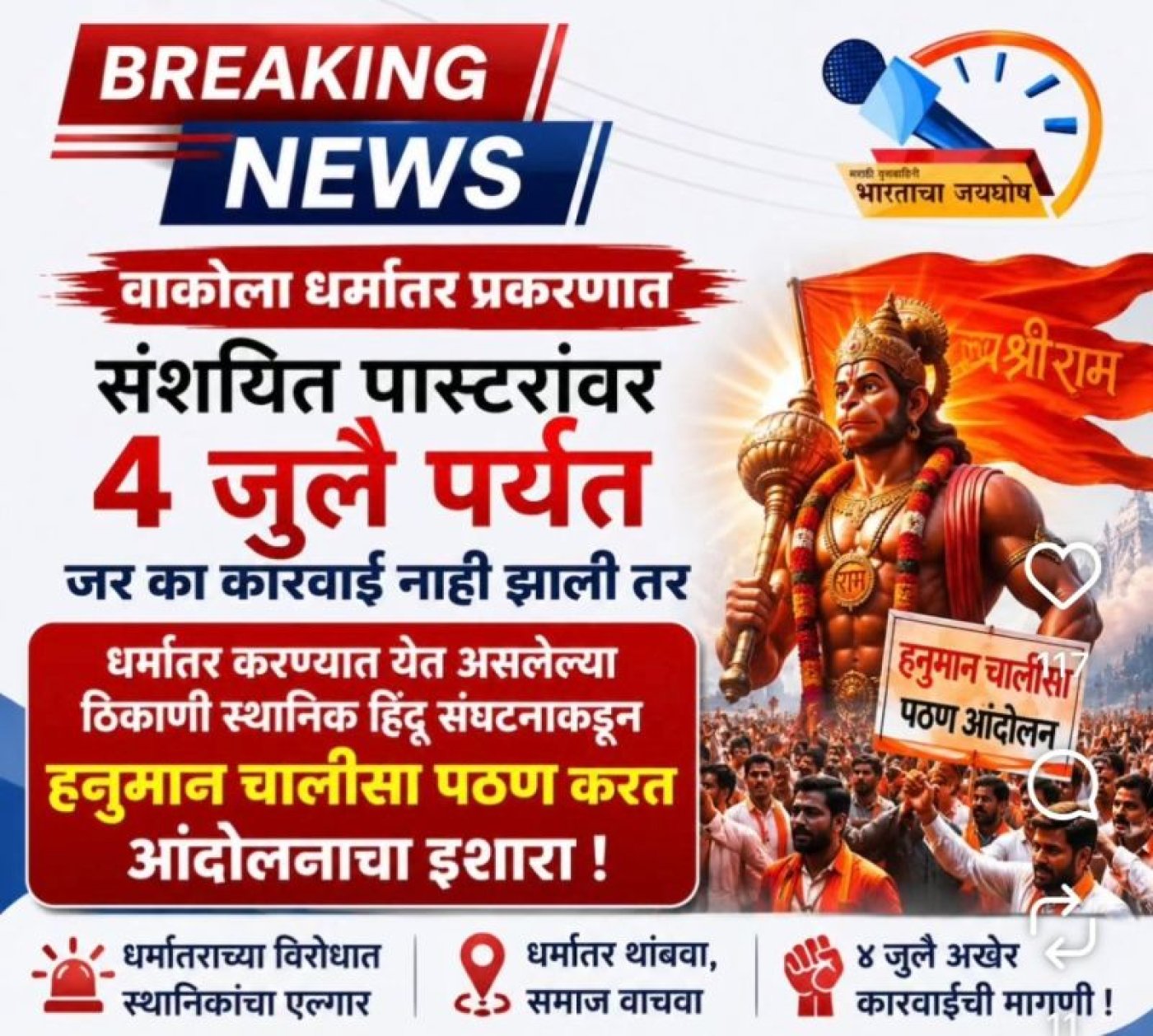
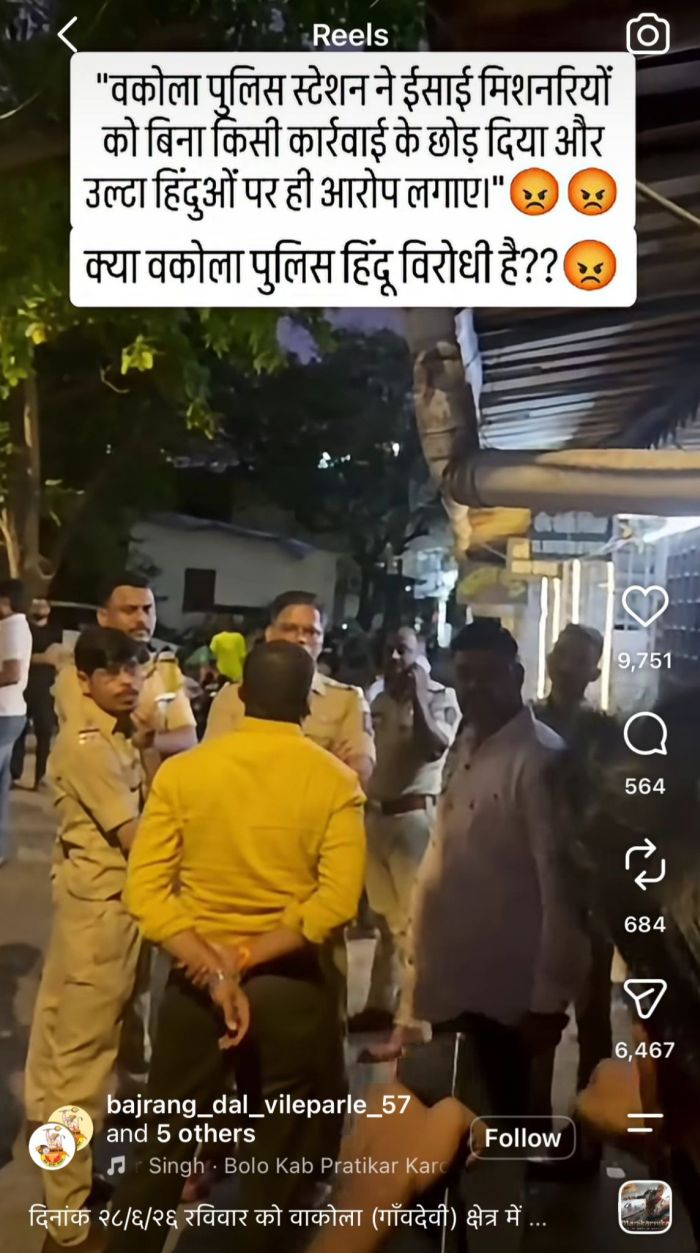
Two weeks later, the Bajrang Dal attempted to disrupt a prayer service in Santacruz East. However, when the police refused to register an FIR, the Bajrang Dal accused the police of being “corrupt” and “opposed to Hindus”. Yadav warned that the Dal would chant the Hanuman Chalisa outside the church unless the police acted within a week.
While the Bajrang Dal was upset over the police ignoring them despite bringing forth a “victim" of illegal conversion, Mumbai's church leaders said they suspected that the same woman was attending and filming church services and immediately contacting the extremist group.
Santacruz resident Elveen Gonsales said that a woman had attended the prayer service in Santacruz East for the first time that Sunday, claiming that she was suffering a stomach ailment.
“In the CCTV footage, she can be seen on her phone the whole time. When the prayers ended, and the first song started, the woman went to the washroom,” Gonsales said. “Then the mob entered. They did not hurt anyone but asked people, ‘Why are you wearing a tikka? ‘Why is there a Bible here?’ Kids started crying.”
The church, which had been holding Hindi prayer services for 30 years, suspended its services for the next two weeks. When it resumed on 19 July, it did so under police protection.
The temporary suspension of prayer services prompted Mumbai for Peace, a coalition of citizen’s groups, to submit a memorandum to Mumbai Police joint commissioner (law and order) Manoj Kumar Sharma, listing instances where the Bajrang Dal “have been targeting the Christian community by trespassing their prayer services across the city in different areas, making intimidatory threats and levelling false accusations to create communal tensions in the city.”
Mumbai for Peace, in their memorandum, also said they feared that “inaction of the police” in previous acts of disruption had emboldened Ankit Yadav and his colleagues to escalate “their criminal acts in order to create a law and order problem and incite communal violence.”
The memorandum also mentioned that the Bajrang Dal had tied up with Sakal Hindu Samaj, “which has antecedents of making communal hate speech across Maharashtra…”
Article 14 reached out to Sharma by phone and text on 4 August to seek his comment. There was no reply. We will update the story if he does.
Irfan Engineer, director of the Centre for Study of Society and Secularism, an advocacy group, said that the Bharatiya Janata Party governments in Maharashtra and the Centre are reaping political benefits by allowing vigilante groups like the Bajrang Dal to proliferate.
“These groups often come accompanied by the police, not on their own strength. And when the police file FIRs, they feel encouraged. Minus the police, they are nothing,” he said.
A ‘Tough Stand On Conversion’
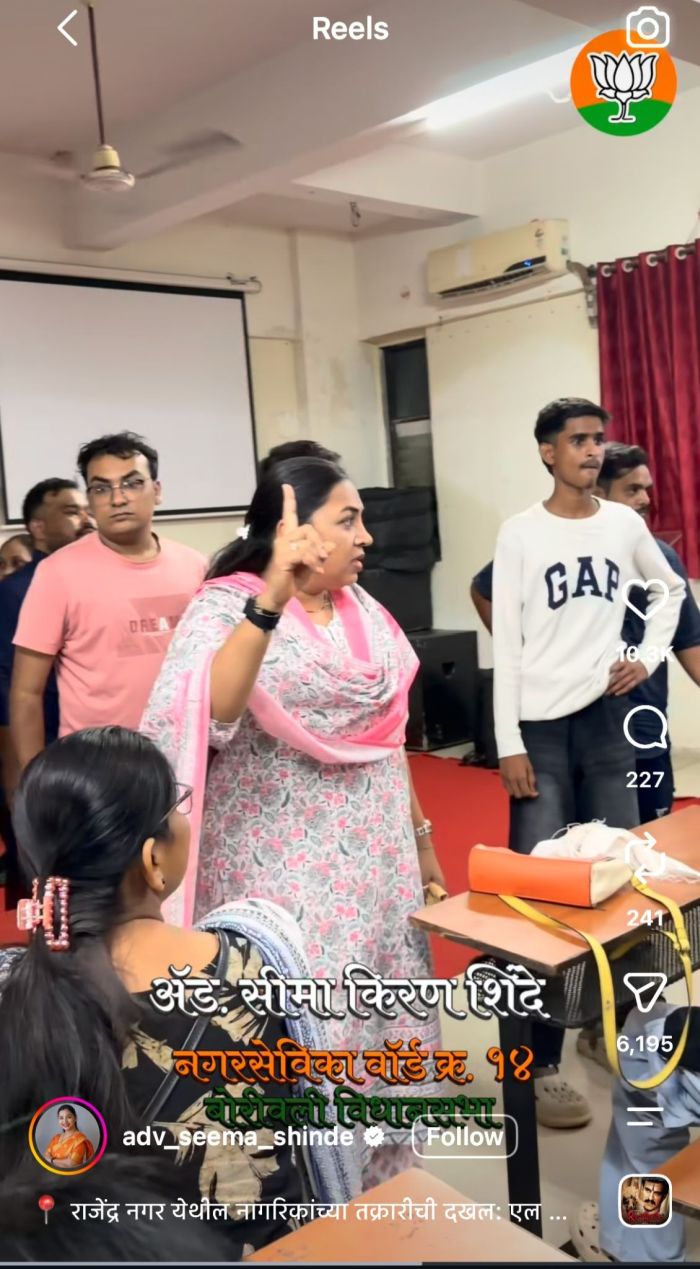
On 12 July, Seema Shinde, a BJP municipal councillor, barged into a college classroom in Borivali East with her supporters to interrupt an evening prayer service.
A reel on Shinde’s Instagram page shows her asking congregants their surnames.
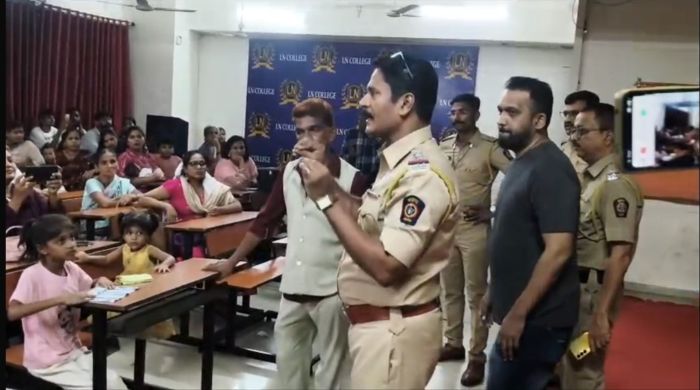
A separate video clip obtained by this reporter shows a police inspector asking the congregants, mainly women and children, if anyone had forcibly brought them there to convert from Hinduism to Christianity.
The crowd responds unanimously—No.
Shinde said that henceforth, no prayer services would be allowed within the college premises.
“We have asked the police to inquire and file an FIR,” she said. “If an FIR is not registered, we will gherao (surround and lay siege) the police station.”
Shinde told Article 14 that she was known in her ward for her tough stand on ‘love jihad’—the conspiracy theory that Muslims marry Hindus to convert them to Islam—and forced religious conversion.
A Mumbai police official, who asked not to be quoted because he was not authorised to speak to the media, said that the groups opposed to prayer services and alleging conversion had not brought any evidence of allurement to convert religion on the record.
“We receive such applications all the time. It has become a menace for our police stations,” he said. “So, to maintain the secular fabric of the city, we take preventive action and provide protection as required.”
No Evidence Of Forcible Conversion
On 9 August, Bajrang Dal and Sakal Hindu Samaj activists attempted to disrupt an afternoon prayer service organised by Ashish Prarthana Ghar at a banquet hall in Bhayandar west. 1500-2000 people were in attendance, the police said.
A scuffle broke out between the activists and police at the hall, while arguments continued inside the police station.
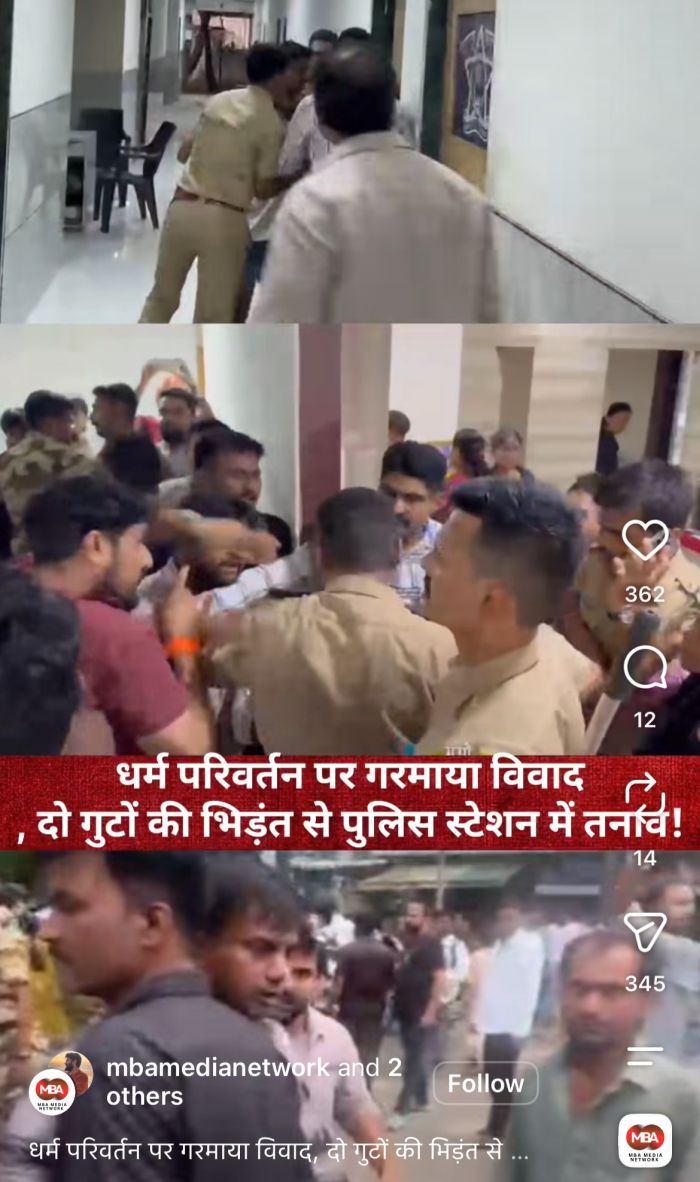
Jitendra Kamble, senior inspector at Bhayandar police station, said the organisers had leased the hall for the day.
“5-6 members of the Hindutva groups reached the hall and then contacted the police alleging that religious conversion was taking place,” he said.
The police found no evidence of forcible religious conversion at the prayer service, Kamble added.
“The area became tense due to a misunderstanding on part of the Hindutva groups,” Kamble said. “We brought the situation under control.”
Kamble said that the organisers, whose prayer service was disrupted for the second time this year, should have intimated the police.
“They did not require police permission for their religious program but should have intimated us in advance for their own safety,” he added.
Kamble told Article 14 that Bajrang Dal activist Ankit Yadav and his colleagues dialled the police control room upon reaching the hall. The police registered an FIR, accessed by Article 14, against eight named and 10-15 unnamed people under the Maharashtra Police Act for violating orders to maintain peace.
Security & Defence
Churches have tightened security in response to the disruptions.
Gonsales, a member of Mumbai for Peace, said that churches have been advised not to admit new members, issue identity cards to members, maintain a register and install CCTV cameras. Senior citizens have been advised to watch the services online at home.
For churches who do not own a fixed address, repeated disruptions have made finding a venue difficult.
“When we hire a venue, we pay the full amount upfront. The owners know what we are doing inside the venue,” said Massey. “These attacks put fear in their (owners’) minds.”
Thane-based lawyer Deenanath Kamath pointed out that Section 12 of the state anti-superstition laws exempts miracles of ‘deceased saints and religious preachers’. Kamath is the lawyer for three men, including an American citizen, arrested in Bhiwandi in October 2025 for allegedly converting villagers during a prayer service.
“The basis of Christianity is the belief in the miracles of Jesus Christ. If someone tells you that your problems will be solved if you pray to Christ, it is simply the basis of the religion and not covered under the Act,” Kamath said.
And so, the pastors under investigation have turned to the Bible for their defence.
“The police have been asking what is written in the Bible about healing through prayer,” said the pastor and lawyer Johnson Ebenezer. “It is just about showing them the right verses.”
(Srinath Rao is an independent journalist based in Mumbai and the author of Meow Meow: The Incredible True Story of Baby Patankar.)
Get exclusive access to new databases, expert analyses, weekly newsletters, book excerpts and new ideas on democracy, law and society in India. Subscribe to Article 14.