
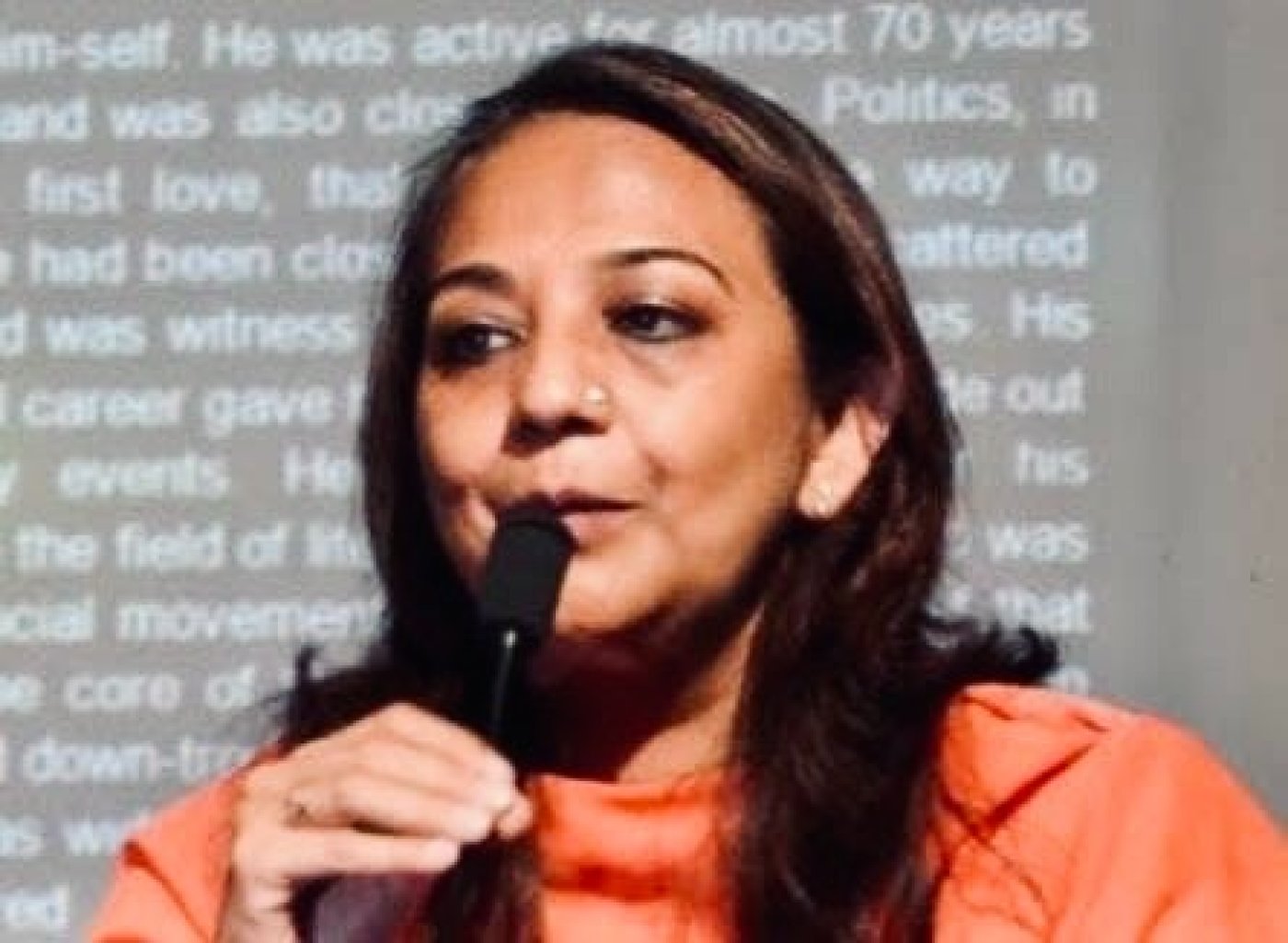
Delhi: “Ridiculous,” “absolutely false,” “surreal,” and “unbelievable”.
That’s how Anuradha Bhasin, the editor of Kashmir Times, described the alleged recovery of weapons and bullets from the Jammu office of her newspaper and the allegation of “involvement in criminal conspiracy with secessionist and other anti-national entities”, levelled against her 10 days after a Kashmiri doctor orchestrated a terrorist attack that killed 13 people in Delhi.
While cautious about accusing Pakistan outright, despite indications of Pakistan-based terror outfit Jaish-e-Mohammed’s role, Prime Minister Narendra Modi’s government has zeroed in on Kashmir with aggressive counterterror operations, widespread detentions and questioning, creating a pervasive climate of fear.
Print operations at the newspaper founded by her father, Ved Bhasin, in 1954 had stopped amid the growing climate of media repression in Jammu and Kashmir (J&K), and the Jammu office has remained shut since 2021. Bhasin, one of the remaining few critical voices from the region, told us.
She and her husband and co-editor, Pramod Jamwal, who is facing the same allegation, had been in the United States—first while she was on a university fellowship, and later as they took on various research projects, after their newspaper stopped generating revenue.
They had revived Kashmir Times as a website in 2023, mostly self-published a few pieces, and occasionally worked with young reporters who wanted to learn the ropes, but made no money from the digital operation either, she said.
On 17 November, Bhasin published her piece, Inventing an Enemy Within: ‘White Collar Hate’ To Combat ‘White Collar Terror’, which questioned why the Indian government was fixated on Kashmir after the Delhi bombing instead of examining Pakistan’s role, and how Kashmiris were being scapegoated.
Three days later, on 20 November, the J&K police registered a first information report (FIR) against the Kashmir Times and its promoters under Section 13 of the Unlawful Activities Prevention Act (UAPA), 1967, India’s counterterrorism law—”punishment for unlawful activities.”
Bhasin and Jamwal are accused of “disseminating terrorist and secessionist ideology”; “spreading inflammatory, fabricated and false narratives”; “attempting to radicalise the youth” of J&K; “inciting disaffection and separatist sentiments”; “disturbing peace and public order”; and “challenging the sovereignty and territorial integrity of India through print and digital content”.
After raiding the Kashmir Times office in Jammu the same day, police reportedly recovered “one revolver, 14 empty AK-series shell casings, three live AK rounds, four fired bullets, three grenade safety levers,” and “three suspected pistol rounds.”
The State Investigative Agency (SIA) of the J&K police said, “The seized arms, ammunition, digital devices and documents will undergo forensic and technical examination to determine their origin, purpose, and any potential connections to proscribed organisations or individuals.”
In a statement, Bhasin and Jamwal said, “In an era when critical voices are increasingly scarce, we remain one of the few independent outlets willing to speak truth to power. The accusations levelled against us are designed to intimidate, to delegitimise, and ultimately to silence. We will not be silenced.”
Journalism in a conflict zone like Kashmir, where governments seek to hide failures, crimes, and human-rights abuses, is always perilous, marked by intimidation, censorship, and pressure, no matter who is in power. But as Article 14 has reported, the pressure on the Kashmiri media has intensified dramatically since the Modi government rescinded J&K’s autonomy and made it a union territory on 5 August 2019.
Journalists have been summoned, detained, and face routine surveillance and harassment. Some have faced travel bans, home and office raids, arrests, preventive detention, court cases and even been charged under India’s counterterrorism law, leaving them broken and traumatised.
The government’s “New Media Policy”, issued in June 2020, formalised this squeeze: it empowered the authorities to define who qualifies as a “journalist,” to screen and “verify” reporters before giving them accreditation, and to withhold government advertising from media outlets deemed guilty of “fake news,” “anti‑national” content or other vaguely defined offenses.
Systemic pressure—raids, criminal charges, advertising shrinkage, and relentless surveillance—has virtually dismantled independent reporting.
All that was left were The Kashmir Walla, an independent news website based in Srinagar, and a handful of freelance journalists contributing to a handful of independent news outlets outside Kashmir, including us.
The Kashmir Walla’s editor, Fahad Shah, was arrested in February 2022 in multiple cases, including under the counterterrorism law. The outlet ceased to publish in August 2023 after its social media channels were blocked.
Asif Sultan, Sajad Gul, and Irfan Mehraj were other journalists arrested under the UAPA between 2018 and 2023.
In October 2025, the government rolled out new accreditation rules to curb alleged impersonation in journalism. Only reporters on an official list maintained by district officers will be allowed access to press briefings, and editors must hire only accredited journalists or face penalties. The worry is that required documents, such as proof of media affiliation and income records, will make accreditation especially difficult for freelancers.
Over the past decade, India’s standing in the World Press Freedom Index by Reporters Without Borders (Reporters Sans Frontières, RSF) has deteriorated, falling from around 133 in 2016 to 151 in 2025, with a low of 161 in 2023. Kashmir has been one of the most influential factors shaping global perceptions of India’s press freedom.
RSF has called J&K an “information black hole” and journalists operating there are “in a climate of permanent intimidation, marked by severe restrictions and constant psychological pressure.”
Many publications slid toward uniform, uncritical coverage, but the Kashmir Times was not one of them.
Because they’ve insisted on staying independent and reporting critically, Bhasin and her publication have been directly in the government’s line of fire.
In August 2019, Bhasin challenged the sweeping Internet, telecommunications, and movement restrictions imposed in J&K after its autonomy was revoked. In January 2020, the Supreme Court ruled that Internet access is protected under free speech, that restrictions must be necessary and proportionate, and that indefinite bans are unconstitutional, but it did not order the restoration of Internet services.
In October 2020, the government sealed the Kashmir Times’s Srinagar office, claiming it was reclaiming property after the original allottee’s death. Bhasin said no eviction or cancellation notice was served.
In August 2025, her book, A Dismantled State: The Untold Story of Kashmir After Article 370, was among the 25 books the government banned for “secessionist content” and spreading misinformation, glorifying militancy, and undermining national sovereignty.
How do you respond to the allegations of the recovery of arms and ammunition?
It is so ridiculous and absolutely false.
You did not issue a statement specifically addressing the later allegations of the recovery of arms.
It is so demeaning to respond to it. This shows the level of desperation to spin a narrative. These are absolutely fictitious findings. We put out a statement initially. We rejected all allegations and accusations, period.
What has been going on with the Kashmir Times?
For four years, the newspaper has not been in print. We recently relaunched the digital version. It is a small operation in November 2023. By the end of 2021, the (Jammu) office had shut down. The print edition was not being published. For four years, this place has been completely locked, in shambles, and we have been out of the country. I really don’t know what the trigger is. Just the bits and pieces that we publish in the digital version of the paper. It is very little work, but it is significant because there is no other voice in Jammu and Kashmir. Everyone else has been silenced.
This must have been quite a shock.
It took time to sink in. Are they talking about me? They raided in the morning, and I thought they were just trying to find a way to keep the narrative going. They always do, but this time it was very, very different. We are still trying to absorb. The only thing I can tell you is that it reflects the government's desperation to completely destroy our credibility.
Given how dangerous it is to report and produce critical reports, and how little independent reporting there is about counter terrorism operations after the terrorist attack, what do we actually know about what is happening on the ground?
Nothing. We are trying to bring out a few fractions, just tidbits of information, even that is not acceptable for this government. This is so wrong because information about Jammu and Kashmir, a sensitive area, is crucial. If there is no information, then we really don’t know what is happening on the ground. If there is a grievance, you cannot wish it away by ensuring that nothing is being published. You can suppress it for some time.
If you have seen Kashmir’s history in the last 70 years, every time grievance or pain is suppressed, every time it springs back, it is more venomous and vitriolic. We have seen signs of that in Pahalgam, in the Delhi blast. There was a mixed crowd (in Pahalgam), and you single out people, you segregate Hindus from Muslims, you pick out the men, you kill the men in front of the women, so that they take back the story, and it is extremely shocking, the way it happened. Not that the other massacres are not. This was extremely, extremely horrifying.
It is not just this government—no government has managed a successful counter-terrorism strategy?
Previously, there was a time when the militancy declined from thousands of incidents a year to a few two-digit figures by 2010-2012. That happened not just because of counterinsurgency operations, but also because they combined counterinsurgency with diplomacy, confidence-building measures, and the peace process. On both sides, there was a lack of sincerity, but the peace process that happened between 2002 and 2008 was what effectively helped to combat the militancy. They filled that space with dialogue and hope. You create a constituency for peace. There was immense hope at that time. Dialogue has a certain power.
What difference has having local lawmakers again made?
They are powerless. People came out in huge numbers to vote, unprecedented in the last 30 years and at a time when people were in despair. It was at odds with so much despair. The fact that this government has not been able to perform is because it is completely powerless. It is a hybrid government. The elected government has no power at all, and the real power is vested in the LG, so New Delhi is still ruling Jammu and Kashmir, and that is so dangerous because people will lose faith even in the elected government or the institution of elections.
Journalism in Kashmir has always been challenging in J&K, even before the abrogation, even before the BJP.
Journalism has always been challenging, particularly after the peace process snapped. They were already squeezing newspapers, choking their revenue, and there were cases of intimidation and harassment of journalists. By then, only the state was powerful. Before that, the media was caught in the middle. The militants were no less scary. In fact, they were much worse. But what has changed is the absolute intolerance for any word of criticism. Nothing will be tolerated. It is an unannounced censorship. It is exercised through very sophisticated ways which are invisible. What is chilling is the harassment daily—summoning to police stations, seizing devices. As per the information department’s directive, they are supposed to hand over all their data.
We work with reporters who no longer take a byline.
If reporters are doing a critical piece, they usually request anonymity. But then you have to put in more work to authenticate every fact, which becomes difficult and laborious, which is why we do less but important work. But not all our work is critical. We cover history and culture, and the whole erstwhile Jammu & Kashmir region. Even in Pakistan-administered Kashmir, where no free media exists, ours was the most extensive coverage when the recent joint Awami committee agitation was going on. We want to do some collaborative work across regions.
You saw the video of the woman in Himachal Pradesh telling the elderly Kashmiri shawl seller to go back. The cycle of bigotry and isolation repeats itself after each attack. How are people feeling?
They are numb. There is despair. There is normalisation. The feedback is also not what it used to he. Our daily interactions have reduced. Reporters say people are not willing to talk.
How did you feel when you heard about the allegations against you?
I’m trying to absorb. It is so surreal and unbelievable. The first thing that came to mind is that your credibility is completely gone. You spent years working on it. This is the desperate level they go to to destroy it.
(Betwa Sharma is managing editor of Article 14.)
Get exclusive access to new databases, expert analyses, weekly newsletters, book excerpts and new ideas on democracy, law and society in India. Subscribe to Article 14.