
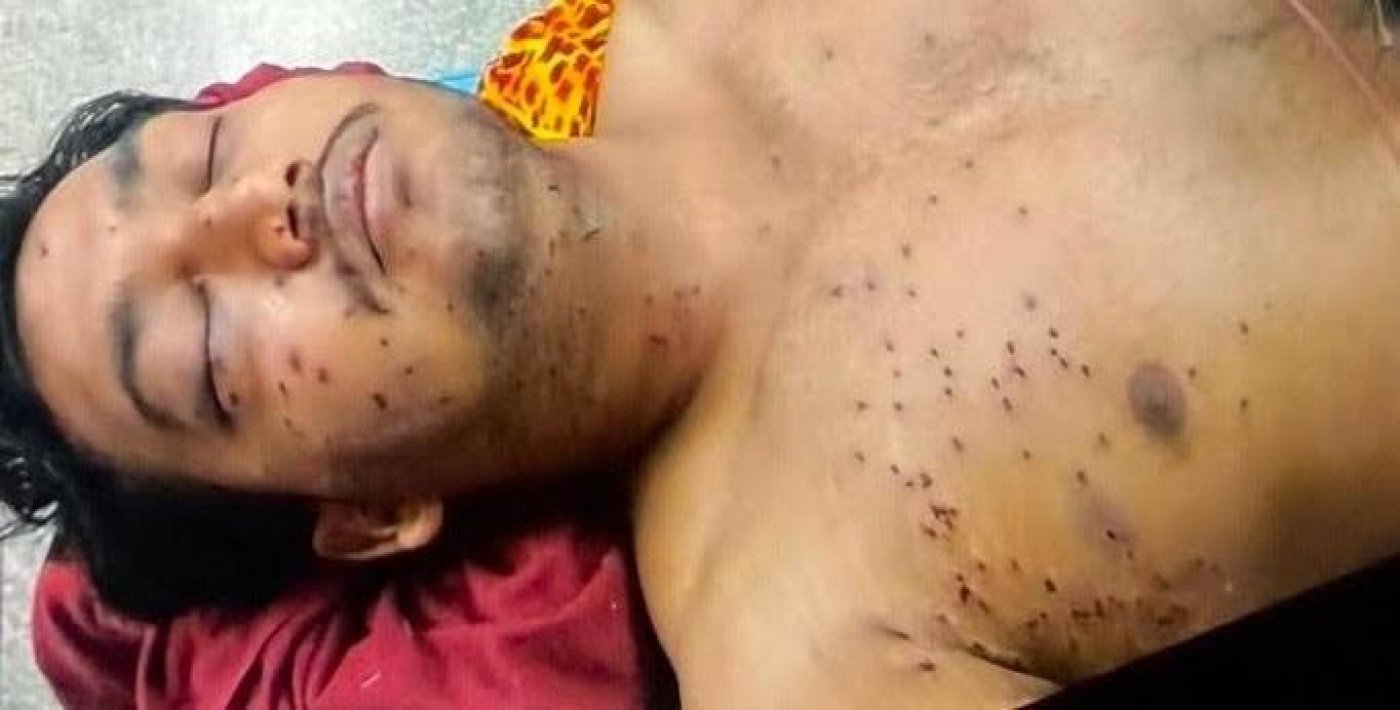
New Delhi: A 20-year-old resident of Delhi's Najafgarh region, Sahil Lochab, might turn “completely blind in his right eye” from pellet-gun injuries, his cousins Shivam and Naman Reddy said when Article 14 met them at the Jai Prakash Narayan Trauma Centre in Delhi's All India Institute of Medical Sciences (AIIMS) on the night of 22 July 2026.
Lochab, a political science student at Delhi University and also preparing for state police services exams, joined a protest march on 20 July to demand education reform and the resignation of the education minister over recent student suicides, when he was struck by pellets on his face, neck, chest and shoulder in central Delhi in the late afternoon, his cousins said.
“The doctor told us there's a 99% chance his vision in the right eye has gone,” Shivam Reddy said. “They will not be able to recover it; they can only try their best in his operation scheduled tomorrow, but it's more or less gone.”
Article 14 sought comment from Delhi Police spokesperson Rajeev Ranjan and additional public relations officer Sanjay Tyagi via WhatsApp message and call on Lochab's case, and asked whether Delhi Police personnel and the Rapid Action Force (RAF)—a specialised wing of the Central Reserve Police Force deployed for riot and crowd control—used pellet guns against protesters. We will update this story if they respond.
On X, the official account of the Delhi police denied allegations of pellet gun use, and issued a “fake news alert” while stating that appropriate legal action would also be taken “against individuals found spreading rumours or misinformation”.
"Claims stating that Delhi Police forces used pellet guns against peaceful protesters yesterday are completely false and misleading,” the police statement said. “Delhi Police neither possess pellet guns nor do they use them in the ongoing protest.” While that is true, RAF personnel have been seen on video using pellet guns.
His cousins said that Lochab was rushed to Lady Hardinge Medical College's (LHMC) hospital by strangers present on the spot at that time, and they themselves came to know about 15 minutes after he was hit.
“They tried to stop the blood loss at Lady Hardinge, but then told us to refer him to Safdarjung hospital,” said Naman, the other cousin. “At Safdarjung, the doctors there didn't treat him like a student but like a terrorist; nobody was helping with anything, and we wasted at least 3 or 4 hours there before we finally took him to AIIMS.”
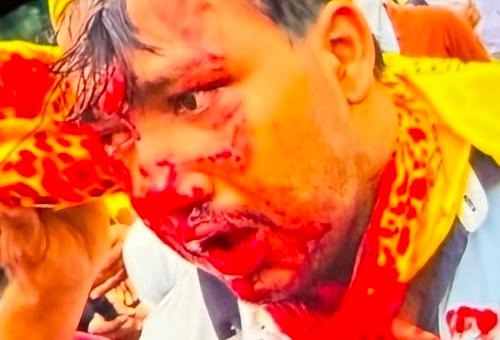
The family said that Lochab's first operation to remove particles from his pellet wounds in his shoulder, chest and face was on the morning of 22 July, more than a day after he was injured.
A second surgery for his eye is due this evening, 23 July.
“We wasted more than 24 hours of time,” Shivam Reddy said.
The family said they had not yet received the medico-legal case (MLC) report and that AIIMS doctors told them the paperwork would only be issued after Lochab was discharged.
Third Pellet-Gun Victim
Lochab's is the fourth reported case of pellet-like injuries, The Wire reported. We have been able to confirm three.
The others include another patient at LHMC, Shaikh Irshad Mansoori and a reporter at Outlook magazine. Both sustained injuries that matched those that would occur after using pellet guns.
Allegations of pellet gun use against protestors in Delhi gained steam after the spokesperson of the online satirical movement behind the protest—the Cockroach Janta Party (CJP)—Saurav Das shared videos and photographs of injuries on X.
Union health minister J P Nadda met Mansoori on Tuesday, 21 July, even as The Wire reported that the mainstream media covered their interaction in a way that neither audio was heard nor his injuries were clearly visible.
The Problem With Pellet Guns
Pellet-firing shotguns were first introduced by security forces in Jammu and Kashmir in 2010 as what authorities described as a “non-lethal” crowd-control weapon.
They were used extensively again during the 2016 uprising after the killing of Burhan Wani, a young commander of the Hizbul Mujahideen, a Pakistan-based designated terrorist organisation, leaving thousands injured.
Government data show that more than 6,200 people, including civilians and security personnel, were injured by pellets between July and August 2016, with thousands injured and about 1,000 left partially or completely blind.
The use of pellet guns has since been criticised by the Supreme Court, the United Nations High Commissioner for Human Rights, doctors and rights groups, who questioned both their legality and lethality.
In 2017, the union home ministry said it would explore alternatives, including plastic bullets and chilli-filled shells, after widespread outrage over blindings.
While security agencies said pellet guns would be used only as a last resort, they have remained part of the arsenal available for crowd control in Jammu and Kashmir. Their reported use against protesters outside the region would mark a significant escalation and is likely to invite renewed legal and human rights scrutiny.
Disappointed With CJP
Back at AIIMS, an exhausted Shivam Reddy scrolled through Instagram videos that he said showed police firing pellet guns during the protest.
“They said they didn't use tear gas either,” he said. “Then where is all that smoke in these videos coming from? They would fire the pellets and then disappear into the line of police personnel.”
Shivam Reddy said the family intended to approach human rights organisations, arguing that pellet guns should not have been used against protesters.
As the family awaited Lochab's surgery, they also expressed disappointment with the CJP, which had led the protest.
Shivam Reddy said that despite a video about Lochab's injuries receiving nearly one million views and repeated attempts to contact party leaders, no one from the organisation had reached out.
“We have crowdfunded for Lochab,” said Naman Reddy. “If they could not come to meet us, they could at least have helped with his treatment.”
(Sabah Gurmat is an independent journalist and writer based in New Delhi.)
Get exclusive access to new databases, expert analyses, weekly newsletters, book excerpts and new ideas on democracy, law and society in India. Subscribe to Article 14.