
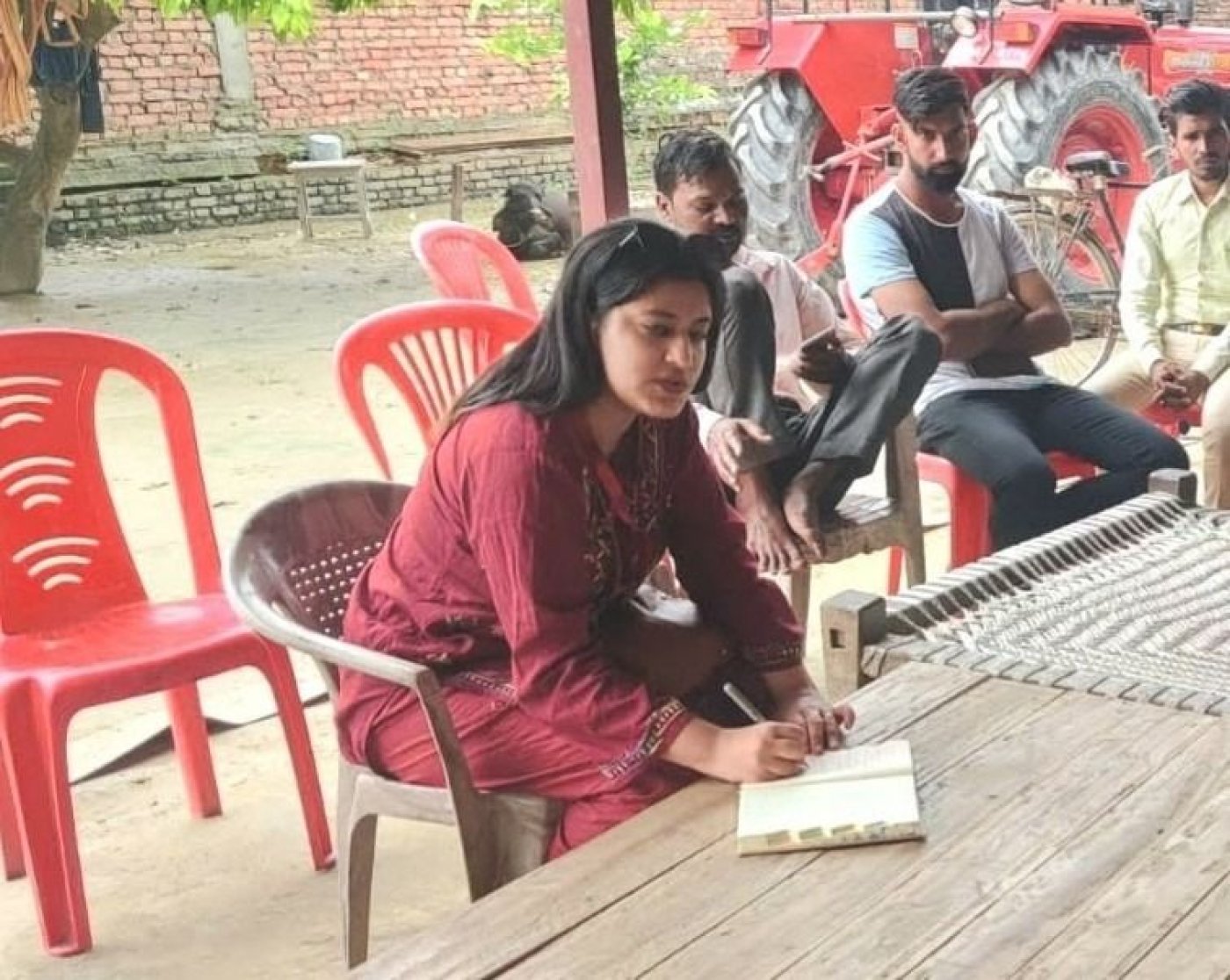
New Delhi: Journalist Ismat Ara’s debut book, ‘Under a Saffron Sky: Inside India’s Crackdown on Love’, traces how the term ‘love jihad’—the idea that Muslim men deliberately lure Hindu women with the aim of altering India’s demography—casts the country’s minorities as antagonists, even in the basic exercise of choosing one’s partner.
Through six years of reporting, Ara interviewed members of Hindu-right vigilante groups, accounts of which reveal the convergence between communal mobilisation that reaps electoral gains and the ways in which caste, religion, and gender are defined through Hindutva's interpretation of nationhood.
These groups have also gained legitimacy through anti-conversion laws enacted or amended across 13 states (here, here and here), most of them under BJP-led governments, who have persistently used it in the pretext of ‘protecting’ Hindu women from conversion, an act these laws proscribe as “allurement, coercion, deceit, undue influence, or any fraudulent means”.
The most recent example is Maharashtra, which enacted the Maharashtra Freedom of Religion Act on 28 August 2026.
Despite the Special Marriage Act (SMA), 1954, which allows couples to marry without converting or marrying under a religious personal law, the hurdles they face continue.
The mandatory 30-day public notice period, in particular, enables families and vigilantes to intervene and obstruct their marriages.
Ara shows how the justifications for the “Love-Jihad” trope are situated in the rhetoric that Muslim population will outnumber the Hindus.
Yet the data shows otherwise. Former election commissioner of India and author S Y Quraishi thoroughly debunked this claim in his book.
In an interview with Ara, Quraishi attributed the high fertility rates and low levels of family planning among Muslims to poverty and other factors that are also prevalent among Hindus, who have the second-highest fertility rate in the country.
According to the National Family Health Survey, the total fertility rate has declined among Muslims—falling from 4.4 children per woman in 1992 to 2.6 in 2021.
The book shows how interfaith couples subjected to surveillance, coercion, violence, and scrutiny, are pushed to confront fault lines of the constitutional safeguards.
In an interview, Kirti Mishra, a woman who planned to register her marriage under the SMA, recalled being told by officials, “Tumhe Hinduon mein nahi mila koi ladka? Muslim se kar liya? (You couldn't find a Hindu man? You married a Muslim man?)”
Her Muslim partner was shot dead the very day they stood outside the city magistrate’s office to register their marriage under the SMA in Uttar Pradesh's Etawah in 2013. The magistrate had even pressured her father to intervene to end the relationship.
In a conversation with Article 14, Ara reflects on the making of her book through encounters with interfaith couples who risked their lives to marry, women who defied social norms, Muslim men targeted by vigilante violence and ‘love jihad’ laws, Hindutva activists who invoke the honour of Hindu women to reinforce patriarchal control and frame it as a defence of the Hindu Rashtra, and families who turn against their children.
She tells us how courts, laws and state institutions meant to protect individual rights can instead reproduce patriarchal social relations, making the regulation of intimacy a means of policing caste, religion and gender.

Edited excerpts from the interview:
You write that the ‘love jihad’ narrative has implications that extend beyond sensationalist claims. As a journalist, what prompted you to investigate this issue, and what are the political and social forces driving it? What purpose does it serve, and how does it shape the regulation of intimate relationships in India?
Over the course of my reporting, I have seen that we often cover cases but are not expected to follow them to their logical conclusion. We report the rape, the murder, the terrible crime, and then the story so often stops at the incident.
I have always believed that the follow-up is where journalism earns its keep, and this book is an extension and manifestation of that conviction: to study and investigate a subject that has the potential to divide and is fast becoming part of everyday language.
I wanted to know what lies behind a divisive term with far too much potential to turn people against one another, policing young men and women. It converts a private relationship into a question of collective religious survival.
In a country where poverty still exists on the ground, where people struggle to drink clean water and eat hygienic food, a disproportionate share of attention is trained on the roughly 3% of people who marry outside their religion. Their relationships are given a name like 'love jihad' and framed as a civilisational threat rather than an exercise of individual choice.
Your book draws on conversations with interfaith couples, lawyers and right-wing activists. How did you approach your fieldwork, gain access to these different groups and navigate the challenges of reporting on such a sensitive subject? What did these encounters reveal about the gap between the constitutional right to choose one’s partner and the social, legal and institutional barriers that shape whether people can actually exercise that right?
I always try to bring in multiple aspects because this term (‘love jihad’) is multifaceted, and so listening to the whole room was essential.
Across the chapters, I touch on the family, policing, society, the couples living through it and the people who are its self-appointed protectors. I try to make the subject comfortable enough to speak freely, without rushing to conclusions. My notebook becomes like a sponge during such interviews, absorbing not just words but silences, mannerisms, tone and demeanour.
The challenge is that you have to broaden your mind to accommodate the ugliest parts of such reporting. You listen to hateful things, sometimes even confessions of crimes, and boasting, alongside heartbreaking stories from couples and parents speaking from fear.
On paper, you are allowed to choose your partner. In reality, it is coded. The distance between constitutional guarantee and lived reality is vast. India's complexity and diversity becoming political currency has complicated it further in the past decade, making an otherwise personal decision far harder to exercise freely.
What does the functioning of Hindutva organisations such as the Bajrang Dal reveal about how cultural and religious threats against minorities are constructed and mobilised, and how do these organisations translate such narratives into action?
Repetition is the basis of anxieties around the narrative of Muslim dominance. A fear is created that if you don't protect the majority religion, and in turn its women, the Muslim minority will establish dominance and reduce the majority to a minority.
An assertion made often enough hardens into an existential fear, particularly among the workers (members of the Hindutva organisations), many of whom are unemployed or juggling multiple gigs in small towns. It gives them a purpose, pushes and encourages them and makes them feel part of something larger. The larger narrative creates the threat and local networks give it an organisational body.
What do demographic data actually tell us about Muslim population growth and fertility rates in India, and how do these facts compare with the right-wing narrative of a Muslim demographic threat?
The idea that Muslims are reproducing at a rate that will eventually alter India's religious demography is not borne out by the broader demographic trends. Fertility rates have been declining across communities, including among Muslims, and the gap between Hindu and Muslim fertility has steadily narrowed.
This is part of a larger demographic transition in India, driven by factors such as education, income, access to healthcare and women's autonomy, rather than religion alone.
What interests me is how the demographic question continues to be framed as a communal threat despite these changes. Instead of examining why fertility rates differ across regions and socio-economic groups, the narrative presents Muslim population growth as an organised threat to the Hindu majority, turning ordinary demographic change into a source of religious anxiety. It’s a reductive way of seeing things in one dimension.
In your reporting, figures such as Balraj Dungar and Amit Bharadwaj, associated with the Bajrang Dal, and acting as self-styled ‘protectors’ of Hindutva, describe networks of informants who alert Hindutva activists to interfaith couples, efforts to ‘rescue Hindu girls’, and the mobilisation of families to file cases against Muslim men, sometimes in collaboration with the police. What does your investigation reveal about how these vigilante networks operate, and how they turn the rhetoric of ‘love jihad’ into surveillance, coercion and criminal cases against interfaith couples?
‘Love jihad’ no longer requires a formal organisational structure to operate. It functions through local networks of informants, activists, families and, in some instances, people within the institutional machinery. Information about couples can travel through neighbourhoods, acquaintances and local contacts, allowing activists to intervene in relationships that would otherwise be private matters.
The idea of rescuing Hindu girls is particularly significant because it recasts adult women as victims who need to be recovered, rather than individuals capable of making decisions about their own lives. The process can then move from surveillance to coercion and, in some cases, criminal proceedings.
Families are mobilised to approach the police or file complaints against Muslim partners, while activists create public pressure around the relationship. The consequences for couples are immediate: separation, detention, intimidation and prolonged legal battles.
The story of Shirish and Anisha is particularly revealing because it unsettles the conventional understanding of interfaith relationships that underpins the ‘love jihad’ narrative. Anisha was Muslim and her partner Hindu, yet their relationship was shaped by caste prejudice, with Anisha belonging to an upper-caste Muslim family. What does their story reveal about the intersection of caste, religion and gender in determining which relationships are accepted and which are treated as a threat?
Their story complicates the binary on which the 'love jihad' narrative is built. When the pairing is reversed, a Muslim woman and a Dalit (Scheduled Caste) man, it disrupts the standard narrative entirely. It triggers instead a distinct set of overlapping patriarchal, religious and caste-based reactions, showing how caste discrimination operates across religious lines in India.
Islam doctrinally rejects caste, yet sociologists note that caste-like stratification exists among Indian Muslims.
An ‘upper caste’ Muslim family often objects not just to the man being non-Muslim, but specifically to his Dalit identity, viewing it through a lens of social inferiority and impurity. And unlike dominant-caste Hindu men, who are sometimes shielded, even celebrated, by right-wing groups when they marry Muslim women (framed as ghar wapsi or 'reverse love jihad'), a Dalit man rarely receives social protection.
The regulation of intimacy in India is not only about guarding religious boundaries but about guarding the boundaries of caste and community too.
Your book identifies Uttar Pradesh as a model state for the ‘love jihad’ narrative under Yogi Adityanath, with anti-conversion laws subsequently adopted by other BJP-ruled states. How do these laws institutionalise the policing of interfaith relationships, reinforce majoritarian politics and serve the BJP’s electoral interests?
Uttar Pradesh became the testing ground where 'love jihad' was carried from political rhetoric into law.
These laws have fundamentally changed the nature of interfaith relationships by bringing what was traditionally a personal choice within the ambit of state scrutiny. The burden often shifts to couples to establish the legitimacy of their relationship, with provisions that allow complaints by third parties, scrutiny of religious conversions and prolonged detention or imprisonment.
This creates an atmosphere in which interfaith couples, particularly those involving Muslim men and Hindu women, must negotiate not just social prejudice but the possibility of state intervention. Once the idea that interfaith relationships require state oversight is embedded in law, it legitimises suspicion towards them and reinforces existing communal anxieties, and every controversy around an interfaith relationship can be framed as evidence of a larger conspiracy.
The electoral significance lies in how effectively such issues can shape public perceptions and consolidate identities, even when the actual number of cases may be relatively small, in the single digits (around 3%).
The Special Marriage Act, 1954, was intended to enable couples to marry across religious boundaries without conversion, yet its 30-day public notice requirement can expose them to surveillance and vigilante intervention. How has this provision become a source of vulnerability for interfaith couples, and what does this reveal about the gap between the law’s promise of individual choice and its implementation?
It exposes couples to a great deal of risk, from society and from those who are against such unions. For interfaith couples, privacy is often not a luxury but a condition necessary for their safety.
In the book, I have stories of couples where their marriage plans led to riot-like situations, and of a stamp vendor telling the girl's parents that the stamps had been bought. A law designed to protect individual choice ends up exposing that very choice to public intervention. Sometimes the state doesn't even need to enforce them. People will keep doing it once they believe in its root ideas and core fears.
The term ‘love jihad’ entered the Hindutva lexicon through proceedings before the Kerala High Court, first in 2009 in Shahan Sha A vs State Of Kerala and subsequently in the ‘Hadiya case’, where the court entertained a father’s claim that his Hindu daughter had been ‘indoctrinated’, despite her assertion that she had converted to Islam of her own free will. These observations later fell apart, even as the court confined an adult woman to her father’s custody. What does this episode reveal about the judiciary’s role in legitimising the ‘love jihad’ narrative, particularly when a woman’s stated choices are overridden by claims of indoctrination and concerns about family honour?
The Kerala case shows how 'love jihad' acquired institutional legitimacy before the allegation was ever established. Judicial language and observations can shape public discourse, sometimes lending legitimacy to narratives that have not been fully established by evidence.
The problem was not that a father's apprehensions were entertained, but that the adult woman's own account of her decision was effectively subordinated to the idea of indoctrination. There is a distinction between protecting an individual and protecting the idea of family honour. An adult woman's autonomy cannot be made conditional on whether her choices satisfy her family's expectations.
The judiciary bears a critical responsibility to safeguard individual liberties, and to tell evidence of actual coercion apart from social or familial disapproval.
How does the preservation of boundaries of caste, religion, and gender inform the idea of a Hindu Rashtra (a Hindu State), and how does it shape women's bodies as sites of regulation and control?
Caste, religion and gender are bound tightly together. In an increasingly polarised society, the preservation of boundaries around them becomes central to how community identities are defined and sustained.
Marriage, in particular, becomes a site of contestation, because inter-caste and interfaith relationships can challenge established ideas of social belonging and disrupt existing hierarchies. This is why women's choices around love, marriage and conversion are so politically and socially contested.
Women's bodies, sexuality and reproductive choices become sites of political anxiety, increasingly framed as matters of collective interest rather than individual autonomy. Women are invoked as symbols of community honour and as people who need protection, but their agency is curtailed the moment they exercise it in ways that challenge established social boundaries.
While Hindu women are cast as bearers of community honour, Muslim men are constructed as predatory outsiders and targets of anti-conversion laws and vigilante violence. How does the ‘love jihad’ narrative reproduce the broader Hindu nationalist construction of Muslims as a perennial threat to the nation?
Portraying Muslims as an inherent threat is hardly new. From Edward Said's critique of Orientalism, which examined how the West historically constructed the East as its cultural and civilisational opposite, to contemporary narratives such as 'love jihad', there is a recurring pattern of depicting the Muslim man as the dangerous, predatory outsider, defined by danger and an alleged threat to the dominant social order.
The 'love jihad' narrative gives this old stereotype a new gendered dimension: the Muslim man is portrayed as someone who threatens the Hindu community, its demographic future and, by extension, the nation itself. Hindu women are cast as vulnerable bearers of collective honour, while Muslim men are made objects of suspicion and surveillance.
This is how an intimate relationship is transformed into a question of national security and religious survival. The terminology may be contemporary, but the underlying trope is constructing an internal enemy against whom the majority community defines its identity and anxieties.
(Syed Affan is a Delhi-based journalist who reports on human rights, the environment and policy.)
Get exclusive access to new databases, expert analyses, weekly newsletters, book excerpts and new ideas on democracy, law and society in India. Subscribe to Article 14.