
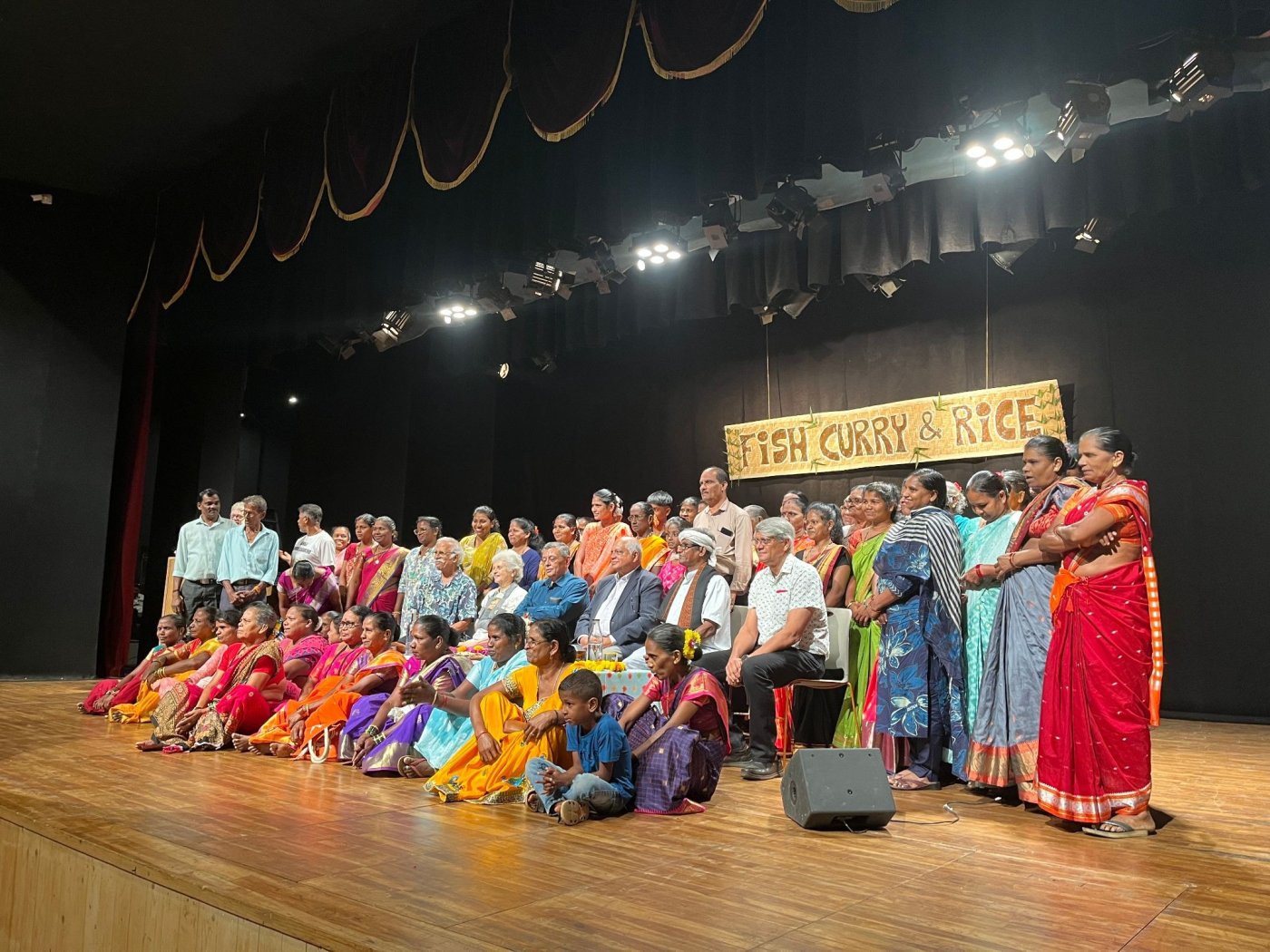
Panaji: On a recent evening in Panjim’s Kala Academy auditorium, a live band, joyous protest songs and the felicitation of 16 grassroots environmental defenders and organisations from across Goa marked the launch of the fifth edition of a book called Fish Curry And Rice: A Sourcebook on Goa, its Ecology and Lifestyle.
It seemed fitting that a landmark book—it first appeared 35 years ago—cataloguing Goa’s forests, rivers, fields and coasts, and a people’s spirited engagement with these landscapes over time, should be released by giving centre stage to a range of movements underway to protect them.
Goa is unique in that its small area is home to five major landforms, from the Western Ghats and plateaus to coastal plains and beaches, all of which support a diversity of ecosystems and flora and fauna and have shaped people’s knowledge systems. As editor Claude Alvares points out in the book’s Introduction, the rich ecologies that make up Goa’s 3702 sq km area are also a reflection of “an amazing community of ordinary individuals who not only understood their environment, but worked within the limits it imposed, interacting wisely and intricately with the demands of the ecosystems”.
Fish Curry And Rice was first published in 1993, and released by Maneka Gandhi, India’s minister for Environment from 1989 to 91. Over three decades, it has remained a definitive sourcebook on Goa’s dazzlingly rich ecology, offering a vivid account of its geography and the communities that have shaped and protected it.
Alvares, who also co-founded the Goa Foundation in 1986, one among many environmental groups that make up Goa’s energetic civil society landscape, brought together 170 contributors spanning naturalists, cartographers, farmers, heritage conservationists, social activists, artists and photographers for this 400-page, richly illustrated edition.
The 5th edition, coming out after a gap of 23 years, also reflects two momentous decades for India’s environment, from large-scale destruction to dogged citizen movements and the expanding sphere of environmental litigation.
In recent years, Goa’s natural wealth and fragile ecosystems have been under great strain. A decade-plus of lawless mining halted by dogged courtroom battles (here, here and here) is now looking to restart. Further, the state is seeing skyrocketing land values (residential property prices have risen by over 66% year on year, according to analysis by a prominent online real estate sales and rental platform). The real estate rush is aided by the government’s far-reaching change to the regional plan in 2024, through controversial amendments such as section 39A of the Goa Town and Country Planning (Amendment) Act 1976.
Amendments like these in recent years have allowed the government to issue zoning changes to individual plots, and the scale of such rezoning permissions has sparked protests across Goa’s villages over resource takeover and environmental impacts.
Analysing the fallout of these amendments, academics Solano da Silva and Tahir F de Noronha write that between October 2024 and March 2026, nearly 6 million sq m of land in the state have been proposed for zoning changes, with 90% of the changes seeking to convert agricultural or ecologically sensitive areas to residential or commercial land use.
As per data shared in the Rajya Sabha by the ministry of corporate affairs in December 2025, 166 real estate and rental companies and 110 construction companies were registered in Goa in just 16 months (April to November 2024 and April to November 2025).
There is a scramble to commodify hills, wetlands, and waterfronts for real estate, particularly for ‘second homes,’ with the market “largely dominated by luxury villas” over Rs. 150 million. Several elected representatives in the state have links with the real estate industry, as the book points out.
Popular agitations against these and other developments rock the state. Many are now coalescing under the banner of ‘Enough is Enough’ a recent movement launched by the former Chief Justice of the Allahabad High Court, Justice (retd) Ferdino Rebello. In its 10-point charter, demands range from an end to hill cutting and the repeal of arbitrary rezoning laws to the removal of casinos from the Mandovi river commons and the urgent need to ensure drinking water for all residents before the government awards permissions for new projects.
In a post announcing the new edition this March, Alvares, in characteristic humour, said that if there wasn’t another edition of the book, it might mean either of two scenarios: “One, that I am dead and gone. The other is that Goa is gone, and there is no fish curry and rice available anymore, so no need for a book with that title anyway.” In an interview with Article 14, Alvares says the state is at an inflexion point, and the goal of this new edition is to spur hope and action.
Fish Curry and Rice is a vivid account of Goa’s geography and people that has stood the test of time and moved with the times. How did the book first come about?
The first edition of Fish Curry and Rice was a direct offshoot of the Center for Science and Environment's Citizens' First Report on the State of the Environment. We worked on that report for the Goa section in 1982, I think. I was a journalist then, and following our work on the CSE report, we thought we must do a dedicated citizens' report on Goa. But we were very keen on emphasising the popular component of the issues. When Norma (Alvares—a senior advocate and winner of the Padmasri Award in 2002 for her environmental protection work) and I came to Goa in 1977 from Bombay, there were already big agitations underway, particularly around the issue of traditional fishing boats versus mechanical trawlers, and then the agitation around the Zuari Agrochemicals factory. It was the first time in the history of India that an agitation shut down a factory on the grounds of pollution, and the Goan people did this before India enacted all its central legislation around water and air pollution. Also, there was the issue of sand extraction from the beaches of Goa—large players coming and just extracting sand for its rich silica content, which was just appalling. The fishing movement of course was a mass movement. The Goemchea Ramponkarancho Ekvott (an association of traditional fishermen founded in 1975) was agitating against the large trawlers then, and they are still active - they are fighting the LED fishing boats now.
So, I guess what distinguished Fish Curry & Rice from the CSE's reports was the amount of space it devoted to the resistance in all these areas: what agitations were taking place, what cases were being filed, which were succeeding, which were not. A focus on people and movements has remained the key characteristic of this book across all the editions. And the title Fish Curry and Rice was meant to convey that–-when all your ecosystems are healthy and functioning well, and you have not destroyed your paddy fields and coconut trees and marine ecosystems and khazan systems [centuries-old, human-engineered buffer zones between estuarine mangroves and land at sea level, used for salt manufacture, fishing, and housing unique agroecological activities, for example the cultivation of heirloom, salt-tolerant rice varieties], and you know how to take care of all of these and you fight to preserve them, what you get is your quintessential meal of fish curry and rice.
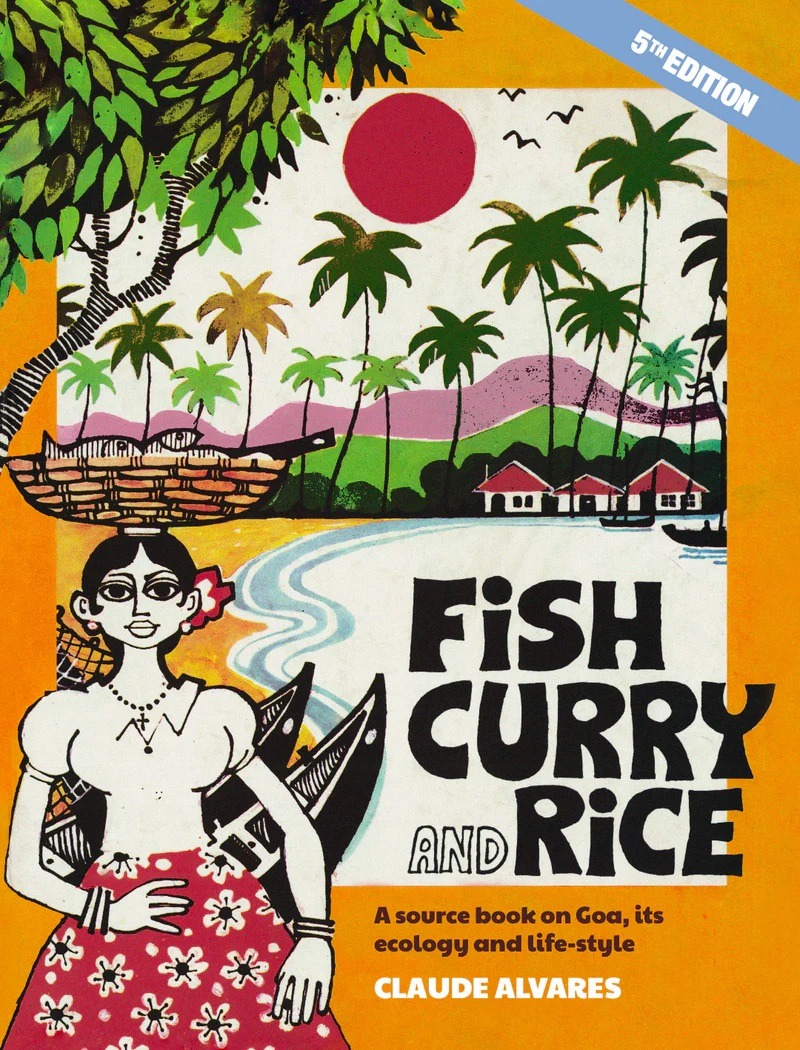
There has been great demand for the book in the intervening years when it went out of print. Given all that has unfolded on the environmental front between the last edition of 2002 and this one, how did you approach this new edition?
People, including booksellers, would ask us if we could just reprint the previous edition since there was a demand, but we could not have done that. We are very conscious that Goa is changing all the time. If you bring out the 2002 edition in 2026, it is an injustice to the person who is buying it. But when I heard that someone is selling a second-hand edition of the book online for 5000 rupees, that’s when I thought there is a serious need for an updated Fish Curry and Rice. I also realised that bringing out the new edition can help us support our work at the Goa Foundation.
After two years of dedicated work, we have revised and updated the book significantly, with a lot of new contributors and new chapters. These updates reflect the past 20 years and our own evolving understanding. For example, we have a new chapter on plateaus and tablelands, which is not there in the earlier editions, and which goes into how vital these landscapes are as hotspots of biodiversity and home to flora and fauna, including frogs, insects, snakes, birds, and so on. And you cannot just degrade them to house industrial estates as has happened in Goa.
The chapter on mining is a vital one in the book - it looks at the whole illegality of mining leases in the past twenty years, the Supreme Court rulings in our Goa Foundation cases, and how we had the law changed to make auctions mandatory, which was not the case earlier. We have included a large collection of photographs, which show the impact of mining on the land.
In fact, across all the editions, what comes out strongly is that the people are resisting throughout. Across decades and in different forms - through morchas and agitations, or petitions before the local courts and the Supreme Court. I think of Goa as somebody who has been stabbed multiple times, but is still alive because he's trying to shout and scream and get attention and survive. That's the only image I can come up with right now. There are multiple attacks and there is so much resistance. I don't think even a book like this can reflect the scale of what's happening, because every week some new assault takes place, and protests are erupting everywhere too.
This edition is also in full colour, and powerfully marries word to image - from maps and photographs to a rich array of artwork that convey Goa’s sublime and beleaguered landscapes.
The earlier editions also came out very well but they were all in black and white, because we could not afford anything more then. But this one is much more lavish with the illustrations in colour. There are archival images from the 1990s of Goa’s splendid beaches which have been completely disfigured now. You have to see those images to know what we have lost. You cannot explain to people the harm done by mining unless you put six pages of photographs, and so we have done that. Same thing with the railways - the railways say we don't kill any animals, the book has two pages of photographs of elephants and gaur killed on the rail tracks by trains. Other photographs show the damage to the mangroves.
And of course, there is all this wonderful artwork by artists from Goa who have contributed their work pro bono for this edition, including the work done by artists for the Save Mollem campaign. My personal favourites are the satirical ads in the vein of newspaper obituaries for all the polluting industries people’s movements have managed to evict from Goa, and the critical takes on builders’ ads that imagine the state of Goa like a piece of real estate to buy and sell to make money.

My daughter-in-law Cinatra Fernandes (who runs the publishing house Ocotillo Bloom) came into the picture when we were working on this new edition and improved everything. The printing is just wonderful, which makes an impact on people. The sales proceeds of the book will all go towards the work of the Goa Foundation—we are telling people unabashedly to buy the book because it tells you what the Goans have done for 40 years to fight for the environment. Every time someone comes up to us now to say, ‘Thank you for what you are doing for Goa’s people and its environment’, I can have a ready response for them: ‘I have copies of Fish Curry and Rice in my car, just buy a copy and that’s how you will support us.’
The Goa Foundation is now 40 years old and has built a landmark body of environmental protection, through the work of lawyers like Norma Alvares. The foundation has not just shaped legal battles but also public discourse around valuing the environment and human-nature interconnections.
The chapter on mining in the book also strikes a hopeful note and offers an argument to sequester the earnings from mining. We are currently preparing a petition, where we are going to ask that all the premium which the state gets from the auction has to go into a permanent fund. That money which the government gets should not be for spending, it is the value of the ore. It is like the principal amount, representing the sale of an asset. And we cannot deplete all our assets but we have to conserve them for future generations.
More broadly—through our litigation work, we are always trying to shape the larger debates around issues of the environment. For example, we have commissioned a study by the environmental scientist Sagar Dhara on the environmental impact in financial terms of a mining operation over the life of a mine. We are assessing the price of this so-called development model. We still do not really evaluate the full scale of damage done to our ecological assets in financial terms. Dhara studied three mining leases in one village. He found that the loss to the economy in terms of water, agricultural production, milk production, forest produce, hills, hydrology and other ecological assets has been to the tune of 4000 crore rupees. The miners, over the same 50 years, walked off with Rs 7,000 crore. Clearly, the village and its population lost everything, with all gains accruing to the miners. This is the first study of its kind in India, and we are very conscious that it will be used by activists in all the mining areas of the country to make their arguments.
We are also challenging the amendments to the Forest Conservation Act. We have challenged the standing committee decisions of the National Board of Wildlife, all of them from 2014 to today, only a couple of which relate to Goa. So we do things here at the local level, but our perspective strives to be at the national level. Over the years, we have developed the expertise to be able to file public interest litigation (PIL) in issues of mining, wildlife, forestry, and CRZ. We have gained this expertise from filing over 350 PILs. We are now putting up our entire public interest litigation repository online, with all the petition copies, judgments and associated documents. This will be useful to people all over India.
Was the Goa Foundation’s focus on taking the legal route a conscious strategy? How has your understanding of litigation as a strategy evolved in these decades?
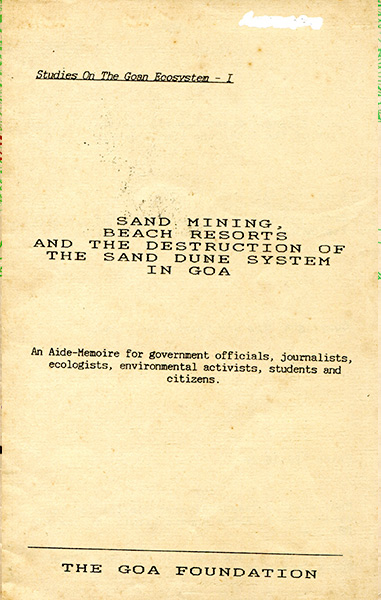
The reason we got into litigation is very funny. We had a very good result in our first petition in 1987, which challenged illegal sand extraction from Goa’s beaches. We had a very good lawyer, Ferdino Rebello (later a judge who headed the Allahabad High Court, and is currently spearheading the citizens’ environmental protection movement in Goa titled ‘Enough is Enough’). The case was being heard by a judge from Bombay, Justice Mohta, who said these Goan beaches are a thing of great beauty, and you cannot just cart away the sand. And we got a favourable ruling in that case. But if we had lost, we might have never gone back to the courts. But because we won, we got hooked!
And at that time, it was so simple to file a petition because you just drafted a petition: the format was very clear. It used to cost us 2 rupees to file. Today it is 150 rupees. And then you filed it any time of the week, and it would come up on the board the following Monday without a need for a mention. And the court would accept your affidavit at truth value. You said that this construction is taking place, that a violation is taking place… and that the judges would issue an interim order then and there. Because they valued an affidavit filed in that proceeding. It had some meaning. Today, the courts take 6 months to pass an interim order, and the National Green Tribunal takes several months just to hear a matter, by which time so much damage has already been done on the ground.
Frankly, we can never claim that we had a litigation strategy when we began the Goa Foundation. We had no expertise in law or the courts. We learnt writ jurisdiction and PIL filing as we went along. We never thought that the courts were the only answer. In some cases, if there was strong agitation with large numbers of people on the ground supporting it, we advocated against approaching the courts. A negative decision from the courts had the potential to demolish a citizen's agitation. So courts had to be approached only when there was no other recourse and clear evidence of a violation of statutory law. In those cases, the courts would be bound to hear the matter. If they ruled against us, we could appeal. Sometimes the Supreme Court was more sympathetic to such concerns than High Court judges. So the decision to go into litigation on any specific issue was taken on tactical grounds. But in all matters, the rule was: if you had a good agitation going, you never approached the courts.
In recent decades, many environmental struggles have been disappointed by the constitutional courts. The judiciary, the government and even large sections of the mainstream media justify the ongoing destruction of the environment as infrastructure, development and economic growth.
This is a completely erroneous discourse. We must understand that our ecosystems like forests are a form of infrastructure too—a complex, multifaceted, self-sustaining infrastructure. So when you are building, say, a highway, you are destroying one form of infrastructure for another: that is the way to think about it. Our litigation and all our other efforts have tried to shape public understanding about our environment as a form of infrastructure, as public goods and as inter-generational assets, which you do not just destroy for some short-term profit.
You write in the book’s conclusion that Fish Curry and Rice is “a document of conscience, and a document of hope”.
Well, we have not written Fish Curry and Rice to make people depressed, but to create hope about what they can still salvage if they act now. The book is written to help people appreciate what we have and value what our formal education systems do not teach us to value. And of course, with the intention of getting them to learn from the people of Chimbel, Mirabag, and so many other places, to come out onto the streets to fight for this valuable environment that we were gifted with. I believe Goa is at a vital inflection point, and the coming 5-6 years will be crucial.
The interview has been condensed and paraphrased for flow and clarity. Fish Curry And Rice is available for purchase here.
(Chitrangada Choudhury is an award-winning journalist and a member of the Article 14 editorial board. She works on issues related to the environment, indigenous and rural communities)
Get exclusive access to new databases, expert analyses, weekly newsletters, book excerpts and new ideas on democracy, law and society in India. Subscribe to Article 14.