
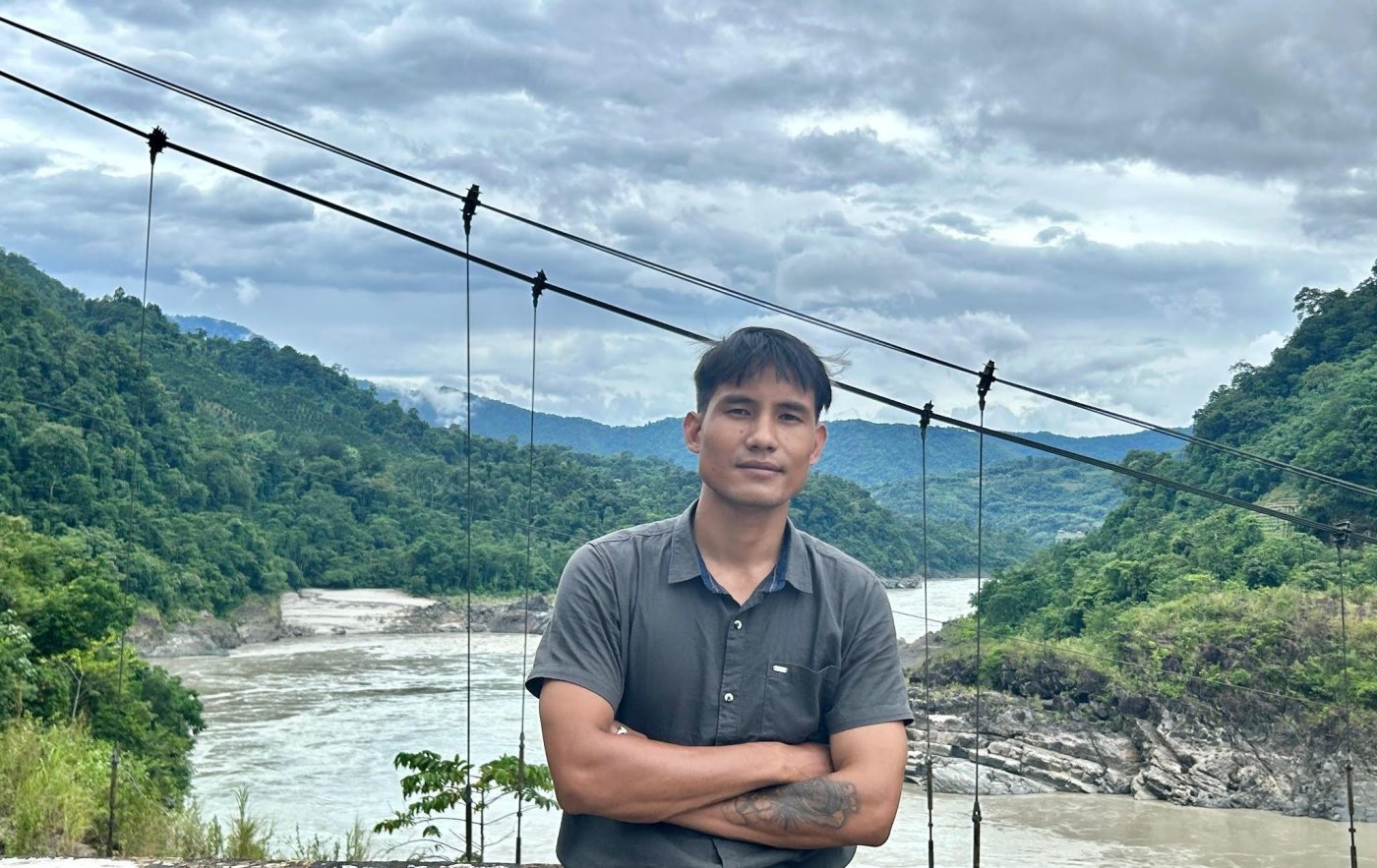
Kolkata: On 4 October, around 7.30 pm, Shaan Jijong, journalist and managing editor of Arunachal Pradesh’s Yingkiong-based digital news platform Upper Siang News, received a notification on his computer that startled him.
It read: “Account not available in India. We have temporarily restricted access to this account pursuant to legal requirements under India’s Information Technology (Intermediary Guidelines and Digital Media Ethics Code) Rules.”
Heading the Facebook-based news page from north-east Arunachal Pradesh’s Upper Siang district for the last six years, Upper Siang News faced such a restriction for the first time.
Jijong contacted the president of the Arunachal Press Club, who released a statement objecting to the restriction on news coverage. He said the Upper Siang News page on Facebook was reinstated on 7 October. But Jijong noticed “many videos related to the protests and people’s anger over the Siang Upper Multipurpose Project were missing”.
The Siang Upper Multipurpose Project is a 11,000 MW hydroelectric power project planned in the lush Upper Siang district of Arunachal Pradesh.
Jijong’s page was not the only one taken down. Facebook pages Aborman Anbo, run by human rights defender Katon Moyong, Save Abor Land, and advocate Ebo Mili were also reportedly blocked.
Jijong realised there was a pattern behind the muffling of voices in Arunachal Pradesh. “All of these Facebook pages had taken a stand against the proposed dam,” he said.
On 17 October, ArunBhoomi News, a Hindi daily news and web portal with 6,81,000 Facebook followers, reported that two of its videos on the issues surrounding the Siang Dam had been restricted from viewing in India.
“We cannot upload any more videos related to the Siang Dam,” Takam Sonia, the news portal’s editor-in-chief, said in a video post. “Media freedom in Arunachal Pradesh is being suppressed and India cannot be a democratic country if it kills freedom of speech in this manner.”
The two restricted videos, uploaded on 16 October, had 13,500 ‘likes’ and 726 shares between them.

This was the latest punitive measure taken by the Arunachal government, coming after a series of cases, arrests and the deployment of security forces in the lush Siang Valley, home and sacred to the Adi people—an indigenous ethnic group of Arunachal Pradesh—who are protesting the building of the dam that they say will take away their land, disrupt the river they worship, and effect their traditional way of life.
The government deployed armed forces in the otherwise peaceful region in 2025, ostensibly to stem the growing opposition against the proposed project that the indigenous community feared would lead to them losing their homes.
According to reports, 27 villages are at risk of being submerged, affecting about 150,000 people.
On 9 October 2026, the BJP government of chief minister Pema Khandu arrested four anti-dam activists and charged them under the Arunachal Pradesh Unlawful Activities (Prevention) Act, 2014, which civil society organisations criticised for “providing the state government or district magistrate with unrestricted power to detain any person.”
The four arrested individuals were senior members of Siang Indigenous Farmers Forum (SIFF), which has strongly opposed the hydel project.
On 11 October, the government prohibited the assembly of five or more people in Yingkiong, the district's administrative headquarters, under Section 163 of the Bharatiya Nagarik Suraksha Sanhita (BNSS).
Earlier in August, the Central Bureau of Investigation registered a case against prominent anti-dam and indigenous rights activist and environmental defender, Bhanu Tatak, allegedly for flouting the Foreign Contribution (Regulation) Act (FCRA), 2010, accusing her of receiving “foreign funds” in order to “organize and sustain anti-dam protests”.
It was reported that two pending police cases from 2021 and 2022 were used to issue a Look Out Circular—used by Indian immigration officials to prevent an individual from leaving the country—against Tatak when immigration authorities stopped her at the airport from boarding a flight to Dublin last year.
On 30 September 2026, as the rest of India braced for protests in Delhi over alleged electoral malpractices, the discontent erupted into violent protests in the Upper Siang district.
Angry crowds vandalised the house of a local politician; vehicles were damaged and roads blocked.
While the state government's apathy was seen as the immediate trigger, the presence of large contingents of armed forces and the curb on civil liberties provided the wider context.
Based in Yingkiong, about 250 km from the state’s capital Itanagar, Shaan Jijong of Upper Siang News, tells Article 14 that insecurity about the proposed dam, the crackdown on media freedom and civil rights, as well the unprecedented deployment of armed forces, have contributed to people of the region living in fear.

You reported that the government blocked your Facebook page in India. Tell us about the kind of issues you were highlighting through Facebook? Are other journalists, activists and organisations facing censorship as well?
I had two Facebook pages: my personal one and another called Upper Siang News 24/7, a digital news channel I ran. On 4 October, I saw a notification mentioning ‘account not available in India…pursuant to legal requirements under India’s Information Technology (Intermediary Guidelines and Digital Media Ethics Code) Rules.’
The Arunachal Press Club condemned the takedown.
After that, on 7 October, the page was reinstated, but videos relating to the Siang Dam were deleted. On 9 October, the page was disabled again.
It is clear that the news page is being targeted because I stay in Yingkiong, the headquarters of Upper Siang district, and often news connected to the Siang Dam comes to me first, which I forward to other news organisations in Arunachal.
My news page would cover news from all sides, but interestingly, I noticed that only the videos related to the Siang Dam were deleted.
Pages of Aborman Anbo, which is run by environmental engineer and human rights activist Katon Moyong; Save Aborland, and that of advocate Ebo Mili have been blocked too. These pages were also focussed on the Siang Dam.
I have heard that 2-3 government employees in Arunachal Pradesh have been suspended for being against the dam.
Just a few days ago (this interview was conducted on 9 October), four anti-dam activists were detained from Pasighat and charged under the Arunachal Pradesh Unlawful Activities Act 2014.
The Central Bureau of Investigation (CBI) recently booked environmental and anti-dam activist Bhanu Tatak for flouting the FCRA law. Do you think this is meant to produce a chilling effect among activists and organisations?
Bhanu Tatak has been an advisor to the Siang Indigenous Farmers’ Forum (which has been against the proposed dam) and has been working in this field for many years. She is well respected for her work and her opinion is taken positively across Arunachal.
It is felt by some, like Thomas Borang, president of the organisation Adi Baane Kebang United, which has opposed the Siang Dam, that the action by the government against Bhanu Tatak is aimed at creating a negative image about her.

The protests have been peaceful for one year. What provoked the recent violence when the local MLA's house was attacked and vehicles burnt?
Chief minister (CM) Pema Khandu had told the media that he would soon visit Upper Siang district to meet the project affected people and the general public. On 30 September, when he did visit he met only government employees and officers and not the affected public.
On the same day, at 8 am a public rally was organised in Yingkiong, and the plan was to march and meet the CM. Women were the face of the protest. But the security forces did not let the marchers proceed.

This led to the marchers burning the effigies of Khandu and local MLAs and becoming aggressive since they were stopped from meeting the CM.
A convoy of the deputy chief minister and other MLAs coming to the meeting was turned away and couldn't reach the venue. Roads were blocked by felling trees.
The meeting itself was thinly attended by government officials, and post-lunch the CM left for Itanagar on a chopper. After this, the protestors reached the residence of local MLA Alo Libang in Yingkiong, the headquarters of Upper Siang district, and tore down the gate and stoned the doors and windows. Some vehicles standing outside were damaged.
In Geku town, about 41 km south of Yingkiong, two police and a commercial vehicle were torched.
What kind of militarisation is the region witnessing? How have residents responded to the presence of large contingents of central armed forces?
Thousands of armed forces have been deployed. Personnel from the Indo Tibetan Border Police (ITBP), Central Armed Police Forces (CAPF), Sashastra Seema Bal (SSB) and Arunachal Pradesh Police (APP) have been deployed in disproportionate numbers since last year.
They have been stationed in government schools, multipurpose buildings, and institutions.

In previous years, there was no armed deployment. The local people have asked the government, the superintendent of police and deputy commissioner to withdraw the forces. They have questioned the agenda behind their presence, more so since these aren’t border districts. People are living in fear.
How many villages and people are likely to be displaced by the dam? What kind of rehabilitation package has the government proposed?
Though exact figures aren’t available yet, 27 villages in both Siang and Upper Siang districts are likely to be submerged, or directly or indirectly affected.
Towns like Yingkiong and Geku are at risk of being submerged.
The government has mentioned both monetary compensation and resettlement, but people are not interested.
What are the main threats from the dam that the local people perceive?
You might be aware that people in Arunachal depend a lot on nature. The Siang River is integral to their lives, and their agricultural fields are mostly adjacent to the river. The dam is a risk to their livelihood and way of life.
The people are emotionally connected to their land. The Adi people have traditionally been nature-worshippers. The rivers and the land are revered by people, their belief lies in nature. They feel that their culture and traditional life will be destroyed when such a massive project comes up.

People are aware of the Chakma-Hajong people in Bangladesh who became landless refugees in India after a big dam came up there. The Adi people in Siang also fear that they will become refugees.
It has to be noted, too, that the entire eastern Himalayan region falls under seismic zone V, the highest category of risk from earthquakes. The soil here is soft, prone to landslides, and a large dam would be at high risk during an earthquake. In the event of an earthquake, the effects of the destruction will be felt even in Assam.
The project area is also a globally recognised biodiversity hotspot. What are the risks facing flora and fauna there?
Upper Siang district is home to the Mouling National Park, one of only two National Parks in Arunachal Pradesh and boasting of an abundance of both flora and fauna. Despite its importance, the proposed dam will definitely and severely affect its biodiversity.
People fear the worst. Thousands of trees may be felled in both the actual construction site and the catchment area of the dam.
Destruction will be rampant.
The project was pitched as a strategic response to China's upstream hydropower activities. Arunachal Pradesh has also been touted as India's emerging hydropower capital. Did these factors resonate with the local population?
The Arunachal government calls the Siang Dam a national project. The government has pointed towards the dam that China is building, and the Siang Dam has been proposed to secure us. But the public has rejected this.
The Chinese dam will have 60,000 MW capacity compared to the Siang Dam's 11,200 MW, and if the much larger Chinese upstream dam breaks for any reason in the future, will the smaller Siang Dam be able to control the deluge?
The government has primarily projected this as a strategically important defence project. Its multipurpose nature, where the Siang Dam will generate hydroelectricity, boost tourism and irrigation, is also mentioned. The local population remains unconvinced.
Has the government tried to secure Free, Prior and Informed Consent (FPIC) from the Gram Sabhas as mandated for such projects? The NITI Aayog conceived the project in 2017. Do you find the current government attempting to speed up the project?
The government has not undertaken a door-to-door or village-to-village awareness campaign. That should have happened.
The main target of the government now is to somehow complete the Pre Feasibility Report (PFR) for the Siang Dam as soon as possible. Many think that the state government is under tremendous pressure from the central government. This also possibly explains the forceful and massive deployment of armed forces in the region.
The general consensus is that if nobody wants the dam, what is the need for the PFR anyway?
In May last year, the state government announced it had signed a Memorandum of Understanding (MOU) with Taba Tamut and Bakin Tali, two residents of Pangkang (Kumku) village who claimed to represent the community. The government claimed this gave the go-ahead for the contentious pre-feasibility survey. There are also allegations that the government is trying to divide the local population to break the resistance. How is this being carried out?
By now, almost all villages in Siang and Upper Siang district have signed MOUs, except Gette and Gosang villages.
Let me explain this contradiction. MOU is signed by individuals and the government has played a big role in getting their consent, even those who are opposed to the dam. The government has lured villagers by offering cash handouts of Rs 250,000 to families and individuals in order to get them to sign.
While some have been offered cash, others have been made beneficiaries of the government's schemes and assistance in orange and poultry farming.
For example, if a family of four has received the Rs 250,000 largesse, the government will get all four members to sign separately. This way, they claim four households instead of a single family's consent.
Recently, on September 30, I asked CM Pema Khandu about getting consent for the MOU by exploiting villagers' greed. He replied that it is to provide livelihood support from the government of India.
Even villages outside the estimated 27 villages likely to be affected by the dam are being asked to sign MOUs. Tuting village, close to the China border, which is outside the affected area has also been shown as an MOU signatory.
This is done so the government can inflate the number of supporters of the PFR. Many people regret accepting the financial handout and continue to be part of the anti-dam resistance.
There is also a fair amount of pro-dam material floating around on social media. How strong is the pro-dam lobby? How important is the role of social media in influencing opinion?
The pro-dam presence in social media is significantly less than that against it. Facebook, Instagram, YouTube and Twitter (now X) are very influential and being heavily used by both sides.
I also suspect some pro-dam accounts have government backing. Those running pro-dam pages also fear raising people’s ire, even as their own homes are at risk of submergence. Already the houses of two local MLAs, including one earlier this year, have already been attacked.
There is considerable fear among the people.
(Shamik Bag is a Kolkata-based independent journalist.)
Get exclusive access to new databases, expert analyses, weekly newsletters, book excerpts and new ideas on democracy, law and society in India. Subscribe to Article 14.