
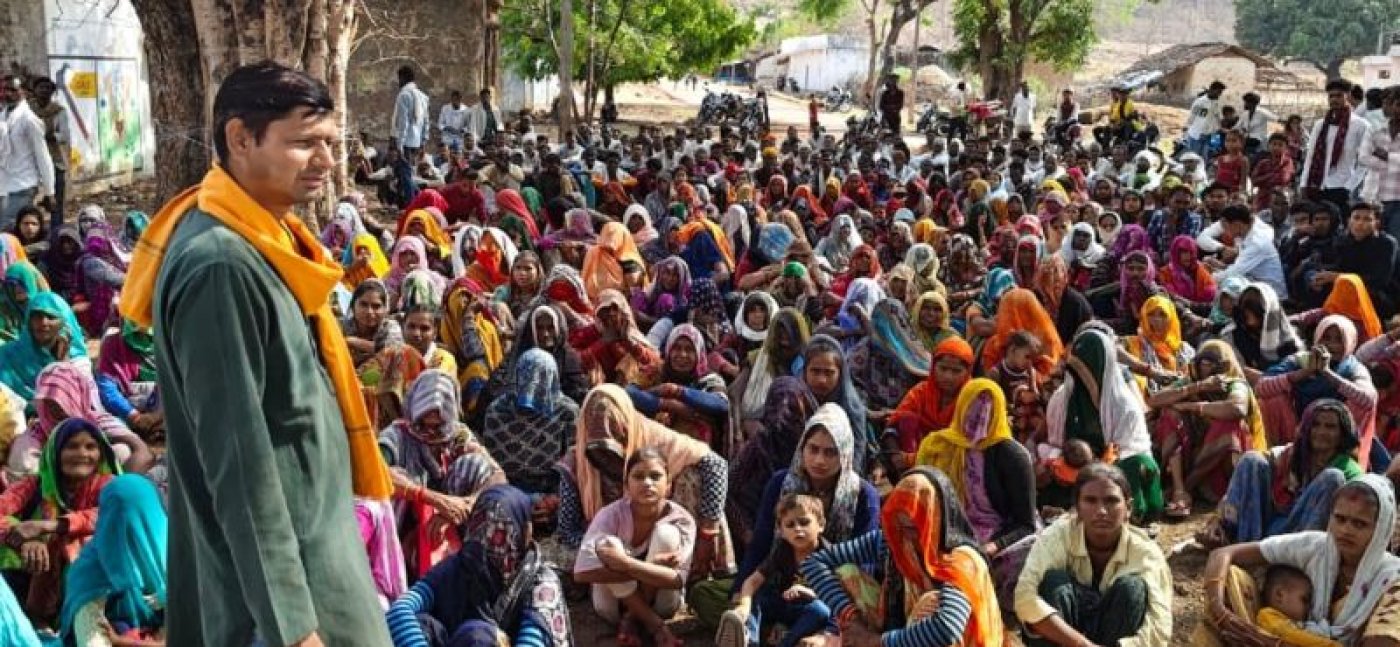
Chhatarpur (Madhya Pradesh): “Jabra maare rone na de.” They beat you and don’t even let you complain.
That is how Amit Bhatnagar, 44, a Gandhian activist and one of the leading faces of resistance to the Ken-Betwa river-linking project, describes the state's response to protests against what is being billed as India's first river-linking project.
In this interview, Bhatnagar discusses how opposition to the project spread across villages in Panna and Chhatarpur districts in Madhya Pradesh (MP), why women became the movement's backbone, and why affected communities say their struggle is about far more than compensation.
On 19 July 2026, less than 24 hours after Delhi police removed Sonam Wangchuk from a hunger strike in the national capital over exam-paper leaks and admitted him to hospital against his wishes, the MP police dismantled the latest of many protests at the Barana River and carried away Amit Bhatnagar on the 14th day of a hunger strike demanding justice for families facing displacement by the Rs 44,000-crore river-linking project, India’s first.
Most of those facing displacement are Adivasi and other rural communities who have lived in the region for generations. On 19 August, leader of the Opposition in the Lok Sabha, the lower house of Parliament, Rahul Gandhi, lent his support to the resistance (here, Bhatnagar talks to him about the project).
Approved by the union cabinet in 2021, the project seeks to transfer what the government describes as “surplus” water from the Ken River to the Betwa River to address water scarcity in Bundelkhand, a region long associated with drought, agrarian distress and seasonal migration.
At the heart of the Ken-Betwa project is the Daudhan dam, a 77-metre-high structure being built inside the Panna Tiger Reserve in Madhya Pradesh. The dam will divert what the government describes as surplus water from the Ken River through a 221-km canal and two tunnels into the Betwa River in Uttar Pradesh.
Environmentalists, activists and affected residents (here, here and here) have challenged the government's assumptions, arguing that claims of surplus water rely on 23-year-old data and warning of severe ecological and social consequences. The Daudhan dam is being built by a company that won a tender despite failing its conditions, as Article 14 reported on 17 August 2026, and after donating Rs 60 crore in electoral bonds to the ruling BJP.
The project will displace more than 20 villages in Madhya Pradesh, and more than four million trees will be felled inside the core of the Panna Tiger Reserve, one of India's most critical wildlife habitats. The environmental cost is out of sync, experts say, for a project that may not even deliver on its promises.
Over the last four years, opposition to the project has evolved from scattered village meetings into one of the country's most unusual anti-displacement movements. Women have emerged as its most visible leaders, organising marches, laying siege to government offices, staging symbolic funeral-pyre protests, hunger strikes and what participants call a panchatattva satyagraha—a campaign drawing on the five elements of nature.
Whenever protests broke out, authorities would close Bhusaur gate—the only road to the dam site—restricting access to media and public representatives. Officials routinely cited restrictions imposed by the Panna Tiger Reserve on outsiders' entry.
In May, after the arrest of Amit Bhatnagar, villagers reached the dam site, stopped work and began a 24-hour sit-in. They cooked on site and stayed through the night. Madhya Pradesh Congress president Jitu Patwari tried to reach the protesters but was stopped at the gate. After a heated argument, he and some local women opened the gate together and reached the dam site on a motorcycle. The forest department booked him for allegedly entering the restricted area without permission.
Patwari alleged that the BJP government was "protecting corporate interests by crushing the rights of tribals, farmers and the poor".
The movement has faced repeated crackdowns. Bhatnagar says villagers have been threatened, excluded from compensation lists, subjected to demolitions and booked in multiple criminal cases. In July 2026, police dismantled a 15-day protest at the Barana, a tributary of the Ken, detaining demonstrators and injuring several participants.
Bhatnagar describes himself as a Gandhian, his thoughts shaped by the ideas of Mahatma Gandhi, Vinoba Bhave and Jayaprakash Narayan. Before the Ken-Betwa movement, he had been part of the Buxwaha movement—against diamond mining in Madhya Pradesh—and other campaigns against displacement and environmental degradation.
Bhatnagar’s house is in the centre of Bijawar tehsil—about 100 km from the Daudhan dam. Within these 100 km lie all the villages facing displacement—the nearest at least 60 km away. In the movement's early days, he travelled by motorcycle with his companions from village to village, meeting people and explaining the project and its impact.
With time, he says, conversations about displacement grew. People began sitting together and slowly talking about all these developments. Yet, the villagers were not united. Local officials, the police, and ruling-party leaders pressured them. Men in the villages were even threatened by this “syndicate”—a word Bhatnagar uses for the alleged nexus of local authority and ruling party leaders.
“You are wasting your time,” people used to tell him, he says. His family too was against him. At first, Bhatnagar himself wasn't sure whether people would come forward to speak out against the project. Initially, only two or three villages came together. In time, all 21 villages facing displacement joined in. “Now they are all united in the movement,” Bhatnagar says.
Over the last four years, he has travelled repeatedly across the villages facing submergence, helping residents organise meetings, marches and protests rooted in non-violent resistance. The movement's means of protest—from padyatras (marches) and tiranga yatras (tricolour marches) to fasting, jal satyagrahas (water protests), and symbolic funeral-pyre protests—draw heavily from the Gandhian tradition of civil disobedience.
Bhatnagar says his politics are shaped by a belief that displacement is not merely the loss of land, but the destruction of a community's relationship with its “jal, jungle and zameen—water, forest and land—and that resistance must remain democratic, even when met with arrests, demolitions and police force.
“People are being displaced from their forests, their lives and their beliefs,” Bhatnagar told Article 14. “With the compensation money they are getting, they can only build one house.”
Why are people protesting the Ken-Betwa project? What are your demands?
The biggest reason is that people are not getting fair compensation. They have lived here for centuries, and now they are being displaced without the law being followed. Rehabilitation has not happened. Compensation has been manipulated. No Gram Sabha was actually held—the documents are fake. There is no record of a proposer or approver; the sarpanch's signature is missing, and the writing is identical.
Prime Minister Modi says the project will bring prosperity to Bundelkhand. How do local communities view that?
Ken jivandayani hai hamare liye (Ken is life-giving for us). This project will destroy our culture. Forty-six lakh trees are being felled. Bundelkhand already faces water scarcity, and this project will further reduce rainfall. So how can the government approve? The forest clearance itself states that if rehabilitation is not completed, the clearance should be cancelled. But people are still being removed.
For those who don't know you, how did you become part of this movement, and what motivated you?
I am a Gandhian. I believe in his philosophy and was influenced by Vinoba Bhave and Jayaprakash Narayan. When I saw this project, I felt this displacement had come to our homes and doorsteps. So I went from village to village and talked to people.
From 2022 onwards, we demanded the gram sabha documents from government authorities, but they did not provide them. Instead, we were threatened. People associated with us were intimidated by the police, and their names were removed from the compensation eligibility list.
I used to stay in the villages. Gradually, a group started forming. We held many protests—the symbolic pyre protest, jal satyagraha, fasting. But we did not get the results we wanted, though we did succeed to some extent. But our demand for transparency and a proper survey of houses and land was never met.
Is this a movement for fair compensation and rehabilitation, or a struggle to protect jal, jungle, zameen? What is the government's attitude to your demands?
Compensation alone is not the issue—this is also a fight to protect our jal, jungle and zameen. Not only is the tiger under threat, but there is also a gharial sanctuary here which is facing danger.
On 26 January 2023, we held our first tiranga yatra. Before that, we ran cycle yatras and marches, going village to village to explain the law. People here had little faith in the law—but once the project affected them directly, they turned to the law. Still, the administration did nothing. Instead, in November 2025, the administration began demolishing houses in Katkari and Bilhata village of Panna district, in the middle of winter.
We protested to stop the demolitions and started a march. Men who joined the protest were heavily threatened. The local MLA, the district magistrate (DM), and the sub-divisional magistrate (SDM) feared that protests would upend that arrangement. In effect, a syndicate of police and ruling-party leaders formed against the movement.
How did women in the villages become the face of this struggle?
The men of the villages who were uniting were targeted first—their names removed from compensation lists. The administration hoped that if they silenced the men, the movement would collapse.
But women started uniting. And when they did, they transformed the movement.
In February 2026, women began protesting with the slogan, ‘no justice, no dam’. They started saying, ‘We are not getting compensation, and you are building the dam, so we will not let the dam be built either.’
There was a lot of loot going on, so then from February 2026 we started becoming active with the women. They came with their sorrow and pain, and then the women started demonstrations. At the same time, on 8 February, I was sent to jail. At that time, I was told to tell the protesters that there was no problem and they should go home. Basically, they asked me to weaken the movement, which I refused.
On 10 February, two to three thousand women surrounded the SDM office in Bijawar demanding my release. They said, 'You have imprisoned the one who speaks for us.’ But the administration did not release me, after which the women said, 'If our bhai saheb (brother) is not released, we will not let the SDM come out either’. After this, the women locked the SDM office. Then the administration started putting pressure on me, to which I said, 'You cannot pressure me for what to say or not say to the women.’
The administration then used water cannons on them in the freezing cold. But the women did not break. And I was shifted to a police station 100 km away, in Lav-Kush Nagar. In the end, the administration had to release me.
After that, people affected by nearby dam projects—from Ajaygarh, Panna, and Chhatarpur—came together.
We started talking to the women and saw they understood the issue better. Women joined and took leadership.
My arrest was a turning point—before it, villages rarely mobilised together. But my arrest shook them, and women came from all the villages to protest— no one was ready to leave, even under lathi-charge, until it became too brutal.
In March 2026, we held a nyay adhikar yatra march, which local media called the largest protest movement in Panna's history. We laid siege to the Collectorate on 8 March, after which [prohibition on gatherings of five or more people] was imposed there. On 23 March—Bhagat Singh's martyrdom day—we began a symbolic hanging protest across villages in Chhatarpur and Panna districts over three days. As people joined, the administration issued notices to intimidate them.
Who are the people leading this movement alongside you? And how did they wind up here?
Women are leading themselves. They sustain this movement and carry it forward. Hisabi Rajput and Divya Ahirwar are with me. Hisabi is a long-time friend and has been a companion since my early Padyatra and other movements. Divya joined in 2022 and has been part of the movement ever since.
Among tribal women, Lakshmi Adivasi, Miththi Bai Adivasi, Sumat Rani Adivasi, Phula Adivasi, and Mamta Adivasi are leading the movement. They hold leadership roles in every village. We all became so close that we care more for each other than for ourselves.
Why did people go on a symbolic funeral-pyre protest, and why did you go on a hunger strike?
In April 2026, we planned to march to Delhi. People collected rations, arranged torches, and sold mahua cheaply. On 5 April, we marched under women's leadership, but the administration blocked our routes, confiscated our rations, and challaned our vehicles. We could not reach Delhi, so we sat down at the Daudhan dam.
From 6 to 16 April, we held a chita aandolan (symbolic funeral pyre) at the Daudhan dam. The administration stopped media and ration supplies from reaching us and began lodging fake cases against us. The more atrocities they committed, the more prepared we became.
And as the administration continued to harass us, the movement intensified.
We turned to the panchatattva—the five elements that make up our bodies. We covered our bodies in soil that represents earth. The pyre symbolises fire. Fasting represents the sky. Hanging symbolises air. Jal samadhi represents water. This became our panchatattva satyagraha. As a naturopath, I saw this as my way of connecting the movement to nature.
After this agitation, the administration made many promises, and we called it off on that basis. We gave them ten days to act, but nothing happened. On 24 April, officials held a meeting at a hotel in Khajuraho but did not keep their word. Then we called a Mahapanchayat on 28 April to discuss the Land Acquisition Act and announced a new nyay adhikar yatra (justice march) from 8 May. That alarmed the administration.
On 7 May, as I was leaving for the affected village, I was arrested—though the Panna police records show the arrest as on 8 May. I was told a complaint of assault had been filed against me, and I remained in jail in Panna until 11 May. I was granted bail the same day, but the forest department arrested me immediately after. I was granted bail again. As I was about to reach the village, the administration began provoking the villagers and demolishing houses in Daudhan village. When people didn't react, a hut near the temple was set on fire, which led to a clash between police and villagers. They filed fake FIRs against more than 150 people, including me, Divya Ahirwar, and Hisabi Rajput—none of us was present. And houses continued to be demolished without compensation.
Pressure built to prevent the movement from rising again—as soon as I got out of one case, another was filed. My colleague Divya faced six or seven cases. Hisabi Rajput had several. It felt like justice would only come after sacrificing our lives, and that the administration had become completely dictatorial. So I began a hunger strike on 6 July; our broader protest had started 3 July.
We chose the Barana river—the other end of the dam from Daudhan—partly because it is outside the tiger reserve's core zone, where the administration routinely blocks the media, and there is no mobile network. So we felt we should protest at the Barana this time.
But the administration blocked people from coming and going, hurled abuse, and threw our water tank so our people would not have anything to drink. We even stopped for medicine. Then we began the hunger strike on the 6th. In this protest, we also started a symbolic crucifixion protest, because the administration had created an atmosphere where we felt we were hanging on a cross.
There is a proverb in Bundelkhand, "Jabra maare rone na de (We will beat you, and we will not even let you complain)". We cannot even tell anyone our pain; no one can even come to listen to us.
What happened on 19 July, and what is the situation in the villages now?
On 18 July, I learned I might be detained—the chief minister had an event in Khajuraho that day, and orders were issued to end the protest by any means because the Prime Minister's Office (PMO) had sought a report on it.
At 6 am on July 19, police arrived. They used my health as a pretext and forcibly removed the women, even though I said I was completely healthy. They broke things, picked me up, and took me away. People from Panna were loaded into buses and sent away. Several were injured. Radha Rani Adivasi and others were hurt in the lathi charge. Genda Adivasi fainted. Many people lost their slippers and are still walking barefoot.
After the incident, despair and gloom set in among the affected people. People are feeling that this time we did not even stop the dam work, yet we were removed. Demolition has taken place at several locations in Panna. Similar destruction was occurring in Chhatarpur prior to our protest, but it has stopped since we launched our agitation on July 3rd.
How long will the resistance continue? What do villagers hope for?
Our protest will continue until we get justice. The villagers hope, at the very least, for livelihood and rehabilitation. People are asking for three acres of land in exchange for displacement. So far, the government has offered only Rs 12.5 lakh and considers the matter closed, while paying nothing for the land under their homes and just Rs 5 lakh per acre for the non-residential land.
The compensation can only build a house – but their water, forest, land, livelihood, and skills have all disappeared with this forest. People are being sent off completely devastated.
What the villagers are asking for is a village in exchange for their village: three acres of land in the joint names of both the woman and the man in each family, with the compensation cut-off date set at April 2026.
What has this fight given the people, and what has it cost them?
So far, from this struggle, we have increased our compensation to Rs 12.5 lakh. Not only here but also those affected by the Runj dam and the Majhgaon dam. The cut-off date was originally 2022, which is now 2024.
But we had to pay a price. Many people in the movement were removed from the eligibility list, and cases were filed against 300 people, some under serious sections like 307. Eight cases have been filed against me alone. During the April 2026 protest, the administration even placed a JCB outside my house to intimidate me.
Do you believe this movement will succeed? What keeps you and the affected villagers going despite all of this?
Our work is to keep making the effort. We are trying through democratic means because we live in a democracy. It is a democratic country; yes, sometimes dictators come into the system. We should know what we need to say, in our own way, and say it. If we are not getting anything, it means our strength is less, so we should build more. That's what we've learned.
Pain of the common people gives you strength, gives you inspiration. It makes you fearless. Once you connect with someone's pain, there's no option to step back
You must have seen the anti-government protests by young people in Delhi and other cities. Do you feel there is common ground with them?
That fight, too, was for justice. The system was significantly disrupted. And our fight is for justice too. Students were not afraid; they stood with courage even under lathi-charge and brutality. The same is happening here—people are not afraid; they keep coming out and stepping forward. Our Gen Z made dictators bow down. We have learned to speak our minds and to struggle continuously.
(Rizwan Rahman is an independent journalist based in Delhi, covering Indigenous communities, human rights and climate change.)
Get exclusive access to new databases, expert analyses, weekly newsletters, book excerpts and new ideas on democracy, law and society in India. Subscribe to Article 14.