
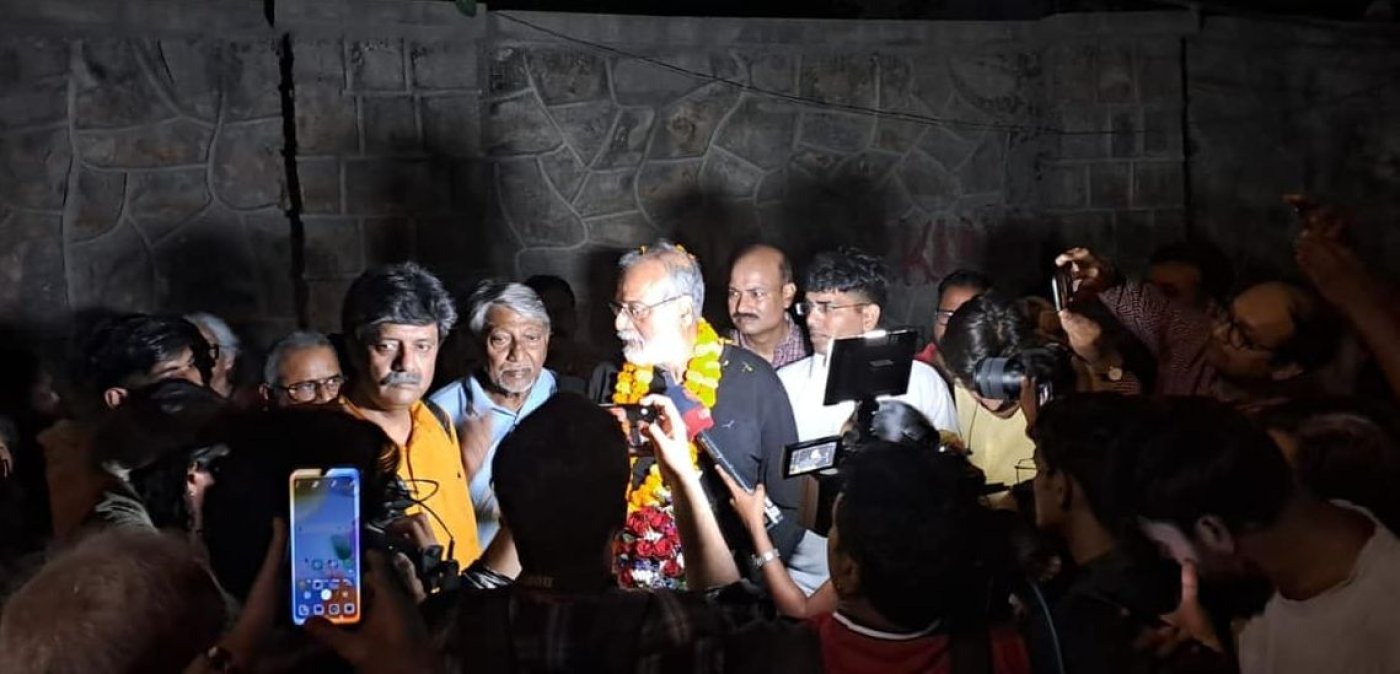
New Delhi: When I asked journalist Prabir Purkayastha about the support he received in the face of mounting criminal cases, he said, “When these things happen, there is a human response. Could it be correct, or is it completely wrong? Most people will say, ‘Let’s wait for the evidence; let’s see how it goes. We don’t really know.’ Let’s face it: the State is a powerful institution, and it can get its message across.”
“Still, both the organisation and I have had a great deal of solidarity from different sections of society,” he said.
We spoke the day after it became public that a Delhi High Court judge had not only quashed the case against him and his digital news platform NewsClick, filed by the Delhi Police and the Enforcement Directorate for criminal breach of trust, FDI violations, and money laundering, but also rebuked them for “gross abuse of the process of law,” “malafide” proceedings, “bald assertions,” “not a whisper of any incriminating allegation,” and an “arbitrary attack” on the “free and impartial journalism of the petitioners”.
Justice Neena Bansal Krishna’s words are a big win for Purkayastha. However, a palpable sense of elation was also felt among all the remaining media outlets that are still practising journalism and have not capitulated to the Modi government, amplifying the agenda of the BJP and the right-wing ecosystem.
“I was delighted by the verdict,” said Purkayastha. “It is an affirmation of what we and many others have said about the case. Overall, a sense of relief. But let’s be clear: this is only one of the cases, and it might also go on appeal to the Supreme Court.”
When I asked if he had seen this coming or if it had taken him by surprise, he said, “I never expect good outcomes but always hope for them. You don’t commit yourself to either hope or despair.”
Cases, Raids, Fear
It began six years ago, in August 2020, when the Delhi Police Economic Offences Wing filed a case alleging violations of FDI norms, followed by an Enforcement Directorate case for money laundering. This was followed in August 2023 by a case under India’s anti-terror law, the UAPA, and, in October, by a case by the Central Bureau of Investigation alleging violations of the Foreign Contribution (Regulation) Act, 2010.
Raids and investigations upended NewsClick’s newsroom, with employees losing jobs and living with fear and uncertainty for a long time amid allegations of links to Chinese interests stemming from a contested New York Times report, eagerly amplified by sections of the Indian media.
Justice Krishna was doing her job, but in these times of pervasive fear and intimidation, a judgment like this, where the accused is seen as having been clearly chosen by the government, is brave, and judges who are simply carrying out their duty deserve to be applauded.
Others who have shown real courage include additional chief judicial magistrate Vaibhav Chaurasia, who ordered an investigation into a sitting law minister, Kapil Mishra, in connection with a complaint related to the Delhi riots, Justice S Muralidhar, who strongly urged the police to register a case against Mishra and other BJP leaders, additional sessions judge Vinod Yadav, who lambasted the police over their investigation in the Delhi riots cases, and Justice Atul Sreedharan, who quashed several baseless preventive detention orders in Jammu and Kashmir (read our story about that here) and was transferred before he was set to become Chief Justice of the J&K High Court.
Journalism in India has never been completely free of political pressure and threats, but not since the Emergency has there been such a sustained crackdown on the free press, freedom of speech and dissent, with journalists, activists and critics facing legal persecution, often under some of the country's harshest laws, including the UAPA.
Purkayastha has experienced both, having spent a year in jail during the Emergency and having been incarcerated from October 2023 to May 2024 in connection with the UAPA case.
‘Let’s Take It As It Comes’
Getting bail under the UAPA is difficult, and people often spend years in jail before securing release, which is one reason the police invoke it even in absurd and baseless cases.
Purkayastha, however, got bail after seven months of incarceration because the Supreme Court found that the procedure followed in his arrest and remand was legally invalid, observing the “entire exercise was done in a clandestine manner and was nothing but a blatant attempt to circumvent the due process of law.”
When I asked him what was worse—being jailed during the Emergency or under the UAPA—Purkayastha said the Emergency had meant a far greater sense of uncertainty, since there were no courts to appeal to after the government suspended the right to move court to enforce several fundamental rights. Today, he added, there was at least the process of law.
But given that the UAPA often keeps people in jail for years without trial, wasn’t it frightening in its own way, too? If the Supreme Court had not found his arrest legally invalid, he could have been looking at years in jail.
“One thing I learnt from my Emergency experience is, let’s take it as it comes,” he said. “Don’t think of when you are going to get out. You only think about what you have to do now. That is the only way to address the problem of uncertainty. It is the uncertainty that really saps people’s will.”
A ‘Much Harder’ Jail Than Tihar
It is always a challenge interviewing people facing legal action because you can’t really litigate the merits of the case in an article. It is equally challenging for them, as they are careful not to say anything that could jeopardise their bail conditions, prejudice the proceedings, or invite further action by the state.
And so it was fortunate that the conversation took an interesting turn of its own, moving into a comparison of jail during the Emergency and jail today.
He was jailed in Tihar jail during the Emergency and in Rohini jail in the UAPA case, which he described as a “much harder” jail than Tihar, where most of the political prisoners were held.
“The difference was that during the Emergency, we were treated as political prisoners because it was actually preventive detention. These are criminal cases,” said Purkayastha. “The treatment is virtually guilty until proven innocent. The kind of freedom and access you get is also different.”
“But there are always people in jail who will show some solidarity,” he said. “I had fellow political prisoners in the same ward this time, and we would meet and try to discuss a safe topic: history, not recent history, but medieval or colonial history.”
His answers to my questions about food and sleeping conditions ended with a warm, throaty chuckle.
Life In Jail
On the question of food, Purkayastha said the nutritional standards had greatly improved, with a daily fare of dal, rice, vegetables, and nutrinuggets, whereas in the seventies the food for general prisoners was much worse, usually rotting rice and wheat with stones.
“Earlier, and this is quite some time ago, political prisoners received rations, and convicts (mashaktis) came to cook. We supervised our own cooking. I did not know anything about cooking. I really learned my cooking in jail.”
In Rohini jail, this time, Purkayastha said he was eventually moved to the budha barak (for elderly inmates), which was relatively better, but the overcrowding in the barracks—two to three times its intended capacity—became most apparent at night, when sleeping became a collective effort.
“You are sort of so close to the other person that if he turns to one side, there is not enough space, and you also have to turn,” he said.
When I asked about the most vivid memory from his two stints behind bars, Purkayastha recalled a day from his imprisonment during the Emergency—the day of an execution and the atmosphere it created, a shared gloom that settled over the prison, enveloping hardened criminals and jailers alike.
“That is when I realised that the death penalty is such a big deal. It was the collective reaction, emotionally, to the wilful taking of life; the cold-blooded revenge of the state,” he said. “That never left me.”
And this time?
“Hearing the bail news, of course,” he said.
(Betwa Sharma is managing editor of Article 14)
Get exclusive access to new databases, expert analyses, weekly newsletters, book excerpts and new ideas on democracy, law and society in India. Subscribe to Article 14.