
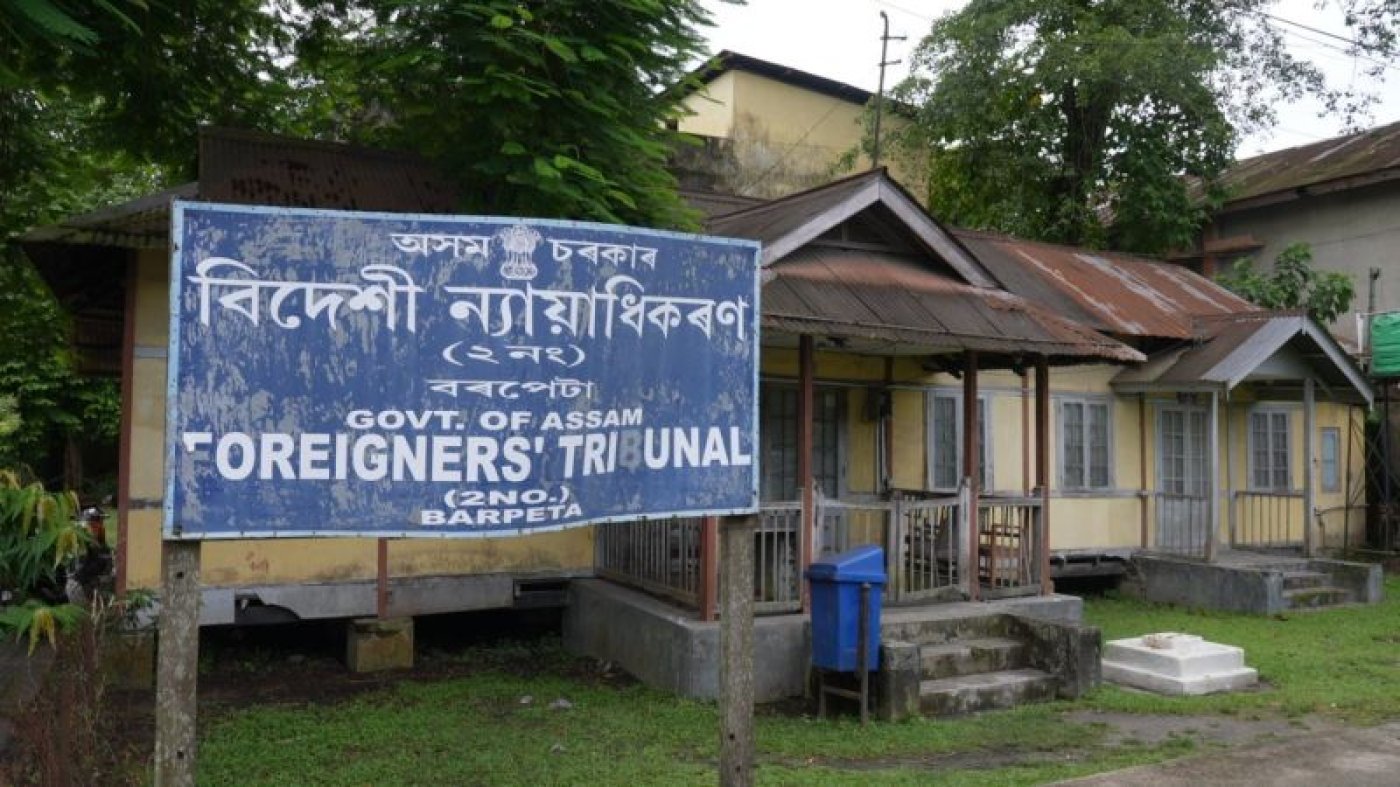
Guwahati, Assam: Fifteen official documents and records spanning more than six decades, along with ancestors listed in the 1951 National Register of Citizens, were not enough to convince the Gauhati High Court that Aminul Hoque was Indian.
On 30 June 2026, it upheld a foreigners’ tribunal (FT) order declaring the Assam daily-wage labourer a foreigner, revealing how the burden of proof imposed in citizenship cases is, often, almost impossible to meet, said experts.
A division bench of Justices Kalyan Rai Surana and Shamima Jahan dismissed a writ petition filed by Aminul Hoque, 38, and upheld a Guwahati-based FT No. 4 of Kamrup (Metropolitan)’s 2019 decision, declaring Hoque a foreigner.
The judgment came less than two weeks before the Supreme Court quashed 27 Gauhati High Court decisions that affirmed foreigners' tribunal orders without hearing the accused in person. Reiterating that citizenship cases must satisfy the constitutional requirements of “fairness, reasonableness and non-arbitrariness”, the Court sent all 27 matters back to the tribunals for fresh hearings.
Hoque, originally from Hashdoba village in Goalpara district, had moved to Guwahati's Azara area in search of work as a daily-wage labourer.
The Gauhati High Court held that Hoque had failed to discharge the burden of proof under section 9 of the Foreigners Act, 1946, which requires the person whose citizenship is in question to prove that they are an Indian citizen.
According to his petition, Hoque's family originally lived in Charai Khasara village in Assam's Goalpara district, where his father, grandparents, and other relatives were listed in the 1951 National Register of Citizens (NRC).
Repeated erosion by the Brahmaputra forced the family to move to Dhobakura village in the same district about 56 years ago, where his grandparents' names later appeared in the electoral rolls of 1966 and 1970.
His parents subsequently moved to Ghugudoba before settling in Hashdoba, where Hoque was born in 1988. According to court records, his own name first appeared on the electoral rolls in 2013.
The Case Against Aminul Hoque
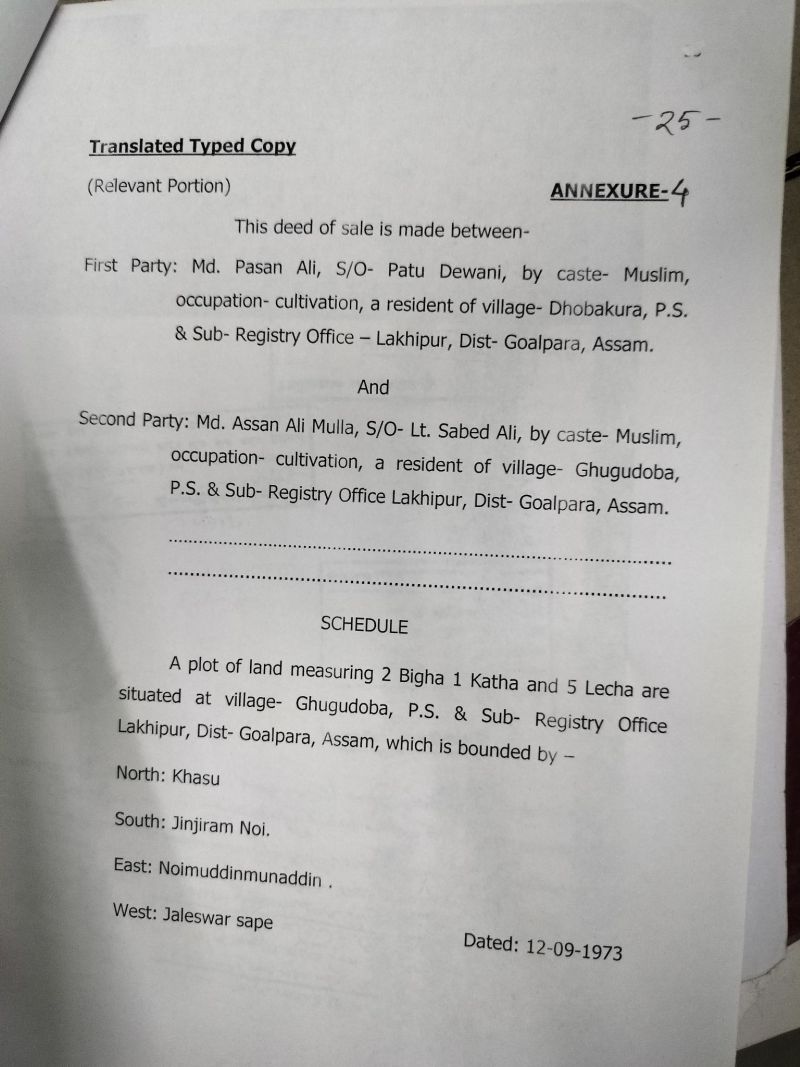
Among the 15 documents Hoque relied on were extracts from the 1951 National Register of Citizens (NRC), certified copies of electoral rolls from 1966 to 2017, a 1973 land sale deed executed by his grandfather, his Permanent Account Number (PAN) card, a school certificate and his Electors Photo Identity Card (EPIC).
According to Talha Abdul Rahman, an advocate-on-record at the Supreme Court, foreigners' tribunals often fail to issue detailed notices explaining why a person is suspected of being a foreigner, leaving many unaware of the allegations against them or the evidence they are expected to produce.
Unlike the NRC process, Rahman said, there is no authoritative list of documents that tribunals accept as evidence of family linkage. “People are therefore forced to gather every record they can find without knowing whether any of it will ultimately be considered sufficient,” he said.
Establishing that “linkage”—the documentary chain connecting an individual to ancestors whose names appear in legacy records—remains one of the biggest hurdles in Assam's citizenship cases, Rahman said. While family relationships can ordinarily be established through oral testimony, foreigners' tribunals place greater weight on documentary evidence.
“Gathering records across generations is especially difficult in Assam's flood- and erosion-prone riverine areas, where repeated displacement often leads to the loss of both personal and official documents,” said Rahman.
Hoque's lawyer, Guwahati-based advocate Muij Uddin Mahmud, relied on the Supreme Court's 2019 ruling in Sirajul Hoque vs State of Assam, which held that minor spelling errors or discrepancies in names cannot, by themselves, justify declaring a person a foreigner if the family's overall identity is otherwise clear.
In Hoque's case, however, the Gauhati High Court distinguished that ruling. While observing that it did "not take a serious note of the spelling discrepancies" in the names of Hoque's father and grandfather, the bench held that he had nevertheless failed to establish, through documentary evidence, a continuous link to his ancestors across three villages.
According to Rahman, that distinction is often more apparent than real. “Although the court may state that it did not take spelling variations into account, it is precisely these variations that lead to the assumption that differently spelt names refer to different individuals rather than the same person,” he said. “As a result, the claimed linkage is often rejected.”
The bench also questioned Hoque's account of his family's movement between Dhobakura, Ghugudoba and Hashdoba because of river erosion and family partition, holding that these claims were unsupported by documentary evidence.
“It appears that to fill up the gaps, the defence of the petitioner is structured around the exhibited voters' lists,” the Court said.
No Document Is Enough
The Gauhati High Court rejected or discounted almost every category of evidence Hoque relied upon.
It held that the extract from the 1951 National Register of Citizens (NRC) was inadmissible because it was a computer-generated printout that was not accompanied by the certification required under section 65B of the Indian Evidence Act, 1872. Citing an earlier judgment, the bench reiterated that an NRC extract, by itself, cannot establish domicile in India.
The court also upheld the tribunal's decision to disregard a 1973 land sale deed executed by Hoque's grandfather, observing that Hoque had failed to explain whether the land still existed or why it had not devolved upon his grandfather's legal heirs.
His school certificate met a similar fate. The court held it inadmissible because neither the headmaster who issued it testified before the tribunal nor was the school's admission register produced to authenticate it.
Hoque also relied on his father's testimony identifying him as his son. But the court held that, without documentary corroboration, oral evidence was insufficient to discharge the burden imposed by the Foreigners Act.
Legal scholars questioned whether such evidentiary standards were consistent with the civil nature of citizenship proceedings.
"I believe this requirement is excessively stringent. If it were applied across the country, many people would struggle to prove their citizenship," said Faizan Mustafa, vice-chancellor of Chanakya National Law University in Patna. "How many labourers possess the documents needed to establish citizenship?"
Mustafa argued that the Gauhati High Court was "not applying a standard based on the preponderance of probabilities; instead, it is imposing a burden that is even stricter than the criminal standard of proof beyond reasonable doubt."
Darshana Mitra, assistant professor at the National Law School of India University, Bengaluru, agreed. Citizenship proceedings, she said, require courts to assess whether the evidence, taken as a whole, makes it more likely than not that a person is an Indian citizen.
"What you are supposed to examine is the cumulative effect of the evidence, not whether every individual document matches perfectly, because discrepancies will inevitably exist," Mitra said.
Not An Isolated Case
Hoque's case reflects a recurring feature of Assam's citizenship adjudication process: government-issued documents that many people assume establish citizenship often fail to meet the evidentiary standards applied by foreigners' tribunals and the courts.
The current regime is rooted in decades of political mobilisation against suspected illegal migration. In 2005, the Supreme Court struck down the Illegal Migrants (Determination by Tribunals) Act, 1983—which had required the state to prove that a person was an illegal migrant—and restored the 1946 Foreigners Act, under which the burden of proving citizenship rests on the individual.
Today, Assam has 100 foreigners' tribunals—quasi-judicial bodies staffed by retired judges, lawyers or bureaucrats—that determine citizenship using 24 March 1971—the cut-off date established by the 1985 Assam Accord—as the benchmark.
In its 2013 judgment in State of Assam vs Moslem Mondal, the Gauhati High Court laid down procedural safeguards for foreigners' tribunals, including the requirement that people accused of being foreigners be informed of the allegations against them and given a meaningful opportunity to defend themselves.
Lawyers, however, continue to question whether these safeguards are consistently followed.
“People are expected to prove everything through documents, and even documentary evidence is often disbelieved,” said Hoque's lawyer, Muij Uddin Mahmud.
Talha Abdul Rahman said this creates “an impossible paradox”. “There is an insistence on documentary evidence over oral testimony, while at the same time official documents are often disbelieved,” he said.
Darshana Mitra of the National Law School of India University said the evidentiary burden had become disproportionate.
“Applying a standard akin to proof beyond reasonable doubt effectively assumes that individuals have access to the resources of the state,” she said. “They are expected to produce every possible piece of evidence, while the state bears no comparable evidentiary burden.”
Mahmud said Hoque's case was far from unique. He cited that of Mohela Khatun, whose citizenship claim was rejected despite her producing about 27 documents.
“People frequently shift because of river erosion or other reasons," he said. “Yet even when there are records from both places of residence and certificates explaining the move, these are often disregarded. Minor spelling errors or differences in surnames end up being held against the individual.”
Long Shadow Of Citizenship Litigation
Parallel to the foreigners' tribunal system is the category of D-voters, or doubtful voters, introduced by the Election Commission in 1997.
People marked as D-voters are barred from voting until a tribunal determines their citizenship. Article 14 has previously reported how many spend years trying to have the designation removed.
The Supreme Court-supervised update of the National Register of Citizens (NRC), completed in 2019, required residents to prove that they or their ancestors were present in Assam before 24 March 1971.
Applicants submitted legacy documents, electoral rolls, land records and proof of family linkage. The final NRC excluded nearly 1.9 million people, although it is yet to be formally notified by the Union government.
Citizenship litigation has continued long after the NRC process ended. According to data tabled in the Assam Assembly, more than 436,000 cases had been referred to foreigners' tribunals by January 2025, and 165,992 people had been declared foreigners. Recent figures presented to the Assembly show that Assam has identified about 172,000 foreigners under the framework established by the Assam Accord.
What follows a declaration of foreigner status remains deeply contested. Assam established detention centres in 2009 for those awaiting deportation, but repatriation has long been constrained by diplomatic and legal hurdles.
Assembly data show that 193 people were deported to Bangladesh over the last two years, including 67 under the Immigrants (Expulsion from Assam) Act, 1950, which the state revived in 2025. Separately, the Assam government has also used the Act to "push back" people identified as foreigners by the district administration and the Assam Border Police without first routing their cases through foreigners' tribunals.
Against this backdrop, Hoque's case illustrates how decades of official records may still fail to establish citizenship in Assam. Hoque and his family declined to speak to Article 14, citing fears of detention and ongoing legal proceedings.
His next legal remedy is an appeal before the Supreme Court. But his lawyer, Muij Uddin Mahmud, said many people declared that foreigners never make it that far.
“Many people cannot approach the Supreme Court,” said Mahmud. “They simply do not have the financial means to do so.”
This reportage was supported by an Investigative Journalism Fellowship by The Reporters' Collective.
(Sanskrita Bharadwaj is an independent journalist from Assam.)
Get exclusive access to new databases, expert analyses, weekly newsletters, book excerpts and new ideas on democracy, law and society in India. Subscribe to Article 14.