MUMBAI: On 22 July 2026, journalist Sadhika Tiwari discovered that the Narendra Modi government had ordered X to block a video she had posted of a student crying during one of the largest protests in recent years over exam-paper leaks and unemployment in New Delhi.
The student had allegedly been beaten by police during the demonstration, organised by the Cockroach Janta Party (CJP), a youth-led movement that drew thousands onto the streets of India’s capital and beyond.
“Not hate speech or misinformation,” wrote Tiwari. “No blood or gory visuals even! It’s a student crying!!! What exactly are we being stopped from seeing?”
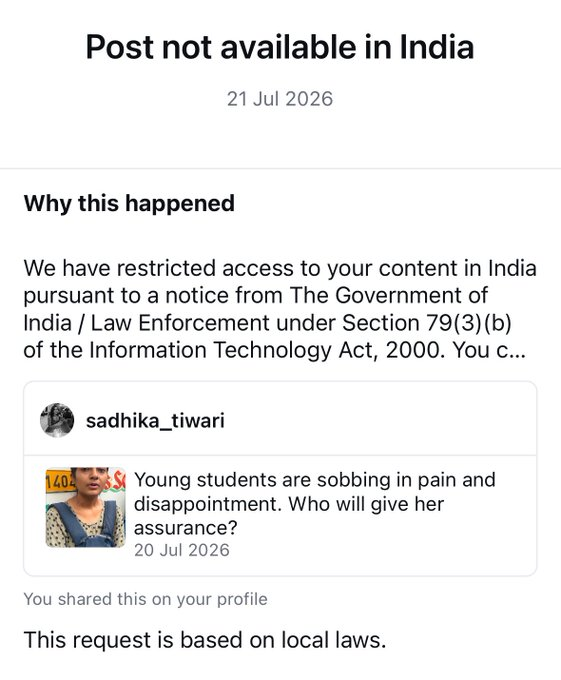
Tiwari's experience is part of a rapidly expanding system of online censorship. On the same day, Meta also blocked the CJP’s Instagram page with over 23 million followers on government orders. After drawing flak for the move, the page was restored within a few hours, while Tiwari’s post remained blocked.
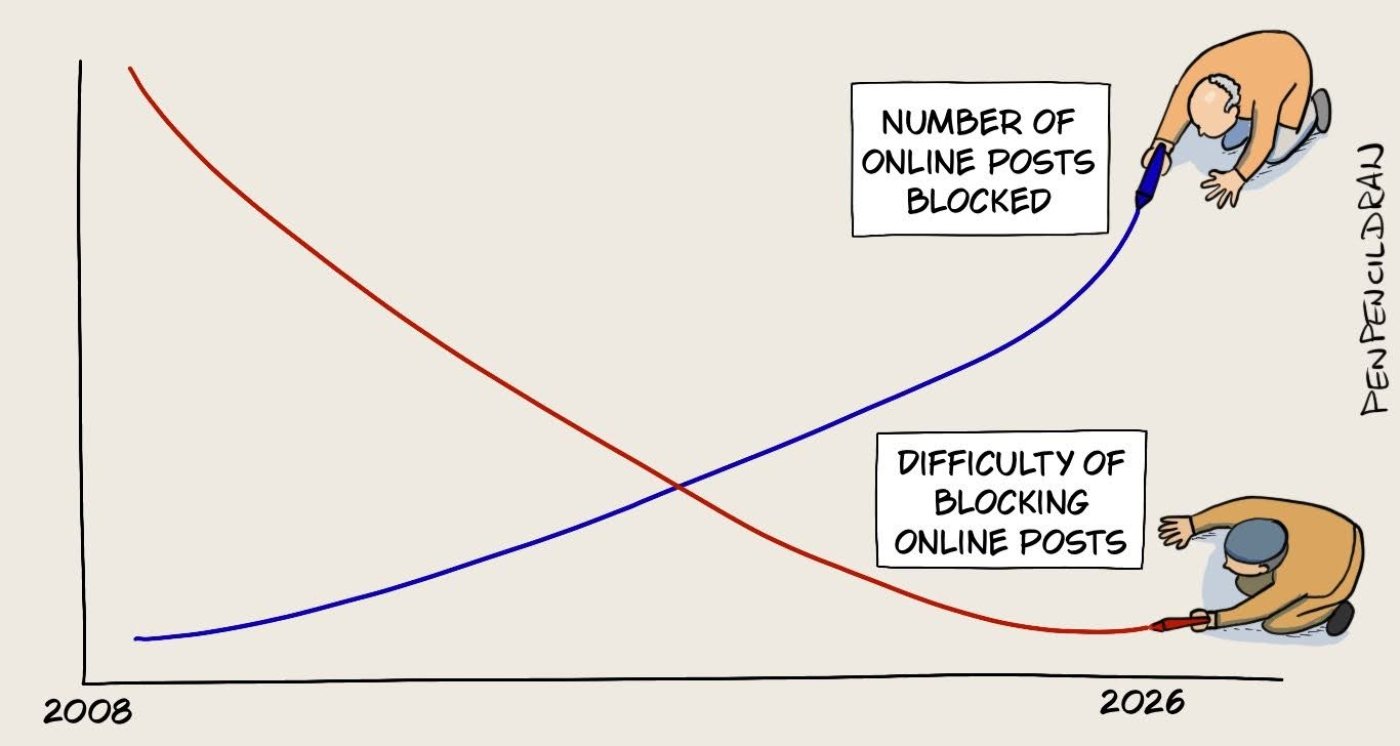
Creators, researchers and free-speech advocates describe an expanding system of Internet censorship in India. Government takedown orders rose 252% in three years, according to an analysis of the data tabled in Parliament (reported here and here) by the union government in April 2026 and media reporting, even as the time social media platforms had to comply with government orders fell from 72 hours to just three over roughly four years.
Government orders directing social media platforms to block online content have risen almost nine-fold over seven years—from 2,799 links in 2018 to 24,300 in 2025, according to analyses of official data (here, here and here).
The content targeted ranges from videos documenting protests and environmental campaigns to criticism of government policy. Those affected include independent journalists, social media creators, academics and news organisations.
One of them is Tamanna, a 22-year-old Instagram creator who uses only her first name.
Censored: A Criticism Of Data Centres
In March 2026, Tamanna was scrolling through videos when one caught her attention. Filmed in the US state of Georgia, it showed a resident holding up a glass of murky brown water and blaming the deterioration in water quality on a nearby artificial intelligence data centre.
The claim prompted Tamanna to investigate. Just weeks earlier, she had read about the Modi government's decision to offer a 20-year tax holiday for new data centres in India. She spent the next week reading about the environmental costs of data centres—their demand for electricity and water, and concerns raised by communities living near them.
“People in India need water more than AI does,” Tamanna told Article 14. “Now that developed countries are placing increasing restrictions on data centres, companies are trying to shift them to countries like India.”
She turned her research into a short Instagram video, where she argued that cities hosting large data centres had reported water shortages and environmental degradation, while India was already facing worsening heatwaves and water stress.
“The question now is, is AI more important than human life?” she asked. “Why are we allowing data centres in our country when we know our country is not capable of providing for them?”
The video resonated with her predominantly Gen Z audience. Although she had only about 7,000 followers, it received more than 60,000 views within two days.
On the third day, Meta removed it.
Takedowns—And No Appeals
Tamanna said she received a notification stating that the Indian government had requested the takedown but gave no reason. She said there was no option to appeal.
“The video was taken down, and that notification from Meta also disappeared soon after, so I couldn't even reach out to them,” she said.
She has continued making videos but says the experience fundamentally changed how she views social media platforms.
“I think Meta is a coward platform,” she said. “The mainstream media is not functioning as media anymore. It isn't telling people about floods, unemployment or the Aravallis. Independent creators are trying to fill that gap—and they're being targeted.”
For creators on the receiving end of government takedown requests, the consequences extend beyond losing a single post. Some described watching years of work disappear without explanation or any meaningful avenue for appeal. Others said online censorship was accompanied by coordinated abuse, including rape and death threats.
The impact has extended beyond independent creators. Political scientist Ashok Swain, a long-time critic of the Modi government, has had his X account withheld in India and says he has been prevented from returning to the country to visit his ailing octogenarian mother.
News organisations, too, have increasingly found themselves subject to blocking orders and content restrictions.
News Outlets, Journalists, Satirists
The government's censorship drive has increasingly targeted entire news organisations, journalists and creators, rather than individual pieces of content.
In March 2026 alone, Meta blocked the Facebook pages of at least six news and digital publications in India. In early March, the company blocked the Facebook and Instagram accounts of three major Kashmiri news outlets—Greater Kashmir, Rising Kashmir and Kashmir Life—without publicly explaining the basis of the action.
The crackdown extended beyond Kashmir.
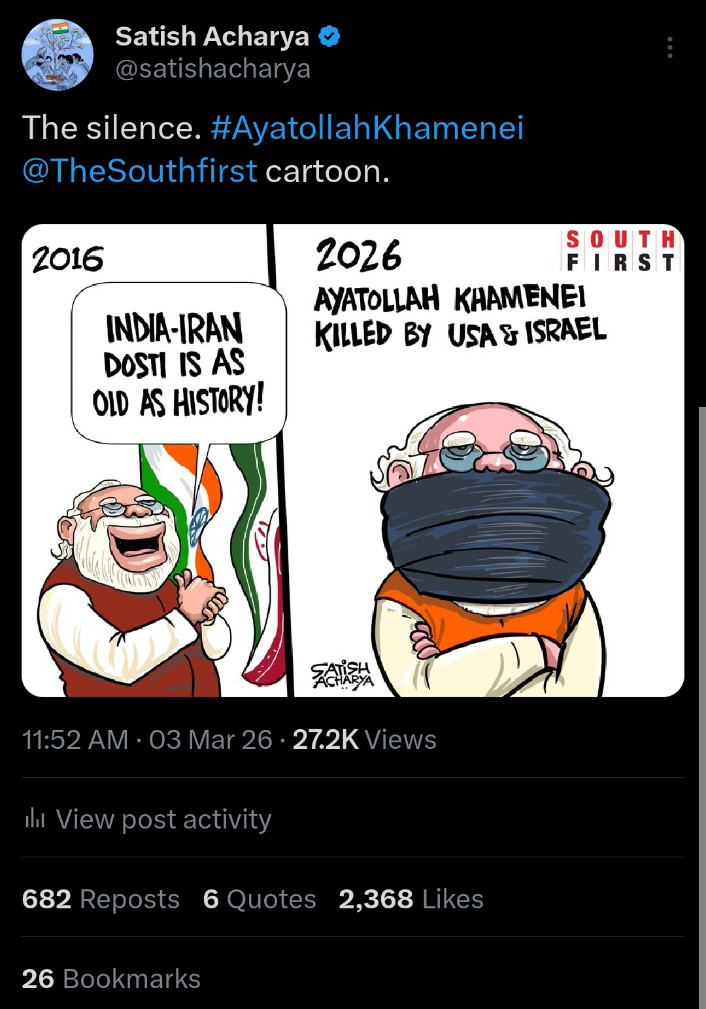
Meta withheld the Facebook page of Molitics India, an online media platform, and later blocked a backup page it created. It also removed the official Facebook page of National Dastak, which reports on issues affecting Dalit, tribal and other marginalised communities.
Before being blocked, Molitics had more than 450,000 followers, while National Dastak had built an audience of over 1.4 million. Another digital outlet, 4PM News Network, saw its Facebook page with nearly 1.7 million followers blocked in India.
The government also targeted individual journalists and creators. Posts by outlets such as The Wire, Maktoob Media, and Peek TV were withheld on X and Meta, while South African journalist Azad Essa, who has reported extensively on India-Israel relations, had his X account withheld in India on government orders.
Political and satirical accounts were not spared.
In mid-March, the government blocked the X accounts of several parody creators and a journalist. The official Jharkhand unit account of the Indian National Congress was suspended. The Cockroach Janata Party had its X account, which had more than 200,000 followers, blocked without explanation, and its website was reportedly blocked two days later.
Meta also blocked the Instagram account of satirical creator Shamita Yadav, who had more than 1.6 million followers; a backup account she created was taken down five days later.
How Online Censorship Became Easier
The growing number of takedown orders is not simply the result of a more assertive government. It reflects more than two decades of legal and regulatory changes that have steadily expanded the state's powers over online speech while shortening the time platforms have to comply.
“This has not happened overnight,” said Prateek Waghre, a public policy researcher and former executive director of the Internet Freedom Foundation. “As things stand today, it is not difficult for the government to pass rules to its liking and justify what it is doing.”
The legal foundation lies in the Information Technology (IT) Act, 2000. Eight years later, Parliament inserted Section 69A, empowering the government to block public access to online content.
In 2015, the Supreme Court struck down section 66A—which criminalised sending "offensive" online messages—as unconstitutional. But it upheld section 69A, noting that the provision contained procedural safeguards: blocking requests were to be examined by a committee of officials, affected parties were to be heard, and decisions were subject to review.
Those safeguards, technology policy experts say, have steadily weakened in practice.
The Blocking Rules also contain an emergency provision allowing the government to order content blocked without first hearing either the person who posted it or the platform hosting it.
"Emergency powers were intended for exceptional circumstances," said Kazim Rizvi, founder of the public policy think tank The Dialogue. “Instead, they have gradually expanded into the routine governance of social media.”
Because emergency blocking orders remain confidential, affected users often receive neither the order nor the reasons for it, making legal challenges difficult.
“A lot of recent blocking happens under section 69A,” Rizvi said. “Orders are confidential, affected parties don't get notices, and they are not published. That makes judicial review very difficult.”
The Censorship Portal
The government's powers expanded further in 2021, when it amended the Information Technology Rules to require social media platforms to remove content within 36 hours of receiving government notices or court orders. The rules also imposed additional compliance obligations on platforms seeking to retain their legal immunity from liability for user-generated content.
In October 2024, the government launched Sahyog, an online portal that automates the process of issuing blocking notices to digital platforms.
Social media platform ‘X’ challenged the portal before the Karnataka High Court, calling it a "censorship portal" and arguing that it enabled authorities to bypass the safeguards built into the blocking process. The company pointed to notices it had received from the railways ministry directing it to remove posts showing overcrowded trains, describing them as “misleading”.
In July 2025, the High Court rejected X's challenge, holding that Sahyog was "not an instrument of censorship but a facilitation mechanism intended to streamline communication."
Waghre disagreed.
“Sahyog is essentially censorship made more convenient,” he said. “Earlier, an officer had to identify the right intermediary and figure out how to send the notice. Those obstacles have disappeared. The problem isn't the technology—it's the quality of the orders.”
Three Hours To Comply
The government's demands on platforms have also become progressively more stringent.
Following the Karnataka High Court's ruling, the government amended the rules to mandate a monthly review of all takedown orders, while retaining the 36-hour takedown timeline.
In February 2026, it shortened the deadline further, requiring platforms to act within just three hours of receiving government orders.
According to Waghre, such compressed timelines leave companies with little practical choice but to comply.
“How much scope do platforms really have to study an order and assess whether it makes sense?” he said. “For most companies, an individual post isn't worth a legal battle with the government.”
Official figures suggest that the pace of blocking has accelerated alongside these changes. Government takedown orders rose from 12,600 links in 2024 to 24,300 in 2025, as we said, following the introduction of Sahyog and the shortening of compliance timelines.
Rizvi said the government's approach had shifted fundamentally.
“We have moved from reacting to online content to proactively taking it down,” he said. “The pressure on platforms has increased, their legal protections are tied to compliance, and the incentive is to remove content first and ask questions later.”
‘Where Are The Spaces For Dissent?’
For many creators, government takedowns are only one part of the cost of speaking online. Coordinated abuse, threats and the constant risk of losing years of work create powerful incentives to stay silent.
Instagram creator Shrishti Khanna experienced both.
In 2025, Khanna began posting videos in support of Palestinians affected by Israel's military campaign in Gaza. What started as an effort to amplify fundraising appeals soon evolved into broader criticism of the Narendra Modi government's support for Israel.
The backlash was swift.
After a video of hers was amplified by Hindu right-wing accounts, Khanna and her partner, Prashant, were inundated with abuse. Trolls contacted her employer, urging the pre-school where she worked to dismiss her. She received rape and death threats, while Prashant was targeted with homophobic abuse.
“My manager called me because he was receiving all these emails and horrible messages about me,” Khanna said. “I had to convince him not to fire me.”
Months later, Khanna faced a different challenge.
In June 2026, after posting a video about an Israeli reservist vacationing in Himachal Pradesh despite allegations by international civil society groups that he had participated in demolitions of civilian homes in Gaza, Meta removed her Instagram Stories, citing copyright infringement.
Khanna appealed, but Meta rejected her request. Days later, her account, which had nearly 98,000 followers, was disabled on the same grounds. Four days later, Meta restored it, saying the removal had been an error.
The reprieve was short-lived.
On 7 July 2026, Meta informed Khanna that her account had been withheld in India following a government order issued under section 79(3)(b) of the Information Technology Act. She said the notice gave no reasons for the action and offered no meaningful avenue of appeal.
“I've started over on my backup account,” she said. “I don't have much hope.”
The repeated harassment has changed how she approaches her work.
“Sometimes you wonder whether saying something will lead to another hate campaign or more threats,” she said. “You start reconsidering whether to say anything at all.”
After one particularly intense wave of abuse, Khanna and Prashant deactivated their accounts for more than two weeks.
Reflecting on the experience after briefly regaining access to her account, Khanna questioned where dissent was still possible.
“Where do we protest?” she asked in an Instagram reel. “Offline, you get lathi-charged. Online, your account disappears. You create another account—but how many times can you start over before you get exhausted?”
‘I Just Want To See My Mother’
For political scientist Swain, the consequences of government censorship have extended far beyond social media.
Swain, a professor at Uppsala University in Sweden and a frequent critic of the Narendra Modi government, first found his X account withheld in India in 2023. The following year, the union government cancelled his Overseas Citizen of India (OCI) status, accusing him of posting content that was "anti-India" and "malicious".
The decision effectively barred him from returning to India.
Swain challenged the cancellation before the Delhi High Court, which restored his OCI status in April 2025 after finding that the government had failed to adequately justify its decision. Months later, however, the ministry of home affairs revoked it again, relying on a fresh set of social media posts.
The consequences have been deeply personal.
Swain's mother, now in her eighties, lives in Odisha and has been seriously ill. Unable to enter India, he has been forced to watch her health deteriorate from thousands of kilometres away.
“My mother is in her last stage,” Swain told Article 14. “I don't know if I will ever get to see her again.”
For Swain, the withholding of his social media account was only the beginning.
“It starts with making your voice disappear online,” he said. “Then it becomes easier to isolate you in other ways.”
Researchers say his case illustrates how online censorship is increasingly intersecting with other forms of state power. Blocking a post or withholding an account may appear to be a digital act, but it can carry consequences that extend well beyond the internet—for a person's livelihood, reputation, mobility and family life.
For creators such as Tamanna and Khanna, the fear is of losing years of work and the audiences they painstakingly built. For journalists such as Tiwari, it is the removal of reporting from public view. For Swain, it has meant the possibility of never seeing his mother again.
As government takedown orders multiply and compliance deadlines shrink, free speech advocates warn that the cumulative effect is not merely the disappearance of individual posts but the gradual narrowing of the digital public square itself.
“I am prepared to do anything,” Swain said. “I just want to go home and see my mother.”
(Kunal Purohit is an independent journalist and the author of the book H-Pop: The Secretive World of Hindutva Popstars. Aaliyah Nair is a second-year student at Ashoka University studying political science and philosophy.)
This reportage was supported by The Reporters' Collective Investigative Journalism Fellowship.
Get exclusive access to new databases, expert analyses, weekly newsletters, book excerpts and new ideas on democracy, law and society in India. Subscribe to Article 14.