
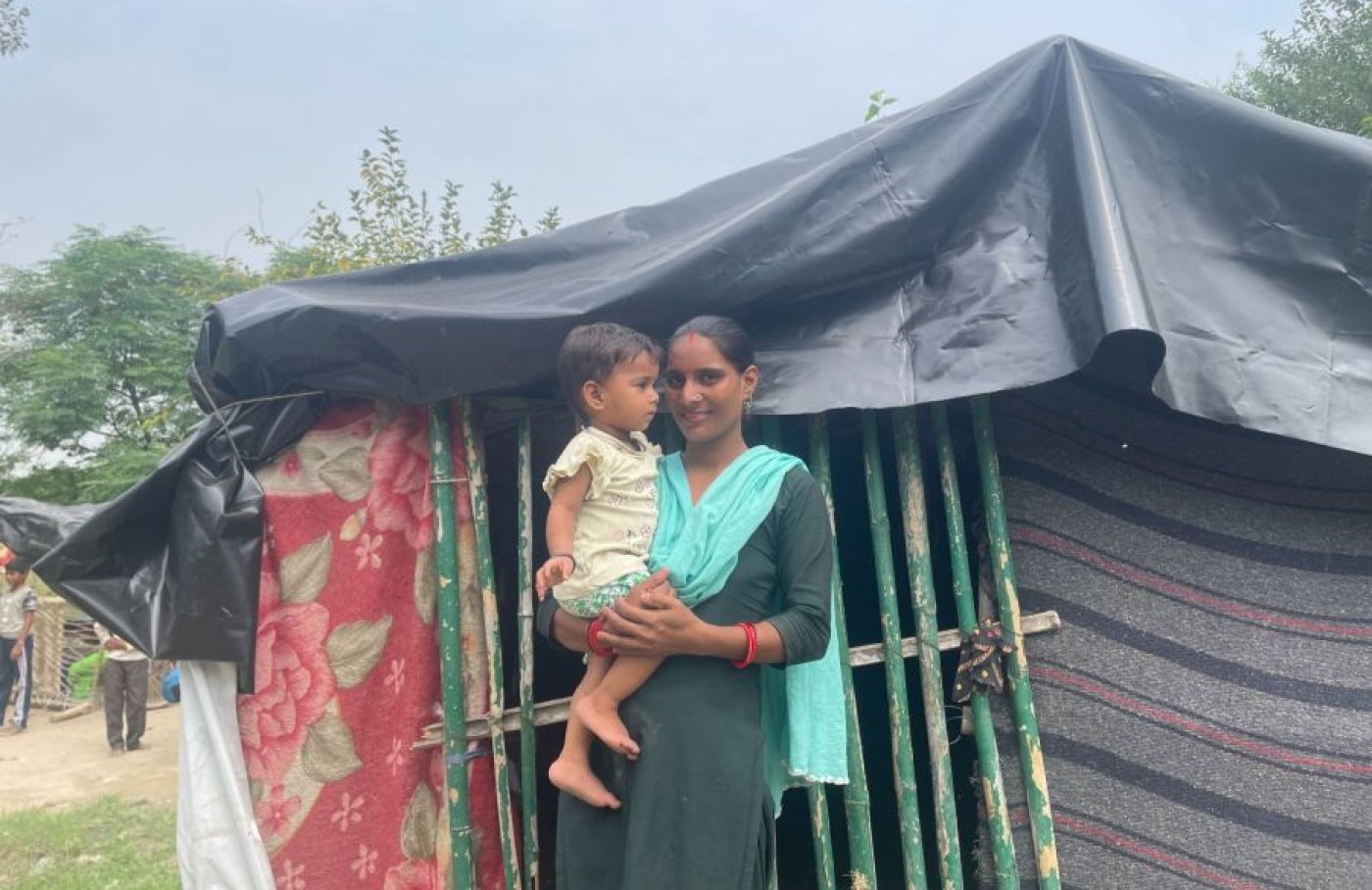
Delhi: Meenu Chowdhury, who has voted in Delhi multiple times over the years, was excluded from its voter roll after the special intensive revision (SIR) this summer, an exercise to verify and update electoral rolls.
Meenu, 42, lives with her two children and their grandmother in a house with a green wooden door and bare-brick walls in Bangali colony, a low-income neighbourhood in southeast Delhi, largely inhabited by migrants who work as daily-wage labourers, domestic workers, auto-rickshaw drivers, tea and vegetable sellers, and mechanics.
While they share two tiny rooms, they barely see each other.
Meenu is a domestic worker who leaves early, while her son, Himanshu,19, rides a scooter for deliveries and her daughter, Tripti, 22, goes to college and works part-time.
Their lives leave little room for the kind of paperwork that now determines whether a person remains on India’s electoral rolls.
Meenu said the booth-level officer (BLO) for the Tughlakabad constituency told her to get her husband’s voter ID details, whose name appears on her voter ID, to fill the enumeration form. But it was impossible.
“I have not had any contact with my husband for the past 18 years. I don’t even know whether he is dead or alive.”
Meenu left her husband to raise her two kids on her own.
Her husband wanted to move back to his village in Rajasthan, and the in-laws discouraged her children’s schooling.
“I wanted them to become educated and make something of themselves. I could not continue my studies beyond class nine. And now my daughter is pursuing higher studies and even supporting herself by working on the side,” Meenu said with pride.
Meenu is marked as “Absent” on the exclusion list of “uncollected forms,” called ASDD, or Absent Shifted Dead and Duplicate, a list of voters whose forms the BLO did not collect for the above reasons.
The BLO, or booth-level officer, is a grassroots-level election official, assigned by the Election Commission of India (ECI), a constitutional body that conducts elections in the country, to verify electoral rolls. With the SIR underway, they are meant to help citizens by distributing forms and guiding them through the difficult administrative process.
The enumeration form is the form citizens must fill, with information to verify identity and eligibility to remain on the rolls, including their existing voter ID number and details linking the person to their parents or spouse on the 2002 electoral roll.
The BLO’s support is particularly important for people from socially and economically marginalised communities, people with limited literacy, people without homes, daily wage and migrant workers who frequently move from place to place for work. Many leave home early in the morning and return late simply to feed their families that day, leaving little time to navigate a complex administrative exercise.
According to rules 7.5 and 8.5 of the ECI’s March 2023 manual, cited before the Delhi High Court in response to a petition seeking special safeguards during the SIR for homeless people and those displaced by demolition drives, BLOs must enrol homeless voters without documentary proof of “ordinary residence,” and must visit the address given for “more than one night” to ascertain that the person actually sleeps there.
BLOs are usually government employees, including teachers, childcare workers and municipal staffers, who are assigned this work alongside their already hectic jobs for modest additional payment.
As the SIR has unfolded over the past 14 months in 26 states and six union territories, there have been reports of BLOs being overworked, overwhelmed, and unable to keep up with the suddenness and magnitude of the exercise, with three dying by suicide.
On 8 August, the deadline for submitting the enumeration forms after the first extension in Delhi, 99% of forms had been distributed. BLOs, however, had collected and digitised only 57%, revealing the enormity of the task and pressure they were under.
Two more extensions followed, with the exercise for collecting the enumeration forms concluding on 24 August.
Every Third Voter Dropped
The SIR already disenfranchised 6.5 million in the first phase and 73.6 million in the second phase, with 61.5 million facing disenfranchisement after the third round conducted in 14 states and three UTs.
Two states—Nagaland and Tripura—have yet to publish their third-phase draft rolls.
Unlike other states, where the ECI conducted an SIR, Assam underwent what the ECI called a Special Revision of electoral rolls, reportedly due to its unique demographic verification history linked to the National Register of Citizens (NRC).
With 4.77 million facing disenfranchisement, the national capital saw the highest rate of deletions, with every third voter dropped from the draft roll.
Former chief election commissioner O P Rawat, who served from 23 January 2018 to 1 December 2018, said the ECI and its officials had traditionally helped voters, with BLOs and EROs (electoral registration officers) setting up Sunday camps at polling stations where voters could get help filling forms and resolving problems.
Even this time, in constituencies where BLOs and EROs stepped up to help voters, deletions did not exceed 5%, he said.
Many voters in Tughlakabad Village’s Bangali Colony, where Meenu lives, confirmed that the BLO did not conduct the house-to-house visits mandated by the Election Commission.
When asked why house-to-house enumerations were not done and assistance not provided, Barsha Devi, the BLO for Tughlakabad village, whose regular job is as a childcare worker in the government’s Anganwadi program, said she set up a camp for two months at Durga Mandir, a well-known spot in the locality, to distribute and collect forms.
“I got calls from people till two in the night. It is not possible. Now we are getting training to deal with notices coming for the voters,” she said. “More work remains.”
Harshit Anand, a Supreme Court advocate who works with the newly-formed citizens’ forum Voter Adhikar Manch, said, “Ideally, the BLO should have collected the forms even if some information was wrong or missing. Then these people would have been on the Draft SIR roll and received notices to provide those details later. They would not have had to re-enrol by filing Form 6.”
Form 6 is the application to register as a new voter.
Mother Deleted Before SIR
Meenu said she also could not use her mother’s voter ID for the forms as her mother, 67-year-old Karuna Bairagi, had been deleted from the electoral roll before SIR was conducted in Delhi in July.
But they only found out about Karuna’s deletion when they visited the BLO for forms.
“The BLO did not even check my details and shouted at me to leave, saying I have been deleted,” Karuna said, visibly angered as she recalled the incident. “I have voted here since 2008. I checked in my previous rented place nearby as well. There was no notice. Why did they suddenly delete me?”
Karuna claimed she was not sent a notice, not called on the phone or given the chance to be heard.
Harshit Anand, the lawyer, said rule 21A (of the Registration of Electors Rules, 1960) mandates that if officials think someone’s name should be struck off the list, they must send the concerned person a notice and give them a chance to be heard.
“They cannot be removed based on unregulated administrative discretion,” said Anand.
Following the 2025 Assembly election in Delhi, 1.3 million voters were deleted, and 160,000 were added, leading to a net decline of 1.1 million voters before the SIR started, The Hindu reported.
These voters did not appear on either the SIR Draft Roll or the ASDD and were not provided an enumeration form.
The Delhi CEO publishes such deletions as part of monthly pooling data.
In the first six months of 2026, until right before the SIR process formally started on June 30, Article 14 calculated over 16,500 deletions from the electoral roll in Tughlakabad assembly constituency alone.
After SIR, when the draft roll was published on 31 August, Tughlakabad recorded the highest rate of voter exclusion (48%) among Delhi's 70 constituencies.
“Nobody helped me understand the process,” Meenu said.
“I have voted several times, including in the last 2025 Vidhan Sabha elections. Now my name is excluded. So are my children. I don’t know if we will get back on the electoral roll. And what happens if we don’t?” she asked worriedly, finding no assurance in the pending process of filling Form 6.
Discrepancies & Deletions
Reports of discrepancies and unfair deletions from the draft roll in Delhi have emerged since 31 August.
In one Chandni Chowk polling station, informally known as Bela Estate, 728 of 729 voters were excluded and added to the ASDD.
After multiple DDA-led demolitions of their homes and farms on the banks of the Yamuna River, these voters “shifted” under a nearby bridge. According to the sub-district magistrate cum ERO of Chandni Chowk, this is why their names were excluded.
In other instances, living voters were marked as dead.
The official data also reveals sharp disparities across Delhi. Thirteen of the capital’s 70 Assembly constituencies saw more than 40% of their electors left out of the draft roll.
Of the 4.77 million voters excluded from the draft electoral roll, the largest chunk, more than three million, are categorised as “permanently shifted” and 1.17 million “absent/untraceable.”
According to reports by The Hindu, the categorisations used in the ASDD list to show the reason for a voter’s exclusion did not match the reports of the BLOs submitted to political party representatives and uploaded on the Delhi CEO’s website.
During fieldwork, BLOs recorded a reason for exclusion as “EF Refused,” with EF referring to the enumeration forms. But the final ASDD list clubbed these same names under the category of “permanently shifted”. In several cases, forms not collected were also marked “shifted”.
The notice and appeals process is underway in Delhi, with The Hindu reporting that around 30% of the 9.75 million on the draft roll are being served notices for document verification and hearings. This includes 1.9 million flagged by the EC’s software for 11 “logical discrepancies” and 1.3 million “unmapped” electors lacking links to previous rolls.
Those on the ASDD list (excluded from the draft roll) can file claims and objections until 30 September.
The final list will be published on 4 November.
Demolition & Disenfranchisement
Priti, who only goes by one name, said she was building her jhuggi for herself, her husband, and their three-year-old daughter when the BLO came to Chilla Khadar slum on the Yamuna floodplain in July.
She had little to build with—bamboo poles, a tarpaulin donated by an NGO, and whatever she could salvage from her hut, demolished in 2024 in the same slum, with the Delhi Development Authority (DDA) citing that the floodplain area was protected.
Priti said a toilet made by the Delhi Urban Shelter Improvement Board (DUSIB) was also demolished in 2024, and now people have to defecate in the open.
Her hut is fragile, but Priti’s life is even more so.
Her husband Guddu, who only goes by one name, was paralysed in an accident three years ago, leaving her as the family’s sole breadwinner. She works as a domestic worker in one house and earns Rs 3,000 every month. Her slum has no electricity. So, she charges her phone at her employer’s house and sometimes cooks food there to bring home.
As Priti spoke to this reporter, a water tanker arrived in the distance. “I have to go fill water now, or the tanker will leave. Then it won’t come for days. I’ll just be back,” she said in a hurry as she picked up two plastic containers and ran.
Priti, a 26-year-old mother, is one of the many people left out of the draft SIR roll.
She has a voter ID registered here and had voted in several elections, including the last two Delhi state and civic polls, Priti said.
But when the BLO arrived, Priti said he told her that she did not live there. “I told him that I have always lived in Yamuna Khadar, see my ID and please give me my form,” she said in despair.
In unauthorised slums like Chilla Khadar, where demolitions have taken place, people’s huts and shanties do not carry house numbers or even street numbers.
Inside the huts, there is little furniture and even less space. Families live out of cardboard boxes and plastic bags, while food is piled on khatiyas to keep it away from ants, insects and rainwater. There are no proper roads, running water or toilets; in summer, the tarpaulin huts become ovens, while monsoon rains can flood the settlement when the Yamuna swells.
Priti’s existing voter ID card has the following address: “Homeless Jhuggi Yamuna Khadar, Mayur Vihar-1, Patparganj, Mayur Vihar, East, NCT of Delhi - 110091”
Priti said she ran behind the BLO as he walked towards the market, some distance from the settlement. “He said, ' Wait, I will give you [the form]’, and then didn’t. That’s why I couldn’t submit the form.”
“Didn’t the government see before that we were staying here? They took our votes. Even then, DDA authorities come and break our jhuggis whenever,” Priti said. “I hope there is some hearing and we get our names on the list.”
“We don’t have water or electricity. And now they are taking away our voting rights,” said Maya Devi, Priti’s mother.
Maya lives in her own little shanty right across from Priti.
Both have been marked as “Permanently Shifted” on the ASDD list.
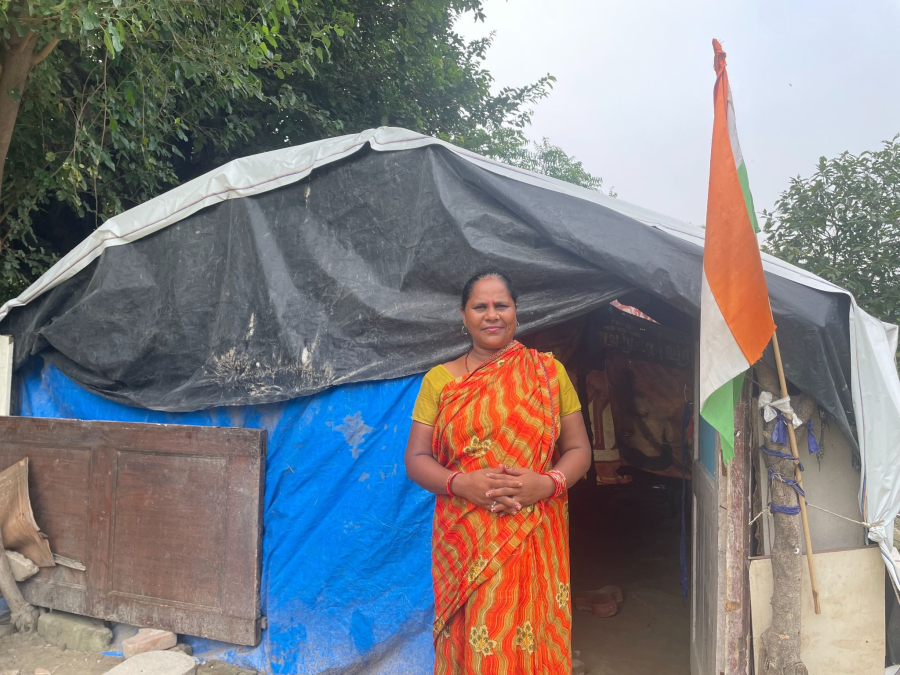
Maya, a widow and a domestic worker, also said the BLO never gave her an enumeration form. After learning that others had received theirs, she said she got his number from a neighbour and called to ask for her form and what she needed to do. She said he kept telling her he would come “today or tomorrow” (aaj ayenge, kal ayenge), but never did.
Eventually, she said, he told her the deadline had passed and that they would only come when the next round began — referring to the process of submitting Form 6 and a declaration for those left out and placed on the ASDD list.
“When will they come? After our voting rights are gone?” Maya asked. She also worries that her widow’s pension could be affected. “We vote every time and have lived here for three generations.”
“Hum sarkar se haath jod ke vinati karte hain ki humara vote na kate (I plead with the authorities with folded hands that our voter IDs are not deleted,” she said.
When Article 14 reached out to the BLO for Chilla Khadar, Sovindra Kumar, and asked whether he had not given forms to some people, he said he could not recall any such incident.
In Part 157 of the Patparganj assembly constituency, which is the Jhuggi Camp Yamuna Khadar, 1,057 people have been added to the ASDD list, of which 887 have been marked as “permanently shifted”.
‘Don’t Know What To Do’
Pintu Kumar was in his village in Bihar for a couple of weeks when enumeration forms were distributed in his area—Begumpur in south Delhi, a low-income neighbourhood of mostly daily-wage labourers and domestic workers who work in affluent neighbourhoods like Hauz Khas and Malviya Nagar.
When Pintu, 40, came back, he had to jump back into work. He works from early morning to late evening as a kabadiwala (scrap collector).
“I have lived here for eight years and voted here,” he said, referring to his one-room rented flat. “I live alone. And have to work every day. I don’t know whether the BLO visited my house. By the time I figured things out, the deadline was gone, and my name was deleted.”
When asked whether he received any calls about submitting his enumeration form, he said he didn’t, or he might have missed it.
Pintu shifted his vote to Delhi after moving here and has been living at the same address shown on his Voter ID.
After the Bihar SIR, his parents were included in the final list in that state. In Delhi, he has been put in the ASDD as “Absent/Untraceable”.
“It does not feel good to be excluded. I don’t know what to do now. Can you tell me?” he said.
(Aritry Das is a Delhi-based multimedia journalist and editor covering politics, governance, human rights and social justice.)
Get exclusive access to new databases, expert analyses, weekly newsletters, book excerpts and new ideas on democracy, law and society in India. Subscribe to Article 14.