
New Delhi: On 15 June 2026, Kerala set bus ticket prices to zero for every woman and transgender person in the state.
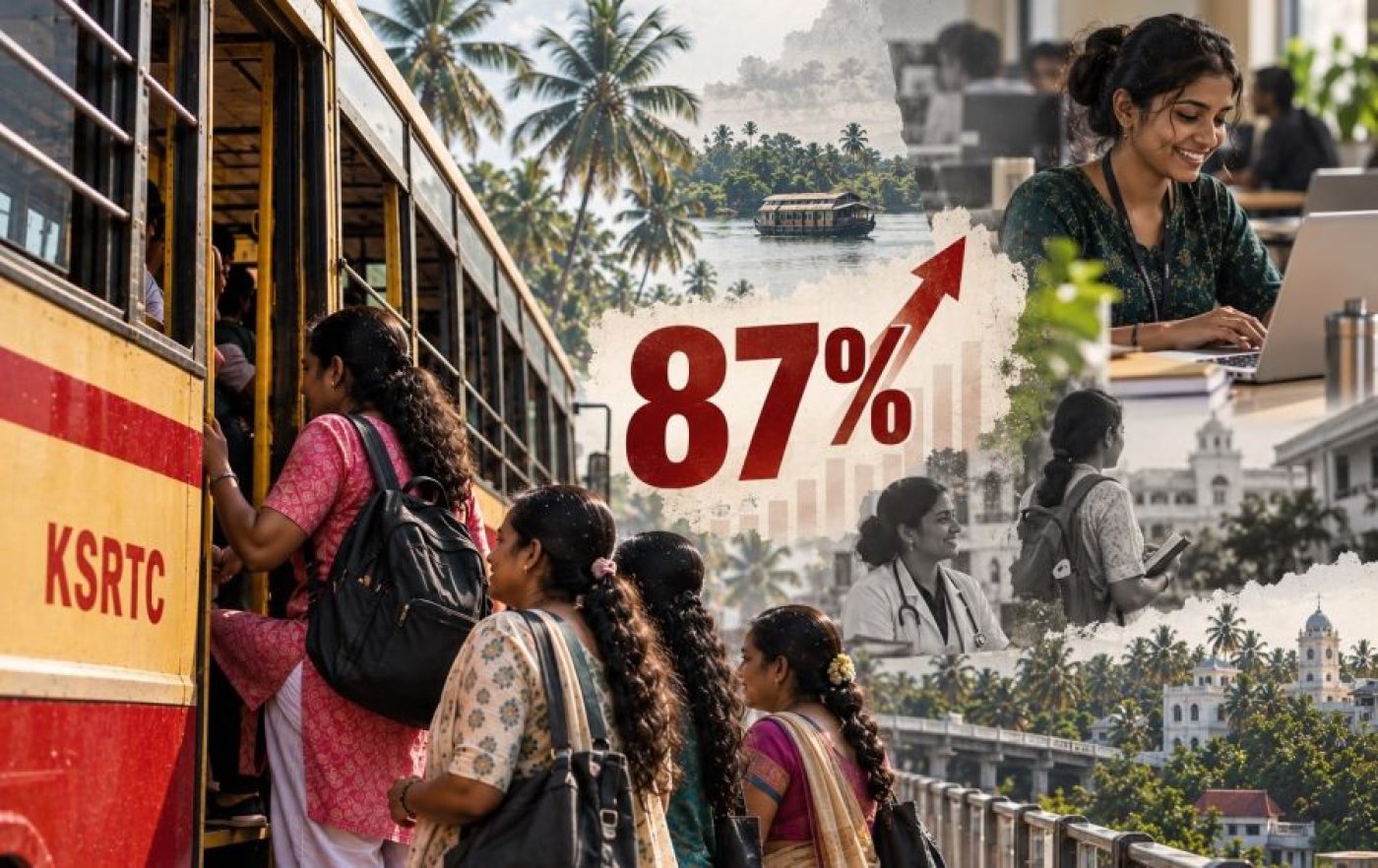
Within a month, 564,000—over half a million—more women boarded ordinary state buses every day than before.
On 4 August, the state's transport minister explained why.
“When Priyadarshini service was introduced, women started crowding these buses,” C P John said at a meeting organised by private bus operators in Palakkad. “It is because housewives do not have money in their hands to spend on fares.”
He then questioned why families using free buses and government hospitals sent children to costly private schools.
The remarks prompted criticism for appearing to belittle the women using the scheme. John initially refused to apologise, telling reporters he stood by his words and meant only to draw attention to poverty.
A day later, he expressed regret. He said he had used words casually and should have been more careful. He described Priyadarshini as a right rather than charity, and said the flagship programme would continue.
The apology corrected the tenor. It did not address the underlying assumption, which is more consequential, because many state governments share it.
Kerala Is Not Alone
Eight states and one union territory already run some version of this scheme. Delhi went first in 2019, using what is called a Pink Saheli card; Tamil Nadu and Punjab followed in 2021; Karnataka launched its Shakti scheme in 2023; Telangana launched Mahalakshmi the same year; and Andhra Pradesh launched Stree Shakti in 2025. Jammu and Kashmir, Maharashtra, West Bengal and Punjab, too, have free or concessional travel for women
When Priyadarshini was challenged—and dismissed—in the Kerala High Court, the state pointed to exactly this list.
Internationally, these schemes, taken collectively, appear to be an outlier. Free transport elsewhere is usually universal or age-based, not sex-based; a gender-targeted, standing, state-funded fare waiver at India's scale appears to have no real precedent elsewhere.
Is free bus travel in Kerala and elsewhere, then, simply relief for a woman with an empty purse? Or is affordable transport part of the public infrastructure that determines whether she can study, work, reach a hospital and appear in public life at all?
An Election Promise, And 38.1 Million Journeys
Priyadarshini, a commitment of the United Democratic Front government that took office earlier this year, was launched on 15 June 2026, allowing women and transgender persons of all ages to travel free on Kerala State Road Transport Corporation ordinary services.
Every scheme in other states is a named election guarantee, which ties its fate to the government that made it—Tamil Nadu's was renamed and relitigated after a leadership change.
The Kerala government order states its purpose plainly: to expand women's mobility, employment opportunities, and social and economic empowerment. The state bears the full financial cost.
At launch, the concession covered 3,125 ordinary KSRTC buses, at an estimated annual cost of about Rs 8,000 million. It excluded higher-class services and special trips. There is no registration and no documentation. A woman simply takes a zero-fare ticket from the conductor, which records where she boarded and where she got off.
The uptake was immediate.
Women made 38.1 million free journeys in the scheme's first month. That figure counts every zero-fare ticket issued, not the additional travel the scheme generated, which is closer to 17 million. Both numbers are large. They are not the same number, and they answer different questions.
Electronic ticket machine data John cited in July showed average daily ridership across KSRTC services rising 28.9%, from 1.903 million to 2.453 million passengers. On ordinary buses, the number of women travelling each day rose from 648,000 to 1.212 million, an increase of 87%. Women's share of passengers on those services climbed from 50.9% to 66.6%.
These figures measure demand, and demand alone. They cannot say why anyone made a particular journey, or whether a single woman found work because the fare vanished. But they dispose of one reading entirely. A crowded bus is not evidence of misuse. It shows that a service became accessible to many people the moment its price was removed.

What India’s Largest Cities Reveal
Two weeks after Priyadarshini began, the National Statistical Office published Labour Market Dynamics in Million-Plus Cities on 29 June 2026, its first employment study devoted to the 46 cities whose populations exceeded one million in the 2011 Census.
A redesign of the Periodic Labour Force Survey made this possible; from January 2025, it treats each city as its own sampling stratum. Until then, India's statistical system could see states. It could not see cities individually.
The labour force counts those who have jobs and those actively seeking one. Across the 46 cities, the proportion of women aged 15 years and above in the labour force rose from 19.8% in 2017-18 to 27.2% in 2025. The proportion actually employed rose from 17.9% to 25.5%.
The improvement is real. The gap it leaves is enormous. In 2025, 75.9% of men in these cities were working or looking for work. Roughly one woman in four was.
Ask the women who weren't, and the answer is nearly unanimous. Among those outside the labour force, 68.7% named childcare, homemaking or related personal commitments as their main reason.
Among men, 1% gave the same answer.
The word “housewife” does considerable work in concealing what that means. A woman classified as outside the labour force may spend much of her day cooking, cleaning, caring for children, and supporting relatives.
That labour sustains the household and the family members who go out to earn. It is unpaid, and conventional employment statistics make it nearly invisible.

The 4-Hour Inequality At Home
Researchers have measured the scale of that invisible work.
According to the ministry of statistics and programme implementation's Time Use Survey 2024 Factsheet, published in 2025, women aged six years and above spent an average of 305 minutes a day on unpaid activities. Men spent 56.
The difference is 249 minutes. Four hours and nine minutes, every day.
These are averages across the entire population in that age group, reported in Table 11, and they include everyone who recorded no time at all in such activities.
That gap is not an abstraction. It decides whether a woman can accept a fixed shift. How far from home she can afford to travel. Who collects the child when school closes before the working day does. Who sits with the elderly relative who cannot be left alone.
Before any question of jobs, wages, or skills arises, people have already spent four hours and nine minutes.

What 68.7% Really Means
The report's most quotable finding is also its most misread.
It does not say that childcare and homemaking keep 68.7% of all women in these cities out of employment. It says that among women already outside the labour force, 68.7% named those responsibilities as their principal reason.
The more revealing number combines two NSO measures: the share of women outside the labour force, multiplied by the share of those women who cite care or homemaking.
City by city, that calculation yields an illustrative estimate of the share of women aged 15 and above who were both outside the labour force and cited care or homemaking as their principal reason. It ranges from about 22.5% in Coimbatore to 67% in Dhanbad, with Prayagraj at approximately 66.6%, Faridabad at 64.9%, Delhi at 61.9% and Bhopal at 61.5%.
These calculations are based on the NSO's published city figures, not percentages the NSO reports directly. They describe what women stated as their principal reason. They do not establish that care responsibilities alone kept any particular woman out of work.

3 Cities, 3 Barriers
The city data also demolish any idea that childcare is a single, uniform explanation.
Coimbatore (41.3% female participation) and Surat (40.6%) look like near-twins. But only 38.3% of Coimbatore's non-working women cite care, against 81.6% in Surat—second nationally only to Howrah's 82.4%. The likely reason: 70.4% of Coimbatore's employed women hold regular salaried jobs, compared with 67.9% self-employed in Surat.
Self-employment can mean flexibility to work around a child, or it can mean insecure, poorly paid work accepted because fixed hours are impossible to combine with home.
The NSO's earnings data supports the darker reading: women in regular salaried jobs across these cities earn Rs 23,700, compared with men's Rs 30,700, and in self-employment, less than half of what men make.
Agra breaks the pattern entirely. Only 11.4% of its women are in the labour force—yet just 41.1% of those outside it cite care, with 14.6% citing "social reasons" and 21.2% "others," categories broad enough to hide family opposition, safety fears, or wages too low to justify the trip.
A survey that asks for one principal reason cannot capture several barriers operating at once. Agra warns against reading a low care figure as evidence of fewer restrictions—it may only mean the restrictions have no tidy name.

Questions Data Can’t Answer
The NSO study establishes where cities differ. It doesn't include the information needed to explain why.
It does not record how many functioning crèches a city has, when they open, what they charge, how they are staffed, how many children they can take, or how far they sit from homes and workplaces. It does not link women's employment to commuting time, transport availability, household composition, or the age and number of children.
The union government's Palna programme at least recognises that care and employment are connected. By March 2025, 11,395 Anganwadi-cum-Crèche centres had been approved across 34 states and Union Territories, against a target of 17,000.
Approval is not operation. It does not establish that a centre has opened, is adequately staffed, is accepting children, or runs during the hours a working mother actually needs. Nor can these national totals be matched to employment outcomes in the 46 cities, which forecloses any direct test of whether childcare provision explains the gulf between Coimbatore, Surat and Agra.
What A Bus Fare Changes
A job does not become available simply because it exists. A woman has to reach it, at a time and a cost compatible with everything else she is responsible for. The route has to be safe, the service frequent, the last stretch of the journey manageable on foot or otherwise.
And the journey is rarely a single journey. Child to school, then to work, then the groceries, then a relative to the clinic, then home. Transport researchers call this trip-chaining. Charging a fare at every link makes the chain expensive in a way a commute never is.
An April 2026 working paper by Udayan Rathore and Ashish Singh examined free bus schemes introduced for women across five states between 2019 and 2023. Using Time Use Survey data from 2019 and 2024 in a triple-difference design, the authors estimated that the schemes raised women's probability of undertaking paid work by three percentage points and their average daily time in paid employment by 16 minutes.
The gains were largest in districts scoring highest on a patriarchy index and on restrictions to women's movement; in other words, the places where a bus does the most work.
The paper is recent, and its estimates await replication. Earlier research is more equivocal. Research on Delhi's Pink Pass scheme found only weak evidence of an employment effect, partly because the available time-use data covered a short period after its introduction. Another study of Punjab and Tamil Nadu found uneven employment gains concentrated among skilled women.
Taken together, the studies suggest a fare concession needs years, not months, to reshape travel and employment decisions, and that what it achieves depends heavily on the labour market it lands in.
A free ticket cannot create a job. It cannot arrange childcare, and it cannot persuade a family to let a woman work. It is worth little if buses are infrequent, overcrowded or absent from the route she needs. Rathore and Singh flag this risk, citing evidence of overcrowding, unreliable scheduling, and rising safety concerns that may offset what the schemes were designed to achieve.
Priyadarshini covers ordinary KSRTC services only. Private buses remain essential on routes the state covers thinly, and private operators have complained of lost revenue. It is worth remembering where John made his remarks. He was standing in front of a hall of private bus operators.
If the additional demand is not met with additional services, crowding will begin to eat into the accessibility and the safety the scheme was meant to deliver.

A Right Requires Evidence
Calling free travel a right, as John did in his apology, creates an obligation to determine whether the right works.
That means publishing route- and time-based ridership, additional services run, trips cancelled, crowding levels, harassment complaints, and the financial impact on KSRTC. The zero-fare ticket already records boarding and destination points for every journey, so the state is collecting this data whether or not it chooses to publish it.
It means asking whether women are making new journeys connected to education, work, healthcare and government services, or simply making old journeys more cheaply. Both are worth knowing. They are not the same finding.
It also means identifying who the scheme does not reach: women living far from KSRTC routes, women working hours that ordinary bus timings do not serve, women dependent on the private services the scheme excludes. Over time, it will also change how far women look for work, how far they can travel, and how many hours they can give to paid employment.
Two questions are routinely conflated.
The first is whether free travel delivers immediate financial relief. The surge in ridership settles that: the concession has substantial household value, and the minister was not wrong that a fare is a real cost to a woman without money of her own. He was wrong to think that was all there was.
The second is whether it expands women's economic participation. That depends on transport working in concert with childcare, eldercare, safe public spaces and jobs worth travelling to.
A free ride cannot remove four hours and nine minutes of unpaid work from a woman's day. It can ensure the remaining hours aren't further restricted by the cost of reaching a college, workplace, market, or hospital.
The most revealing fact in Kerala's controversy, therefore, is not that women crowded the buses. It is that so many more women travelled when the fare disappeared.
The question for the government is where they finally went.
(N V Geetha is a former senior technical director with the National Informatics Centre, ministry of statistics and programme implementation.)
Get exclusive access to new databases, expert analyses, weekly newsletters, book excerpts and new ideas on democracy, law and society in India. Subscribe to Article 14.