
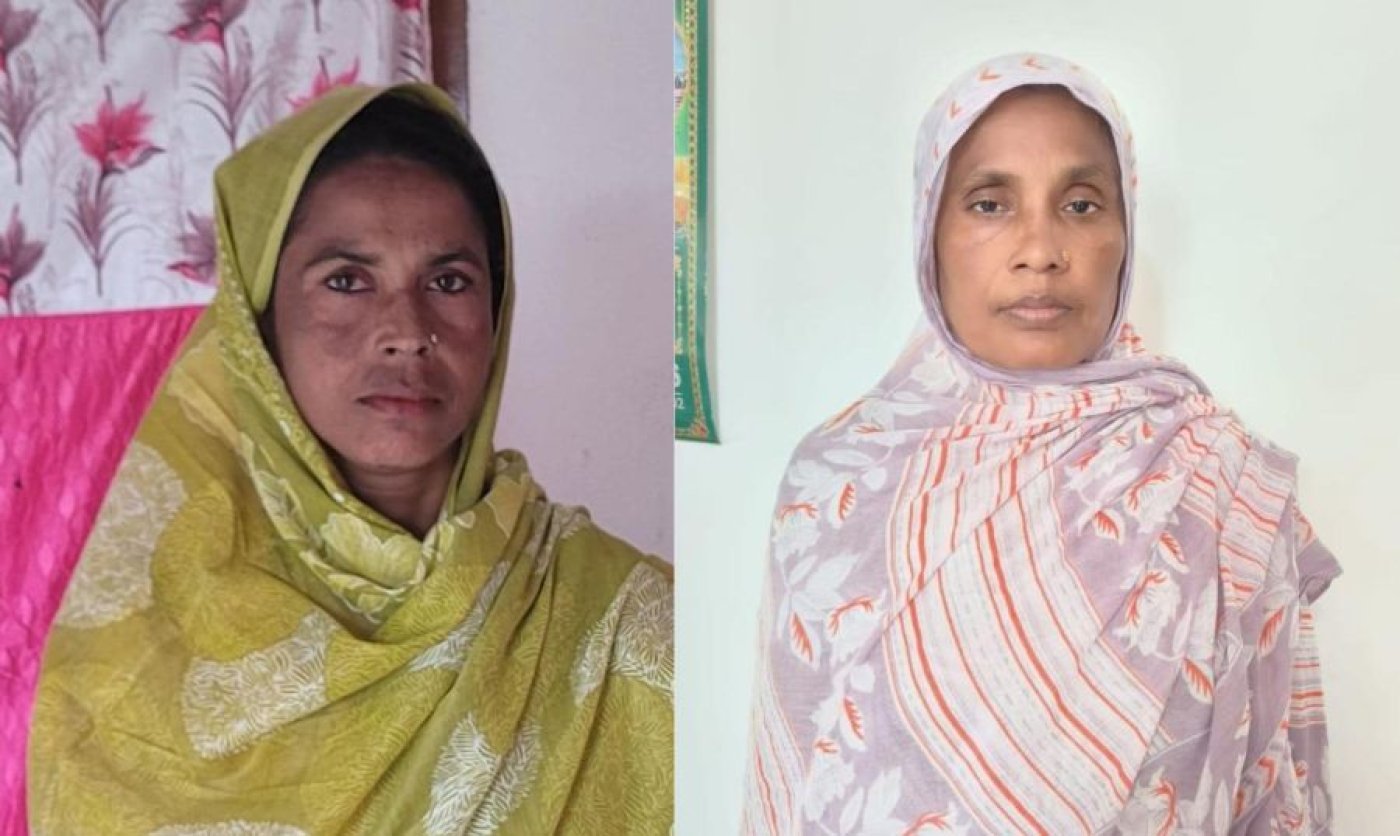
Guwahati, Assam: Shortly after midnight on 14 June 2026, Indian authorities, probably border guards, forced Mumtaz Begum and Jahanara Begum across the border into Bangladesh at a border crossing in southern Assam’s Cachar district.
Official records show how the two Assam women reached a crossing in what is called the Kalaincherra sector—through a Foreigners Tribunal, police stations and holding centres spread across several districts.
Four months later, their families still do not know where they are.
Mumtaz, 43, a mother of four, lived in Dhing Gaon, while Jahanara, 47, lived in Bagariguri, both in Juria, Assam’s Nagaon district, about 300 km from the border crossing where authorities pushed them out of the country.
Mumtaz’s son, Momruz Ali, said he had not spoken to his mother since authorities took her into custody in May after her Foreigners Tribunal hearing. Jahanara’s son, Md Mujahidul Islam, similarly, said he had received no information about his mother’s whereabouts.
Their confusion deepened on 7 October, when The Times of India reported that Assam chief minister Himanta Biswa Sarma said Mumtaz was safe and in daily contact with her son.
When speaking to Article 14 on 8 October, Ali disputed that account. He said he had not spoken to his mother and had received no information about her whereabouts from the police or any other government authority.
“We don’t need politics,” he had told the newspaper earlier. “We need to know where our mother is.”
In its order on 7 October, which Article 14 has accessed, the Gauhati High Court recorded that instructions received from the ministry of external affairs (MEA), along with an enclosed letter, appeared to show that inquiries into the whereabouts of both women were being conducted. The Court recorded that the union government would require more time.
The two orders passed that day, of which we have a copy, do not identify the steps taken, whether India had formally contacted Bangladesh or whether either woman had been traced.
Declared Foreigners Twice
This was not the two women’s first experience of a Foreigners Tribunal, quasi-judicial bodies that exist only in Assam and were constituted under the Foreigners (Tribunals) Order, 1964, to determine whether people referred to them are foreigners or Indian citizens.
Article 14 has previously reported on a variety of issues with these tribunals (here, here, here and here).
Assam has 100 such tribunals. These tribunals have identified 172,673 people as foreigners and have 73,759 cases pending as of 31 May 2026, according to a statement by chief minister Himanta Biswa Sarma in the Assam assembly.
The same tribunal in central Assam’s Nagaon district had declared Mumtaz and Jahanara foreigners in 2019. Both challenged those opinions before the Gauhati High Court—and succeeded.
In April 2026, the Court set aside, in orders Article 14 has copies of, the tribunal’s opinions—the formal decisions declaring the two women foreigners.
In Mumtaz’s case, the Court found that the tribunal had not considered all the evidence placed before it. In Jahanara’s case, the tribunal failed to consider the testimony of three of her four witnesses.
The Court did not declare either woman an Indian citizen; it returned both cases to the tribunal for fresh consideration.
Jahanara appeared before the tribunal for the second time on 29 May. Mumtaz appeared the next day. The tribunal again issued fresh opinions—formal decisions—declaring them foreigners.
Assam Police took both into custody without giving them copies of the fresh opinions. They were then handed over to the Border Police.
Their families applied for certified copies of the tribunal’s opinions on 2 June and received them on 5 June.
By then, the women had been moved.
Before They Could Appeal
Mujahidul learnt that they had taken his mother, Jahanara, to the Matia holding centre in Goalpara. He met her there on 2 June. When he returned on 5 June to obtain her signature on a vakalatnama—the document authorising a lawyer to represent her—she was gone.
Mumtaz’s family also travelled to Matia on 5 June, where she had been taken as well, to arrange the papers needed for a legal challenge, where they learned she had been moved.
The two women had been moved from Matia to another holding centre in Sribhumi, about 400 km away, on 3 June, where they were held until the Assam Border Police handed them over to the Border Security Force (BSF) on 13 June.
The women were pushed into Bangladesh the following night.
The families had received copies of the tribunal opinions before the women crossed the border, but the paperwork was not enough to bring the cases to court.
They needed to find the women, obtain instructions and arrange representation. The State controlled where the women were held and continued moving them while their families tried to reach them.
There is no ordinary statutory appeal against a Foreigners Tribunal’s opinion. A person must ask the High Court to examine whether the tribunal acted lawfully.
Mumtaz and Jahanara used that remedy successfully once. The second time, they were outside India before they could use it effectively.
On 3 September, the High Court found that the “State machinery, acting in tandem” had prevented the women from approaching it in time to challenge the fresh opinions.The Court also directed, in the same order, Assam’s home and political department to establish, in both cases, the precise date and time when the fresh tribunal opinions were “made ready” to determine whether the opinions were prepared before the women were taken into custody.
A ‘Farcical’ Process
The High Court’s 3 September orders reconstruct the women’s journey from the tribunal to Bangladesh, via police stations and multiple holding centres, in the custody of first the Assam police, then the Border Police and finally the BSF.
The district authorities had directed the women to leave India on their own within 24 hours on 2 June when they were already in State custody and could neither return home nor arrange to leave independently.
The High Court called the purported opportunity given to the women “farcical”.
A formal repatriation would ordinarily require Bangladesh to verify the women’s nationality, accept their return, and coordinate their handover with Indian authorities. The High Court’s order did not establish that any such process took place before the BSF sent them across the border.
In its 3 September orders, the High Court found that official action had denied both women a reasonable opportunity to challenge the fresh tribunal opinions before their removal.
The Court ordered Assam to pay Rs 200,000 in interim compensation to Mumtaz’s husband and to Jahanara’s son. Neither family had received the money when interviewed on 8 October.
Jahanara’s family said they had applied for the compensation. Mumtaz’s husband had signed the necessary documents and sent them to their lawyers, but as of 8 October, the application had not been submitted.
Mumtaz’s husband, a daily-wage labourer, works in Dimapur, Nagaland. Their son, Momruz Ali, estimated that the family had spent approximately Rs 150,000 on legal proceedings and related travel.
Despite the promise of compensation the families continue to ask: where are Mumtaz and Jahanara?
A Journalist’s Search
While the families waited for official information, The Times of India journalist Ismat Ara began making inquiries in Bangladesh.
On 29 September, Ara reported that Bangladesh’s home ministry had begun searching for Mumtaz after the newspaper contacted officials. The matter was reportedly sent to police and other departments on 27 September.
Police in Sylhet, a border district in north-east Bangladesh, searched for Mumtaz but found no lead, according to the Times of India reportage. Her photograph and identification details appeared in Bengali newspapers. Bangladeshi officials told the newspaper that they were awaiting formal communication from India.

By then, the Gauhati High Court had brought the MEA into both women’s cases. On 3 September, the Court said the ministry’s presence was necessary so that directions could later be issued to locate the women in Bangladesh and bring them back to India, allowing them to challenge the fresh tribunal opinions.
The Court has not yet ordered their return. Its directions have required the MEA and the Assam authorities to ascertain their whereabouts.
On 7 October, counsel for the u nion Government placed instructions from the MEA before the Court and indicated that “an enquiry is [being] conducted” into the women’s whereabouts and that the Union Government would “require some more time to do the needful”.The contents of the MEA’s instructions and the letter are not set out in the publicly available orders. The orders therefore do not disclose what steps were taken to locate the women or whether India formally contacted Bangladesh.
Bangladeshi officials told The Times of India that, as of 29 September, India had not sent any official communication.A week later, the publicly available record still gave no answer on the women's whereabouts.
On 14 October, the Court again directed the MEA and the State machinery to take steps to ascertain their whereabouts, in an order we have a copy of. The cases are next listed on 6 November.Such returns are not unprecedented. In 2025, Assam brought back former schoolteacher Khairul Islam after his family pointed out that his challenge to the tribunal’s opinion was still pending before the Supreme Court.
In another case, six West Bengal residents expelled to Bangladesh returned after the Calcutta High Court ordered the union government to bring them back, and the Centre later agreed before the Supreme Court.
These cases do not establish an automatic process, but they show that return is possible once a person is located and governments take the necessary steps.
The Ignored Woman
Publicly reported search efforts have focused principally on Mumtaz. Jahanara crossed the same border that night, but far less is known about efforts to find her.
Her lawyer, Zahidul Hoque, told Article 14 that Jahanara could not operate a mobile phone independently, making it difficult for her to contact her family even if she obtained access to a telephone.
Her estranged husband had remarried and lived separately, leaving Mujahidul as the only immediate family member pursuing her case.Hoque said the Assam Police took Jahanara into custody after her hearing at approximately 1 pm on 29 May. According to him, the tribunal’s written opinion was not ready then; he said it was ready later that afternoon, between 4 pm and 4.30 pm.
His claims raise the same question that came under scrutiny in both women’s cases: had the women been taken into custody before the opinions declaring them foreigners were ready?
More than a month after the high court directed Assam’s Home and Political Department to provide the precise time when each opinion was prepared, the State had not answered.
On 7 October, the Court reiterated its direction and warned that, unless the information was produced at the next hearing, it would presume that the opinions had not been ready before the women were taken into custody. The warning was conditional, not a final finding.
At the next hearing, on 14 October, the Assam government told the Court it had received inquiry reports in both cases and asked for time to file them. The Court granted the request. Its short orders do not disclose what the reports found or refer to the warnings issued a week earlier.
The High Court has not determined whether Mumtaz or Jahanara are Indian citizens. The fresh tribunal opinions may ultimately survive judicial scrutiny.
That unresolved question does not explain why the women lost an effective opportunity to obtain that scrutiny before their removal. Nor does it answer what happened after officials sent them across the border.
(Sahil Hussain Choudhury is an advocate and constitutional law researcher from Assam.)
Get exclusive access to new databases, expert analyses, weekly newsletters, book excerpts and new ideas on democracy, law and society in India. Subscribe to Article 14.