
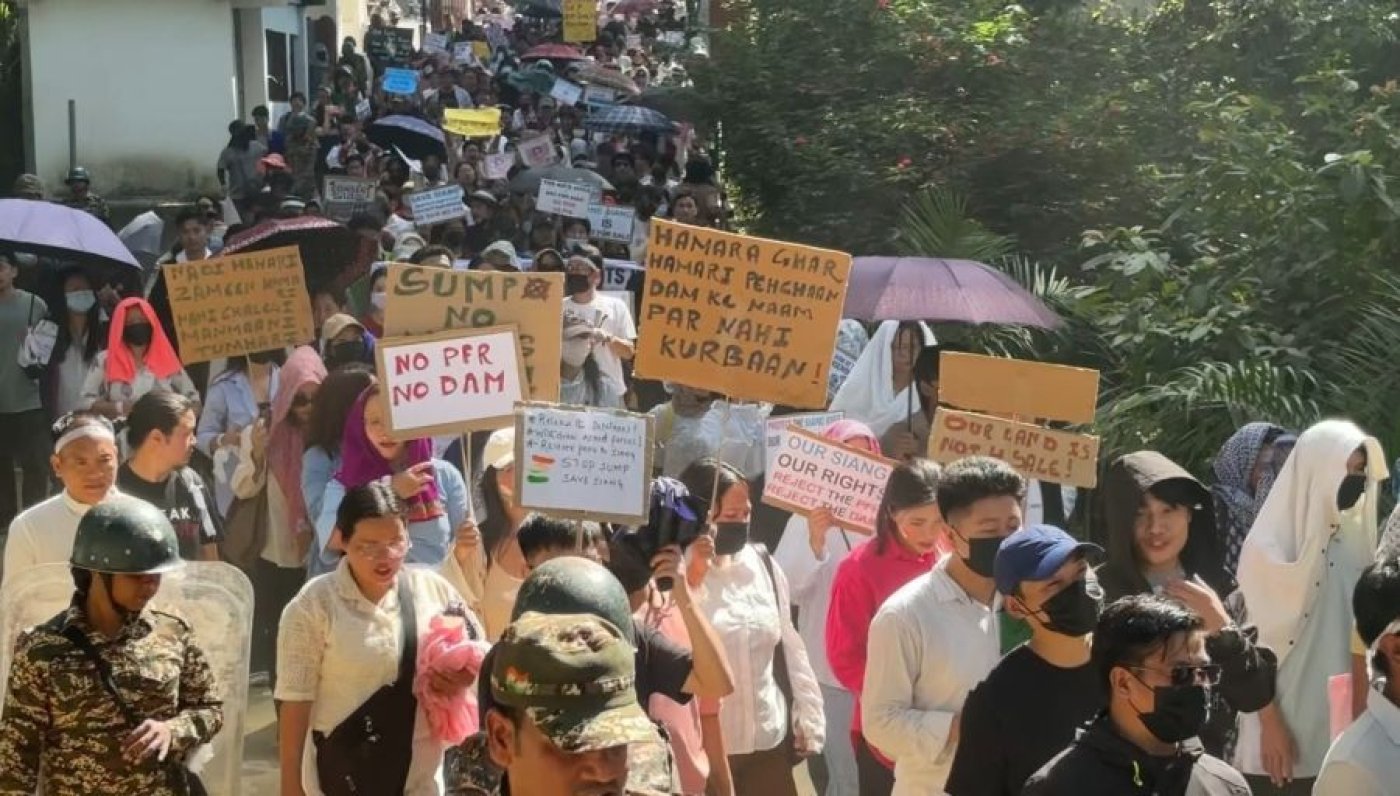
Arunachal Pradesh: On the evening of 11 November 2026, Tajong Talom walked out of jail after a local court granted him bail. Outside the prison in Pasighat, a town in mountainous Arunachal Pradesh bordering Tibet, his family, lawyers, and supporters had gathered to receive him.
They carried traditional khadas, ceremonial scarves presented as a gesture of respect and welcome, waiting to greet him. Before they could do so, a police unit arrived and attempted to take him into custody again.
Talom is one of the most vocal opponents of the proposed Siang Upper Multipurpose Project (SUMP). He has repeatedly spoken against the project and raised concerns about its implications for the lush Siang region.
I was present that evening.
Before Talom was released, jail security had asked those waiting to stay 100 yards away from the premises. Most of them drifted towards the adjacent parking area and stood in a queue, holding the khadas.
As Talom stepped out, the police tried to put him into a police vehicle that had just arrived. His family members and advocates rushed towards him. There was a brief commotion.
After some time, Talom cooperated with the police and went with them to the Pasighat police station in East Siang district, of which Pasighat is the district headquarters.
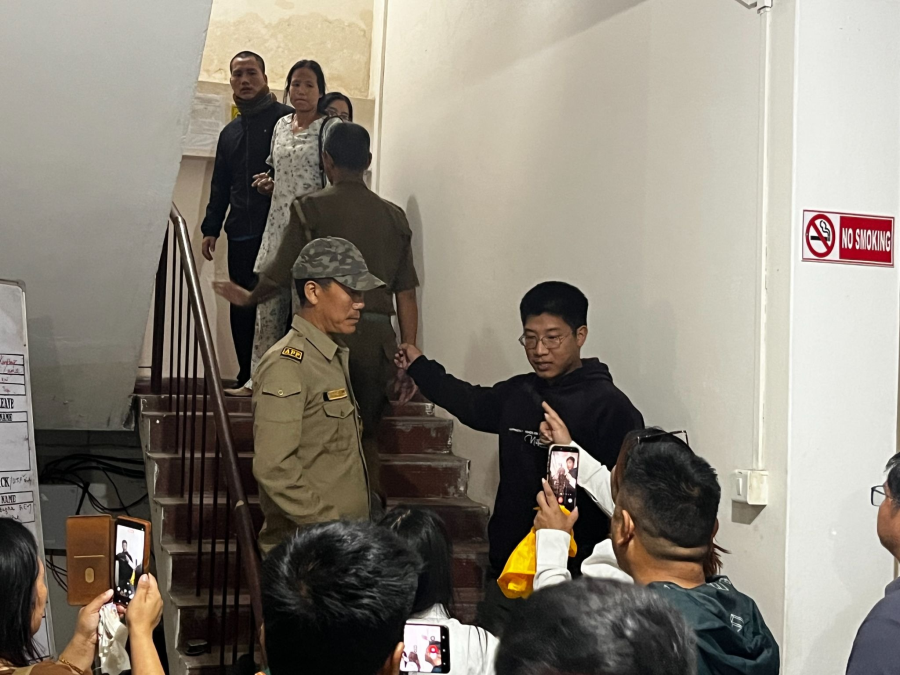
At the police station, his lawyers were initially not allowed to accompany him. After repeated requests, one of them was permitted to go inside.
His family and legal counsel had every reason to ask why the police were arresting him again, especially when they had provided no advance notice, written order, or explanation before taking him away. It was later learned that Talom had been arrested in a separate case relating to the violence during the 23 October protests in Pasighat.
This bail-and-rearrest playbook has been repeatedly deployed in states run by the BJP (here, here and here), and it has now come to previously peaceful Arunachal, which is also ruled by that party.
Talom had secured bail in an earlier case. His fresh arrest was in a separate matter. Police records refer to allegations connected with the 23 October incidents under India’s penal code, the Bharatiya Nyaya Sanhita, and the Prevention of Damage to Public Property Act, including rioting, arson, assault on security personnel, and damage to public property.
Following the 23 October unrest in Pasighat, Talom was initially arrested in neighbouring Assam while travelling to New Delhi, around the same time two other outspoken critics of the dam, environmental advocate Ebo Mili and young writer Otul Jerang, surrendered to police. All three became prominent voices associated with the movement against the proposed project.
Ebo Mili has consistently questioned the government’s handling of the project and spoken out against it. Otul Jerang has made multiple public statements (here, here and here) about the growing presence of security forces in the Siang region. Their arrests and continued detention have become central to the concerns raised by people opposing SUMP.

The timing of Talom’s rearrest came just as the state government was speaking about opening talks with those opposing the dam.
The government was asking people to come to the table, while communities were still dealing with the consequences of a crackdown.
The Siang River
The Siang flows through Arunachal Pradesh in India's northeast before entering neighbouring Assam, where it joins other rivers to form the Brahmaputra, one of Asia's major river systems. It originates in Tibet, where it is known as the Yarlung Tsangpo.
The proposed SUMP is a massive hydropower and water storage project planned on the river, with a proposed capacity of around 11,000 to 11,200 megawatts.
The Indian government has presented it as a project of national importance, linked to electricity generation and India's strategic and water security concerns, particularly in response to China's plans for major hydropower projects upstream in Tibet.
For the Adi people, an indigenous community with deep roots in the Siang region, the river is part of everyday life. Their villages, agricultural fields, ancestral land, and cultural practices are closely connected to the surrounding landscape. For people in the Siang region, the land is not simply a property holding. It is where they have lived, cultivated their fields, and maintained relationships across generations.
The project has not received final approval for construction. The current exercise involves the preparation of what is called a Pre-Feasibility Report, or PFR, a technical assessment to determine whether a proposed dam is viable.
A collective of 114 scientists, researchers and practitioners have called for suspending all construction, surveys and pre-clearance activities related to the dam, citing its ecological, cultural, and socio-political risks. The government has said a PFR is not an approval to construct the project and that further consultation is necessary.
Affected villages, however, have questioned the survey process and the way PFR-related activities are being carried out. For people who do not want the project, allowing the survey to proceed is itself a concern. They have been asking whether their views are being taken seriously before the process moves further.
During one of my visits to the village of Geku—one of 27 villages expected to be submerged by the dam, which has emerged as a center of resistance—I went to a house hoping to speak with a family. The person I approached paused and made a phone call. Soon, several women arrived.
It was around 9 pm, already late by village standards, yet they came to talk about the proposed project and their concerns. The discussion was not limited to those organising protests or attending public meetings. Women and families across the valley were following the developments closely.
The Flashpoints
The past few months have been chaotic for villagers in the Siang region, who have been living through growing tensions. One major flashpoint came in September, when villagers blocked the road leading to Konggong Lingkok near Uggeng to prevent machinery from entering for the PFR.
Uggeng lies along the Siang River, around six to eight km from Komkar. The dispute was no longer only about the survey. The deployment of paramilitary forces controlled by New Delhi in these rural villages had become another major source of anxiety.
Affected villagers have continued to make their voices heard, whether by coming out onto the streets or finding other ways to express their opposition publicly.
The protests were visible during Arunachal Pradesh chief minister Pema Khandu’s two-day visit to Siang and Upper Siang districts on 29 and 30 September.
While Khandu held meetings with officials and local council leaders in Boleng and later chaired the first meeting of the Empowered High Level Committee on SUMP in Yingkiong, villagers from Riga, Parong, and Riew gathered at town called Dite Dime, to protest under the slogan “No PFR, No Armed Forces.” Parts of Upper Siang also observed a strike, with road blockades along the Yingkiong, Komkar, and Geku route. Demonstrators clashed with security personnel and set a police vehicle on fire.
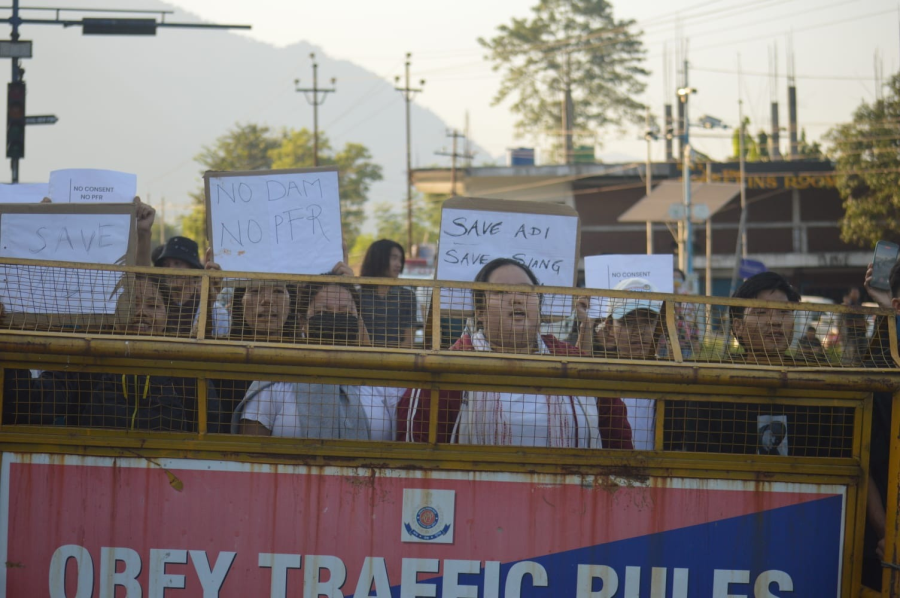
During his visit, Khandu said one day was not enough and promised to return, spend a week in each district, visit villages, and meet people. He also asked the deputy commissioner to invite a delegation of five or six people for a meeting.
Speaking to the media, he said the government was open to dialogue. Yet, while he held meetings with officials indoors and spoke about meeting affected people, villagers were protesting outside. He did not meet those who had gathered to oppose the project during that visit.
By October, the protests had reached Pasighat. A rally was held on 20 October despite the denial of official permission. On 22 October, young people held a sit-in at what is called Miracle Field. The following day, 23 October, the situation turned violent. Tear gas was reportedly used against protesters.
Vehicles were later set on fire, public offices were attacked, and private property and residences were damaged.
Months Of Protests
The incidents of 23 October were serious. Damage to public and private property and attacks on people cannot be justified and require investigation. Yet the violence that day did not mark the beginning of the opposition. People had been raising concerns about SUMP and the PFR for months before the protests reached Pasighat.
The young protesters, referred to locally as Gen Z protesters, raised four core demands: no PFR or survey, the release of detainees, the withdrawal of police cases against protesters, and the removal of central paramilitary forces from the region.
Their demands reflected the concerns that had been building in the affected villages, along with anger over arrests and the heavy presence of security forces.
On 9 October, four villagers of Geku, Adum Tayom, Omak Paron, Okut Paloh, and Oson Paron, were detained under the Arunachal Pradesh Unlawful Activities (Prevention) Act, 2014 (APUAPA), a strict state preventive detention law. They were released on 7 November, after almost a month in jail, alongside the reinstatement of suspended traditional village heads, known locally as gaon buras and gaon buris. The government described these steps as a goodwill gesture intended to create an atmosphere for dialogue and reconciliation.
Their return brought relief to their families. Yet the release of the four villagers did not end the concerns of the village. Other protesters and activists remained in custody, and the demands for the withdrawal of cases and the removal of security forces continued. Talom’s rearrest was just four days after their release.
The Adi Galo Welfare Society's foot march from Geku toward the state capital, Itanagar, which began on 4 November, was another expression of the continuing resolve in the region.
A group of participants walked in support of people affected by the proposed project and those detained in connection with the agitation. The march passed through Siang valley, carrying the grievances of the villages toward Itanagar. It showed that the issue had not ended with the arrests or the release of a few detainees.
Governmental Inconsistency
There is a pattern here that cannot be separated from the government's present effort to start negotiations. Villagers from affected areas opposing the proposed dam are detained under harsh security laws for weeks and then released as a goodwill gesture. Other activists remain in custody. A person walks out of jail after securing bail and is taken away again in a separate case. Meanwhile, central paramilitary personnel continue to be deployed in the affected villages.
The government says it wants to listen to the people, yet these are the circumstances in which people are being asked to come forward and talk.
CM Khandu has been making efforts to open a channel of communication with the affected communities. He has spoken about the Adi people's traditional relationship with their ancestral land and acknowledged their emotional attachment to it. While describing SUMP as a national project, he said villagers should have the opportunity to understand its possible benefits and disadvantages. He has also offered to visit Pasighat, Geku, Boleng, or Yingkiong with technical experts if residents do not wish to travel to Itanagar.
The government has also communicated with the Siang Indigenous Farmers' Forum (SIFF), a key grassroots organisation leading the anti dam movement, regarding the demands raised by affected communities. While the government agreed to release the four Geku residents and reinstate village leaders as a goodwill measure, it stated that the withdrawal or closure of criminal cases would have to follow legal due process, and indicated that the deployment of security personnel would only be reviewed once talks take place.
SIFF and other community organisations have maintained that the unconditional withdrawal of central paramilitary forces from the region and action on cases connected with the youth protests and the arrests of Ebo Mili, Otul Jerang, and Tajong Talom must be addressed before they agree to meet the Chief Minister.
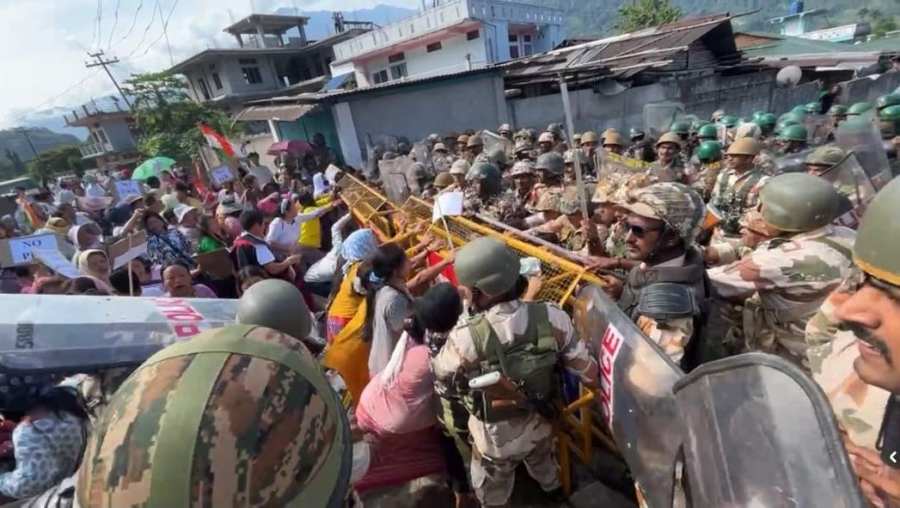
This is where the government's offer of dialogue runs into the reality on the ground. It is asking communities to sit across the table while the people who have been speaking most openly about the project are in custody—Talom, Ebo Mili and Otul Jerang remain behind bars.
The government may see the release of the four Geku residents as a step toward building confidence and for their families it was certainly a relief. Yet releasing some people while others remain in custody does not settle the wider concerns. Nor does inviting people to meet the Chief Minister address the unease caused by continued paramilitary deployment in the villages.
The attempt to begin negotiations is welcome. Yet it has come after months of protests, arrests, detention, and growing distrust. The government cannot expect confidence to return simply by announcing that it is ready to listen. Its actions on the ground will matter just as much as its statements.
Releasing detainees, addressing concerns over security deployment, ensuring transparency in legal proceedings, and taking the questions raised by residents seriously are all part of creating an atmosphere in which talks can take place. That does not appear to be happening.
For people in the Siang region, the uncertainty surrounding SUMP remains part of their everyday life. They continue to worry about the proposed project, the PFR process, and the future of the land and river on which their lives depend. The invitation to dialogue may still offer a way forward. Without a change in the conditions that have for sure deepened the distrust, however, it risks being too little, too late.
(Marina Dai is an independent journalist based in Arunachal Pradesh)