
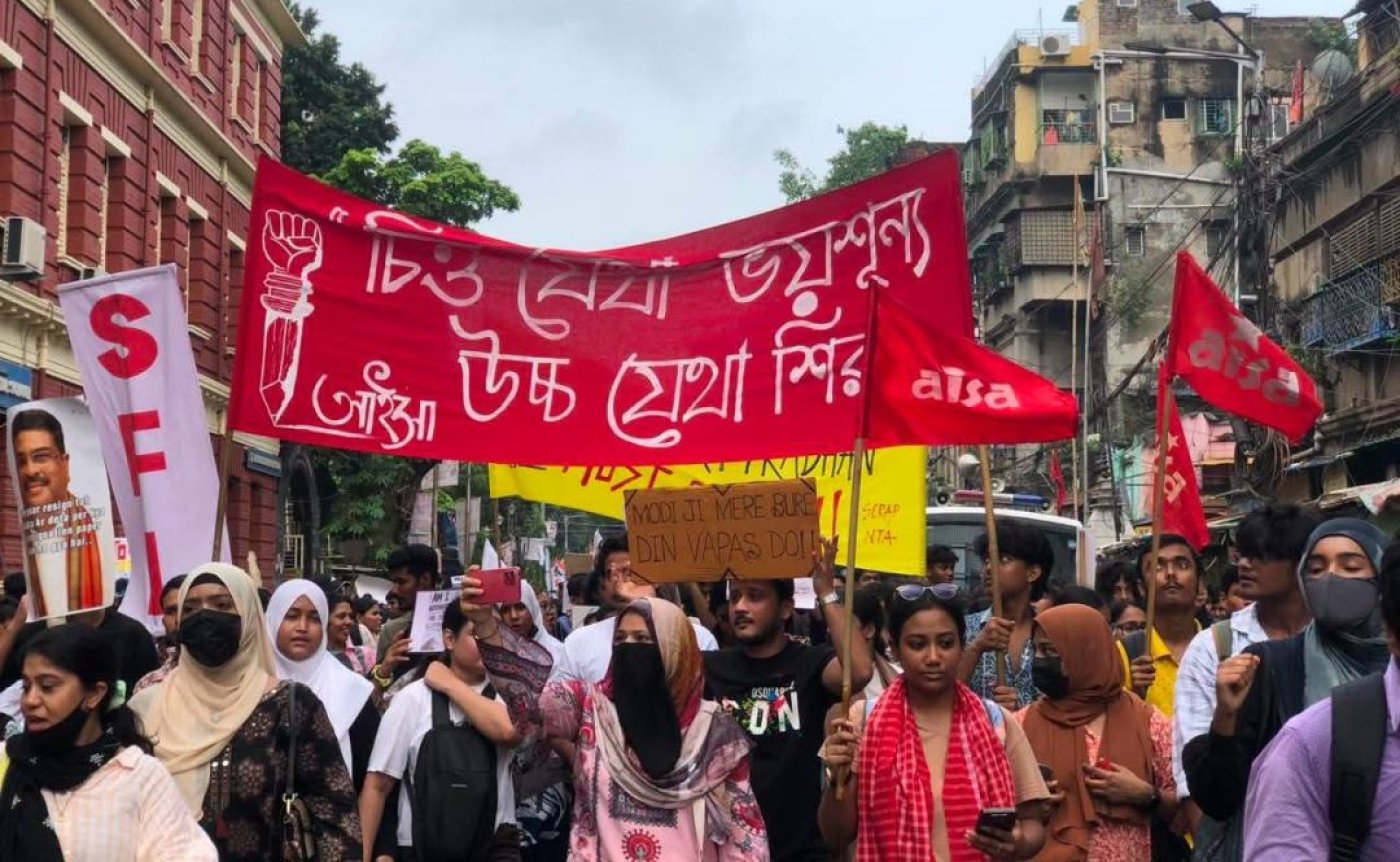
Kolkata: On 25 July 2026, 12 days after his new law came into force—to supposedly dismantle networks of communist and Trinamool Congress goons—West Bengal's chief minister rose in the Assembly to announce its first use.
Around 70 people “identified” from the previous day's protest in the old colonial neighbourhood of Dharmatala over exam-paper leaks, Adhikari told the House, were “not students”; seven first information reports (FIRs) had been registered, with the new Act's provisions written into the cases.
The next day, police arrested 14 people—13 of them Muslims—as Adhikari alleged that “Islamic fundamentalists”, possibly with “foreign backing”, were responsible for violence during the protests.
Those named would face punishment “their next three generations will remember”, said Adhikari. That meant a statute sold to the legislature as a shield against gangsters was, on its maiden outing, slapped on people identified at a protest, without following the normal process of criminal law.
That did not appear to be a misuse of the new law. It is, as everything that follows will show, the use.
There is a particular kind of historical vertigo that a Calcutta lawyer feels reading the West Bengal Public Safety and Control of Anti-Social Activities Act, 2026 (in force from 13 July 2026).
In 1923, the colonial government of Bengal enacted the Goondas Act—Bengal Act I of 1923, “An Act to provide for the control of certain Goondas residing in, or frequenting Calcutta … and for their removal elsewhere”—empowering the commissioner of police to report any person who was a goonda and to have him removed from Calcutta without a trial.
The Act deliberately declined to define the goonda. As the historian Sugata Nandi has shown in his study of the statute, Respectable Anxiety, Plebeian Criminality: Politics of the Goondas Act (1923) of Colonial Calcutta, the law “deliberately did not define the goonda, as it was ‘known’ to all in the city who he was”.
A century later, an elected government—a government that campaigned against precisely the “goonda culture” it now claims a monopoly to define—has reinvented the same instrument, asking us to receive it as public safety.
A Circular Definition
The tell is in the definition. Section 2(a) of the 2026 Act defines “anti-social activity” as “anti-social acting in any manner which causes” one of seven listed harms. Read that again: the definition defines the term by the term. A circular definition is an empty vessel, and an empty vessel can be filled by whoever holds it.
When one of the seven limbs sweeps in anything causing “alarm, danger, fear or insecurity among the general public or any section thereof,” and another reaches illegal mining and sand extraction “causing loss to the exchequer”, the statute has told us that it does not really have a subject at all. It has a mood—the mood of a state that would like the power to decide, case by case, who is dangerous.
To read section 2(d), which defines the “goonda,” is to watch the colonial genealogy surface in the text. It reaches, of course, the person charge-sheeted—not convicted, charge-sheeted—under sections 111 and 112 of the Bharatiya Nyaya Sanhita: the snatching and shoplifting of the urban poor.
But it also reaches, in a phrase lifted almost verbatim from the imagination of 1923, anyone “generally reputed to be desperate and dangerous to the community.” Reputation, not conduct, not proof, not even a specific allegation, but the sedimented social knowledge of who is trouble.
This is the exact vice for which the Supreme Court struck down the Central Provinces and Berar Goondas Act in State of Madhya Pradesh vs Baldeo Prasad (1961), 1961, which likewise supplied no test and prescribed no procedure. Sixty-five years later, the Bengal legislature has re-enacted the vice that Baldeo Prasad condemned, and it has done so knowingly.
A History Of The ‘Desperate’ & ‘Dangerous’
“Reputation” is never neutral. The category of the person “reputed to be desperate and dangerous” has a history in India, and it runs directly from the Criminal Tribes Act of 1871, which declared entire communities criminal by birth.
When those communities were “denotified” in 1952, the Habitual Offenders Acts inherited the surveillance, and the suspicion, and the denotified and nomadic communities continued to be policed as though criminality were heritable.
“Generally reputed” is the phrase in which caste, class, religion and migrant status do their slated work. A statute that turns detention on reputation does not detain at random; it detains along the grain of existing prejudice.
That is not an incidental risk of the Act. It is the mechanism of the Act.
Consider next the collapse that lies at the heart of every preventive detention law and that this one performs with unusual candour: the collapse of the distinction between “law and order” and “public order”.
The Supreme Court has policed that boundary for six decades, from Ram Manohar Lohia vs State of Bihar (1966), which drew the three concentric circles of law and order, public order and security of the State, through to the Telangana line of cases—Banka Sneha Sheela vs State of Telangana (2021) and Mallada K. Sri Ram v. State of Telangana (2022)—in which the Court, wearily quashing detention order after detention order, held that a mere apprehension of a breach of law and order cannot found preventive detention.
In Mallada K Sri Ram, the Court recorded at paragraph 18 that “in the last five years, this Court has quashed over five detention orders under the Telangana Act of 1986,” that “these numbers evince a callous exercise of the exceptional power of preventive detention by the detaining authorities and the respondent-state”.
The 2026 Act reads as though this jurisprudence did not exist. By making "alarm" and "fear" among "any section" of the public the trigger, it dissolves the very distinction that the Constitution's structure requires the State to respect.
Inverting The Burden Of Proof
And it dissolves the deeper premise, the one the Court articulated most fully in Ameena Begum vs State of Telangana (2023): that preventive detention is an exception, to be reserved for the rarest circumstance in which the ordinary criminal law is genuinely incapable of meeting the threat.
Ameena Begum inverts the burden—the State must show why the ordinary process will not do. The 2026 Act inverts Ameena Begum. Its Statement of Objects and Reasons offers a single, unembarrassed sentence: the existing laws “were found to be inefficient and inadequate”. There are no data, no diagnosis, no demonstration. As the Court held in Rekha vs State of Tamil Nadu (2011), preventive detention cannot be a substitute for the failure to investigate and prosecute.
Here the substitution is the design.
The architecture of Article 22 is where the Act does its most sophisticated damage, because here it is compliant in form and diluted in substance. Section 3(4) allows a district magistrate's order to run for 15 days, excluding public holidays, before the state government needs to approve it—against 12 days under the National Security Act (NSA).
Extraordinary Phrases
Section 7(2) requires that the grounds be furnished only “as far as practicable.” Section 7(3) permits the withholding of facts on grounds of "public order" or "public safety”, the very grounds of the detention. Section 7(5) purports to validate a detention even where the grounds are “non-existent”, a phrase so extraordinary that it inverts Icchu Devi Choraria vs Union of India (1980), where the Court held that a single vague or irrelevant ground vitiates the entire order.
Sections 10(4) and 10(7) exclude the legal practitioner from the Advisory Board; 1982’s A.K. Roy vs Union of India held that a detenu cannot be left to face the State's legal apparatus unassisted. Section 12 caps detention at twelve months; Section 13 permits a fresh order the moment the cap is reached.
Section 17 authorises warrantless search and seizure under a general order, with no reasons, no magistrate and no time limit. Section 19 makes every offence cognizable and non-bailable.
The Act observes the letter of Article 22(5)—communicate the grounds, afford the representation—in a manner engineered to defeat the purpose the letter was meant to serve. The tragedy of A.K. Gopalan's proceduralism, which Maneka Gandhi was supposed to have buried, returns here dressed in the form of compliance.
Shutting The Door
Then there is the companion statute, which deserves as much attention as the Act it accompanies: the West Bengal Maintenance of Public Order (Amendment) Act 2026, passed the same day—carried by 176 votes to 42, with 20 abstentions—which establishes Claims Commissions, vested with the powers of a civil court, to assess and recover the cost of damage to public and private property during riots, unlawful assemblies and violent protests.
The Bengal amendment is not without precedent; it belongs to a recent and distinctly partisan legislative lineage. At least five other states have enacted dedicated recovery laws: Uttar Pradesh in 2020; Madhya Pradesh, Haryana and Tripura in 2021; and Uttarakhand in 2024.
All five were enacted under BJP governments or BJP-led coalitions, and establish Claims Tribunals or comparable special forums to determine liability for damage arising from protests, riots and other disturbances to public order.
Bengal has thus borrowed a device developed and replicated in BJP-ruled states: the displacement of ordinary civil adjudication by a state-created tribunal for imposing protest-related financial liability.
The Commission may fasten liability not only on those who committed the damage but, in terms, on “organisers, financiers, instigators and logistical supporters”, and unpaid awards “may be recovered as arrears of land revenue through attachment and auction of property”.
The awards are final: the Bill provides that “the decision of the Claims Commission will be final, with no appeal allowed before any court”. This is a body that is not a court, adjudicating civil liability that flows from an alleged crime, imposing it on people defined by their political role—organiser, financier, instigator—and executing it against their homes, with the courthouse door locked behind the award.
This is punishment before, and instead of, trial. In In re: Destruction of Public and Private Properties (2009) and again in Kodungallur Film Society vs Union of India (2018), the Supreme Court built a careful framework for such recovery, anchored at every step in the courts. Bengal's model severs that anchor. It does to the recovery of damages what the UP Recovery of Damages ordinance did in 2020—the ordinance that followed the anti-CAA protests, against which the Supreme Court faulted the Uttar Pradesh government for acting as “complainant, adjudicator and prosecutor” in its own cause, directing it to withdraw the 274 recovery notices it had issued.
And it runs directly into the teeth of the Court's 2024 judgment in In re: Directions in the matter of demolition of structures, the "bulldozer justice" case, in which the Court held that the executive cannot pronounce guilt, that punitive action against property inflicts "collective punishment" on the innocent.
A Claims Commission whose non-appealable award ends in the auction of a home is the bulldozer, re-engineered as a revenue instrument and given a hearing officer.
Political Adversaries As Targets
We should be honest about the timing, because the law itself is not shy about it. The chief minister who moved the Bill—Adhikari, who also holds the Home portfolio—has described its purpose in the plainest terms.
“There was a government of communist thugs for 34 years. Then there was a government of Trinamool goons for 15 years. This law was very necessary to seize them,” he said on 14 July 2026.
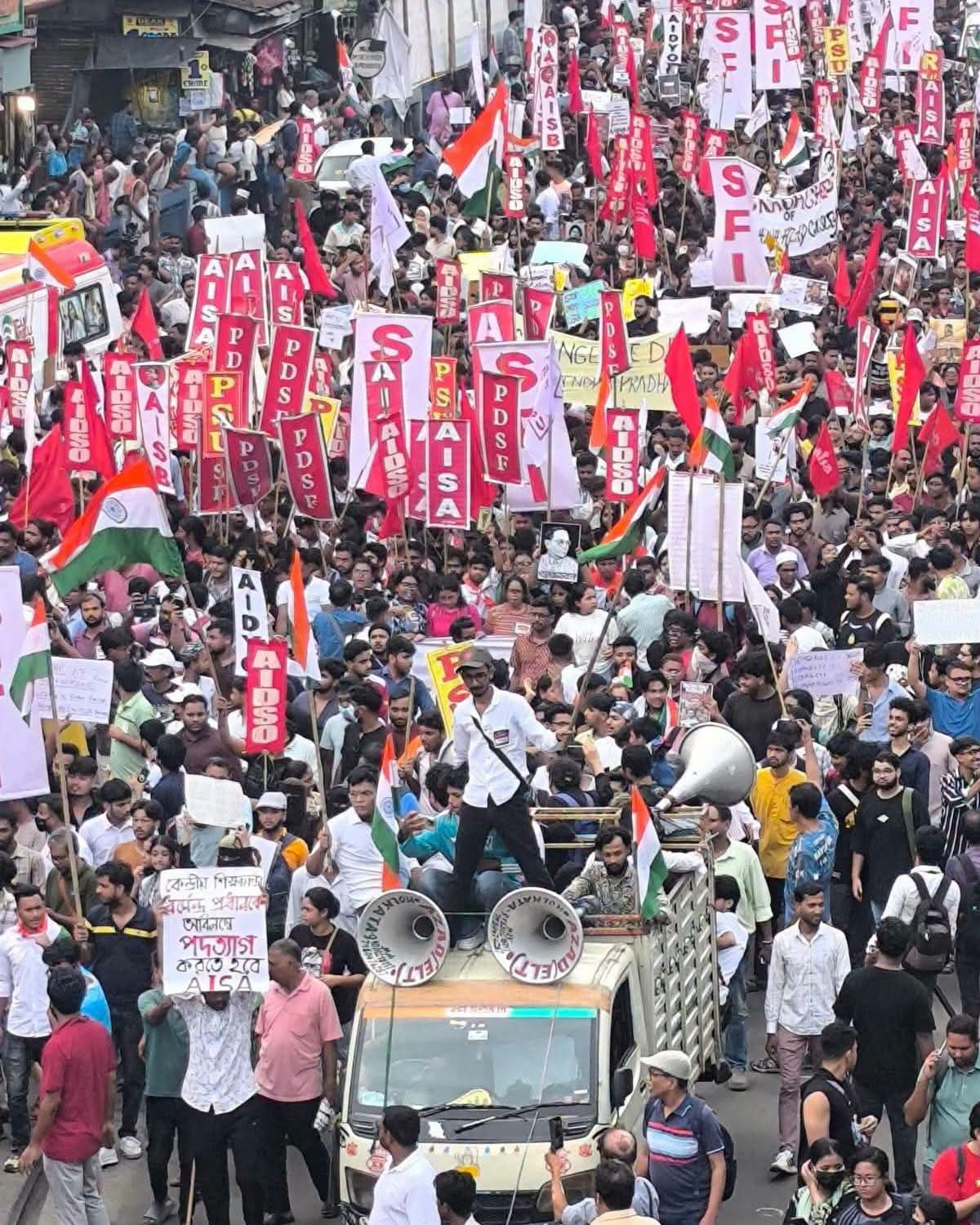
A preventive detention law introduced within weeks of a change of power, by a home minister who is also the chief minister, who names his political adversaries as its intended objects, wears its dominant purpose on its face. When “violent protests” are folded into “anti-social activity”, the chilling effect that Shreya Singhal vs Union of India (2015) identified reaches the trade unionist, the student, the anti-eviction organiser, the journalist.
In the Assembly, Indian Secular Front member of the legislative assembly Naushad Siddiqui asked the obvious question: if the Bharatiya Nyaya Sanhita already deals with riots and obstruction, “What is the need for a new bill? … people fear their right to protest will be curtailed.”
The Supreme Court has repeatedly affirmed that the freedoms of speech and assembly are not the state's to switch off for administrative convenience. A law that lets the State pre-classify a protest as anti-social does exactly that.
Constitutional Objections
The constitutional objections are many and, in my view, formidable: that the Act is ultra vires Article 22(4); that it is manifestly arbitrary under the standard of Shayara Bano vs Union of India (2017); that it is void for vagueness under Baldeo Prasad, K.A. Abbas and Shreya Singhal; that its property provisions violate Article 300A and the presumption of innocence; and that, absent Presidential assent, it is repugnant to the NSA, the BNSS and the Prevention of Damage to Public Property Act under the doctrine of Kaiser-i-Hind. A public interest litigation has already been filed in the Calcutta High Court.
The Supreme Court's preventive-detention jurisprudence makes the fate of any Goonda Act depressingly predictable.
The Court may sever an offending clause, read down an overbroad provision or quash a detention order, but it rarely places the statute itself in constitutional jeopardy. That reflects four judicial choices. In A.K. Roy, the Court transformed what the Constitution's framers viewed as an exceptional, transitional power into a permanent feature of governance.
Since then, it has largely insulated preventive-detention laws from doctrines—vagueness, manifest arbitrariness and proportionality—that it routinely applies elsewhere.
Through severance and reading down, it repeatedly repairs defective statutes, assuming the role of legislative co-drafter instead of requiring the State to bear the constitutional cost of enacting them. And by confining review to individual habeas petitions, it may rescue a detenu while leaving intact the legal architecture that produces detention on an industrial scale.
Yet Article 22 prescribes minimum safeguards; it does not immunise preventive-detention laws from scrutiny under Articles 14, 19 and 21. The constitutional tools to test the Act as a whole already exist in Maneka Gandhi, Shreya Singhal, Shayara Bano and Ameena Begum. Unless those doctrines are brought to bear on the legislation itself, the Court risks becoming less the guardian of liberty than the editor of the laws by which liberty is taken away.
The litigation, however it fares, is not the whole of the answer. Courts strike down orders one detainee at a time; they rarely strike down the political imagination that produces them.
The deeper failure the 2026 Act reveals is a failure of imagination about what citizens are. A constitutional order treats the citizen as a bearer of rights who may occasionally offend, and whom the State must prove to have offended before it may punish. This statute treats the citizen as a suspect who may occasionally be innocent, and whom the State may detain, extern and dispossess on the strength of what she is “reputed” to be.
That inversion is not cured by a severance order. It is cured only by a political culture that refuses to govern by detention without trial.
The measure of our constitutionalism will not be whether the Calcutta High Court reads down section 7(5). It will be whether we can still recognise, in the figure of the “goonda generally reputed to be desperate and dangerous”, not an enemy of the public but a fellow citizen whom the Constitution was written to protect—including, and especially, from us.
(Jhuma Sen is an advocate and practices in the Calcutta High Court.)
Get exclusive access to new databases, expert analyses, weekly newsletters, book excerpts and new ideas on democracy, law and society in India. Subscribe to Article 14.