
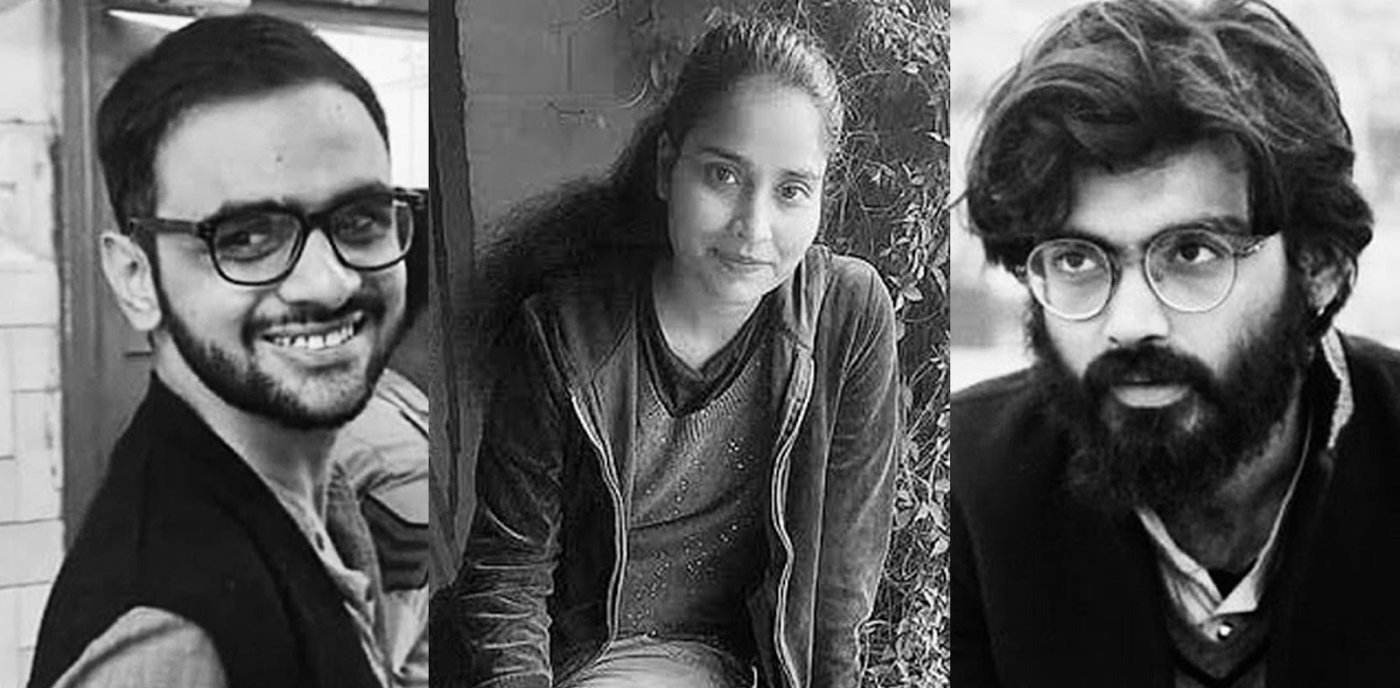
Delhi: Senior advocate Kapil Sibal, appearing this month for political activist Umar Khalid in his bail hearing, told a Supreme Court bench that a key conspiratorial meeting, allegedly held on 8 January 2020 between three co-accused to plan the communal riots of February 2020, never took place.
Sibal said the mobile location data showed that Khalid Saifi, a social activist and businessman, had left Shaheen Bagh by 9:30 pm, Khalid arrived at 11:31 pm, and Tahir Hussain, a former councillor, was never there that day.
And yet, when it was the State’s turn to argue, additional solicitor general S Raju said the meeting had taken place. He did not explain the discrepancy between what the mobile phone locations showed and the allegation, saying only that there were no calls between 7:58 pm and 8:54 pm that day, and that, in the absence of calls, the location could not be captured.
Raju cited the police witness whose testimony on this alleged meeting was dismissed by a trial court judge, who described it as “sketchy” and “does not appeal to the senses”, and criticised the police for “non-application of mind which goes to the extent of vindictiveness”.
In effect, in a case involving terrorism, murder and sedition charges, which could carry a life sentence or even the death penalty, the State’s claim of a key conspiratorial meeting rests on a witness whose testimony was already found unreliable by a trial court, without any explanation for the mobile phone location data that shows the accused were never actually there together.
Noting that there have been fabrications in what the police call the larger conspiracy case of the Delhi riots and other riots cases discovered by the trial courts in the past five years, Sibal, in his closing remarks, questioned the police’s credibility: “Now, if this is the conduct found by a judicial decision, what authority does this organisation have at all, except a motive?”
When arguments were heard before the Supreme Court this month, a crucial round that could be the last chance for bail for the foreseeable future, the prosecution once again laid bare the glaring lack of evidence against Khalid and the other Muslim activists, who have spent more than five years, some close to six years, in jail without bail or trial.
Our reporting over the years shows the case against them is mainly built on inference and conjecture, aimed at linking the riots to activists involved in the movement against the Citizenship Amendment Act (CAA), 2019, and alleging that they planned to escalate from sit-in protests to violent chakka jams (roadblocks) that would trigger communal violence in northeast Delhi.
Raju’s remark before the Supreme Court, which had no legal bearing, showed the political nature of the case: “When intellectuals become terrorists, they become more dangerous than those on the ground.”
Of the 53 people killed in the riots in northeast Delhi in 2020, three-quarters were Muslim. Of the 18 accused, 16 are Muslim, and six have received bail.
The Supreme Court’s more recent bail decisions under the Unlawful Activities (Prevention) Act, 1967, which balance the counterterrorism law’s strict bail rules with the right to life and liberty, allow a “surface-level” review of the probative value of evidence and grant bail amid long trial delays, have so far not been extended to the accused.
When the Delhi High Court rejected bail pleas of ten accused, including Khalid’s, in September, Justices Shalinder Kaur and Navin Chawla seemingly ignored the Supreme Court’s thrust on giving bail in cases of long delays while appearing to accept the prosecution’s claims at face value, without the prescribed surface-level analysis.
Some of their bail pleas languished for three years before the high court.
Bail arguments before Justices Aravind Kumar and NV Anjaria for seven of the accused concluded on 10 December 2025, and the Supreme Court’s judgment is awaited.
The January 8 Meeting
The police witness for the 8 January meeting, as Khalid’s lawyer, senior advocate Trideep Pais, has repeatedly pointed out in the trial court and the Delhi High Court bail proceedings over the years, gave four different statements in five months. In his very first statement, he never mentioned the meeting.
Pais has also argued that Khalid’s mobile location doesn’t support the claim that he was at Shaheen Bagh. But when the Delhi High Court first denied him bail in October 2022, it didn’t seem to consider that point or the trial court’s discrediting of the police witness as relevant.
“Although a point has been raised based on CDR analysis that these three never met at the same time, but what we have at first look discerned from all of this so far is that the three of them met and while there seemed no contradiction as far as the factum of meeting of the trio was concerned, variance was only to the limited extent of the witness stating that he was present inside or outside the office,” the bench of Justice Rajnish Bhatnagar and Justice Siddharth Mridul said.
Before he was incarcerated in September 2020, Khalid said that he had never met Tahir Hussain, and he was not asked about the meeting when the police questioned him on 31 July 2020. “This is absolutely false and does not have an iota of truth…” he said.
The police claim Hussain admitted to meeting Khalid, but the evidence from mobile phone locations, which Sibal gave in court, does not support the claim.
Another police fabrication was that conspirators were to discuss timing the riots with President Donald Trump’s visit. But that story collapsed once it became clear that no public information about the visit was available until 13 January 2020, five days after the alleged meeting, and that the visit dates were reported on 11 February.
While Pais had already told the courts about the mobile phone locations, this time Sibal went further, detailing exactly where each of the three accused was—information Khalid’s lawyers might have been hoping to save for the trial.
With defence lawyers pressing to secure bail for the 38-year-old JNU PhD, who has spent five years and three months in custody and has come to symbolise Muslim resistance amid deepening Islamophobia, and with the State equally determined to keep him incarcerated, both sides have advanced extensive arguments, turning the bail hearings into proceedings that resemble a full-fledged trial.
A Political Case
In this round of arguments before the Supreme Court, the State sought to widen the case dramatically, recasting it from one about communal riots into an alleged plot for regime change, the severing of the Northeast from the rest of the country, and the economic strangulation of Delhi and Assam, claims that were never core allegations in the case itself.
While arguing for Gulfisha Fatima, a 32-year-old Muslim woman and MBA graduate, who has been jailed for five years and eight months without bail or trial, senior advocate Abhishek Manu Singhvi said, “It was never the prosecution’s case that the protest was to bring about regime change. This allegation of a pan-India conspiracy is quite extraordinary.”
“What kind of criminal prosecution are these generalities? The object of prosecution cannot be to keep me inside by hook or crook,” he said.
The defence lawyers said the accused were not in a position to tamper with witnesses and documents, flee or disrupt law and order, so there was no public interest served in keeping them locked up.
While closing his arguments, Sibal said that the years-long pre-trial detention was ultimately a case of dissent being criminalised.
“There is no point in keeping us in jail,” said Sibal. “If you have a case against me, prosecute me, convict me and send me to jail, but you can’t keep me incarcerated, as if to say we will punish you for your protest, that will be the law of the country.”
The Case For Bail
Under the cover of the expansive crime of conspiracy, the contours which are challenging to understand, the police have forced connections between the accused that do not exist, linked unrelated events and made mundane, innocuous encounters, meetings and messages appear dangerous, all without tying the allegations against the accused to any violence on the ground, and without recovering any physical evidence of any kind.
The police case is built on statements from protected individuals (whose identities have been hidden), most of them identical and vague, some demonstrably false, and a handful of messages from WhatsApp groups created to coordinate the protest, populated with scores of people with different viewpoints on how to carry them out.
The police have not explained why these Muslim students and activists were singled out while others on the WhatsApp group or within the movement, who were in fact the senders of messages, were not.
The so-called “secret” meetings to plan the riots, which were attended by many, including now-deemed police witnesses, could have been reported to the police at any time if anything nefarious or violent was being planned.
Ironically, the chargesheet relies on a photo of one such secret meeting, which is “downloaded from the Facebook account of one of the participants,” and shows eight young people squashed together on a couch.
Other photos show people like Harsh Mander, a former civil servant and veteran human rights activist, and Yogendra Yadav, a prominent political scientist, who this year wrote about Umar Khalid: “If he (Umar Khalid) is in jail for saying the CAA was anti‑Muslim, I should be too. If Khalid Saifi is in jail for coordinating local protests against the CAA, I should be too.”
Another false claim suggests that a WhatsApp group called MSJ (Muslim Students of JNU) was created by Sharjeel Imam at Khalid’s direction, even though there is no evidence to support this. He was added to the group, and he never sent a single message.
“Being added to a WhatsApp group is not a criminal act,” said Sibal. “Several persons added to the MSG group have not been arrested or arraigned.”
Sharjeel Imam, a 37-year-old alumnus of IIT Delhi and JNU, has been, after Khalid, one of the main targets of the police, who have been eager to draw a connection between the two. It is clear that, while both opposed the law, their politics and methods differed.
There was nothing incendiary in Khalid’s speech, in which he said Mahatma Gandhi’s weapons were non-violence, civil disobedience, and non-cooperation, delivered in Maharashtra on 17 February 2020, a week before riots broke out 1,500 km away in Delhi.
It is the only speech the police have against Khalid, and they obtained the whole speech in July, five months after the FIR was registered in March 2020. In the meantime, authorities had access only to fragments of the speech circulated via a tweet by the head of the BJP IT cell, along with the message, ”Was the violence in Delhi planned weeks in advance by the Tukde Tukde gang?”, amplified by pro-government television channels.
Sharjeel Imam has been widely vilified for his speeches, especially a now-infamous line from an address at Aligarh Muslim University on 16 January 2020, calling for mainland India to be cut off from the Northeast. The remark was unpalatable but arguably protected under free speech as upheld by the Supreme Court, even at the peak of the Khalistan movement, and the court’s position that the violence caused should have a direct nexus to the speech.
Multiple cases were filed against Imam in different states for his speeches under provisions like sedition, promoting enmity between different groups, and assertions prejudicial to national integration. He was granted bail or default bail when the police failed to file chargesheets on time.
Imam was arrested on 28 January 2020, six weeks before the riots, and there is scant evidence linking him to the communal violence that took place.
“Speech, speech, speech. Speech is one part. What more did I do for a conspiracy?” his lawyer, senior advocate Siddharth Dave, told the Supreme Court. “Surely they have some evidence. I must have met people, I must have done something.”
“I’ve been labelled as anti-national and as a dangerous terrorist,” said Dave. “Not one conviction to date.”
Imam, who has been incarcerated for five years and eleven months in connection with the Delhi riots case and cases related to his speeches, has spent the longest time in jail.
Misleading The Court
The prosecution has also tried to mislead the court. For instance, Raju told the Supreme Court that co-accused Tasleem sent six messages to Khalid from 5 January to 22 February 2020, suggesting he was coordinating the protests. What he didn’t mention was that Khalid never replied, and Tasleem had to introduce himself twice, indicating Khalid did not know him, or barely did.
Another instance of misleading the court was the insistence that the “four weeks” mentioned by accused Sharjeel Imam in his 23 January 2020 speech referred to US President Donald Trump’s visit to India. It did not. Imam was actually referring to the four weeks the Supreme Court had given the Union government on 22 January 2020 to respond to over 100 petitions challenging the citizenship law. Solicitor General Tushar Mehta misled the Delhi High Court, and Raju repeated the same in the Supreme Court.
When we asked him about it, Mehta said, “I have argued both—court date be tentative date of Trump’s visit, correlating with other evidence after dates of visits were declared.”
Delay
The primary ground for seeking bail has been the prolonged delay in the trial.
A total of five chargesheets were filed following the first information report (FIR), which was registered on 6 March 2020, with the last one coming three years later, in June 2023.
Still, the prosecution tried to shift the blame onto the defence.
Some defence lawyers hesitated to begin arguments on the charges in September 2023—the stage where the charges are formally framed before the trial court—until the police said the investigation in this case was complete.
The prosecution argued the accused had no legal right to know when the investigation ended, but given the case’s political and vindictive nature, defence lawyers were concerned the police might strengthen their case after hearing their argument. Their fears were justified, as the police had bolstered their case in connection with the 13 December 2020 student protest against the citizenship law, which turned violent.
Even the additional sessions judge, Sameer Bajpai, who is hearing the arguments on the charge, told the police to specify when the investigation was completed.
After the police informed the court in September 2024 that the investigation against all 18 accused had been completed, proceedings on the charges commenced. Each accused has taken two or three hearings to present their case, with eight having done so so far.
Any delay on the part of the accused is minimal compared to the extraordinary delays by the police: three years to complete the investigation, an additional year to confirm that the investigation was complete, and earlier delays in providing hard copies of the main chargesheet, which runs into thousands of pages.
The State’s apparent disregard for the court and the lives of the accused was again on display when Mehta initially stated that the trial would conclude in six months, only for Raju to revise the timeline to two years a few hearings later.
While the delay in trial is the primary factor relevant to bail, the prolonged delay in processing bail, particularly before the Delhi High Court, is also deeply egregious.
Arguing on behalf of Gulfisha Fatima, Singhvi told the Supreme Court that her bail plea had been pending for three years and had already come before the High Court three times since May 2022—once before a bench that reserved its judgment, again before a second bench that did not, and finally before a third bench, which dismissed it.
Her bail application was listed 90 times, the bench was unavailable 25 times, and the matter was renotified for arguments 26 times.
“Each time there is a delay of one year, as if one year is nothing,” said Singhvi. “This will make a caricature of our criminal justice system. Nobody should be punished like this until they are convicted.”
Parity
In addition to the trial delays, lawyers also raised the issue of parity, similar treatment.
They argued that the accused deserve the same treatment as Devangana Kalita, Natasha Narwal, and Asif Iqbal Tanha, whom the Delhi High Court granted bail in June 2021, while observing that “shorn-off the superfluous verbiage, hyperbole and the stretched inferences”, there was no case made out under the UAPA and the State has “blurred the line between the constitutionally guaranteed right to protest and terrorist activity.”
Justices Siddharth Mridul and Anup Jairam Bhambani said that “making of inflammatory speeches, organising chakkajams are not uncommon” when there is widespread opposition to the government.
The police immediately challenged the bail and obtained a stay on the High Court's legal interpretation of the UAPA from the Supreme Court.
In May 2023, the court upheld bail for the three and allowed the co-accused to apply for bail on parity of treatment based on the facts, while the stay on the legal interpretation of the UAPA remained in effect.
While rejecting bail in September, the Delhi High Court did not undertake a fact-and logic-driven analysis that would have clearly made a case for parity.
Pointing out that Fatima is now the only Muslim woman still in jail, Singhvi highlighted that the allegations against her are the same—or perhaps even less severe—than those levelled against Kalita and Narwal.
She was part of the same WhatsApp groups, attended the same meetings, and was allegedly involved in calls to stockpile red chilli powder, acid bottles, and sticks—claims made by protected police witnesses, with no such items ever recovered from her.
“What will she do if she is released?” said Singhvi. “Will she tamper with witnesses and destroy documents after five chargesheets and five and a half years of investigation. Will she flee before the eyes of the Supreme Court and the whole world? What public interest are you serving by keeping her in jail and objecting so vociferously?”
(Betwa Sharma is managing editor of Article 14.)
Get exclusive access to new databases, expert analyses, weekly newsletters, book excerpts and new ideas on democracy, law and society in India. Subscribe to Article 14.