
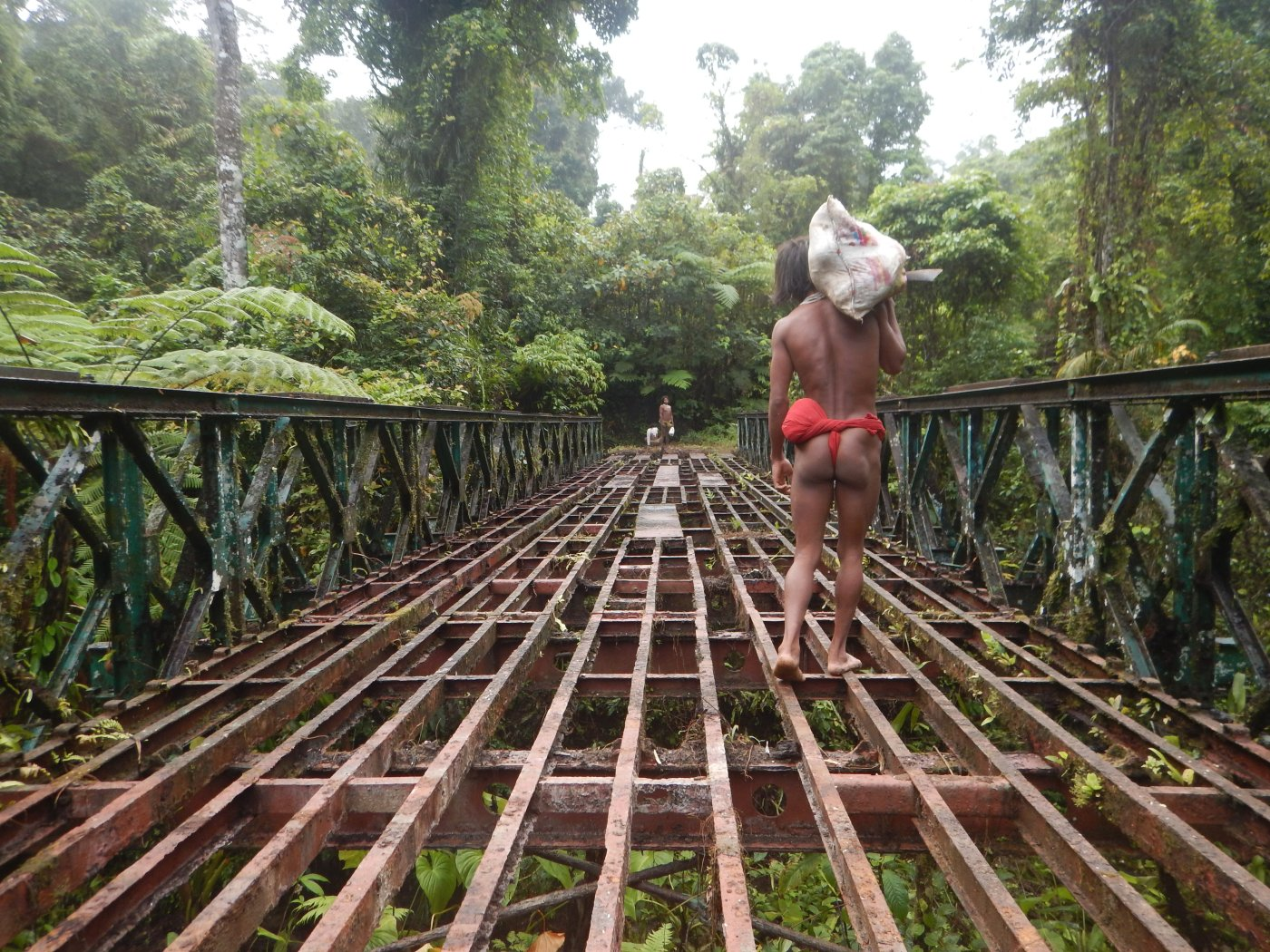
Andaman and Nicobar Islands: “Before, it was the British Raj. Today, these people rule.”
The “these people” that Biswajit Mondal, an auto driver in Sri Vijaya puram (or Port Blair), capital of the Andaman and Nicobar archipelago, referred to are the Andaman Adim Janjati Vikas Samiti (AAJVS), an autonomous body under the Andaman and Nicobar administration, “to look after the interest” of the main tribal groups—the Great Andamanese, Jarawa, Onge, Sentinelese and Shompen—spread across five islands in the Andaman Sea.
These communities are classified as particularly vulnerable tribal groups (PVTGs) in government records, based on criteria like “pre-agricultural level of technology, low-level of literacy, economic backwardness and a declining or stagnant population”.
The mandate of AAJVS is to oversee the implementation of governmental welfare measures for these communities.
We met Mondal in Ferrargunj, a district in the South Andaman Island. Mondal previously worked with AAJVS on a contract basis, under the formal title of a ‘daily rate mazdoor ’.
“These people are tribal welfare officers only in name,” alleged Mondal. “Their real welfare is for poachers. How to assist the entry of poachers [into the forests of the Jarawa, a tribe], how to get out safely and if they’re caught, how to help with their release.”
As he spoke, he handed over letter after letter he had written in the last four years, raising concerns and formal complaints to the Andaman and Nicobar administration about AAJVS.
Those letters went unanswered, as were his verbal complaints when he worked with AAJVS. He was removed from his job in June 2022 because he raised complaints, Mondal alleged.
Since then, he has been running an auto in South Andaman Island.
AAJVS, whose members are almost exclusively mainlanders and non-tribal, was established in 1976 and is headed by the lieutenant governor and the chief secretary of the Andaman and Nicobar Islands, which include 500 islands, of which fewer than 40 are inhabited.
Even the organisation's name needs to change, said experts. “Adim Janjati”, meaning “primitive forest-dwelling folk” in Hindi, is considered derogatory.
The AAJVS has 15 other members on the executive council, including anthropologists, social workers, and representatives from the Andaman and Nicobar administration. Registered under the Societies Registration Act, 1860, the AAJVS focuses on welfare, providing free rations, medical aid, and other essential goods, including fishing tools.
Millions Of Trees At Risk
In August 2022, AAJVS assumed a right to sign away Shompen lands, a right that it was not legally entitled to, three former members confirmed to us—including one of the founding members, anthropologist Triloknath Pandit—sparking a chain of clearances that enabled one of India’s most contentious projects to take shape, the Rs. 92,000 crore Great Nicobar mega project.
The project involves cutting about 10 million trees in an ancient rainforest that is home to numerous endemic and endangered species, such as the Nicobar megapode and the Giant leatherback turtle. The project also seeks to take over vast swathes of tribal lands without tribal consent.
The Nicobarese community withdrew the clearance just three months after it was granted in August 2022, stating they were rushed to sign it on the very first day they were made aware of it, without time to consult the community.
Yet the project continues to move forward.
On 28 April 2026, leader of the Opposition, Rahul Gandhi, visited Great Nicobar island and met with the Nicobarese community who raised concerns about their lands being taken over by the project. In a post on X, Gandhi called the project “one of the biggest scams and gravest crimes against this country’s natural and tribal heritage in our lifetime”.
In response, the Modi government on 1 May repeated the claim that tribal welfare “remains central” to the project and that it involved “no displacement” of the Shompen and the Nicobarese.
This is a false claim because the project envisages a take over of many forest homes of both tribes without their consent.
Article 14 sought comments via email on 3 April 2026 from the Lt Governor, D K Joshi and the chief secretary, Chandra Bhushan Kumar, and on 10 April from the director of the tribal welfare department, Rakesh Das, of the Andaman and Nicobar administration, about the lack of legitimacy in the AAJVS signing away Shompen lands.
On 3 April 2026, we sent questions via email to the union tribal affairs minister, Jual Oram, and to Antar Singh Arya, the chairperson of the National Commission for Scheduled Tribes, asking if they were aware that AAJVS had assumed authority to sign the NOC on behalf of the Shompen.
There was no response.
The 1 May government response to Gandhi had this to say: “The project has also secured a no-objection certificate [NoC] from the tribal affairs ministry, with due adherence to the Forest Rights Act, 2006.”
‘The NOC Is Illegitimate’
The AAJVS signed the no-objection certificate for forest “diversion”—an official term for permission to cut more than a million trees in an ancient, pristine rainforest, in this case, on behalf of the Shompen on that island.
Two tribes of Southeast Asian descent are indigenous to the island: the Nicobarese, who mostly live along the island’s south and west coast and the Shompen, who inhabit the interior of the island’s lush forests.
“AAJVS has no right to do this,” said Pandit. “The NOC is illegitimate.”
The Great Nicobar project, which will occupy a third of the island, ignores the ancestral claims of the Nicobarese and the Shompen, who continue to live in the rainforest, their future uncertain and the plan for them, if any, not made public.
Article 14 sought comment from Papu Rao, an AAJVS officer whose signature appears on the NOC.
“The project doesn’t come under Shompen land, no?” Rao said over a phone call. “Shompen stay inside the forests.”
But when asked about Shompen areas like Kokeon, south of the island, which will be taken over by the project, Papu Rao stayed silent.
The Shompen are a semi-nomadic community that has lived on Great Nicobar Island for thousands of years alongside the Nicobarese. The Shompen inhabit the island's interior forests, living largely isolated lives, and their language is as yet undeciphered.
Rao asked us to contact Mohan Kuruvilla, an administrative officer at AAJVS, who did not answer calls or respond to WhatsApp messages.
Contradictions In Consent
Union environment ministry clearances for the project were challenged by Meena Gupta, a former secretary of the ministry of tribal affairs and the ministry of environment, in 2024 before the Calcutta High Court for allegedly violating consent procedures and forest rights of the Nicobarese—who have been demanding a return to their ancestral forest lands after being displaced by a 2004 tsunami—and the Shompen.
The petition also includes challenges to the “illegitimate” NOC signed by AAJVS on behalf of the Shompen.
“You see, the Shompen have an integral association with the environment,” said Pandit, who was the head of the Andaman and Nicobar Regional Centre of the Anthropological Survey of India, by virtue of which he became an AAJVS founding member.
“For such hunting and food gathering communities, the environment—that is, the land, the ocean, the air and the water—is an integral part of their community,” said Pandit.
Pandit said such relationships were built over thousands of years. “They use the environment to the extent that it is necessary [to life],” he said. “AAJVS has no authority to surrender the autonomy of the Shompen and their special relationship with the environment.”
The union government said in August, 2024 that the Great Nicobar project would not displace the local tribes, but The Hindu reported on 4 April 2026 that the local administration had prepared a relocation plan.
Government lawyers told the Calcutta High Court that they would “demonstrate” consent of the tribal communities in 15 days, the paper reported.
The next hearing is scheduled for 6 May 2026.
“The bulldozer moves on unmindful of the concerns of the local communities,” former union environment minister and Congress spokesperson Jairam Ramesh said in an X post on 4 April. “But there is a fundamental contradiction here: the Modi Govt claims that the Great Nicobar infra project will not disturb or displace tribes—then why a relocation plan? Clearly, the claim is a lie.”
Ashish Kothari, an environmentalist and founder of Kalpavriksh and Conservation Action Trust, the two petitioners who challenged the controversial project in the country’s top environmental court, the National Green Tribunal (NGT), lost the case.
On 16 February, the NGT said that “the project has great significance not only for the economic development of the island and the surrounding areas of strategic location but also for defence and national security”.
The order can be challenged in the Supreme Court. The project has also not yet received final forest clearance, which is legally required under the Forest (Conservation) Act, 1980.
Dubious Details
The full extent of the Shompen lands to be taken over for the Great Nicobar project remains unclear. Much about the project has been criticised, and due process given short shrift, experts and others have said.
Plans for the project, once called India’s “alternative to Hong Kong” by a former chief secretary, include an international airport, a transhipment terminal, gas and solar power plants, a township, and tourism facilities.
Great Nicobar is the southernmost tip of India and lies at a strategic spot, less than 200 km north of the Indonesian island of Sumatra. It is hilly and covered with lush rainforests, sustained by around 3,500 mm of annual rainfall. Mangroves line its coast.
This reporter has previously written about how tribal lands in Great Nicobar Island have never been systematically mapped by the government, and how India’s top wildlife and biodiversity institutes tasked with assessing the environmental impact of the Great Nicobar project were pressured to deliver favourable reports.
While a 130 sq km swathe of ancient rainforest will be razed—with “compensatory afforestation” in Haryana, about 2,400 km to the northwest—scientists were pressured to report that fragile habitats could be translocated, and that the ecological impact of a shipping terminal, power plants, airport and township would be minimal.
Since the Shompen are semi-nomadic—unlike the Nicobarese, who are largely settled, work as daily wage labour and forage for forest resources—they use vast tracts of the forests in Great Nicobar Island.
About 750 sq km of the island's 920 sq km is categorised as a tribal reserve in government records.
It is unclear how the AAJVS reached the conclusion that the Shompen had no objection, as there had been no official consultations with the Shompen community.
The only contact about the project was recorded in a five-year-old video.
Contact Led To Refusal
“When we spoke to [some members of] the Shompen community, they categorically stated on camera that they do not want anyone coming into their forests,” said Manish Chandi, previously a member of an advisory board of the Andaman Nicobar Tribal Research Institute, a former entity of the department of tribal welfare from 2011 to 2018.
“We” refers to an empowered committee formed in 2020 by the Andaman and Nicobar administration and the NITI Aayog, a union government think tank, to understand on-the-ground sentiments about the mega project.
In the empowered committee’s interaction with the Shompen, they said they did not want any intrusions into their hills and forests.
“They said this in the presence of AAJVS field staff and an officer in the tribal welfare department,” said Chandi.
The interaction between the committee and members of the Shompen community was captured on video and submitted to the administration. Chandi was a member of this committee.
Since it is difficult to communicate with the Shompen, the committee members used Mathias, a Nicobarese who understands their language. Mathias also works with the AAJVS as a daily-rated mazdoor.
AAJVS has no employees from the Shompen community because the community is largely uncontacted, as we said, and lives deep in the forest on Great Nicobar Island.
The report has not been released publicly, but some video clips were included in a 2021 webinar. “There is no real understanding within the AAJVS of who the Shompen are and their relationship with natural resources in the island,” said Chandi.
It was during his decades-long work in Great Nicobar that Chandi introduced AAJVS to Mathias and recommended his full employment. Mathias, the only interpreter in Shompen contacts, remains on a daily wage despite having served for more than 15 years.
Poaching & Other Allegations
Mondal's complaints to the Andaman and Nicobar administration detail AAJVS officials allegedly safeguarding poachers of wild boar and venison, enabling illegal fishing and crab-hunting in Jarawa reserve forests, and supplying the Jarawa with tobacco, alcohol, rice and spices for forest access—alongside AAJVS-assisted smuggling of Padauk wood, a prized timber native to the islands.
Anstice Justin, former deputy director of the Anthropological Survey of India's Port Blair centre, confirmed that such complaints about AAJVS have been raised for over two decades without any independent investigation by the administration.
"These complaints should have been investigated," said Pandit, the founding AAJVS member. Mondal alleged he was told to keep quiet about these issues while working at AAJVS; he was eventually removed for allegedly failing to perform his duties.
Independent research appears to corroborate some of these concerns. A May 2020 study by the Centre for Equity Studies, a think tank based in New Delhi, alleged that "early recruits to the AAJVS were known to engage in sexual exploitation, introduction of intoxicants and poaching of pork and venison”. One of the study’s co-authors was human rights activist and former Indian Administrative Service officer, Harsh Mander.
A PhD thesis from the University of North Bengal similarly documents the negative impacts of bartering on the Jarawa by AAJVS officials.
Chandi alleged that wild boars were “being poached out of existence” in Little Andaman Island. “And the fish, lobsters and crabs that the Jarawa and Sentinelese consume from reefs near the Andaman islands and North Sentinel are going to the export market,” he said.
Such poaching is also a question of the exploitation of resources that belong to indigenous communities.
Over the years, experts and also the Union tribal ministry itself have suggested (here and here) that the AAJVS dole policy needs review, noting the negative dependency impacts and that certain items supplied, such as rice and lentils, were earlier alien to such vulnerable tribes.
For example, the Shompen cultivate taro and various kinds of tubers, alongside other commonly known fruits and vegetables, such as bananas, chillies, and lemons. Such activities can be supported, if needed, rather than supplying rice and lentils, which they cannot grow but become dependent on, said Chandi.
(Rishika Pardikar is a freelance environment and climate reporter covering science, law and policy. She lives in Bengaluru.)
Get exclusive access to new databases, expert analyses, weekly newsletters, book excerpts and new ideas on democracy, law and society in India. Subscribe to Article 14.