
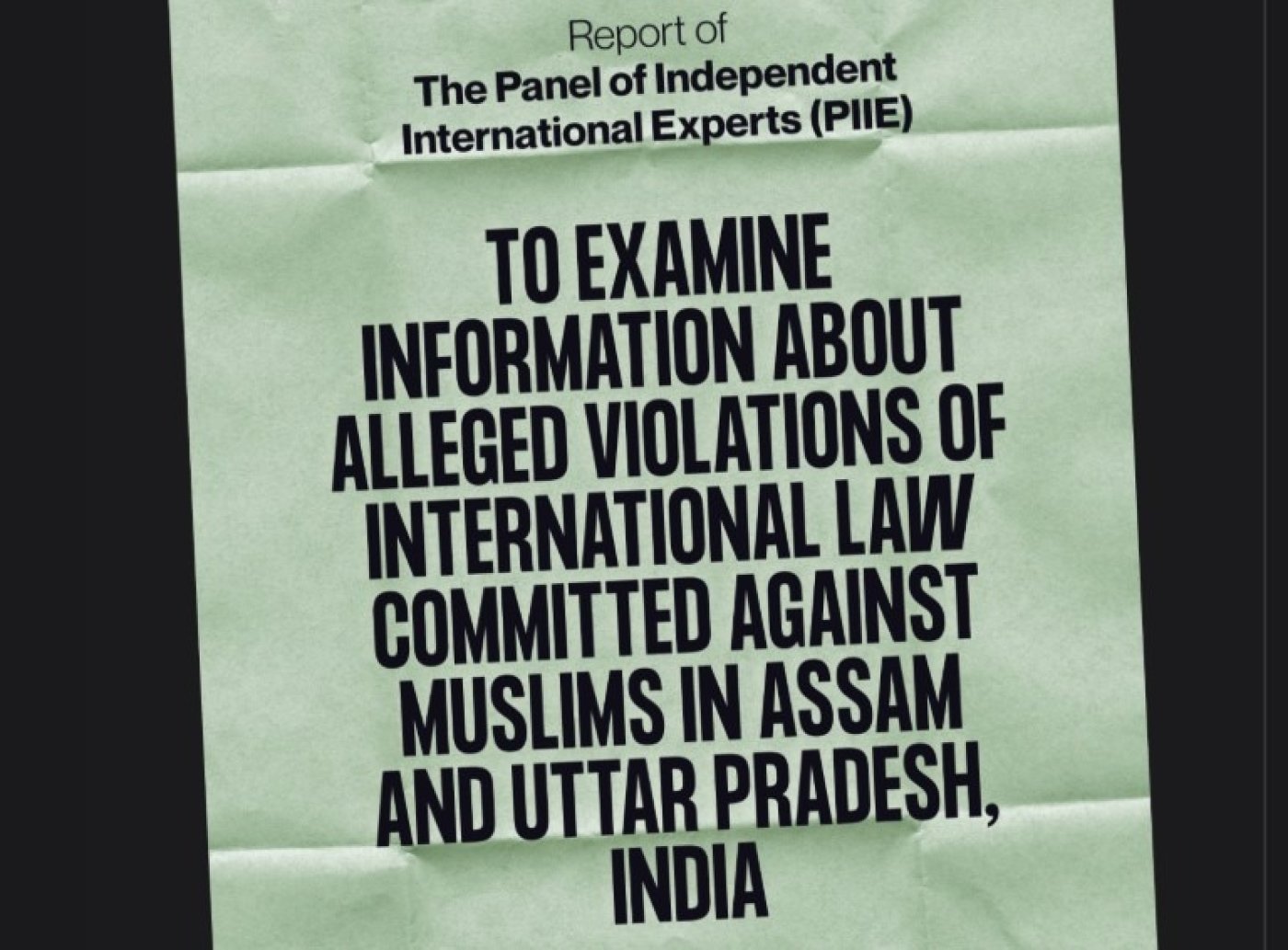
A March 2026 report by three independent human rights experts, published by the Transnational Legal Clinic at King’s College London, says “systematic discrimination” and anti-Muslim crimes in Assam and Uttar Pradesh from 2022 to 2025 may constitute international crimes, including crimes against humanity.
In his foreword to the report, Report of the Panel of Independent Experts To Examine Information About Alleged Violations Of International Law Committed Against Muslims in Assam and Uttar Pradesh (2022-2025), retired Indian Supreme Court judge Justice Madan Lokur wrote:
“Experts of this calibre turning their attention to India reflects the gravity of what is unfolding. The eyes of the region and the world are on us. The spirit of this age will be defined by those in power—and by whether the Constitution remains a living document or becomes a dead letter for millions. What we do now will determine the nation we are remembered as.”
The said experts are Sonja Biserko (president, Helsinki Committee for Human Rights in Serbia; member, UN inquiry on North Korea), Marzuki Darusman (former attorney general of Indonesia; chaired UN panels on Sri Lanka and Myanmar), and Stephen Rapp (former chief prosecutor for Rwanda and Sierra Leone tribunals; former US Ambassador-at-Large for War Crimes Issues).
The panel of experts found credible evidence of “systemic discrimination” against Muslims in both states, denying them equal protection and rights in violation of international law, and found reasonable grounds to believe that “international crimes” may have been committed against them.
The panel found that repeated statements by the chief minister of Assam, Hemanta Biswa Sarma, portraying Bengali-speaking Muslims as “infiltrators” and existential threats, and invoking violent confrontation, appear to be “preparing the ground for ethnic cleansing”.
It also identified a pattern of conduct in Assam that “may amount to crimes against humanity”, including “deportation or forcible transfer” through “large-scale expulsions”, a “pattern of hate speech”, “forced evictions and home demolitions”.
And the “systematic stripping of citizenship, legality and residence from Bengali-speaking Muslims in Assam may amount to apartheid as a crime against humanity, involving inhumane acts committed within an institutionalised regime of systematic oppression and domination over a racialised group”.
The panel found that several practices in Uttar Pradesh may amount to crimes against humanity, including so-called “half-encounter maimings” by police, amounting to torture, “a widespread and institutionalised pattern of anti-Muslim hate speech”, “the official targeting of Muslims protesting discrimination”, “discriminatory enforcement against Muslims in meat-related trades”, and a “widespread and systematic pattern of abusive and punitive policing” causing “suffering or serious injury”.
The number of documented anti-Muslim hate speeches given by top public officials from 2024 to 2025 includes 81 by Prime Minister Narendra Modi, 85 by home minister Amit Shah, 52 by Sarma, and 108 by UP chief minister Yogi Adityanath.
On methodology, the report said the panel reviewed evidence compiled by legal researchers, experts, victims, civil society, and journalists (including reports by this publication) on alleged serious human rights violations against Muslims in the two states from July 2022 to January 2026. It assessed the material under international human rights and criminal law, including whether credible information indicated violations, possible perpetrators, and the effectiveness of domestic remedies.
Sources included victim testimony, government records, court documents, and social media, and the process was guided by UN fact-finding principles of independence, impartiality, objectivity, and “do no harm.”
The Laws In Question
Article 7 of the Rome Statute of the International Criminal Court (ICC), “crimes against humanity”, includes and defines “‘apartheid” as “inhumane acts” including deportation or forcible transfer of population, imprisonment or other severe deprivation of physical liberty in violation of fundamental rules of international law and persecution of any identifiable group or collectivity on political, racial, national, ethnic, cultural, religious, gender grounds, “committed in the context of an institutionalized regime of systematic oppression and domination by one racial group over any other racial group or groups and committed with the intention of maintaining that regime”.
India has not signed nor ratified the Rome Statute that established the ICC, meaning it does not formally recognise its jurisdiction.
Noting that India is not a party to the Rome Statute—the only treaty that defines ‘crimes against humanity’—the panel’s analysis was also based on other international conventions and treaties, including the Universal Declaration of Human Rights, International Covenant on Civil and Political Rights, International Covenant on Economic, Social and Cultural Rights, The International Convention on the Elimination of All Forms of Racial Discrimination, Convention on the Elimination of All Forms of Discrimination against Women, Convention on the Rights of the Child, the Genocide Convention and the Apartheid Convention, which India is a party to.
Findings On Uttar Pradesh
Since 2017, Uttar Pradesh Police have carried out over 16,284 recorded “encounter” operations, resulting in 266 deaths, including at least 48 in 2025 alone, the highest annual toll, while official data shows Muslims are disproportionately affected, accounting for over 32% of those killed despite making up about 19% of the population.
At least 56 Muslims were grievously injured in 2024 in so-called “half-encounters”.
An encounter is often an extrajudicial killing when police kill suspects outside due process, without trial or judicial oversight.
In UP, a half encounter refers to an alleged police practice in which suspects are deliberately shot in the leg, typically below the knee, rather than fatally wounded.
No FIRs were registered by the police for encounters or half encounters.
The panel said the remedies available to Muslims in Uttar Pradesh are “ineffective in practice”, leaving those affected by the documented violations with “no realistic prospect of justice through domestic channels”.
Findings On Assam
Official data shows that between May 2021 and August 2022, 171 police encounters led to 56 deaths and 146 injuries in Assam. By January 2024, media reports put the death toll at 83, with over 45 victims (54%) identified as Bengali-speaking Muslims, who make up about 34% of the state’s population.
Between July 2022 and December 2025, there were 67 recorded Muslim fatalities in mob lynchings and other religiously motivated hate crimes nationwide, including 15 in Uttar Pradesh and 5 in Assam.
Since 2016, at least 17,600 families have been evicted, with reports since 2022 indicating a sharp acceleration in the scale and frequency of these drives under Sarma.
Between 7 May and 3 July 2025, at least 1,880 Muslims were expelled to Bangladesh across 22 border points, including around 100 Rohingya refugees, while statements by Sarma indicate that at least 2,450 people had been expelled from Assam by January 2026, with projections of 10,000 to 50,000 more expulsions in 2026.
The panel found ongoing discrimination against Bengali-speaking Muslims in Assam’s political rights, with around 93,000 “D-voters” effectively disenfranchised without remedy.
The panel concluded that, as per the evidence, there was a campaign of “dehumanisation and incitement to violence against Muslims”, often led by “senior elected officials and Hindu religious leaders”, “to harass, boycott, expel, often assault, and sometimes kill and destroy Muslims”.
It points to a “settled pattern of inhumane acts against Muslims, in some states at least, that is widespread and systematic, amounting to severe deprivation of fundamental rights” based on Muslim identity.
“The conclusion we have arrived at, based on our factual and legal analysis of the evidence, is that the international human rights of Muslims in India, already being violated, are increasingly hardening in intensity and expanding in scope, especially in the two states in question,” the panel wrote.
The panel found that “violations under international criminal law”, including “crimes against humanity such as torture and inhumane treatment, deportation, persecution, apartheid, and ethnic cleansing”, “appear to be deepening and expanding against Muslims in Assam and Uttar Pradesh”, with no effective domestic remedy available to victims.
(Betwa Sharma is managing editor of Article 14.)
Get exclusive access to new databases, expert analyses, weekly newsletters, book excerpts and new ideas on democracy, law and society in India. Subscribe to Article 14.