
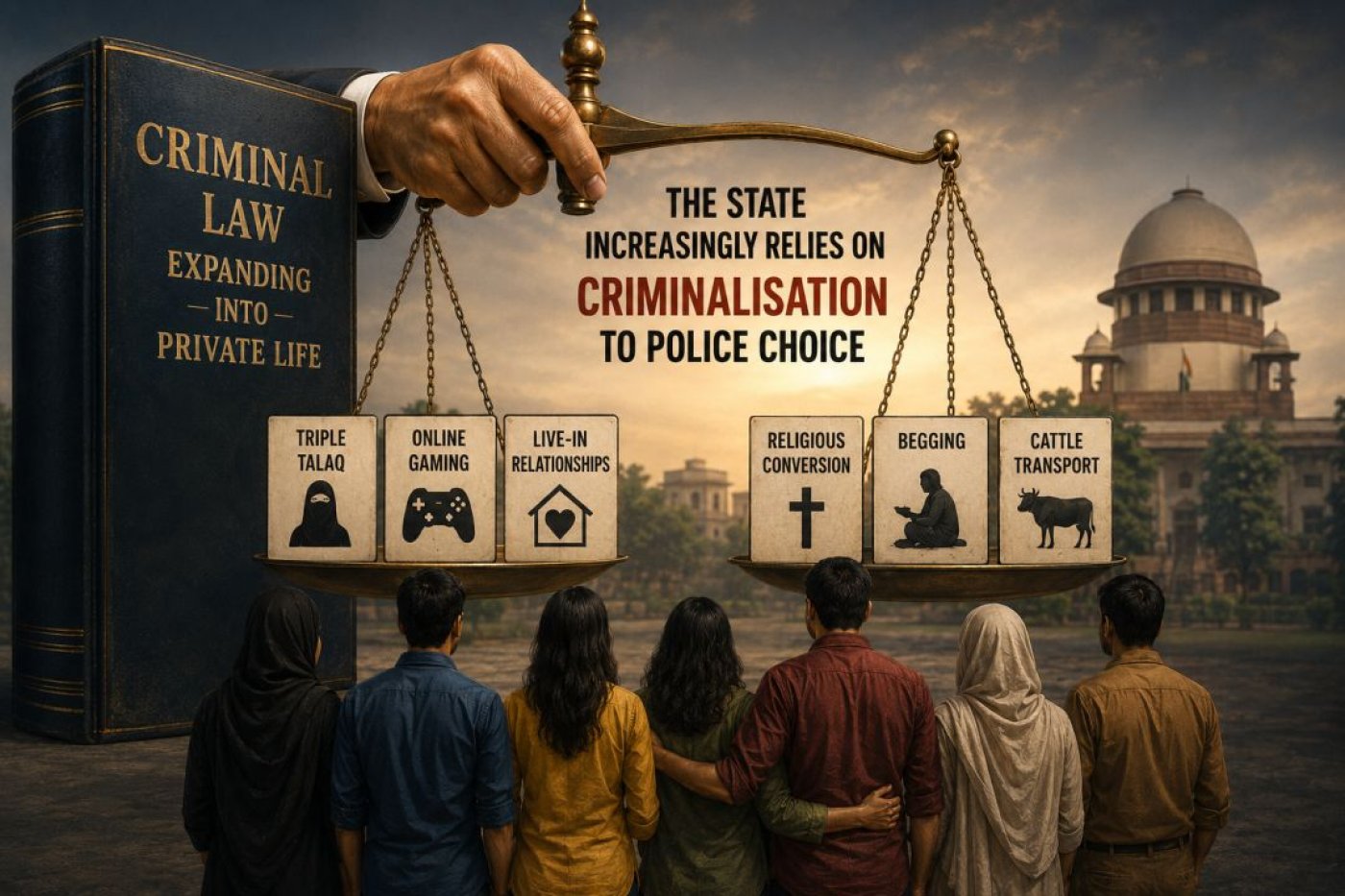
Bengaluru: Triple talaq. Online gaming. Live-in relationships. Religious conversions. Begging. Cattle transport.
Over the last 10 years, state legislatures and Parliament have criminalised certain issues of social conflict and private conduct, even as courts have cautioned against the routine use of criminal law.
An online gaming law criminalises the participation of adults in activities that courts had previously treated as lawful. Anti-conversion laws attach penal consequences to intimate relationships and shifts of faith. Interfaith couples are drawn into police processes. Failure to register a live-in relationship constitutes grounds for arrest. Orders banning begging place destitution within the reach of routine policing.
Conduct that was earlier treated as a matter of private choice or addressed through civil law is being reframed as a criminal offence. Here are some examples:
- In cities such as Indore and Bhopal, recent orders have criminalised begging and the giving of alms in public. They bring survival-based conduct within ordinary policing despite judicial warnings and the Supreme Court’s refusal to impose a blanket ban.
- The Muslim Women (Protection of Rights on Marriage) Act 2019, was one such moment. Despite the Supreme Court having declared the pronouncement of triple talaq void and unconstitutional, Parliament chose to criminalise it in 2019. The move expanded state intrusion without clearly advancing its protective aims.
- Enacted in 2025, the Promotion and Regulation of Online Gaming Act 2025 converts participation in certain online money games into a criminal offence, even where courts had earlier treated similar activities as lawful.
A similar governing logic has also appeared in several state laws. Although a few states had narrow anti-conversion statutes for decades, recent laws and amendments in Gujarat, Haryana, Himachal Pradesh, Jharkhand, Karnataka, Madhya Pradesh, Rajasthan, Uttarakhand, and Uttar Pradesh have gone much further.
They criminalise a wide range of religious conversions and, in several cases, reverse the burden of proof by requiring the accused to establish the lawfulness of a conversion rather than placing that duty on the prosecution.
Some of these laws have already met judicial resistance. High courts in Gujarat and Madhya Pradesh have stayed or struck down key provisions. Challenges to these enactments are now pending before the Supreme Court.
Uttarakhand’s Uniform Civil Code of 2024 makes failure to register live-in relationships punishable under criminal law, thereby converting non-registration under a civil regime into an offence.
An Opposite Movement
At the same time, Parliament has moved in the opposite direction in areas linked to commerce and regulation. Through reforms such as the Jan Vishwas Act 2023, criminal penalties for a range of regulatory violations have been diluted or replaced with monetary sanctions in the name of efficiency and ease of doing business.
These parallel moves reveal a broader legislative pattern. Together, they show how criminalisation and decriminalisation are deployed selectively in response to governance failure. The turn to punishment reshapes the reach of criminal law in ordinary life.
Once an act is criminalised, enforcement becomes uneven. It is shaped by social position, and its costs are borne disproportionately by those with fewer resources.
As socio-legal scholarship on policing in India has shown, enforcement discretion is not exercised neutrally or abstractly. It is embedded in institutional practices that have historically subjected marginalised groups to heightened surveillance and control rather than neutral regulation.
The Triple Talaq legislation departed from the constitutional position that emerged after Shayara Bano, in which the Supreme Court in 2017 declared the practice void and without legal effect.
Parliament nonetheless converted the pronouncement into a cognisable (meaning the police can investigate the case without court permission and arrest the accused without a warrant) and non-bailable offence in 2019.
Constitutional challenges to the statute remain pending.
In January 2025, the Supreme Court directed the union government to place nationwide figures on first information reports and chargesheets filed under the Triple Talaq Act. Ethnographic work records how women are pushed towards policing and criminal courts rather than through family-law remedies.
Once triple talaq no longer alters marital status, penal sanction operates only through the pressure of criminal consequences. Thus, the law converts marital breakdown into a matter for criminal procedure and makes punishment the primary instrument for governing such conflicts.
Criminalising Gaming
The Online Gaming Act also departs from settled principles of law. Contract law has long rested on a clear distinction. Where consent is free, the law respects individual choice.
Where consent is not free and is vitiated by fraud or misrepresentation, civil consequences follow. Such agreements are voidable, preserving the agency of the affected party. Concerns about exploitation are ordinarily addressed through these vitiating factors.
The Online Gaming Act takes a different route. It criminalises participation itself without asking whether consent is free. Further, courts had distinguished chance-based games from skill-based games and held that activities involving substantial skill may qualify as protected commercial conduct even when played for stakes.
Even where the law expressed disapproval of wagering, it refrained from enforcement rather than imposing penal consequences. This approach was also extended to online formats.
The Madras, Karnataka, and Punjab and Haryana High Courts struck down blanket prohibitions that failed to preserve the skill-chance distinction and treated such platforms as legitimate business activity protected under Article 19(1)(g) of the Constitution, which guarantees the fundamental right to practise any profession or carry on any occupation, trade or business.
Thus, this Act converts what had long been governed through civil law and judicial line-drawing into a matter for police enforcement.
Abandoning Settled Law
Uttarakhand’s live-in registration regime departs from the settled law on registration of marriage. Across India’s personal law regimes, marriage registration has been treated as a civil compliance requirement rather than a basis for criminal liability.
Laws governing Hindu, Muslim, Christian, and Parsi marriages permit or encourage registration, but non-registration attracts at most a monetary penalty and does not invalidate the marital tie.
The Law Commission has also framed marriage registration as a means of securing maintenance and legal protection. Judicial interventions followed the same logic. Courts promoted registration to reduce vulnerability and facilitate legal claims rather than to criminalise relationships.
They extended protective frameworks to live-in partnerships through domestic-violence jurisprudence and placed intimate personal choices within the right to privacy.
Such regimes convert registration from a gateway to welfare into a mechanism of surveillance, with predictable chilling effects on women, interfaith couples, and those already exposed to familial or community violence. It also raises serious concerns under the post-Puttaswamy proportionality doctrine and risks converting welfare regulation into moral policing.
Policing Intimate Choice
Recent anti-conversion statutes depart from earlier enactments, which operated through prosecution only after an alleged wrong had occurred.
The newer laws, in states such as Madhya Pradesh, Himachal Pradesh, and Uttar Pradesh, require advance declarations to a district magistrate, trigger a police inquiry before any conversion occurs, and criminalise procedural non-compliance itself. They also shift the burden of proof onto the accused.
Family members and third parties are authorised to initiate proceedings, converting intimate disagreement into policing and disproportionately subjecting women to parental and community control through criminal process.
FIRs are often lodged by relatives or local organisations rather than by the converts themselves, and arrests frequently precede any serious inquiry into the voluntariness of the conversion, as Article 14 has reported.
Data show that at least 700 people were booked under the Uttar Pradesh law since 2020, with high arrest rates but few convictions.
Article 14 reporting (here and here) has shown how protection petitions by interfaith couples have, in several instances, been rejected because courts treated non-compliance with anti-conversion formalities as a bar to relief.
The resulting pattern flows from statutory design rather than episodic misuse. The framework builds suspicion into ordinary administration and makes coercive intervention predictable even where conversions are consensual.
Criminal law thus ceases to operate as a last-resort response and becomes a governing instrument for managing intimate choice, with the process itself functioning as punishment.
The Turn To Punishment
This approach is reinforced by the expressive use of criminal law. As Cass Sunstein, a constitutional law scholar, argued in an 1996 article, the law is often used expressively when the State aims to influence norms rather than regulate conduct directly, especially where enforcement is uncertain or uneven.
Read this way, these enactments do more than regulate conduct. They recast social practices as moral wrongs and respond through punishment. The difficulty with this strategy is not merely a matter of symbolic excess.
In this sense, these laws fit within India’s broader problem of over-criminalisation. As Andrew Ashworth, a leading criminal law scholar, warned in his 1991 book, when legislatures create too many crimes, consistent enforcement becomes impossible. The result is selective policing and growing disregard for the law itself.
This stands in contrast to recent decriminalisation measures such as the Jan Vishwas reforms I referred to earlier. Regulatory offences affecting business have been softened in the name of efficiency. At the same time, conduct associated with moralised social risk has attracted harsher criminal sanctions.
Criminalisation As Governance
The expansion of criminal law also carries consequences beyond arrest and prosecution. The Criminal Procedure (Identification) Act 2022 allows police and prison authorities to collect biometric and biological data from anyone arrested for an offence, not only from those convicted.
That data may be retained in central databases for decades. Even minor allegations can trigger long-term State scrutiny. These developments show how new offences multiply coercive power and produce lasting intrusions into fundamental rights.
Criminal law is often deployed to signal condemnation rather than to regulate behaviour effectively. That expressive turn makes criminalisation politically attractive and creates conditions for uneven enforcement. Broad criminal prohibitions widen discretion and weaken the law’s protective claims.
Laws enacted in the name of protection often travel far beyond their stated purpose. Some statutes may be defensible in principle yet fail because of uneven application or institutional misuse.
Others are flawed from the outset because their assumptions cannot sustain resort to criminal punishment. The most troubling cases combine both defects. Several of the enactments discussed here exhibit this convergence precisely.
(Shantanu Pachauri is an assistant professor and co-director at the Centre for Criminal Justice Studies, School of Law, R V University, Bengaluru.)
Get exclusive access to new databases, expert analyses, weekly newsletters, book excerpts and new ideas on democracy, law and society in India. Subscribe to Article 14.