
Mumbai: As preparations for Diwali picked up pace, India heard news of a growing drought, along with bleak forecasts of heat-related deaths, crop losses, and rising food prices.
At the University of Chicago, the Climate Impact Lab said its El Niño Heat Mortality Tracker projects 373,000 excess deaths worldwide over the next six months, through the summer of 2027. About 55,000 of those would be in India. These are projections, but they offer a sobering measure of the heavy toll the “Super El Niño” is likely to take on poorer countries of the Global South, where extreme heat meets poverty, inadequate healthcare and little protection for outdoor workers.
That was not all. The International Monetary Fund identified lower crop yields and rising food prices as factors that cut into what households can afford. It listed these among the risks India faces from the developing Super El Niño, an especially intense warming of the Pacific Ocean that tends to bring weaker monsoons and hotter weather to India.
None of this belongs to a distant future or a remote place. In Maharashtra, the number of talukas declared drought-hit expanded from 265 on 25 September to 305 in mid-October. That is 85% of the state’s 358 talukas.
Gujarat and Rajasthan have declared drought in several districts, while Telangana has declared hundreds of mandals drought-affected. The details differ from state to state, but the warning is the same: too little rain has set off a chain of consequences that reaches well beyond the fields where crops fail.
Maharashtra has received about 19% less rain than normal this monsoon season. In Marathwada, a dry, drought-prone region of eight districts in central Maharashtra, the shortfall is nearly 39%, according to Skymet Weather Services rainfall data.
The Central Water Commission’s 29 October bulletin shows that India’s major reservoirs were 66% full. In western India, they were 77.64% full, compared with 97.35% at the same time last year.
Of the 38 major reservoirs monitored in Maharashtra, six hold less than half the water they normally would at this time of year. Jayakwadi, Marathwada’s biggest reservoir, was 73% full. The Manjara and Majalgaon dams, which serve the sugarcane-growing areas of Latur and Beed districts, held only 9.14% and 28.79% of their normal water levels.
Hundreds of villages in Marathwada now depend on water tankers for drinking water. As of 25 October, 463 tankers were running. In October 2025, there were none.
Many other parts of the country face similar conditions. In the west-flowing rivers of Kutch and Saurashtra, reservoir levels were as much as 60% below normal. The smaller rivers in the north-east that drain into Myanmar and Bangladesh reported the same conditions.
E-KYCs & Other Shocks
The effects of drought extend beyond India’s farms. Falling fertiliser sales point to mounting stress in agriculture, while workers struggling to find employment face bureaucratic barriers to accessing the very scheme meant to provide them a safety net.
Sales of all fertilisers are down compared to last year, The Indian Express reported, indicating the impact of El Niño on agriculture.
The crisis is also exposing problems with the Viksit Bharat–Guarantee for Rozgar & Ajeevika Mission (Gramin), or VB-GRAM(G), which replaced the Mahatma Gandhi National Rural Employment Guarantee Act in 2025.
The Swabhimani Mazdoor Sanghatana, a workers' union, sent us an illustration of how the new scheme is failing rural workers.
Work is unavailable at some sites, while workers who seek employment face documentation and compliance hurdles to register under the scheme. The union shared a letter it received from the Panchayat Samiti in Chakur, in Marathwada's Latur district. Of 73 people seeking work, only 26 could be included in the work muster. The remaining 47 had not yet completed e-KYC and banking formalities.
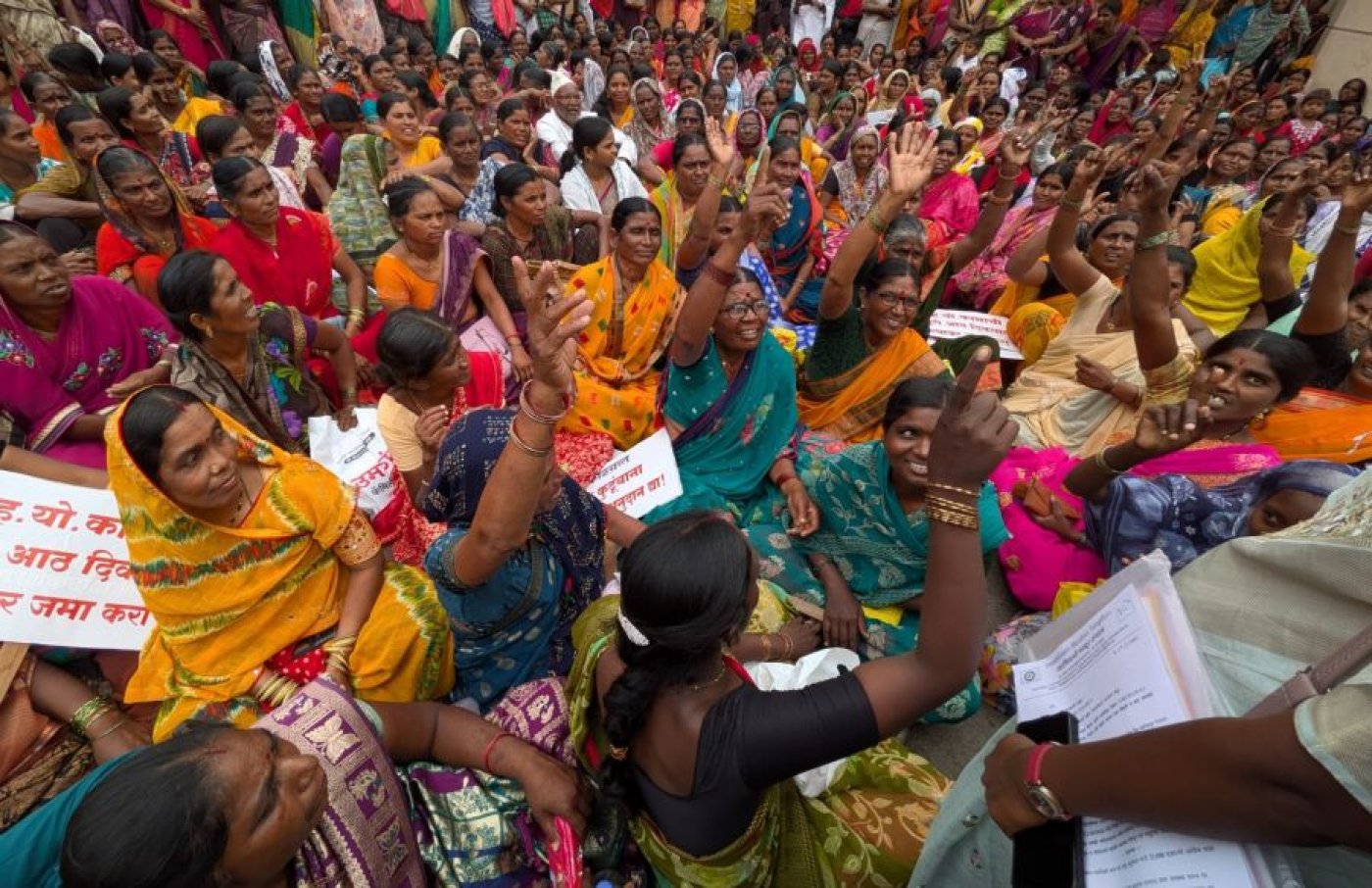
The Swabhimani Mazdoor Sanghatana is organising a series of protests across Marathwada to demand work under VB-GRAM(G), under the banner Kaam Magani Morcha. “Although applications (Form 4) have been repeatedly submitted to gram panchayats, panchayat samitis, and district collectors, and muster rolls issued, workers face systemic delays and administrative apathy,” the union's leaders said.
Hundreds of men and women joined a protest in Latur on 28 October, with further protests scheduled in Nanded and Dharashiv. Their demands include immediate provision of work, cash assistance for labourers facing drought conditions, higher employment-guarantee wages, payment of unemployment allowance, correction of technical glitches in face-recognition attendance systems and job cards, and free e-KYC for workers.
Jeewan Rathod, Maharashtra coordinator for the union, told Article 14: “Workers are forced to pay bribes just to get job cards or register attendance through flawed apps.”
Maharashtra has announced emergency measures, including crop-loan restructuring, land-revenue waivers, electricity concessions and deployment of water tankers. Necessary as these interventions are, they follow a familiar pattern in drought-prone regions and do little to reduce communities' vulnerability to the next drought.
Damage That Travels
Drought is not just a farming problem. It is an economic shock that spreads well beyond the fields it hits.
Marathwada shows how. A poor monsoon cut farm incomes and the demand for farm labour. With fewer days of work and lower wages, rural households are spending less and even eating less. Indebted families are selling livestock and other assets. Women in these households routinely put off medical treatment, and families cut spending on education, particularly for girls, and borrow to cover basic expenses.
The damage does not stop at state borders. Farm production, jobs, food supply chains and investment are all linked. A drought concentrated in a few regions can affect employment, wages and prices across the country.
India faces this at a particularly bad moment. A weak monsoon threatens food supplies and farm incomes just as costlier imported oil strains household budgets and the wider economy. Figures from the Petroleum Planning and Analysis Cell put India’s oil import bill at $90.6 billion for April to September, up 46.3% from the same months in 2025. The rise came almost entirely from higher global oil prices, not from buying more oil.
For poor and middle-class Indians alike, this is a perfect storm. Millions of households already hit by both pressures are looking to public policy to step in before temporary hardship becomes lasting poverty.
A government response built mainly around coping with a poor monsoon will not fix the economic and institutional arrangements that make each failure worse than the last.
We have known for decades what helps drought-prone regions cope: farming suited to locally available water, replenishing groundwater, and managing watersheds so rivers, reservoirs, and aquifers are treated as one connected system. Yet this knowledge has not consistently shaped farm incentives or produced clear priorities for who gets scarce water.
Procurement and pricing policies still encourage water-hungry crops, even in water-scarce regions. Meanwhile, farms, growing cities and industry compete for the same water. That raises hard questions about whose needs come first and who pays the cost of scarcity.
Misplaced Priorities
In 2018, the Bombay High Court castigated cricket administrators for wasting water on pitches for Indian Premier League matches during a severe water crisis. In 2026, India’s data centres guzzled 150 billion litres of water a year, and that figure is set to grow to 358 billion litres by 2030.
We still have no map of the vulnerabilities beyond the obvious crop losses. These include the erosion of household savings, people returning to their villages as small businesses close down, exclusion from welfare schemes because of improper documentation, the growing burden of medical expenses, and the further marginalisation of the poor on account of caste.
Despite years of drought management, we do not know which parts of the state are most likely to see children drop out of school because families cannot afford transport. We do not know which social-security systems are not designed to respond to climate shocks. As for deaths from heat, we are still finding the language needed to put cooling spaces, healthcare preparedness for heat stress, and enforceable protections for outdoor workers in place.
It is tempting to treat El Niño as an outside force that governments can do little about. But while the weather is beyond political control, how its consequences are distributed is not.
A drought does not make everyone equally thirsty, just as a rise in food prices does not burden every household equally. Those with secure incomes, savings, reliable water supplies and access to healthcare can absorb a shock. Those without them must make painful choices, often at the cost of nutrition, health, education or future livelihoods.
Policy must therefore ask not only how much water remains, but who gets it; not only how much crop production is lost, but who bears the loss; and not only how much relief is handed out, but whether it stops households from sliding deeper into poverty.
This means governments must move beyond the familiar cycle of forecasts, declarations, concessions and relief. It requires clear priorities for allocating water, climate plans suited to each region, reliable rural employment, and social protection that can expand when livelihoods shrink.
A Drought Of Political Imagination
India cannot legislate a good monsoon into existence, but we should require public accountability for whether mitigation measures reduce vulnerability over time. (For now, overwhelmingly, they do not.)
In response to the Maharashtra government’s call to manage water availability carefully, the press releases from government agencies have started trickling in about strengthening monitoring of water supply. The coming months will see inboxes flooded with news about relief measures delivered, water tankers mobilised, perhaps a water train like the one that went to Latur in 2016. These have all the makings of a spectacle.
On the other side of the immediate crisis, India will continue to organise agriculture, economic activity and urban growth as though a plentiful monsoon is guaranteed.
This Super El Niño will test India's ability to manage heat, water scarcity and food insecurity, but the deeper test is whether the country can govern the conditions that turn climate shocks into prolonged and worsening human suffering.
The drought that demands urgent attention is not only the one unfolding in the fields. It is also the drought of political imagination that allows the same vulnerabilities to return with every failed monsoon.
(Kavitha Iyer is a member of the editorial board of Article 14 and the author of Landscapes of Loss, a book on India’s agrarian crisis.)
Get exclusive access to new databases, expert analyses, weekly newsletters, book excerpts and new ideas on democracy, law and society in India. Subscribe to Article 14.