
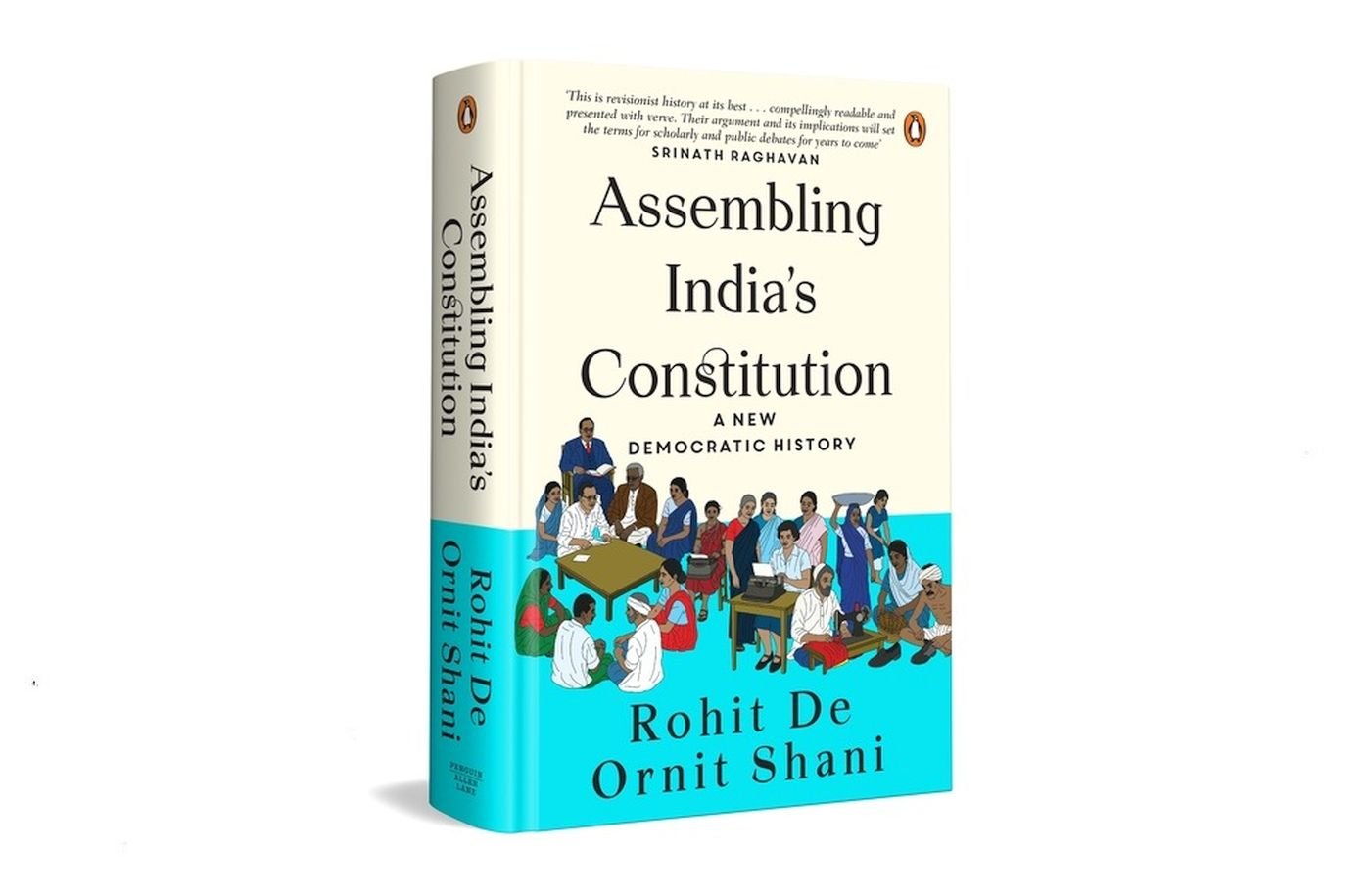
Assembling India’s Constitution: A New Democratic History by historians Rohit De and Ornit Shani turns the gaze away from the Constituent Assembly debates to offer a new history and a new paradigm for understanding the making of India’s constitution. The book reveals the existence of multiple, parallel constitution-making processes underway across the subcontinent, arguing that the Indian constitution was not solely an elite exercise anchored in the Constituent Assembly in Delhi. Informed by their lived social realities and experiences, the Indian public deeply engaged with the future constitution, in an organic process that emerged from below. From the sparsely populated Spiti and Lahaul region in the northern Himalayas to the small village of Kattunedungulam in the deep south, from the remote Chittagong Hill Tracts in the east to the numerous princely states of Saurashtra in the west, and even as far away as Stockton, California, diverse Indian publics debated the future constitution and made constitutional demands.
As the authors argue, “The vibrant life of the constitution-in-the-making outside formal legal chambers was critical for its future reception, legitimacy, and endurance. Moreover, the deep sense of ownership the public assumed over the constitution through their engagements with its making became pivotal to the formation of India’s democracy against arduous challenges and many odds.” The book, they write, offers “a history of public constitutional struggles for a constitution that people were convinced would change their lives for the better. It remains an open struggle.”
The excerpt below explores how Dalit men, women, and groups across the country engaged with the constitution-making process. They raised critical and still pertinent issues of the violence of the caste system, and its implications for building a democratic society.
—---------------------------------------------------------------------------------------------
EXCERPT
The principles and ideas that Indians channelled into their conception of an ideal constitution were informed by their daily life. Caste is one of the most important determinants to Indians. Caste not only placed all Indians on a hierarchy, it also determined what work one did, where one could live, who one could marry, what one could eat and with whom, among other things. The constitutional imaginations that were unshackled in 1946 declared, in Upendra Baxi’s words, ‘a normative war against the foundational violence’ of caste hierarchies. Indeed, the constitution ultimately outlawed untouchability, serfdom, and bonded labour, and provided for redistributive justice through affirmative action in ways that were unprecedented in comparative constitutionalism at that time. It is therefore not surprising that the most intense struggles were over the constitution’s potential to radically change the social order based on caste.
When Mr S. Uppiliappan of Kattunedungulam village, in the Sivaganga district, read an announcement in the newspapers regarding proposed constitutional safeguards for minority communities, he decided he should write to the Constituent Assembly. He wrote his memorandum by hand, in Tamil. The secretariat of the Constituent Assembly, despite being headed by Tamilian, was unable to decipher the letter. They forwarded it to the Press Information Bureau in New Delhi, which was also headed by a Tamilian, for assistance. But he, too, was unable to translate the letter, and so he sent it to the regional office of the Press Information Bureau in Madras. In a one-page note in English, the Madras Bureau wrote that the memorandum ‘is unintelligible in several places’, and that ‘it is not possible to make out what he [Mr S. Uppiliappan] means’. With some ‘difficulty’, however, the Bureau identified Mr Uppiliappan’s key points, which centered on special privileges and safeguards for his community in the constitution. The Bureau could not identify the community the author belonged to, but believed that it was a Hindu minority community, and speculated that he might be a ‘scheduled caste’ or dalit.
The Madras Bureau likely thought this because Mr Uppiliappan demanded, for instance, that ‘members of his community should have’ freedom of worship and autonomy to manage their own community. But these demands could equally have been made by a member of an upper caste or a scheduled caste. Indeed, his demand that ‘localities, urban and rural, where people of his community reside should be constituted into separate self-governing “colonies”, entry into which should be restricted to people of his own community and creed’, could represent the aspiration for constitutional guarantees of either group. Upper caste groups might be seeking to protect themselves from anticipated changes that might dismantle ritual and caste segregation. But scheduled caste groups might be demanding ‘separate settlements for untouchables to improve their economic position and escape discrimination by caste Hindus [upper castes]’, and to ensure that the transformation in the social order would not fall short of the promises made to them.
Already, both provincial legislatures and princely states had begun to pass laws prohibiting and punishing caste discrimination, exacerbating these different anxieties. Dalit parties, associations, and individuals started to prepare for their self-determination within the future constitution. Their sense of determination and urgency was driven by the fact that the British had failed to ensure any specific safeguards for scheduled castes during the transfer of power negotiations. Nor had dalits been recognised as a separate group (like Muslims and Sikhs) deserving distinct representation in the Constituent Assembly. Instead, they had been included in the “General” category along with caste Hindus and all other minorities. Dalit organisations took to the streets to remind future constitution makers that ‘sixty million people with democratic rights cannot be crushed’.
From the 1930s, dalits had organised at an all-India level under two broad umbrella organisations, the All India Depressed Castes League, which was closely linked to the Congress Party, and the Scheduled Caste Federation (SCF), whose leaders included Dr B. R. Ambedkar. Much has been made of the ‘crisis’ of dalit politics in 1946, and the apparent divide over rights and representation between these parties, but dalits’ constitutional demands show wide consensus across organisational lines.
In June and July 1946, the SCF protested the betrayal of dalit interests in the future constitution by the Cabinet Mission, which did not allot them separate representation in the Constituent Assembly. In Bombay and Poona, hundreds of dalits demonstrated, carrying black flags, defying police orders, and courting arrest. In the aftermath, the Congress Party and the SCF began negotiating over revisiting certain constitutional arrangements around scheduled castes. In mid-November 1946, dalit members of the legislative assemblies across India and dalit representatives who had been elected to the Constituent Assembly held a two-day convention in Nagpur at which they drafted a brief for the scheduled castes members of the Constituent Assembly. While most of them were members of the Congress party, they assembled outside of the party structure with the intention of forming a lobby with a distinct agenda and a common set of interests. The resulting Harijan [scheduled castes] Advisory Committee included several leaders who were not members of the Constituent Assembly and was distinct from the official Advisory Committee that the Constituent Assembly set up in February 1947.

The recommendations of this group make clear that they understood the limits of conventional liberal rights that sought liberty from the state. Their freedom and emancipation depended on their ability to escape violence and discrimination from other castes, including their neighbours. For example, they wanted to ensure that their right to free speech would not affect their employment or physical well-being. Given the hostility that the dominant upper castes had thus far shown towards scheduled castes’ attempts to enter the public sphere, dalit leaders knew it was insufficient to guarantee the freedom of speech without also protecting them from social consequences, like economic boycotts and dismissal from employment, or from actual violence.
While most groups asked for freedom of occupation, the scheduled caste members also wanted protections from being forced into degrading occupations, such as scavenging or the removing of dead cattle. They demanded an express constitutional provision that persons should not be forced to perform certain ‘social, religious and public functions’ on account of their birth, with attempts to force people to do so subject to criminal prosecution. Dalits were often forced by social pressure, physical violence, and economic sanctions to continue to perform labour and services, such as forced agricultural work or cleaning latrines and drains, that were considered unclean or degraded and were often demeaning.
The Gandhian campaign against untouchability often sought to valorise this work, so as to confer dignity to labour and to encourage other castes to take it. The schedule caste leaders, however, were clear in their goals for the constitution: they wanted the option to exit this degraded work. In this, they shared Dr Ambedkar’s argument that liberty should mean the right to choose one’s profession; to be compelled to carry on the work assigned by their caste was a form of slavery.
These leaders moreover recognised that liberal rights would have little value in an economic system where most dalits were poor and landless and depended on upper castes for employment. In the brief produced for the scheduled caste members of the assembly, the dalit leaders demanded that all lands should be nationalised and settled by ‘persons who have no religious or social prejudice’. Until that was possible, they asked that only members of the scheduled castes be granted the ‘nationalised agricultural land’.
In this, the brief echoed a memorandum by Dr Ambekdar, which argued that state socialism was necessary for liberty in a caste society. He argued for a ‘connection between individual liberty and the shape and form of an economic structure of society’. In his view, state socialism and redistribution would be necessary to protect the rights of individuals from encroachment by other individuals. Otherwise, what freedom of speech could a landless dalit agricultural labourer exercise against his landed, upper-caste neighbours?
Across parties, then, dalit political leaders shared an understanding of the limitations of ordinary constitutional rights and a scepticism of the ability of an upper caste–led Constituent Assembly to deliver them. It is striking that the Scheduled Caste Legislators Convention not only circulated their brief among their own members, but also sent 700 copies to the British parliament to inform every British MP about their demands. Seeking to direct and control social reforms for the scheduled castes, dalit groups mistrusted the upper caste–led anti-untouchability movement of the time, claiming that these were intended to fundraise in the name of the scheduled castes without actually involving them in the organisation.
In their view, it was upper-caste Hindus who needed to be the object of reform, and not dalits. The general secretary of the Chamar Mahasabha, even suggested that the movement should be renamed, perhaps the ‘Savarna Hindu Mental Change Society’. Towards the end of the constitutional debates the scheduled caste members of the assembly joined hands with the six scheduled tribe members to insist that the lists of scheduled castes and scheduleds tribes would require their approval.
Across India, hundreds of dalit men and women gathered in smaller towns and districts to discuss the constitution, pass resolutions, and to make demands. They warned political leaders that they would sit out of the constitution-making processes if their demands were not met, and if a ‘new constitution is forced upon the Scheduled Castes’ without their real representatives, they would resent it and stay out of it. Dalit groups remained unconvinced by political rhetoric that promised to address caste inequality without concrete constitutional assurances.
The All Assam Scheduled Caste Association (whose slogan was ‘United We Stand Divided We Fall’) responded to the Congress Party’s promise that the ‘state shall provide all necessary safeguards for the protection of backward and suppressed elements in the population’ by sending a list of such ‘constitutional safeguards to materialise these ideals’ to all members of the Constituent Assembly. They demanded equality with caste Hindus and access to ‘sacred shrines and sastras’, a ‘vigorous’ legislative resistance to Brahmin theocracy, criminalisation of the use of anti-caste slurs, the abolition of upper castes’ social boycotts of dalits and economic opportunities, including a quota of government contracts.
On the question of enforcement, too, the consensus among the Congress-dominated All India Depressed Classes Association, the Ambedkar-led Scheduled Caste Federation and provincial groups like the Assam Scheduled Caste Association was striking. Dalit groups across the political divide demanded an independent body to enforce minority rights. The commission that they suggested would have the authority to call for information, examine government officials, and review legislation and administrative acts. It could also serve as a forum that any aggrieved minority could approach for taking action.
Dalit women identified multiple barriers to equality, including the consequence of applying Hindu law to them. Annai Meenambal Sivaraj, the president of the Scheduled Caste Women’s Conference, argued for legal equality for dalit women within the family and workplace. Upper-caste women, she explained, faced disabilities arising out of their religion, but dalit customs, from the earliest time, recognised divorce, remarriage, and inheritance rights for women.
The Indian constitution’s radical steps to abolish untouchability and provide for affirmative action have been portrayed as inevitable and has often been attributed to the benevolence of the upper-caste leadership of the Constituent Assembly. But the energy, fury and nature of demands from dalit political groups show that these were achieved through their organised struggle. Figures like Dr Ambedkar played a critical role in the formal constitution-making process, but his actions reflected a wider consensus among dalits across India and were supported by active mobilisation on the ground.
(Excerpted with permission from Assembling India’s Constitution: A New Democratic History published by Cambridge University Press, Penguin Random House India.)
Get exclusive access to new databases, expert analyses, weekly newsletters, book excerpts and new ideas on democracy, law and society in India. Subscribe to Article 14.