
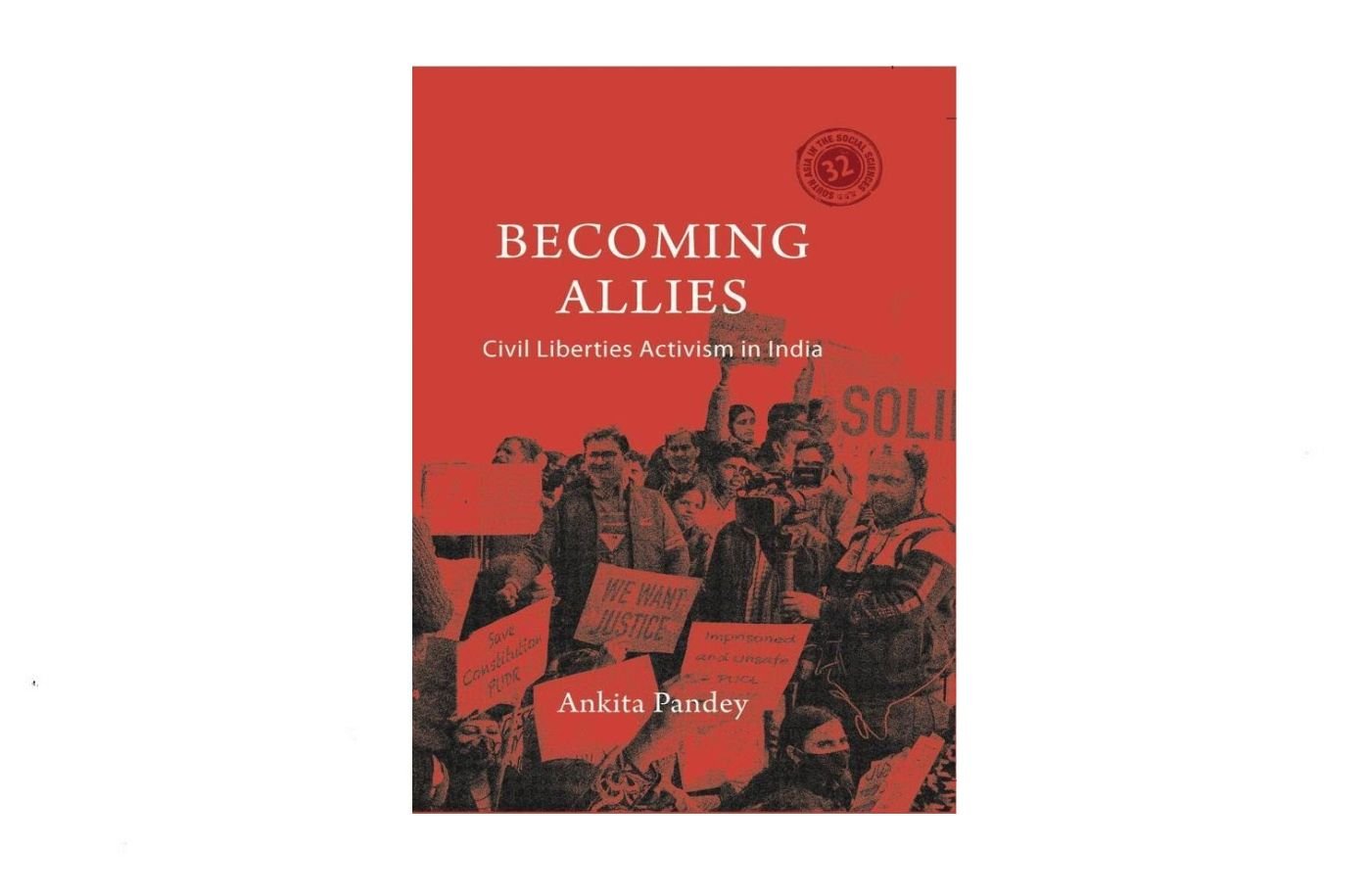
At a moment when democratic rights are increasingly contested, social movements often depend not only on those directly affected by injustice, but also on those who choose to stand beside them. Becoming Allies: Civil Liberties Activism in India (Cambridge University Press, April 2026), is an important new study of civil liberties activism in India, in which the author examines this overlooked world of solidarity: the lawyers, journalists, academics, writers and concerned citizens who commit themselves to causes in which they have no immediate personal stake.
Drawing on interviews, archival material, and the histories of organisations such as the People’s Union for Civil Liberties and the People’s Union for Democratic Rights, the book traces the emergence of non-party, non-movement activism around democracy and rights between the 1960s and 1980s.
Situated in the aftermath of the Naxalite movement and the Emergency, it explores how citizens organised fact-finding commissions, documented abuses, amplified marginalised voices, and built connective infrastructures that sustained democratic dissent.
The author, an associate professor at the Jindal School of International Affairs, O P Jindal Global University, and a research associate at the Oxford School of Global and Area Studies, University of Oxford, argues that these “allies” are central to understanding how democracy functions beyond elections and institutions. Rather than viewing politics solely as a confrontation between movements and the State, Becoming Allies reveals a wider constellation of actors whose work enables political demands to travel across social and institutional domains.
—------------------------------------------------------------------------------------------
Excerpt
In the winter of 1984, large-scale and targeted violence against Sikhs engulfed New Delhi’s suburbs such as Sultanpuri, Mangolpuri and Trilokpuri. The country witnessed a massacre that left an indelible scar on its history. Between 3,000 and 17,000 Sikhs were killed, and over 50,000 forced to flee their homes. Amid all this violence and curfew-bound streets, a group of like-minded people—university professors, government officials, doctors, lawyers, students and members of civil society groups—took to the streets carrying nothing more than notepads and pens. They had first gathered at a friend’s place and divided themselves into two teams. One was led by the People’s Union for Democratic Rights (PUDR) and the other by the People’s Union for Civil Liberties (PUCL), both of which were civil liberties groups that had been set up about a decade ago in the early 1970s.
Both teams navigated the violence-prone neighbourhoods, documenting testimonies of the survivors, destruction of gurudwaras and people’s allegations against Congress leaders for having orchestrated the carnage. They interviewed victims, police officers, neighbours, army personnel and political leaders. They collected perpetrators’ information, car numbers and locations which had been targeted during the riots. The testimonies they recorded revealed that mobs had precise information on Sikh households across the city and were armed with kerosene and sulphur powder to set fire to those. Instances of complicity by officials were also recorded, including the names of those who looked the other way. This systematic documentation and its release in the form of a report exposed the chilling coordination behind the violence and revealed how massacres often unfold with calculated precision.
This documentation exercise, however, came at a cost. One team member’s car mysteriously caught fire, while another was stalked by ominous figures. The risks escalated when both teams decided to publish their findings as a report, naming individuals complicit in the violence. The decision to publish names was fraught with fear as their findings could endanger more lives, even their own, or encourage retaliatory violence (Haksar 2014). Despite this, the team released Who Are the Guilty? —a landmark fact-finding report by independent citizen groups in India. The report—a damning indictment of the violence and its enablers—was swiftly banned in Punjab (under president’s rule at the time). The police raided the press printing it, and the publisher was arrested for waging war against the Government of India under Section 121 of the Indian Penal Code (IPC), 1860 (Sharma 2014).
Some other activists came together and formed the Nagrik Ekta Manch (Citizens’ Unity Forum) to provide relief work to the victims of the massacre. Another few used the report based on the fact-finding to file a writ petition in the Delhi High Court (DHC) seeking an independent investigation by the Central Bureau of Investigation (CBI) and for a magistrate-led identification parade of accused police officers and politicians. The petition included affidavits like that of a woman who witnessed her daughter’s rape and named the perpetrators. Given that the DHC requires all documentation to be filed along with its English translation, her testimony in Punjabi was translated into Hindi and English, and activists ensured that the same was read back to her before she signed it. Justice Rajinder Sachar admitted the petition and issued a notice to the police, but subsequently the case appeared before another judge and the petition was dismissed (Haksar 2014).
On 24 November 1984, over 20 civil society organisations in Delhi marched from the Red Fort to the Boat Club, demanding a judicial inquiry and that the culprits be punished. Artists, painters and theatre actors joined a peace march. Uma Chakravarti, a history professor from the University of Delhi, along with Nandita Haksar, a human rights lawyer, interviewed survivors to document the tragedy for a book. The interviews they conducted were published as a book, Delhi Riots: Three Days in the Life of a Nation, which revealed the long-standing causes such as land disputes which were behind the immediate triggers causing communal violence (Chakravarti and Haksar 1987). Furthermore, activists kept an eye on the implementation of a relief scheme promising compensation to the victims by the government and continued to monitor the status of official inquiries and prosecutions.
Taken together, these efforts—organising relief work, pursuing legal remedies, documenting testimonies, publishing survivor’s stories, demanding accountability through protest, and monitoring state action embody a distinct form of collective action. These initiatives from 1984 were not an isolated episode but part of a longer tradition of activism that has unfolded since the late 1960s. Over the past five decades, civil liberties groups such as the Association for the Protection of Democratic Rights (APDR), Committee for Protection of Democratic Rights (CPDR) and Andhra Pradesh Civil Liberties Committee (APCLC) have been conducting fact-finding investigations, arranging legal aid, releasing press statements, following up with government departments, organising protest demonstrations and publicising the issues at stake in the national press. At its core, they have been amplifying the concerns and demands of various affected groups, marginalised communities or social movement groups for national and global audiences.
Though not recognised as such in existing scholarship, this longstanding collective action by such groups to support and amplify the struggles of the disadvantaged marks the emergence of the practice of ally activism. By ally activism, I refer to the collective action undertaken in solidarity with a marginalised group by those who do not have a direct, personal or material stake in the cause. Unlike the mobilisations of those who are directly impacted, ally activism is defined by its principal orientation and mandate of acting in support of or alongside others (Rucht 2004; Myers 2008; Pandey 2021).
Today ally activism has become a prominent and contentious site. Ally activism often becomes a deliberate target for vilification by those in positions of authority. In many instances, allies draw greater ire from those in power than even the aggrieved groups themselves. Substantial resources are invested in discrediting allies. Smear campaigns on television and print media, speeches by high-level politicians and public narratives are designed to undermine ally credibility. Allies are frequently framed as instigators of societal discord, accused of sowing division and labelled unpatriotic or anti-national. Currently, these efforts at discrediting allies are part of a broader, global backlash against so-called woke politics, namely a reactionary response to progressive movements and ideologies. While ‘woke’ originally signified awareness of issues like racial injustice, gender inequality or systemic oppression, it has evolved into a pejorative term for excessive political correctness, overreach or imposition of certain moral or cultural standards. At the heart of this anti-woke crusade is a campaign to undermine left-liberal thinkers, intellectuals, progressive advocates and journalists. In contemporary Indian political discourse, terms like ‘deracinated’ and ‘sickular’ are often employed pejoratively to criticise liberal and left-leaning intellectuals, where ‘deracinated’ suggests a disconnection from cultural roots, and ‘sickular’ sees secularism as a sickness detrimental to national interests (Sajjanhar 2024). Their allyship with social movements is depicted as a threat to national unity, and they are seen as responsible for societal tensions, discord and bringing disrepute to the country.
I believe civil liberties groups are the longest-standing and one of the most significant instances of collectively undertaken allyship in independent India, making these groups a great case study to examine the broader genre of this politics. Over the years, these groups have provided legal representation and filed complaints or public interest litigations (PILs) on cases of custodial violence, deportation, rights of political prisoners, labour law violations, and so on. They have undertaken independent fact-finding investigations on matters where apathy is shown by police and local administration, like during riots, instances of police firings, cases of arrests, custodial tortures and persecution of activists. They have also campaigned against the death penalty, protested against internal displacement caused by development projects and exposed issues of electoral corruption. Focusing on civil liberties groups, I explore the circumstances, influences and sociological contexts of ally activism, how it has been conducted, and the role it has played in shaping India’s democracy.
Despite certain individual activists making national headlines, civil liberties activism is neither well known or well researched, nor is it part of the national public discourse in India. The names of civil liberties groups rarely make it to newspapers or media stories. If reported on, they are referred to as generic civil liberties groups or civil society groups. Even within scholarship on this activism, as I will detail in a later section, these groups are frequently either subsumed within the broader movement they supported, or treated as a distinct social movement in their own right. To analyse this activism as yet another social movement is to miss the essence of this politics. It misclassifies this activism and chooses an incorrect yardstick for its evaluation. Therefore, I argue for recasting it as ally activism.
Situating ally activism within the broader ecology of social movements allows us to recognise what I call the politics of amplification. I use this phrase to refer to the strategic efforts made by people of groups with relative privilege, to elevate or amplify voices, struggles or causes that are marginalised or underrepresented. One way to think more clearly about the politics of amplification is to set it against the politics of representation. While the politics of representation centres the question of who gets to speak for whom, the politics of amplification explores the question: who passes the microphone to whom, who amplifies which voice, why and how?
(Excerpted with permission from Becoming Allies: Civil Liberties Activism in India published by Cambridge University Press.)
Get exclusive access to new databases, expert analyses, weekly newsletters, book excerpts and new ideas on democracy, law and society in India. Subscribe to Article 14.