
Mumbai: For the last few years, each time Muslim Kashmiri students like him faced discrimination in parts of India, Aaquib Ali (name changed) felt a quiet sense of reassurance and even pride.
Ali, 25, is finishing his bachelor’s course in Pharmacy at CT University, a private campus in Ludhiana, Punjab. Being on campus made him feel he was “in safety”, whenever Islamophobia and anti-Muslim feelings rose, he said.
Kashmiri students like him were not just safe, Ali said; they felt protected by fellow students and university officials.
Last week, all this changed.
Ali and other Kashmiri students were abused, threatened with eviction, and forced to spend a night in the college passageways—all because they insisted the university honour an old tradition of serving dinner an hour early during Ramzan so that underprivileged Muslim students could break their fast.
This time, when they urged the university to implement this arrangement, they were initially stonewalled. Then, during a confrontation, Ali alleged, the university’s vice‑chancellor Nitin Tandon abused them. The exchange was captured on video and widely shared on social media.
“In sab ko baahar nikalo, bhenc***. In sab ka admission cancelled,” Tandon is seen saying angrily, his index finger raised in the air. “Throw these sisterf****** out. All their admissions are cancelled.”
Ordered to get out, the fasting students sat in protest, having had only water and bananas.
“After he told us to get out, we couldn’t go back to our rooms, so we sat in the passage of the college building, braving the cold,” Ali said. Sehri, the pre‑dawn meal, came and went, but they had no food. “We all sat hungry and continued fasting, but no one from the college came and tried to resolve the issue.”
The protest lasted 48 hours. According to news reports (here and here), the university later removed Tandon from his post.
Nationwide Harassment
The abuse and harassment are part of a larger nationwide trend: as Muslims mark the holy month of Ramzan, Islamophobia—specifically targeting this occasion—has seen an uptick.
Such targeting of Muslims during Ramzan comes just over two months after Hindutva outfits targeted the country’s Christian community on the occasion of Christmas in December.
In the run‑up to Christmas, various Hindutva groups targeted community celebrations across India. In Delhi, women wearing Santa caps were intimidated by Hindutva vigilantes. In Kerala, some schools reported receiving threats from officials believed to belong to the Rashtriya Swayamsevak Sangh (RSS), warning against holding Christmas celebrations. In Madhya Pradesh, a mob led by a BJP leader disrupted and attacked a Christmas lunch for visually impaired children in Jabalpur.
Now, as the country’s Muslim community marks Ramzan, they face abuse, intimidation, harassment and, in some cases, open violence. For instance:
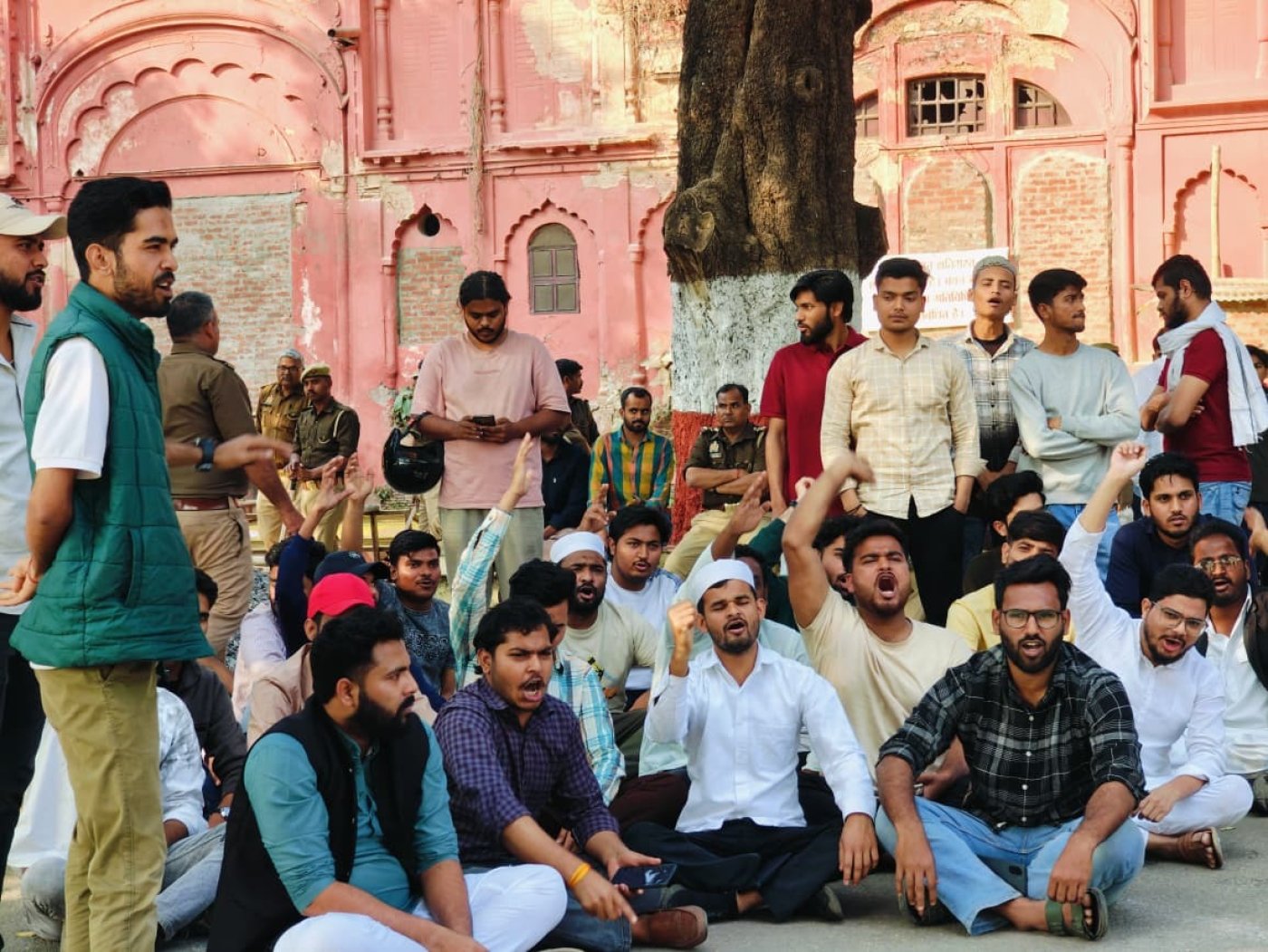
- Authorities at Lucknow University shut down the only Muslim prayer hall on campus, inside the 19th‑century Lal Baradari building, citing concerns about its structural integrity, without offering an alternative space for students to pray during Ramzan. When students protested and offered namaz on the lawns outside the structure, the university registered an FIR against 14 students.
- In Uttarakhand, a Muslim man named Shaheed was kicked, punched and beaten with a wooden stick by a Hindu man on‑camera while he was offering namaaz alone on a farm. The attacker forced him to chant “Jai Shri Ram” and abused him, shouting: “Namaaz ki ma ki c***. Meri Brahman ki zameen pe tu namaaz kaise padh raha hai?” (F*** your namaaz. How dare you offer namaaz on my Brahmin land?).
- In Madhya Pradesh’s Jabalpur, Hindus and Muslims clashed on 19 February after some Hindus, despite police orders, insisted on performing an aarti coinciding with taraweeh prayers in a nearby mosque.
- In Maharashtra’s Malegaon, the police filed a first information report (FIR) after a video showed locals protesting water scarcity breaking for namaaz in a room inside the Malegaon municipal corporation. The FIR followed a letter by BJP leader Kirit Somaiya, who complained to Chief Minister Devendra Fadnavis on 25 February that the namaz was “a serious matter”.
- In Mumbai, hundreds of street vendors in the predominantly Muslim neighbourhoods of Dongri, Bhendi Bazaar and Pydhonie, known for their Ramzan markets, were evicted by civic authorities on the eve of Ramzan. The move came days after newly‑elected BJP mayor Ritu Tawde said that removal of “Bangladeshi hawkers” from Mumbai’s streets was one of her top priorities.
- In Telangana’s Sangareddy district, government authorities, without notice, as the law requires, demolished an allegedly illegal mosque shortly after Ramzan prayers began.
- In the city of Jyotirmath in Uttarakhand, officials sealed a municipal hall where Muslims traditionally offered Ramzan namaz after a video of the prayers went viral, drawing protests from Hindu extremists. The sealing forced fasting Muslims to offer Friday prayers, meant to be held in congregation, inside their homes.
Rising Islamophobia
A 2025 report by India Hate Lab, a project of the Center for the Study of Organised Hate, a nonprofit think tank, listed 1,318 hate‑speech events targeting Muslims and Christians in 2025, a 97% increase from 2023.
Hindu supremacist groups have fuelled anger and hate against Muslims, who form just over 14% of India’s population, and Christians, who account for a little over 2%.
On the ground, this rising virulence has snapped old traditions and syncretic bonds that held communities and institutions together.
Irfan Engineer, director of the Mumbai-based Centre for Study of Society and Secularism, said that “constantly creating fear" was an “essential” part of what he called “right-wing, fascist politics”, playing out across the country.
“All festivals are being weaponised in this climate,” said Engineer, referring to attacks against Christians and Muslims during Christmas and Ramzan, respectively.
“Festivals of religious minorities are exploited as opportunities to make them feel that they don’t belong here, that this is not their country, that the protection of the law does not apply to you.”
Pointing to objections and assaults over minorities celebrating their festivals, Engineer said, “In some ways, they (Hindutva vigilantes) are saying, the Constitution might treat you as citizens, but you are not citizens of the Hindu Rashtra.”
Barricading A Prayer Area
At Lucknow University, Muslim students like 24‑year‑old Taukeel Gazi had, for years, used the dedicated prayer room on campus to recite prayers, especially during Ramzan.
On 22 February, days after Ramzan began, Gazi—also a member of the Samajwadi Party’s student wing, the SP Chhatra Sabha—was headed to the prayer room when he saw men bolting the doors of the 19th‑century Lal Baradari mosque and walling off its windows.
That same morning, Gazi and his friends had offered fajr, the early‑morning prayer, in the same room.
Aghast, he and other students sought answers from the university, only to be told by the site workers that the structure needed repairs. Students at the university criticised this explanation.
“I was inside Lal Baradari just a few hours before they shut it,” said Gazi. “What changed in those hours?”
Another student and National Students’ Union of India (NSUI) national coordinator, Prince Prakash, currently in the second year of his MA in public administration, agreed that part of the structure was in poor condition.
“However, the place where the prayer room was located was in a sound state,” said Prakash. “Even if they had to undertake repairs, they should have consulted students and allotted an alternate space for Muslim students to offer prayers.”
Prakash said the university deliberately gave the issue a communal spin to evade accountability questions.
“We learnt that there was a Rs-5‑crore fund granted to the university for the building’s repairs. For over a year, we have been asking the university authorities about its utilisation,” said Prakash. “But now, they made it a communal issue.”
When the university did neither, Muslim students, bereft of a prayer room, offered namaaz on the grounds outside Lal Baradari while a group of Hindu students stood guard. Videos of this interfaith solidarity display went viral.
Two days later, on 24 February, Hindutva outfits gathered outside Lal Baradari, chanted “Jai Shri Ram”, recited the Hanuman chalisa, a Hindu prayer, and demanded that the area be “purified”.
Solidarity = An FIR
On 26 February, Lucknow University lodged an FIR against the students who had offered namaaz and stood guard against disruption, charging them with rioting, disturbing communal harmony and vandalism.
The FIR, filed by university registrar Dr Bhavna Mishra at Lucknow’s Hasanganj police stationon behalf of the university, alleged that unnamed students and outsiders vandalised the barricades around Lal Baradari, offered namaaz, and conducted an iftar on 22 February.
Emails that Article 14 sent to Mishra seeking comment went unanswered.
The local station house officer, Amar Nath Verma, told Article14, said that the police have videos of students pushing barricades and offering namaaz. “The complaint might be against unnamed students, but we have videos that show exactly who was involved, and we will take action against all of them.”
Verma, said he was “not aware” of Hindutva workers reciting Hanuman Chalisa there. He said, “Hanuman Chalisa kahaan padha gaya? Humein toh kisine bataya hi nahi,” Where was the Hanuman Chalisa recited? Nobody came and told us of this.
The SHO said the room inside the Lal Baradari was never a mosque, merely a prayer room frequented by university staffers. “Bematlab mein yeh toh riot karwa denge. (Woh) masjid thi hi nahi,” Without reason, these guys will create a riot. It was never a mosque.
According to university students such as Gazi, Verma is only partly right—it was not a mosque, but a prayer room frequented by not just the faculty but also Muslim students, especially during Ramzan.
Verma said there were attempts to “forcefully politicise” the issue. “Woh dusra JNU bana dete ( They were trying to make a second JNU),” he said, referring to New Delhi’s restive Jawaharlal Nehru University, known for its defiance of authority.
Prakash said the closure of the prayer room during Ramzan was an attempt to “polarise” the campus. Two days before the campus mosque was shut, the university hosted two major political events: an 18 February visit by RSS chief Mohan Bhagwat as part of the outfit’s centenary celebrations, followed by a 20 February visit by BJP Uttar Pradesh chief Pankaj Chaudhary to mark the birth anniversary of Maratha king Chhatrapati Shivaji.
“Could they not have carried out these repairs before Ramzan and allotted a space for Muslim students to pray?” Gazi asked. “If the university wanted, it could have resolved this issue within minutes.”
Trust, Traditions Broken
Islamophobia was evident not only at Lucknow University but also in Ludhiana, where CT University’s administration removed vice‑Chancellor Tandon after the controversy.
Kashmiri Muslim students said that although the fiasco has formally ended, it has left them shaken. The university is a favourite destination for Kashmiris, Ali said.
“We have at least 65 to 70 Kashmiris studying here currently, and CT is the first choice for many Kashmiris who want to study pharmacy,” he said.
In 2024, when violence erupted against Kashmiris across the country after the Pahalgam terror attack, the university management reassured Ali and other Kashmiri students. When they wanted to return home, the management helped them travel safely.
“The place felt like a cocoon,” said Ali. “But to see the vice‑chancellor abuse our sisters was unbelievable. Tomorrow, someone else will come and abuse our mothers.”
In Lucknow, students like Prakash said the incident had “changed something” on the campus. The campus, he pointed out, hosted a temple, a mosque and a church, all coexisting for years.
“Irrespective of which political party students lean towards, the university campus has never had any communalism among students,” said Prakash.
That, he said, has now changed.
(Kunal Purohit is an independent journalist and the author of the book H-Pop: The Secretive World of Hindutva Popstars.)
Get exclusive access to new databases, expert analyses, weekly newsletters, book excerpts and new ideas on democracy, law and society in India. Subscribe to Article 14.