
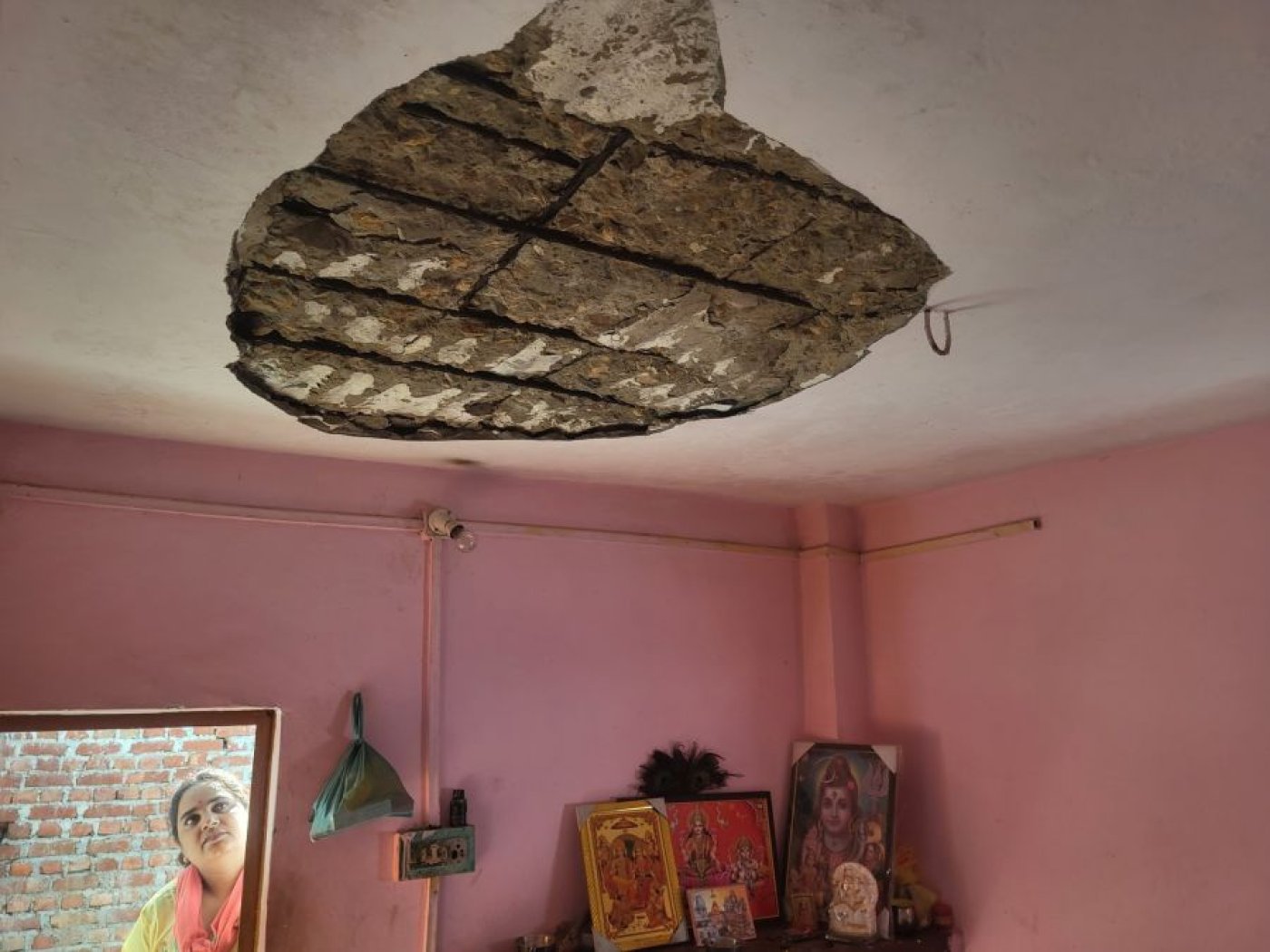
Solan District, Himachal Pradesh: On 22 November 2024, a window pane in 62-year-old Bimla Devi’s home in Mangu village, southwest Himachal Pradesh, shattered during a blast at the limestone mine about 500 m away.
Like many others in the village, her house stands downhill from the Adani Group-run mine.
She said the falling glass struck her right shoulder and thigh, causing pain and swelling, which required treatment at a government hospital in Shimla, 60 km away.
For two years, residents of 17 villages in five panchayats nearby—including Mangu, Kashlog, Giyana, Sewadha Chandi and Sanghoi Dhar have alleged that repeated blasting in the mines in Solan district has cracked their homes and endangered lives in the ecologically and geologically sensitive Himalayan region, prompting a series of complaints to the authorities and through the Chief Minister's Seva Sankalp helpline—the state government’s grievance-redressal platform for citizens to register complaints.
The Kashlog and Mangu limestone mines in the area are operated by Mumbai-based Ambuja Cement Limited (ACL), founded in 1983. The Kashlog mine began operations in 1994, when the company leased 287.38 hectares of land from the government.
ACL leased more land over the years—the latest land acquisition by the state government was in 2016 under the then Congress government—and currently controls about 4,000 acres in the area, according to documents from the geological wing of the department of industries obtained by Article 14.
‘Indiscriminate Mining, Blasting’
In September 2022, the Adani Group, run by India’s richest man, Gautam Adani, acquired Ambuja Cements and ACC (formerly The Associated Cement Companies Limited) from Swiss company Holcim Limited, which had owned the company for about 17 years.
Bimla Devi and other residents Article 14 spoke to said their houses lay outside the land acquired by the mining companies, but they were adversely affected by mining operations uphill from their village.
Bimla Devi’s son Sandeep Kumar claimed that after 2022, “indiscriminate mining and blasting began”.
In 2024, mining began in the Mangu hills in addition to the Kashlog mine, leading to protests after blasts and falling rocks from mining operations began affecting residents' homes and livelihoods.
On 6 December 2025, a blasting operation at Ambuja-Adani Cement's Mangu mining block—that villagers said propelled rocks downhill, endangering their houses and safety—triggered fresh allegations of unsafe mining practices.
“People had to run for their lives,” Kumar said.
On 22 December, residents of Sanghoi Dhar began a hunger strike to protest the police’s failure to register a first information report (FIR) against the management of Ambhuja Cements.
Villagers said repeated complaints about blasting at all hours of the day—including at night—falling rocks endangering people, and cracks appearing in houses had gone unanswered. They alleged that the mining area had neither been declared a danger zone nor had adequate safety measures been put in place.
Cracked Houses
Kumar alleged that repeated blasting at Ambuja Cement's Sanghoi limestone mine not only shattered their windows, but permanently damaged the house where he lives with his mother, Bimla Devi.
A spot inspection conducted by the Naib Tehsildar, Darlaghat, on 7 June 2023, found that the house, built in 2019, was located about 40-50 metres from land leased for mining and approximately 500 metres from the active blasting site.
The inspection was carried out in the presence of Kumar and officials from Ambuja Cement's mining, blasting and land acquisition departments.
The inspection noted cracks in the roof but concluded that it was "not clear" whether blasting caused them.
Kumar, however, maintained that repeated mining blasts caused the cracks.
Vidya Devi, a resident of Ghamaru village, also filed a complaint about the same matter through the Chief Minister’s Seva Sankalp Helpline on 8 December 2025.
During a phone call with Article 14, she said that the cement company had been carrying out blasting at a site uphill from her house.
She said the blasting on the evening of 6 December 2025 caused large stones to roll downhill and land around her house and cattle shed.
In her complaint, she claimed that she requested that the company’s blasting be stopped and that an FIR be registered.
“Himachal Pradesh is highly vulnerable to earthquakes,” said Himachal-based environmentalist Kulbhushan Upmanyu. “The steep terrain is also prone to landslides.”
He added that these risks make it important to conduct geological assessments, slope stability tests and monitor the vibrations from blasts during mining.
“Blasting near inhabited areas should be carried out with strict controls and its impact on nearby structures and slopes should be independently assessed,” Upmanyu said. “In such a fragile seismic environment, safety cannot be based on assumptions; it must be supported by continuous monitoring and technical evidence.”
The Environmental Impact Assessment report, conducted in July 2012, before the company was allowed to use the land, mandated that the company must "adopt extensive supervision and adopt exhaustive control measures" whenever blasting is conducted within 150 meters of a habitat.
Inconclusive Inspections
An inspection report, accessed by Article 14, submitted by the assistant geologist-cum-mining officer, Solan, on 23 January 2026, recorded structural damage at several properties in Kashlog, Mangu, Sangoi and Gamaro.
While the report attributed some of the cracks to possible sinking of foundations, aging of buildings and shrinkage of construction materials, it stopped short of conclusively ruling out the influence of mining activity.
In the case of Bimla’s house, the report made a more significant observation: loose boulders near the dwelling had toppled, and their fall, according to the officer, may have been accelerated by vibrations generated by blasting during mining operations.
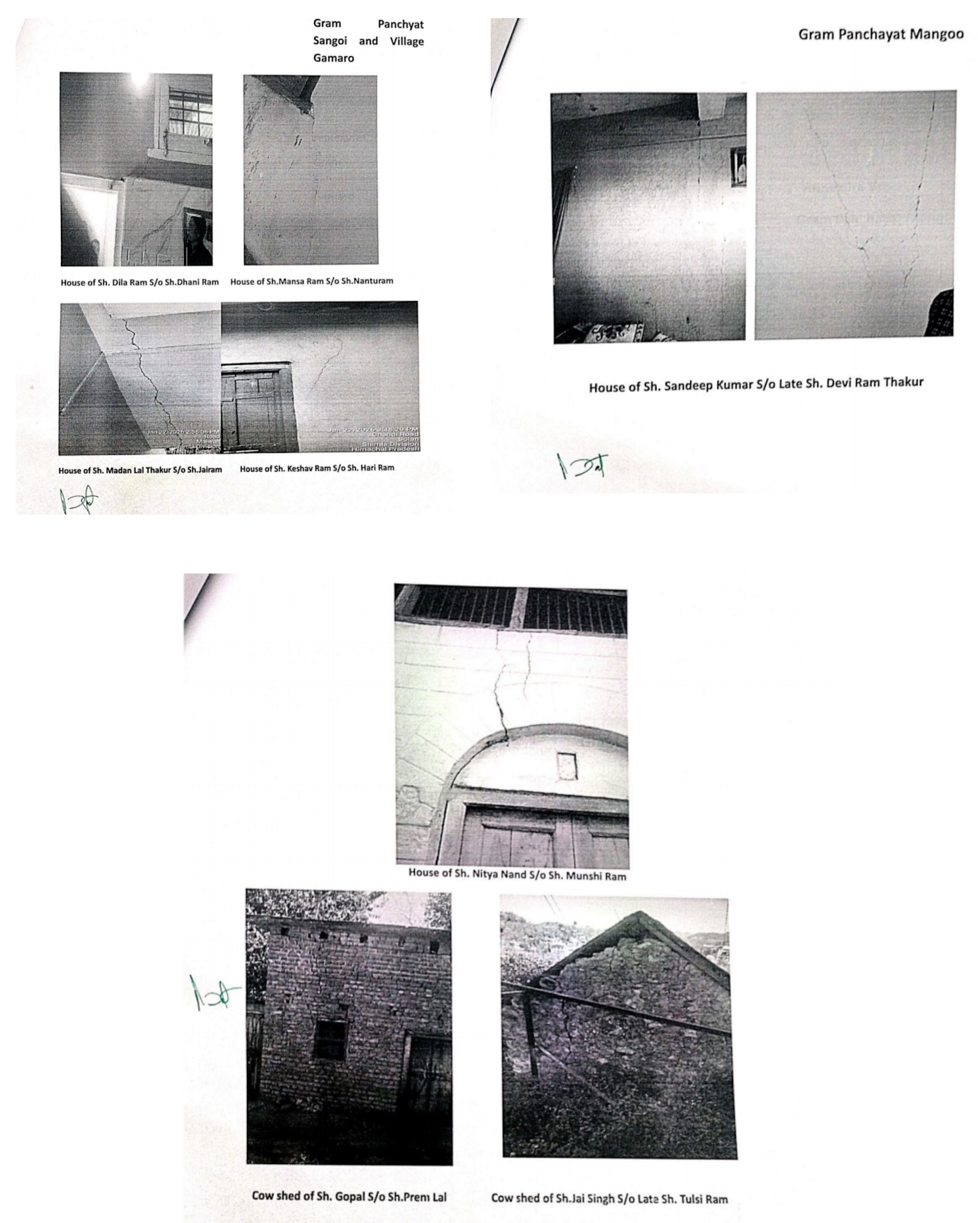
But the report does not establish that blasting caused all the cracks documented during the inspection. Instead, it adopts a cautious position, stating that external factors, including vibrations from mining blasts, “cannot be ruled out” as a contributing factor, particularly in relation to the destabilisation of loose boulders.
The report also said that determining a cause requires a “careful approach”.
For residents living close to the mining operations, the question is not simply whether cracks exist, but when they appeared and whether their emergence coincided with blasting activity.
The National Green Tribunal (NGT) in Rajasthan’s Kotputli tehsil in Jaipur district also examined whether mining blasts can cause structural damage, when residents living near stone mines complained that the operations were causing cracks and structural damage to houses.
In its 2022 order in Khanan Grasth Sangharsh Samiti vs Union Of India, the NGT found that there was “damage to the buildings specially (sic) school building due to blasting” and ordered compensation to be paid to the school and local residents who had been affected.
It further ruled that “the regulations for danger zone (500 m) prescribed by Directorate General of Mines Safety also have to be complied” with, by the mining company.
Three years later, in a separate 2025 ruling in Khanan Grasth Sangharsh Samiti v. Union of India, the Tribunal noted that the impact of blasting in mines on buildings and human health had not been adequately assessed and called for scientific assessment of blast-induced vibrations.
The NGT, while dismissing this case, said that the connection between the mining and cracks in houses could not be proven without scientific evidence and that the residents could approach the court once they obtained that proof.
Article 14 emailed Vinod Bahety, CEO of Ambuja Cements, and Adani Cement's corporate communications email on 9 September, seeking comment on villagers’ allegations that blasting activities damaged houses and affected local residents. There was no response. We will update the story if they respond.
‘No One Listened’
Villagers also alleged that mining blasts took place throughout the day, including late in the evening and at night.
According to the Himachal Pradesh Mineral Policy 2024, “no mining of minor minerals shall be allowed in the State between 8:00 P.M. and 5:00 A.M.”
Kunta Devi, a resident of Ghamaro village, said blasting during the night had become a constant anxiety for her family. She said the loud explosions often frighten her elderly mother, who is completely blind.
For any premises or public place, airblast noise limits regulate safety. The recommended limit is 115 dB Linear, with a maximum tolerable level of 120 dB Linear to prevent structural damage or significant disturbance, according to the Environmental Impact Assessment report.
“We have approached company officials many times,” Kunta Devi said. “We pleaded with them, but no one listened.”
‘Did Not Register An FIR’
Kunta Devi said her house and land had not been acquired by the mining company, but she suffered the negative effects of the mining activities because her house lay downhill from the mining site.
Kunta Devi said that on 6 December 2025, she and other villagers were cutting grass in their fields when a blast at the Mangu mining site sent rocks downhill towards their fields and homes forcing them to run from the area to save their lives.
Kunta Devi said she went to Darlaghat police station the same day to file a complaint against Ambujha Cement and its staff, but alleged that the police “did not register an FIR.
Despite the multiple complaints to authorities by residents of villages surrounding the mines, according to a response to an RTI request sent in July 2026, the only FIR registered on a local resident’s complaint was filed on 25 December 2025 against unnamed persons, under Section 125 (endangering life or personal safety of others) of the Bharatiya Nyaya Sanhita, 2023, after a series of protests by the locals.
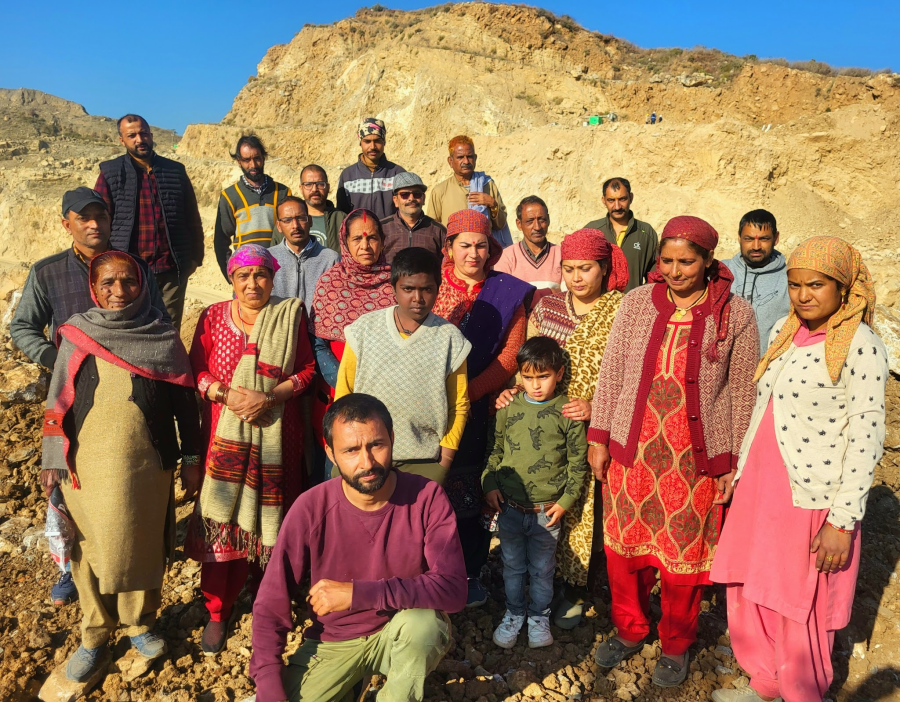
Pratap Singh Thakur of Mangu village, who filed the complaint that led to this FIR, alleged that negligence during blasting propelled rocks downhill towards his house, creating a potential risk to life and property.
The Darlaghat police station’s response to the RTI request said that two people had been arrested after their investigation. The police did not reveal who these people were and whether they were employees of the Ambuja Cement company.
FIRs Against Villagers
Yet, villagers claimed, the police had registered multiple FIRs against residents of the nearby villages for protesting against the cement companies' mining activities
According to FIRs registered at Darlaghat station, obtained through an RTI application, company supervisor Bhanu Pratap Singh lodged a complaint on 4 May 2025 alleging that Raju Kumar, a resident of Sadmaras village, blocked the company’s gate for about an hour. An FIR was registered under Section 126(2) (wrongful restraint) of the BNS.
On 7 June 2025, an FIR was registered against Pyare Lal, another resident of the area, for allegedly attempting to run over Ambuja Cement’s chief security officer (CSO) for the mine and a security guard, the complainant Lucky Chandel, who further alleged that Pyare Lal got into a physical altercation with the CSO, abused him and threatened to kill him.
The FIR was registered under Sections 125 (endangering life or personal safety), 351(2) (criminal intimidation) and 352 (intentional insults with intent to provoke breach of peace) of the BNS.
On 2 December 2025, an FIR was filed against Sandeep Kumar of Mangu and Kashmir Singh of Bilaspur district, under multiple sections of the BNS, including 329(3) (criminal trespass) and 351(2) (criminal intimidation), at the Darlaghat police station based on the complaint of Mahendra Mertia, head of mines at Ambuja Cement.
The FIR alleged that the two illegally trespassed onto company land and disrupted mining operations, causing financial losses to the company and allegedly endangering the safety of life and property. The complaint also claimed that they threatened to kill employees.
Another FIR was filed on 2 December, invoking Section 329(3) of the BNS, alleging that on 28 November 2025 Sandeep Kumar trespassed into the company’s Kashlog limestone mines area. According to the FIR, Kumar was asked to leave the area but refused to do so.
The station house officer of the Darlaghat police station, Pankaj Sharma, as well as the police’s RTI response, indicated that chargesheets had been prepared in three of the four FIRs against villagers in the area.
The accused villagers whom Article 14 spoke to said they had not been arrested.
Concerns Not Addressed
On 15 February 2025, Madan Lal, a resident of Sanghoi Dhar village, submitted a representation to the Chief Minister of Himachal Pradesh on behalf of the entire village, requesting government intervention over alleged damage to residential houses and cattle sheds following mining activities by Ambuja Company.
In the representation, the residents stated that the company’s mining operations “have reached close” to their land. “Whenever blasting occurs in the mining area, our houses and cattle sheds begin to shake, causing cracks.”
The residents, in the representation, a copy of which Article 14 has accessed, also alleged that their houses were on “the verge of collapse”.
Article 14 emailed the Chief Minister’s Office, the deputy commissioner, Solan, and the industries ministry of Himachal Pradesh on 9 September for comment. There was no response. We will update the story if they respond.
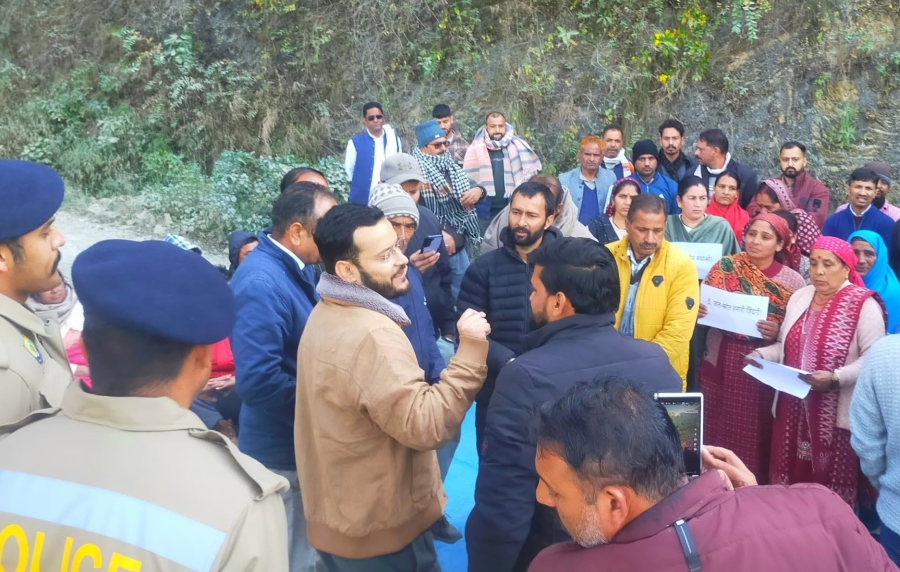
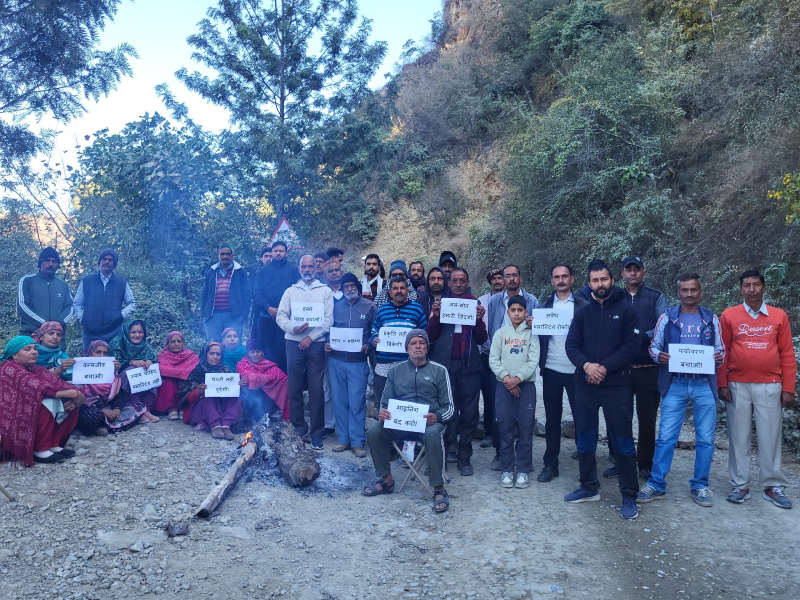
As frustration grew and no FIRs had been registered based on their complaints at the time, on 22 December, locals began a hunger strike to protest the police’s failure to register an FIR against Ambuja Cement's management, demanding action from both the authorities and the company.
Following this, an FIR based on residents’ complaints was filed on 25 December 2025.
“Our concerns have still not been properly addressed,” said Kumar. “With no support from the government or the local administration, the residents were left with little choice but to temporarily call off their protest.”
“People’s problems and suffering were simply ignored,” Kumar said.
Prem Lal, 59, lives in Thaanv village about 300 metres downhill from the Mangu mine. He said that although his house did not fall within the area acquired by the company for mining, his family was forced to bear the consequences of the company’s indiscriminate blasting.
“Our lives are at risk. The administration and the government have left us as if we are meant to die under rocks falling because of the company’s blasting,” Lal said. “We are helpless, but no one is listening to us.”
(Surinder Kumar Thakur is a freelance journalist based in Chamba district, Himachal Pradesh.)
Get exclusive access to new databases, expert analyses, weekly newsletters, book excerpts and new ideas on democracy, law and society in India. Subscribe to Article 14.