
New Delhi and Cambridge (UK): For more than a quarter-century, India’s apex wildlife body, the National Board for Wildlife (NBWL), was supposed to independently carry out its mission of protecting the country’s most fragile habitats and wildlife.
It was in September 2003 that it replaced the largely advisory functions of the Indian Board for Wildlife, officially gaining the power to use the expertise of its scientists and officials to examine—and, if necessary, stop—projects that threatened the country’s embattled wildlife and last wild areas.
Yet, over the last 12 years, the Standing Committee of the National Board for Wildlife (SC‑NBWL) approved about 97% of projects—mines, dams, highways and other infrastructure—inside or near Protected Areas, most in ways that are unconstitutional, illegal and ecologically destructive.
The SC-NBWL, tasked with rigorously scrutinising development in Protected Areas and their Eco-Sensitive Zones, has instead functioned as a clearance factory. Our analysis of 58 Standing Committee meetings between 2014 and 2026 shows that of 2,186 proposals placed before it, 2,121 were approved, while just 52 were formally rejected.
The near‑total approval rate after 2014 is especially stark because Protected Areas make up barely 5.4% of India’s land, compared to the 17.6% of global land that is formally protected. Studies (here and here) credit this thin network with India’s lack of documented species extinctions over the last 70 years, even as the Standing Committee clears roads, mines, and dams through the same habitats.
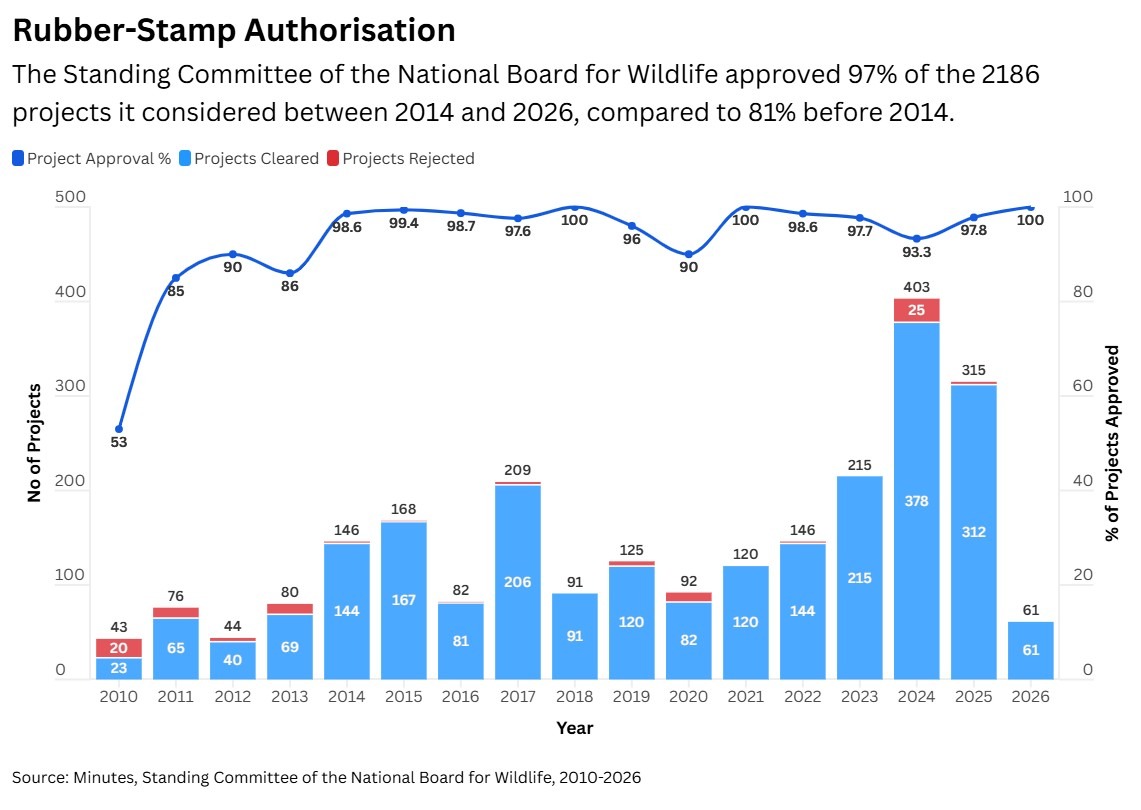
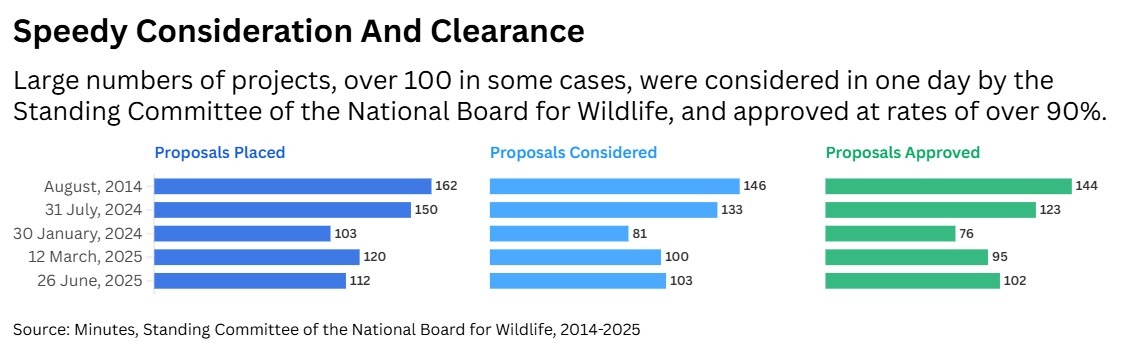
The graph above shows approval rates above 90% every year from 2014–2026, with 100% clearance in 2018, 2021 and 2026, at an extraordinary speed. In some sittings, over 100 projects were taken up; the August 2014 meeting alone cleared 133 proposals, many of which had earlier been flagged—or even rejected—as damaging.
For example, the SC‑NBWL in August 2014 cleared a road cutting through the Kutch Wildlife Sanctuary—despite an earlier September 2011 site visit report strongly advising against it—thereby endangering the only mass nesting site of flamingos in India, and possibly Asia.
The pace of approvals is reflected in the Committee discussing more than 100 proposals in a single day. Each project, however, requires detailed scrutiny, including assessment of cumulative impacts, species-specific vulnerabilities, and possible alternatives. Such a volume of proposals raises questions about the extent to which each can be evaluated in the depth these considerations require.
Questions raised by scientists and civil society (here, here and here)—about the SC‑NBWL’s operations complying with the law, the Supreme Court orders, and the principles of natural justice—remain largely unanswered in the minutes, decisions and notifications that now shape the fate of India’s last wild habitats. We will address these issues in the second of this two-part series.
‘Expedite’
So concerned is the SC‑NBWL that projects are approved—and quickly—that in its 47th meeting in January 2018 it issued an advisory to all States to devise “a mechanism which can expedite the disposal of proposals”, in response to the ministry of environment, forest and climate change’s (MoEFCC) concerns about the slow movement of proposals by the State Boards for Wildlife (SBWLs).
SBWLs are the State‑level counterparts of the NBWL, with similar mandates, and all proposals must first be cleared by them before reaching the national board.
The law requires the SC‑NBWL to scrutinise diversions of land inside Protected Areas, Eco‑Sensitive Zones & Tiger corridors and to weigh cumulative impacts and viable alternatives. Instead, the records show repeated approvals for highways slicing through core tiger areas, mining near Gir National Park, petrol pumps inside or next to wildlife sanctuaries, and aerial ropeways inside several reserves.
Haste apart, the SC‑NBWL’s generosity in doling out Protected Areas and their surrounding eco‑sensitive landscapes to developers is indiscriminate. There appear to be no red lines any longer.
Some of the projects cleared include: mining for stone near Gir National Park, Gujarat; construction of residences and commercial complexes close to Mangalavanam Bird Sanctuary, Kerala; cruises in the riverine National Chambal Sanctuary, petrol pumps and retail outlets inside or near Itanagar Wildlife Sanctuary, Tripura, and Hazaribagh National Park, Jharkhand; and aerial ropeways inside Nandankanan Wildlife Sanctuary, Odisha, including for religious purposes in Rajaji Tiger Reserve and Girnar Wildlife Sanctuary.
Pre-2014: Slower, More Deliberative
Were wildlife and Protected Areas better insulated before the coming of the Modi government? The change from 2014 is apparent when compared to the previous government led by the Congress Party.
Between 2010 and 2013, 13 Standing Committee meetings considered 243 projects, with about 81% accepted and 19% rejected—significantly lower approval and higher deliberation, even though the Congress-led government of then Prime Minister Manmohan Singh was criticised, including by the members themselves (here and here), by experts for pushing through restraints.
A comparison of the two periods shows that the earlier minutes record more detailed deliberations, explicit dissent, and greater attention to policy considerations. The number of meetings was far fewer, and deferred proposals were also more frequent, with projects routinely referred for site inspections or additional studies to assess their ecological impact before any decision was taken.
A Rubber Stamp
The SC‑NBWL, created under the Wild Life (Protection) Act, 1972, is meant to advise governments on the creation and management of Protected Areas. Its composition, however, has been altered to favour executive control over independent expertise, especially after 2014.
Instead of naming 10 independent experts and five NGOs, as was the case in 2010, the government of Prime Minister Narendra Modi constituted a board in August 2014 with just one ecologist, two so‑called “independent” members and a single “NGO” in the form of the Gujarat Ecological Education and Research Foundation (GEER), which is chaired by the Gujarat chief minister.
The Supreme Court later observed that the NBWL had not been constituted in accordance with the law, but the ministry’s response was a procedural sleight of hand that retained the same Standing Committee for over a decade.
This weakly constituted body went on to approve projects at an extraordinary pace. The inclusion of corporate and infrastructure proponents in meetings, coupled with the near absence of dissenting voices from conservationists or local communities, tilted the balance decisively in favour of user agencies.
Virtual meetings during the COVID‑19 period were also used to expedite wildlife clearances, with a former environment minister hailing them in April 2020 as a way to “boost growth and development”. The move limited debate, site‑based scrutiny and public participation while sanctions for mining, dams, ports and highways rolled on.
Invading Tiger Habitats
Tiger habitats have not been spared.
Large patches of core tiger reserves have been cleared for highways, including 310 hectares in Namdapha Tiger Reserve (Arunachal Pradesh) and 139 hectares in Rajaji Tiger Reserve (Uttarakhand).
In Rajasthan’s Mukundra Hills Tiger Reserve, 10 projects—including an eight-lane highway—were approved in 2020 alone, according to a 2016 analysis by the Legal Initiative for Forest and Environment, an advocacy group.
All these diversions were approved under the banner of “inviolate” core areas mandated by official guidelines.
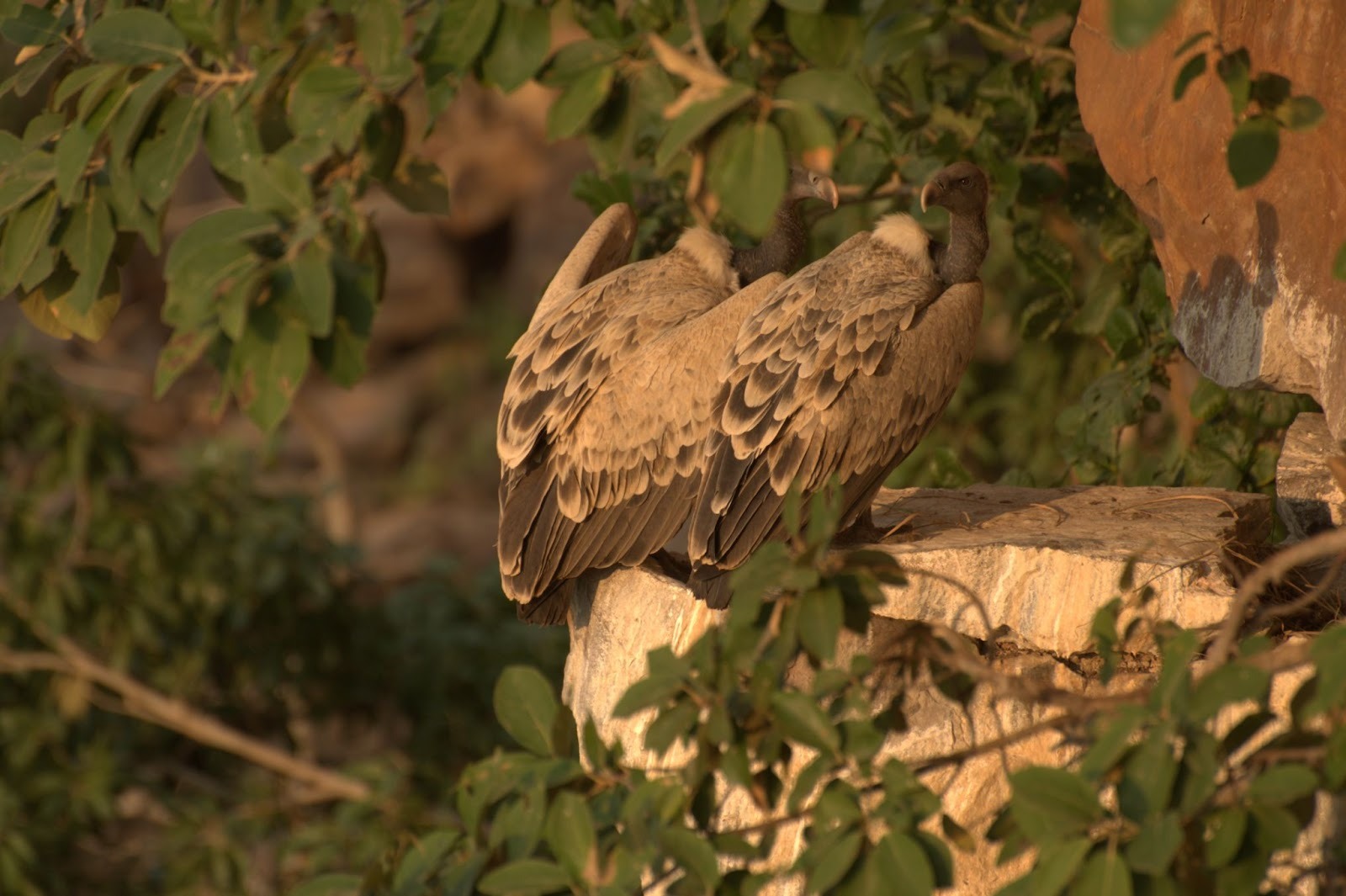
The Ken‑Betwa river‑linking project in Panna Tiger Reserve, cleared in 2016, is emblematic of this pattern. The dam will submerge roughly a third of the reserve, including critical tiger breeding zones and habitat for the critically endangered white‑rumped and long‑billed vultures. The SC‑NBWL’s approval relied on unspecified “mitigation” measures, even though Panna’s tiger population had been painstakingly rebuilt after local extinction in 2009.
The committee later cleared additional diversions in the very landscapes meant to ‘offset’ Ken‑Betwa’s damage. In 2023, the Veerangana Durgavati Wildlife Sanctuary in Madhya Pradesh was notified as a tiger reserve, yet in its 88th meeting, in January 2026, the SC‑NBWL approved the use of about 272 hectares of forest land inside this new reserve for an irrigation dam, with similar boilerplate conditions on “minimum disturbance” and night‑work bans.
These standard conditions rarely translate into enforceable safeguards. The records show no systematic monitoring regime to track whether blasting, construction, or mining actually avoid critical corridors, breeding sites, or seasonal movements, or to ensure adherence to mandated conditions, turning “mitigation” into a paper‑only exercise.
‘A Mockery Of The System’
The SC‑NBWL has also “rationalised” Protected Area boundaries, effectively deleting or shrinking designated land to accommodate mining and infrastructure. In October 2020, nearly 47% of the Hastinapur Wildlife Sanctuary (978.10 km²) in Uttar Pradesh was removed from PA status, opening up previously protected habitat.
In the Sariska Tiger Reserve, the Standing Committee and Rajasthan’s State Board for Wildlife held back‑to‑back meetings in June 2020, moving with such speed that the Supreme Court later described them as acting like a “post office”, mechanically endorsing a boundary shift that would revive marble and dolomite mining.
The altered boundary skirted earlier Supreme Court orders prohibiting mining within 1 km of a Protected Area. The Court criticised both bodies for “making a mockery of the system” and ordered them to reconsider the approvals in accordance with due process.
The Hastinapur and Sariska cases are not isolated.
The SC‑NBWL has approved several other boundary “rationalisations” in the same period, often without detailed public justification or ecological assessment, signalling a pattern where PA maps are reshaped to suit commercial interests.
Bypassing Scientists, Communities
The SC‑NBWL adopts an almost autocratic approach to decision‑making, with scientists, conservationists and affected communities rarely given meaningful opportunities to engage with or question project claims, while project proponents often secure the floor.
As the minutes of the August 2014 meeting recorded, 18 project proponents were present, including representatives of the Sardar Sarovar Narmada Nigam, who pressed for the “diversion” of 134 hectares of forest land from a sanctuary in Kutch for a canal.
The SC‑NBWL’s record also shows a repeated failure to assess cumulative impacts, even as linear infra projects—highways, railways, power lines and canals—stack up in the same fragile landscapes.
The same strips of protected and “eco sensitive zone” land in Goa’s Bhagwan Mahavir Wildlife Sanctuary and Mollem National Park, for example, have seen clearances for railway doubling, highway widening and power‑transmission lines within months, without any recorded assessment of their combined effect on wildlife.
ESZs, also called ecologically fragile areas, are buffer areas notified around Protected Areas—such as national parks and wildlife sanctuaries—to regulate human activity and reduce ecological pressure on core habitats, usually
In its 87th meeting in December 2025, the SC-NBWL permitted tree felling—previously disallowed—in the Dampa Tiger Reserve, citing the “convenience of transportation and smooth execution of the project.”
In its 35th meeting on 18 August 2015, the committee waived an earlier condition restricting drilling for a gas processing plant near Assam’s Dehing Patkai Wildlife Sanctuary and within the Dehing Patkai Elephant Reserve, allowing operations to proceed in an ecologically sensitive area.
The literature on linear infrastructure consistently notes that each new road or canal fragments habitats, disrupts animal movement, and intensifies edge effects. Yet the SC-NBWL minutes contain no structured assessment of these cumulative impacts. Instead, projects are considered in isolation, cumulatively expanding road and rail corridors while progressively fragmenting wildlife habitats and corridors.
This pattern continued during the Covid-19 period. While many government institutions were shut or operating at reduced capacity, the SC-NBWL continued to meet virtually and clear proposals. Such proceedings can limit deliberation, constrain site-based scrutiny, and reduce opportunities for stakeholder participation.
Erasing Protected Areas
The repeated pattern of giving floor time to user agencies while sidelining ecologists, citizen groups, and forest‑dependent communities institutionalises an imbalance in favour of development lobbies, even as the SC‑NBWL’s disregard for ecological consequences extends to erasing Protected Areas from the map.
In 2020, Kachhua Wildlife Sanctuary in Varanasi—the Prime Minister’s constituency—the only Protected Area in the country set up to protect freshwater turtles, was denotified for the National Waterways project and luxury tourism along the banks of the Ganga.
The following year, in January 2021, the SC‑NBWL, via video conference, erased the Megapode Sanctuary and Galathea Bay Wildlife Sanctuary from the Andaman & Nicobar Islands. Besides requiring the clearing of over 130 sq km of tropical rainforest, this approval will destroy the last strongholds of the Nicobar megapode and the leatherback sea turtle’s only nesting site in India, to clear the way for a NITI Aayog‑driven economic, maritime and tourism hub envisioned as an “alternative to Hong Kong” on Great Nicobar.
The diversion—and destruction—of Protected Areas is not only fatal to endangered wildlife but also threatens the country’s ecological security.
Beyond halting and reversing biodiversity loss, Protected Areas provide a wide range of social, cultural and economic benefits and of ecosystem services—for instance, protecting watersheds, buffering communities from natural disasters like storms and cyclones, and enabling carbon storage and sequestration—functions that are critical for a country as acutely vulnerable to climate change as India.
Note: An earlier version of this article identified the Hastinapur Wildlife Sanctuary as being in Haryana rather than Uttar Pradesh. We regret the error.
First of a two-part series.
(Prakriti Srivastava is the former principal chief conservator of forests, Kerala, and Prerna Singh Bindra is a former member of the National Board for Wildlife, and its Standing Committee.)
Get exclusive access to new databases, expert analyses, weekly newsletters, book excerpts and new ideas on democracy, law and society in India. Subscribe to Article 14.