
Bengaluru: Five minutes.
That was roughly the difference between the transcript of a supposedly inflammatory speech made by innovator, educator—and now detainee under the National Security Act (NSA)—Sonam Wangchuk and the actual speech, which, according to the State, was responsible for violent September 2025 protests demanding statehood in Leh, the capital of the union territory of Ladakh.
“Your translation goes on for 7 to 8 minutes, but the speech is for 3 minutes,” Supreme Court Justices Aravind Kumar and P B Varale told the State on 17 February 2026. “What he relied upon and what you say are different.” The defence pointed out that the transcript accused Wangchuk, 59, of things he never said, such as provoking Ladakhi youth to violence by referring to a youth rebellion in Nepal. Six days earlier, the same Justices said the union government was “reading too much” into Wangchuk’s statements.
One of the most unbelievable arguments was that Wangchuk had referred to the union government as “them” and to Ladakhis as “us”. This, according to the solicitor general—who accused Wangchuk of instigating Gen Z to “civil war” and “indulge in bloodbath (sic)”—was grounds for detention under the NSA, which allows for detention without formal charges for up to a year.
It is clear that the Supreme Court is sceptical of the State's gossamer-thin arguments. Yet, it has allowed Wangchuk’s case to meander along for five months. With the next hearing on 23 February, there is no sign of a quick resolution, as is required in a habeas corpus (literally, 'produce the body') case, which his wife filed. It is meant to compel the State to produce a detained person before the court and justify the detention.
A day after the argument over the Wangchuk speech transcript, the National Green Tribunal (NGT), India’s apex court for environmental matters, cleared a Rs 92,000-crore port-airport-city plan that experts say will devastate one of India’s last pristine rainforests, the homes of two tribes on Great Nicobar island and numerous rare and endangered species. One expert told us the project, on India’s southernmost tip, endangered “unknown unknowns”, a reference to species and effects not yet recorded or studied.
One of the affected communities, the Shompen—an isolated tribe whose language remains undocumented—could not conceivably have given informed consent, contrary to claims by the government of Prime Minister Narendra Modi. The other, the Nicobarese, were displaced from their ancestral islands by the great tsunami of 2004 and have since been prevented from returning. Most are now labourers. The government shows their ancestral lands as “uninhabited”.
The NGT cleared “India’s alternative to Hong Kong” despite ample evidence, as Article 14 reporting has shown over nearly three years, that the government had lied or otherwise misrepresented facts about local consent, the scale of destruction and environmental clearances, which it is accused of manipulating.
The Signal To The Govt
Judicial meekness—and at times an outright refusal to intervene—have had the effect of normalising ecological destruction, the erosion of liberty and repression, signalling to the government that such actions carry little cost, even as dissent and protest are increasingly criminalised on implausible grounds and laws and constitutional guarantees meant to protect citizens, communities and natural resources are steadily discarded.
Often, anxious to placate the executive, India’s higher judiciary has recently reversed its own decisions and resolve. A recent example is the evident reluctance (here, here and here) to address the proliferation of hate speech, in contrast to the resolve it displayed between 2021 and 2024: In 2022, the Supreme Court ordered the police to take suo moto action—meaning, without waiting for a complaint—against hate speech. Earlier this week, the Supreme Court refused to entertain a petition against UP chief minister Yogi Adityanath and Assam chief minister Himanta Biswa Sarma, the latter accused of running xenophobic campaigns against Muslims.
Instead, the Supreme Court questioned the neutrality of the petitioners in targeting, as the Chief Justice put it, “only selected individuals”, ignoring the fact that the BJP chief ministers mentioned are India’s leading purveyors of hate speech. Go instead to the high court, said the Chief Justice.
The retreat of India’s institutions goes beyond the judiciary.
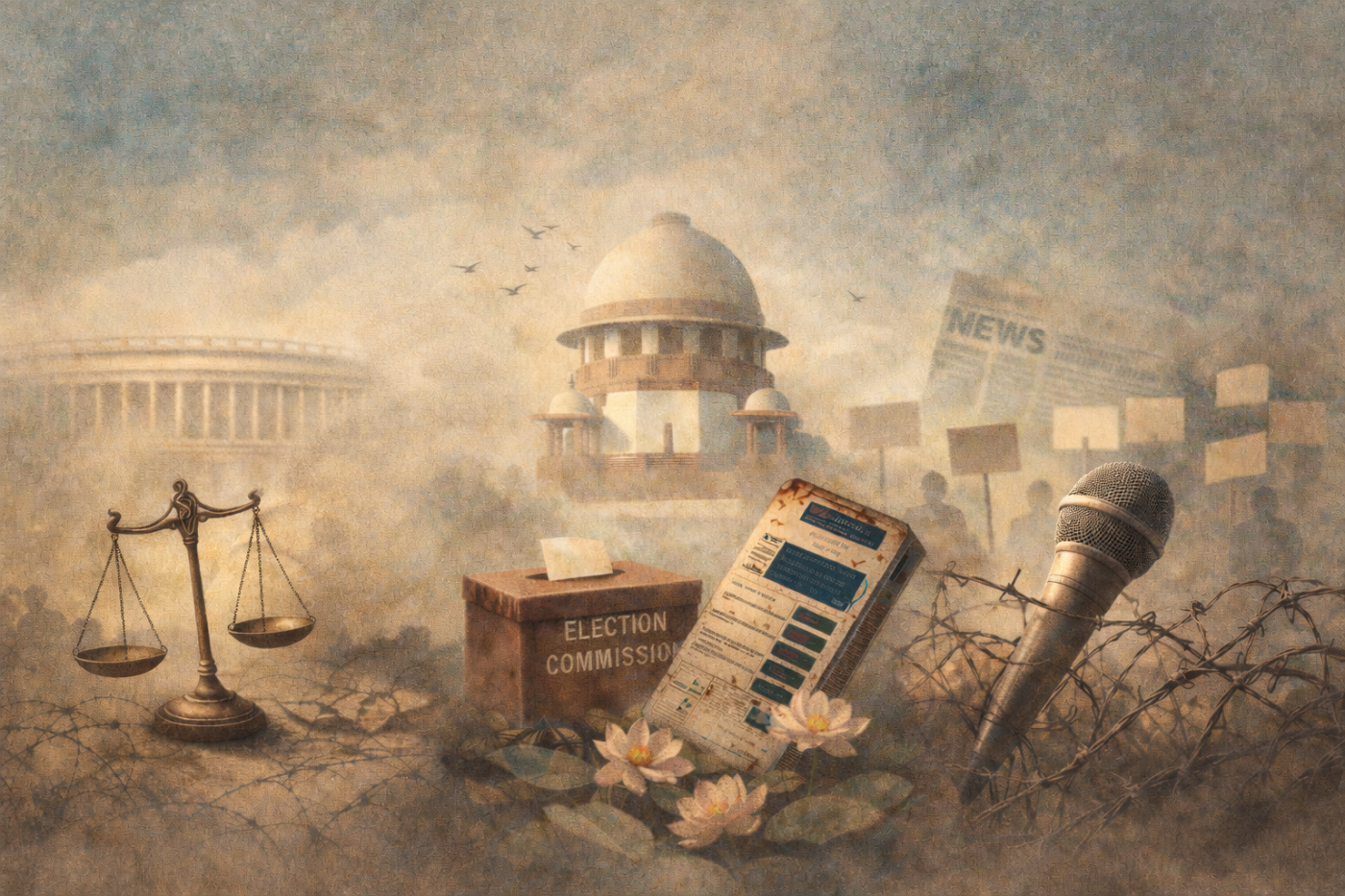
The Election Commission’s credibility and competence are in free fall: about 65 million voters have been struck off the rolls, even as efforts to deliberately remove Muslims grow, such as in Rajasthan, West Bengal, Madhya Pradesh and Gujarat (When deletions were challenged before the Supreme Court, it said no one had complained. When they did, the Chief Justice said, appeal to the high court). The government uses legal fixes and delays to cripple or hinder the public's right to information. The government auditor, once known for adversarial audits that shaped Parliamentary debate, is neutered, with reports falling by 75% in five years. Parliament itself has become a rubber stamp of the government.
A Great Acceleration
The decline of India’s institutions began on a recognisable scale when former Prime Minister Indira Gandhi launched a wide-ranging assault on them in the 1970s. Yet, democracy and its institutions rebounded in fits and starts, remaining relatively robust through the turn of the century. But the rot lingered.
In 2015, just after Modi had taken office, then President Pranab Mukherjee called India’s institutions the “infrastructure” of the idealism that reshaped ancient values into a modern context and institutionalised various freedoms. Yet, he warned, “Our institutions of democracy are under stress.” That stress has greatly accelerated over the past decade.
The result is a government that now operates with minimal checks and balances, each institutional retreat encouraging and lowering the cost of the next act of repression.
Our reportage over the past five years has documented this spiral. Those opposing India’s discriminatory citizenship law have been jailed under terrorism and sedition provisions. Adivasis and environmental activists resisting mining, cement plants, or land acquisition have been branded as security threats. Muslims have been arrested for interfaith relationships, prayer, or simply making a living. Christians have been prosecuted for praying or alleged conversion. Journalists have been prosecuted for—well—journalism.
If institutional decline escapes the scrutiny that it requires, that is because the fight appears to have gone out of many of us. Indeed, there appears to be a growing tendency to align with the government and its priorities, possibly a function of the takeover or realignment of the mass media and the relentless social-media barrage of hatred, majoritarianism, and adulation of the great leader.
“The democracy that we have practised so far since Independence is at a crossroads today, and a kind of cultural conformism is taking hold of the citizens of India,” P D T Acharya, a former secretary general of the Lok Sabha, Parliament’s lower house, wrote in The Tribune earlier this month, arguing that Parliament’s collapse was a reflection of the citizenry it represented. “They do not seem to worry about the perceptible decline of institutions of democracy any longer.”
I am not as despairing. There are millions who will not conform. They cherish India’s hard-won freedoms and remain willing to fight for them, like the thousands, if not millions of workers who—ignored by the media—protested new labour codes. But sentiments like Acharya’s are a reminder that there is far more to worry about than many of us are prepared to admit.
(Samar Halarnkar is the founding editor of Article 14.)
Get exclusive access to new databases, expert analyses, weekly newsletters, book excerpts and new ideas on democracy, law and society in India. Subscribe to Article 14.