
New Delhi and Cambridge (UK): The body meant to protect India’s wildlife has recommended shrinking or erasing 35 protected areas since 2012, for mining, infrastructure, tourism, temples and urban expansion.
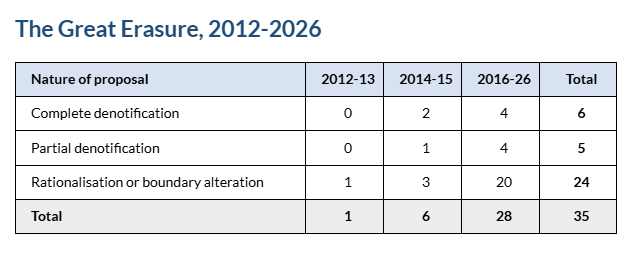
Our analysis of 64 meetings of the Standing Committee of the National Board for Wildlife (SC-NBWL), the decision-making arm of India’s apex statutory wildlife body, found that 13 proposals involved the complete or partial “denotification” of protected areas, while 21 sought boundary alterations or “rationalisations”.
None of the 35 proposals was placed before the Supreme Court for prior approval, in defiance of binding judicial orders, which meant the SC-NBWL lacked the authority to do what it did.
In October 2025, the Standing Committee approved the deletion of 3,485 hectares—nearly 35 sq km—from Chhattisgarh’s Pamed Wildlife Sanctuary for a Central Reserve Police Force jungle-warfare facility and battalion camp.
The meeting minutes did not disclose the scale of the reduction: It was more than 12 times the CRPF’s original request for 283 hectares.
The deletion was presented as a “rationalisation”, offset by a “compensatory” addition of 3,535 hectares from an adjoining forest division. That addition has yet to materialise, leaving the sanctuary drastically shrunken while the claimed increase remains on paper.
The committee also bypassed the foundational “principle of avoidance”. It did not ask whether the facility could be located outside Pamed, nor did it require officials to explore alternative sites. The same failure to genuinely examine alternatives was evident across all 35 proposals we examined.
Pamed’s reduction severely threatens one of central India’s last populations of the endangered wild water buffalo. Once widely distributed, the species has dwindled to just 30-35 animals in Chhattisgarh, concentrated mainly in Pamed and the adjoining Bhairamgarh area.
Pamed is also a critical part of one of central India’s largest conservation landscapes, connecting the Indravati Tiger Reserve with the Tadoba Tiger Reserve in Maharashtra, the Udanti Tiger Reserve in Chhattisgarh and the Sunabeda Wildlife Sanctuary in Odisha.
The boundary alteration directly violates the Supreme Court’s order of 13 November 2000, reiterated in 2015, which prohibits the dereservation or denotification of forests, wildlife sanctuaries and national parks without the Court’s prior approval.
The data also reveal a striking trend: a surge in decisions to shrink or erase protected areas—from one in 2012-13 to six in 2014-15 to 28 in 2016-26.
Mutilating India’s Protected Areas
Pamed is far from an isolated case.
Our analysis of the minutes of 64 meetings from 2012 to February 2026 found 35 proposals to slash the boundaries or erase national parks and wildlife sanctuaries to make way for mining, ports, infrastructure, commercial expansion and tourism.
Eleven, as we said, involved the complete or partial denotification of protected areas. The remaining 24 were presented as boundary alterations or “rationalisations” or variously labelled as “deletions” or “exclusions”—changes that redrew India’s protected-area map, overwhelmingly to the detriment of wildlife
The Standing Committee acts on behalf of the NBWL, India’s apex statutory wildlife body, chaired by the union environment minister. It scrutinises projects proposed within protected areas and their Eco-Sensitive Zones and can withhold approval when necessary to safeguard them.
The Wild Life (Protection) Act 1972 requires and empowers the NBWL to protect wildlife and its habitat and promote their conservation.
This investigation found the opposite.
The Standing Committee has repeatedly facilitated the diversion, deletion or denotification of protected areas and Eco-Sensitive Zones to accommodate industrial, infrastructure and other damaging projects.
An earlier two-part investigation by the same authors for Article 14 (here) and here) found that the Standing Committee approved about 97% of proposals placed before it for projects within and around protected areas, most in violation of the Wild Life (Protection) Act and Supreme Court orders.
We found a further pattern: when protected-area status obstructed a project, the SC-NBWL recommended redrawing its boundaries—or erasing the sanctuary altogether—despite having no final statutory power to do so.
The Wild Life (Protection) Act recognises denotification only in the case of Tiger Reserves, and only in “public interest” but does not provide for the complete removal of protected-area status from national parks and wildlife sanctuaries. Such denotifications are therefore not lawful.
Despite its legal mandate, the SC-NBWL has unilaterally and routinely dissolved, slashed or “rationalised” sanctuaries and national parks for everything from airports and mining to roads, tourism and urban expansion—mostly without any recorded assessment of alternatives or ecological consequences.
The Compensation Myth
Protected-area boundary changes are frequently presented as “rationalisations”—an administrative euphemism for surrendering land to development projects, expanding or encroaching cities and commercial interests.
Most such cuts are justified by promises of “compensatory” land. Of the 35 proposals examined, 24 promised additional land. But land was actually notified in only 10 cases. Ten proposals offered no compensatory addition, while in the remaining 15, the promised additions were never notified.
Even in the 10 cases where additional land was notified, it did not necessarily match the promised area or provide ecologically equivalent habitat.
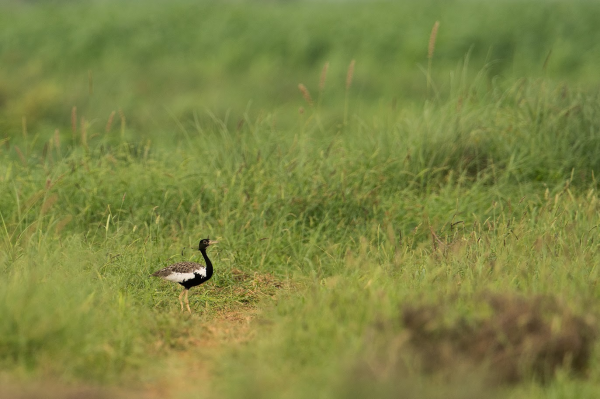
Sardarpur Kharmor Sanctuary exposes the fundamental flaw in treating protected areas as interchangeable parcels of land. At its 73rd meeting, the SC-NBWL approved reducing the original 348.12 sq km sanctuary to a “reorganised” 132.83 sq km—a 62% reduction.
The sanctuary was established on the recommendation of ornithologist Sálim Ali specifically to protect the lesser florican, locally known as the kharmor. Sardarpur was one of the last strongholds of the critically endangered, endemic bird’s dwindling grassland habitat. Fewer than 200 lesser floricans survive in the wild.
To offset the loss, the proposal suggested adding land to other protected areas in Madhya Pradesh, including Kuno National Park and Karmajhiri Wildlife Sanctuary. But land hundreds of kilometres away cannot replace the highly specialised lesser-florican grassland habitat lost from Sardarpur.
Nor can arbitrary additions of forest land compensate for lost ecosystems. Protected areas are created for specific habitats, species, water systems and ecological linkages. Land added elsewhere cannot duplicate what is removed, particularly when there is no systematic scientific assessment of habitat quality, ecological function or equivalence.
The compensation is also illusory in another sense: forest destroyed for mining, infrastructure or other non-forest use is supposedly “replaced” by land that was already forest. A protected-area boundary may expand on paper, but the country still suffers a net loss of forest and vital wildlife habitat.
Neither the Standing Committee nor the environment ministry maintains a mechanism to track or enforce whether promised additions materialise. In response to a right to information (RTI) query from one of us (Prakriti Srivastava) on 7 November 2025, the ministry of environment, forest & climate change (MoEFCC) admitted it had no information on the extent of such additions.
These denotifications and boundary alterations violate the Wild Life (Protection) Act in another fundamental way. Section 29 permits intervention within a Protected Area only when it directly improves and better manages wildlife.
None of the 35 recommendations met this statutory test. Instead, wildlife sanctuaries and national parks were redrawn or denotified to accommodate development and other priorities, from bauxite extraction to sandstone mining, often under the neutral language of “reconciling boundaries” or “correcting geographical discrepancies”.
Rajasthan’s Band Baretha Wildlife Sanctuary offers a striking example. The state government, MoEFCC and SC-NBWL acted in concert to fast-track the deletion of 2,785 hectares “on priority”, removing the legal obstacle to mining its high-quality pink sandstone for the construction of the Ram temple in Ayodhya.
The MoEFCC also denotified parts of the surrounding Eco-Sensitive Zone, reducing it to just 25 metres and easing mining restrictions.
Although this was one of the few cases in which additional land—197.85 sq km—was notified, that addition could not compensate for the loss of ecologically valuable sanctuary land.
Band Baretha Wildlife Sanctuary harbours a wide diversity of birds and serves as a critical satellite habitat and feeding ground for migratory birds that fly into the adjacent UNESCO World Heritage-listed Keoladeo National Park. Legalising a highly polluting industry near a vital Chambal River catchment also threatens biodiversity and water used for drinking and irrigation.
In Odisha’s Karlapat Wildlife Sanctuary, the SC-NBWL went further. In December 2022, it approved redrawing the sanctuary boundary, ostensibly to correct geographical discrepancies. Although the sanctuary’s total area increased, 4.32 sq km of critical elephant habitat was carved out, freeing the bauxite-rich Karlapat block from sanctuary protection.
Rather than reject the proposal, the SC-NBWL in December 2022 directed Odisha Forest officials to resubmit it, accounting not only for existing mining proposals but also for future plans for bauxite extraction and transportation. Proposed changes to the Eco-Sensitive Zone could further ease restrictions on the Sijimali and Kutrumali mines, already leased to private mining conglomerates Vedanta and Adani.
Bustard Sanctuaries Denotified, Tiger Reserves Axed
Not even India’s premier tiger reserves were spared from the Wild Life Board’s violations of the law and Supreme Court orders.
The SC-NBWL recommended carving out 435.51 hectares from the buffer zone of Ranthambhore Tiger Reserve for limestone mining to supply an ACC Limited cement plant. The decision ignored explicit warnings from the National Tiger Conservation Authority (NTCA) that the mining zone lay within a vital corridor linking Ranthambhore with Ramgarh Vishdhari and Mukundara Hills Tiger Reserve, threatening to further isolate Ranthambhore’s tiger population.
Ramgarh Vishdhari’s buffer zone was cut back twice—first for the expansion of Bundi city and later by another 539.7 hectares for an airport.
The apex committee also dismantled protected areas created for critically endangered species. Karera Wildlife Sanctuary, originally established to protect the Great Indian Bustard, was completely denotified after the bird went locally extinct, opening the land to agricultural and urban expansion.
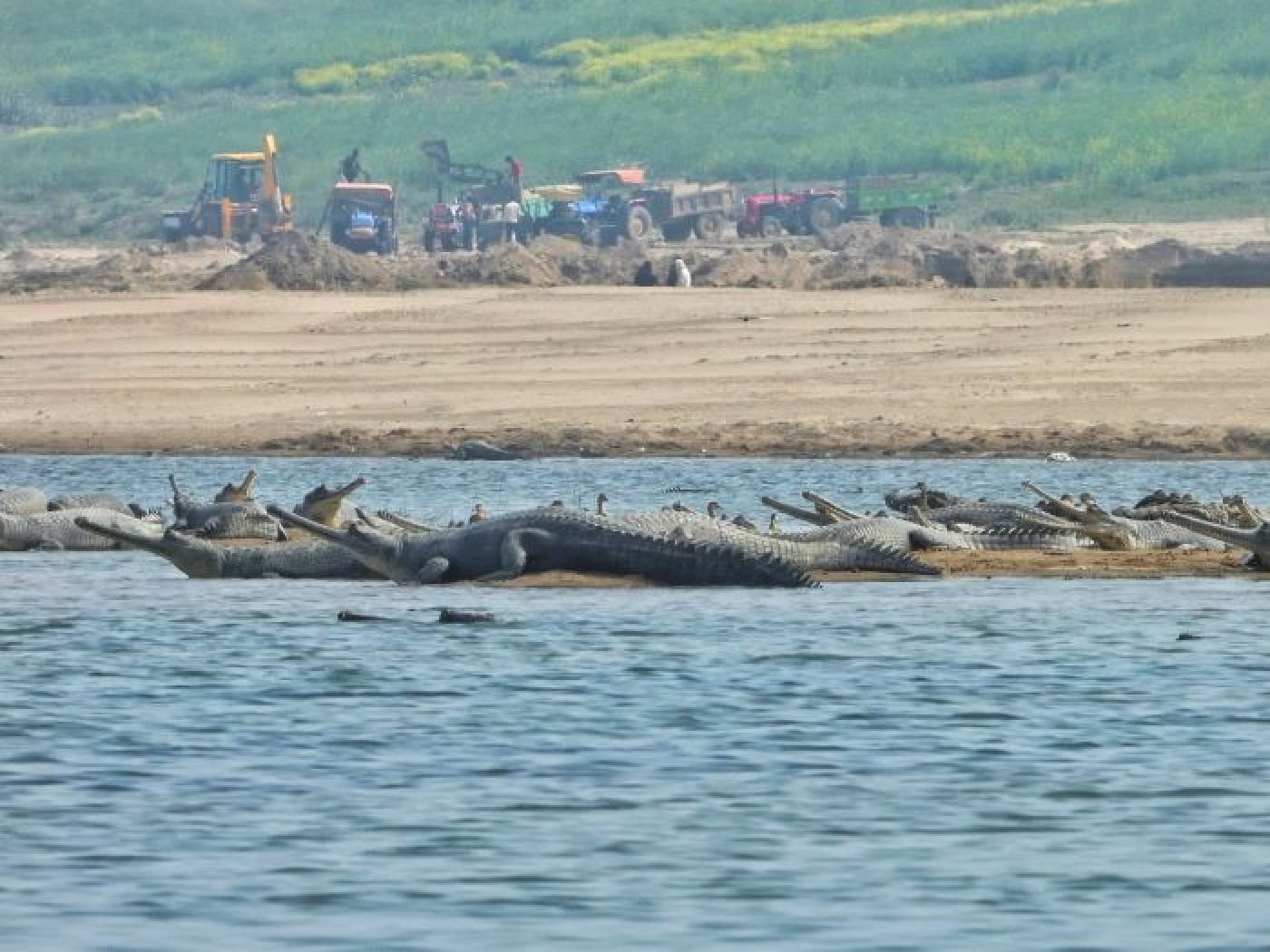
Instead of protecting and restoring the habitat for a possible reintroduction—as the government claims—the sanctuary has lost its legal protection. In the National Chambal Sanctuary in Madhya Pradesh, the committee similarly recommended deleting 207.05 hectares to legalise sand mining.
The contradiction is stark. The Great Indian Bustard and gharial are both covered by the MoEFCC’s Species Recovery Programme. Yet while the ministry funds captive breeding and species recovery, its own apex wildlife board is facilitating the diversion or removal of protection from habitats these species need to survive.
Sandbanks along the Chambal are essential gharial nesting and basking sites. Instead of pressing authorities to stop illegal extraction within the sanctuary, the committee allowed part of the sanctuary to be deleted to legalise the mining.
The decision risks creating a perverse precedent: where enforcement fails, protected-area boundaries can instead be redrawn to accommodate the activity that violated them.
None of these boundary deletions was submitted to the Supreme Court for prior approval, in defiance of its binding orders.
Denotification Surge
In 2000, the Supreme Court ruled that any diversion, denotification or boundary alteration of Protected Areas requires its final approval, removing this authority from the Government and the National Board for Wildlife (NBWL).
The safeguard was reinforced on 5 October 2015. The Court established that NBWL decisions on PA boundaries and diversions must also be scrutinised by its Central Empowered Committee (CEC), while retaining final authority over denotifications.
On 15 December 2015, the MoEFCC reaffirmed this position in Parliament, confirming that PA denotifications require both Union government clearance under the Forest (Conservation) Act and Supreme Court sanction.
However, the minutes of the SC-NBWL record no referral of any of the 35 decisions to the CEC. In response to an RTI application filed by one of the authors, the ministry said it had “no information” on whether SC-NBWL decisions had been forwarded to the CEC.
Nor did the CEC raise a single objection before the Supreme Court to any decision involving the diversion or shrinking of a protected area under its watch.
The SC-NBWL, through the MoEFCC, also failed to place denotification proposals before the Supreme Court for a final decision, as required. At least six protected areas were denotified after 2014 without the Court’s approval.
This marked a break with established practice. The first author, who handled Standing Committee matters as an MoEFCC official between 2010 and 2012, confirmed that such proposals were routinely referred to the Supreme Court during that period.
When The Court Stepped In
The consequences of this failure were visible in the Sariska Tiger Reserve case. The CEC strongly recommended rationalisation of Sariska, a move that would carve out 42 sq km from the tiger reserve’s buffer and place more than 50 closed mines outside the prohibited mining zone.
The State Wildlife Board approved the proposal on 23 June 2025, the NTCA on 25 June and the SC-NBWL the following day. The Supreme Court subsequently sent it back for reconsideration, excoriating the agencies, including the SC-NBWL and the CEC, for acting “like a post office” and making “a mockery of the system” to facilitate miners.
The Court took an equally uncompromising position on Rajasthan’s partial denotification of the tri-state National Chambal Sanctuary. In April 2026, it stayed the denotification of 732 hectares, called the state’s action “illegal” and said it would not permit reserve land protecting endangered species to be denotified to facilitate sand mining.
The Sariska and Chambal cases, along with several other denotification and boundary-alteration cases, were either taken up suo motu by the Supreme Court or brought before it by citizens and environmental groups—not by the MoEFCC or the CEC, despite their mandate to intervene.
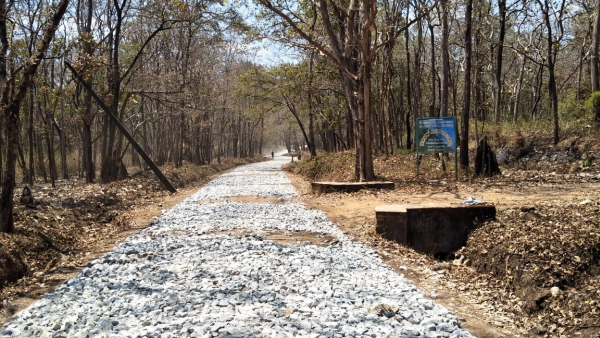
The CEC did intervene in two other cases. It strongly criticised the proposed exclusion of approximately 300 sq km from Karnataka’s 695.6-sq-km Shettihalli Wildlife Sanctuary, a move intended to legitimise extensive illegal settlements and commercial encroachments. It warned that rewarding encroachers would set a dangerous precedent and criticised the state’s unilateral “rationalisation” for bypassing Supreme Court-mandated protocols.
The CEC also questioned Andhra Pradesh’s proposal to remove 8,093 hectares from Kolleru Wildlife Sanctuary. Both Karnataka and Andhra Pradesh were then governed by parties opposed to the BJP-led government at the Centre.
This selective intervention may be better understood in a socio-political context than as an ecological imperative. But the CEC’s mandate was not to admonish state governments; it was to bring such transgressions before the Supreme Court. By failing to do so, it abdicated its role as a watchdog while protected areas continued to be redrawn or reduced.
The Curious Case Of Galathea Bay
The positions taken by the MoEF&CC, SC-NBWL, and CEC were particularly stark in the controversial denotification of Galathea Bay Wildlife Sanctuary, notified in 1992.
The SC-NBWL recommended denotifying the sanctuary for an international container transhipment port at Galathea Bay—India’s most important, and the northern Indian Ocean’s largest, nesting site for endangered giant leatherback turtles.
The committee relied on the absence of a final notification to justify its recommendation. The Andaman and Nicobar administration had issued only a notification declaring its intention to constitute the sanctuary, while the subsequent statutory process remained incomplete. Yet the ministry itself recorded that this preliminary notification had not lapsed. Galathea Bay therefore remained protected under the Wild Life (Protection) Act.

The Nicobar Megapode Wildlife Sanctuary was also denotified on similar grounds at the same 60th meeting in January 2021. An RTI response from the MoEFCC further confirmed that the Supreme Court had not approved the denotification of either Galathea Bay or the Megapode sanctuary.
The reasoning has implications well beyond Galathea Bay. A significant majority of India’s 700-plus wildlife sanctuaries and national parks still await final notification because the preceding rights-settlement and statutory processes remain incomplete. In Madhya Pradesh, for example, 10 of 11 national parks—including Kanha Tiger Reserve and Kuno National Park—lack final notifications.
Yet these areas continue to function as protected areas under wildlife law and receive regular funding and technical support from the MoEFCC. The ministry’s own 2011 guidelines make no distinction between preliminarily and finally notified protected areas and state that the absence of a final notification does not strip a protected area of legal protection.
By treating the absence of a final notification as extinguishing legal protection, the MoEF&CC, SC-NBWL and CEC proceeded with the denotification without obtaining the Supreme Court approval required under its orders.
In Galathea Bay, that interpretation removed a major legal obstacle to a proposed megaproject in one of the world's most important leatherback turtle nesting sites.
The case also risks setting a wider precedent: if the absence of a final notification can be used to remove protection from a sanctuary, other protected areas awaiting final notification could similarly become vulnerable whenever their status is seen to obstruct a project.
Data for this report emerged from an analyses of documents available on the PARIVESH portal https://parivesh.nic.in/#/wlc of the union environment ministry, Court orders and, additionally, from right-to-information queries filed by one of the authors, Prakriti Srivastava.
(Prakriti Srivastava is the former principal chief conservator of forests, Kerala, and as deputy inspector general of wildlife in the union environment ministry handled the National Board for Wildlife and its Standing Committee. Prerna Singh Bindra is a former member of the National Board for Wildlife and its Standing Committee and the author of The Vanishing: India’s Wildlife Crisis. She recently completed her PhD at the University of Cambridge.)