
Delhi: “If my name is cut, what will happen to me”
“If your name is cut, they will send you to Pakistan or Bangladesh”
“If your name is cut, you will end up in jail”
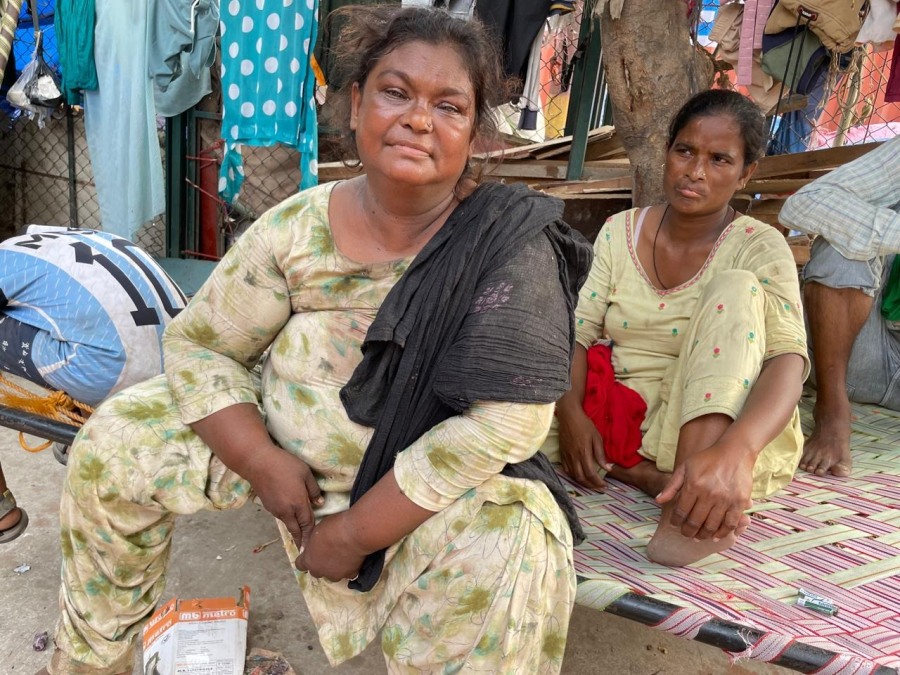
These were the fears voiced by homeless Muslim women who now faced the prospect of losing their voting rights in India’s capital city.
They spoke of being sent to Pakistan or Bangladesh, or even ending up in jail, half-jokingly, teasing each other. Yet the ease with which they turned such fears into casual banter showed how deep the threat of persecution had seeped into their everyday lives, becoming something they had come to accept.
Beneath the women’s wry humour was a very real worry that disenfranchisement in the massive revision of the electoral rolls now underway would make them even more vulnerable amid a growing political campaign to identify and remove alleged Bangladeshi migrants from India.
They were either deleted from the draft electoral roll for the national capital, published on 5 August 2026 or issued notices because they could not establish a link to the 2002 draft roll through their own records or those of their parents or grandparents. For many, the problem is simply that they don’t have the documents needed to prove that connection.
After an Indian Express investigation revealed that two commissioners of the three-member Election Commission (ECI) had questioned the legality of requiring a link to the 2002 electoral roll, and an uproar over politicians and bureaucrats who had faced the same difficulty but were being quietly reinstated, the ECI announced a change in procedure: instead of requiring voters who received notices to appear at an office, booth-level officers would visit them at home.
But this does not resolve the underlying problem because the most marginalised sections lack the documents to establish this required link. They must appear with one of 12 specified documents in response to a notice. A birth certificate, passport or class 10 certificate might appear, on paper, to be relatively accessible forms of proof. But for many poor people, even these are documents they simply do not possess.
“Instead of producing the documents there, you produce them at home, but the harassment over documents remains,” said S Y Quraishi, the chief election commissioner from 2010 to 2012. “That has led to many deletions because the documents are not available.”
The same problem confronts those deleted from the draft roll, marked as absent, shifted, dead, or duplicate, as well as those whose verification forms were not received.
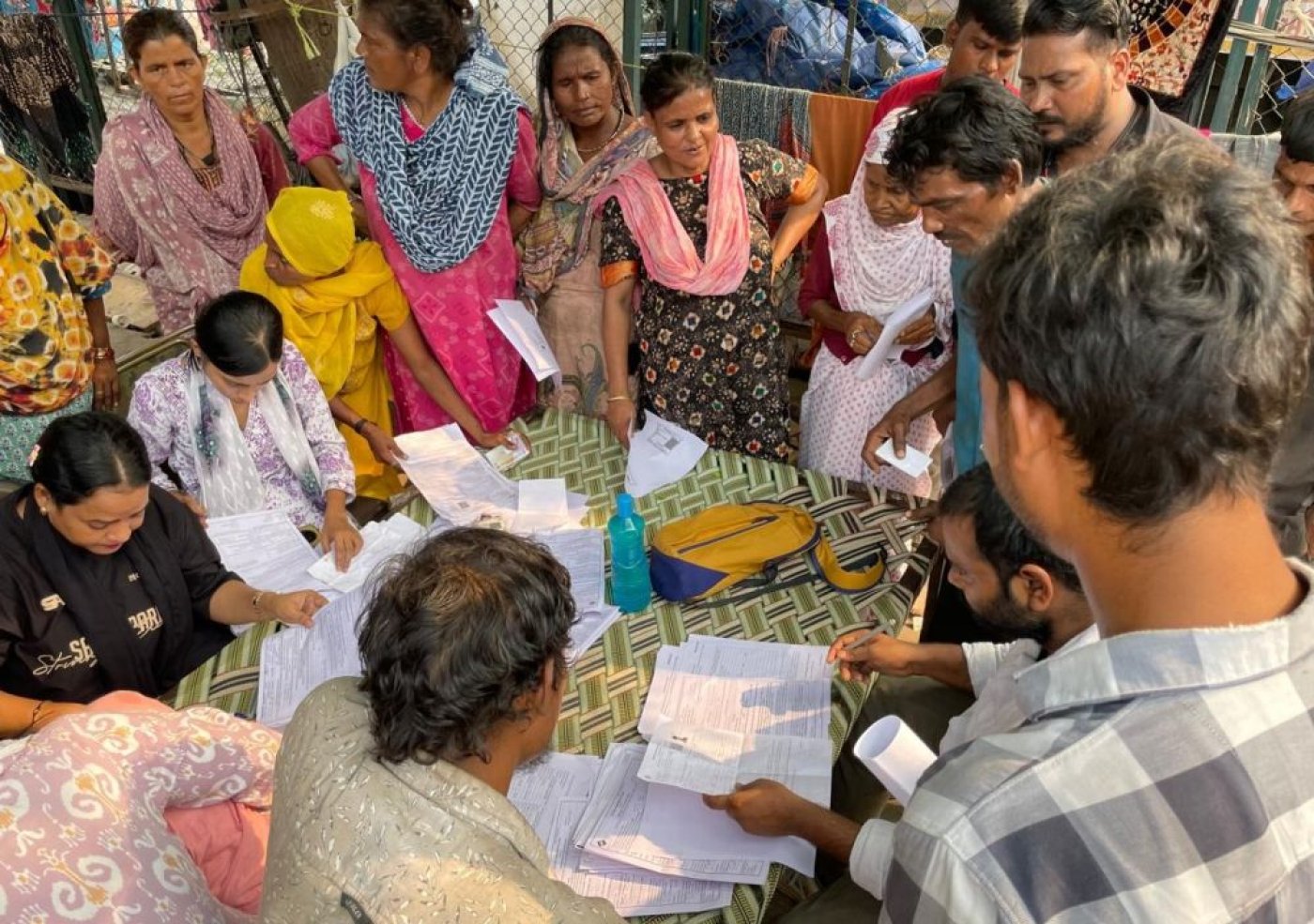
Last week, Delhi’s chief electoral officer held camps in homeless shelters for re-enrolment through Form 6.
For those who already had voter cards and had voted in previous elections, re-enrolment will needlessly erase their voting history—something that, for one mother and waste-picker in Old Delhi, was precious.
Yashmin, 35, said that except for one election, she had voted in every election since getting her voter card in 2015.
“I don’t have any documents,” she said sadly. “How will I get proof? I like to vote. We go every time to the booth behind the hospital.”
Earlier, the revision process was more sympathetic to poor people and required only nominal documentation. This time, it has been divorced from the realities of the poor.
For Muslims, exclusion did not simply mean temporarily or permanently losing the right to vote or facing a long and painful struggle to get back on the rolls. They feared that unlike Hindus, including poor Hindus, being left off the electoral rolls could put their citizenship into question.
Describing her visit with an election official, Yashmin said, “He said, ' Give me proof of your mother or father, naana-nani (maternal grandparents), daada-daadi (paternal grandparents).'”
“They are all gone now. I only have one sister left,” she said.
Then, as she asked, “What will they do if you cannot give documents?” another woman called out jokingly, “You will go to jail.”
Cackling, Yashmin retorted, “I’m not a Bangladeshi.”
‘What Is Written’
Yashmin was homeless in one of the poorest yet most historic quarters of Old Delhi, where traditional Muslim eateries serve world-famous kebabs and kormas in the shadow of a grand mosque and a red sandstone fort built by the Mughal emperor Shah Jahan in the 17th century.
The government shelter, where she slept, sat next to the famed Meena Bazaar, where, by day, cots were piled high with phone cases, suitcases, clothes, footwear, backpacks, bath mats, watches, brass and silver polished crockery, bangles, and hair clips, all sold at bargain prices.
Amid the historic grandeur and bustling commerce, life for Yashmin and other homeless Muslim women was hard and unforgiving.
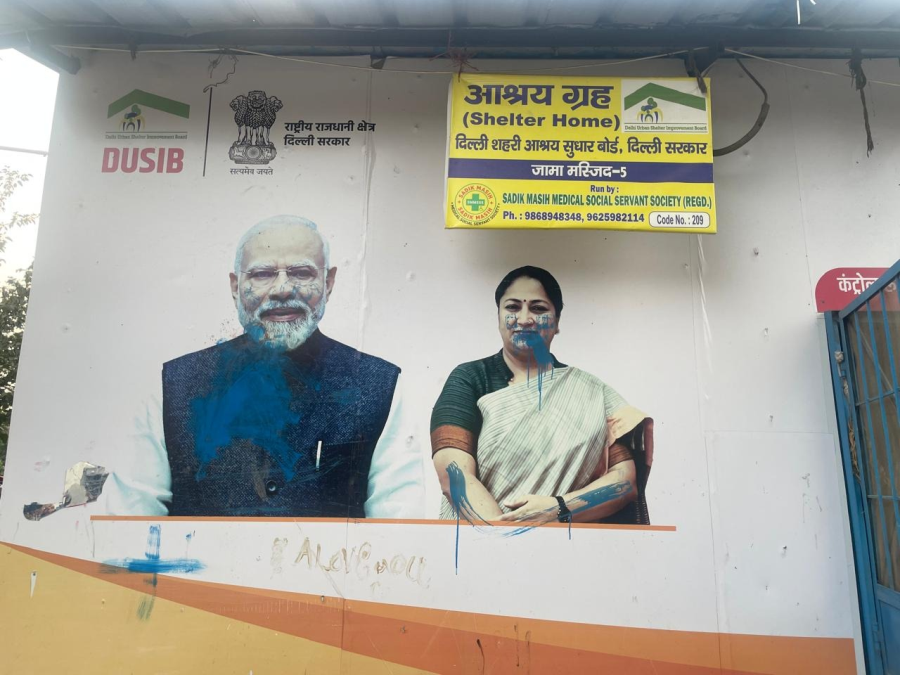
At the shelter bearing the image of Prime Minister Narendra Modi and Delhi chief minister Rekha Gupta, waste lay inside the windowless cabins and scattered across the yard. Hens clucked, goats wandered, and pigeons fluttered about.
The women had a tin roof over their heads and a bed, but not much else. Their conversations were peppered with expletives as they fought, gossiped, and shouted at their children, who ran around in grimy clothes, with some of the youngest wearing little.
Some had received notices asking them to appear on the 18th and 19th, but they said they received them only that day, the 23rd. They said “the teacher from the school near the temple” who gave them the notices told them they could go the next day.
The notices were in English, so they did not even know the dates mentioned. They asked anyone they thought could read, including this reporter, what the notices said.
“What is written?” they asked repeatedly. “What do we have to take?”
Fear & Futility
What may have started as an effort by the Modi government and ruling Bharatiya Janata Party (BJP) to appear tough on Muslim migrants from Bangladesh, consolidate their support base by repeatedly acting against Muslims, and possibly influence electoral outcomes, the special intensive revision (SIR)—carried out by the ECI with unusual haste—has also ended up affecting swathes of people across socio-economic and religious backgrounds, from a Bharat Ratna awardee to those excluded in posh and middle-class colonies, as well as the poor.
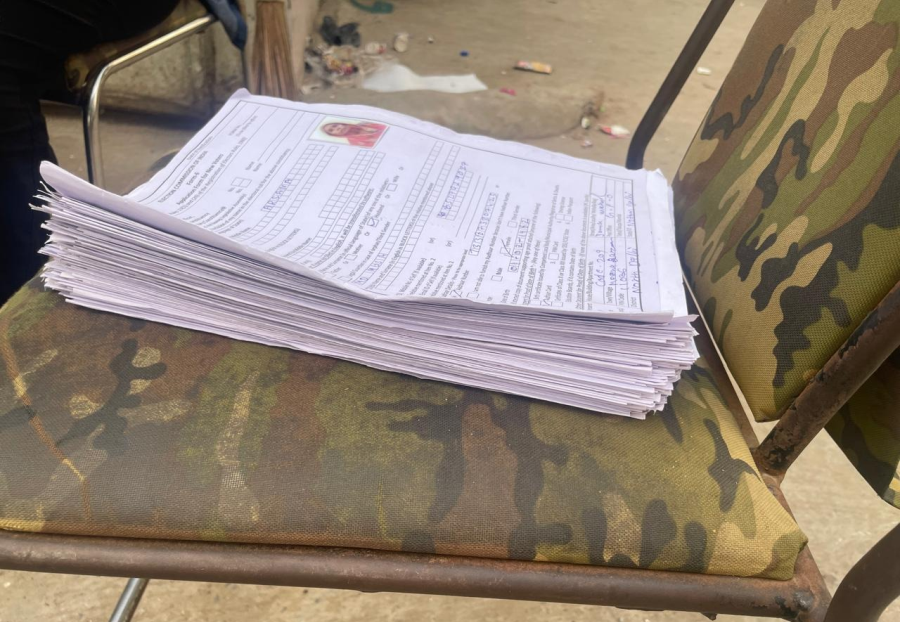
The Express investigation has revealed deepening dissent within the ECI, with commissioners Sukhbir Singh Sandhu and Vivek Joshi repeatedly objecting to decisions by chief election commissioner Gyanesh Kumar, including the change to Form 6 that required applicants to state whether they, their parents, or their grandparents appeared on an earlier SIR roll.
The commissioners said they could not make this change without amending the law, with Sandhu calling it “unauthorised and illegal.”
The ECI has said that during the SIR period, applicants will submit Form 6 along with an additional declaration form seeking information about their linkage to parents or grandparents. Outside the SIR period, Form 6 is the standard application for new voter registration and requires basic information, along with supporting details such as age and residence.
“How can you have two Form 6s?” said Quraishi. “That form is illegal, which these two commissioners have questioned.”
Sabir Ahamed of Kolkata-based SABAR Institute, which reported the disproportionate exclusion of Muslims in West Bengal’s SIR, said the re-enrolment camps were only being conducted under sudden pressure from the media after several excluded “VIPs” were quickly restored to the rolls.
The Reporters Collective found that the ECI was using an app feature to fast-track the verification and restoration of politicians and bureaucrats.
“It is the same cycle. If you could not link (to the 2002 electoral record) in the earlier round, how will you do it now after deletion,” said Ahamed. “The media will forget, there will be some discrepancy or the other, and these poor people will be left following up for a long time.”
The SIR already disenfranchised 6.5 million in the first phase and 73.6 million in the second phase, with 61.5 million facing disenfranchisement after the third round conducted in 14 states and three UTs.
With 4.77 million of Delhi’s 14.51 million electors left out of the draft roll, roughly one in three voters was excluded in the first stage of the exercise. Another 3.31 million, whose names remained on the draft roll, were issued notices—1.38 million for “no mapping” to the 2002 electoral roll and 1.93 million for “logical discrepancies”, meaning their details did not match those in the older roll.
Over one million voters in Delhi were removed from the voter roll even before the electoral revision started in July.
‘If You Are Muslim, They Will Torture You’
Sajra Jahan came to Delhi from Bihar after her father married her to Babloo, a welder, at a very young age.
At 22, she was already raising three small girls.
Sajra said she does not belong in the homeless shelter, which she found both demoralising and unsafe. She was desperate to leave, find work and secure a clean, one-room home for her family.
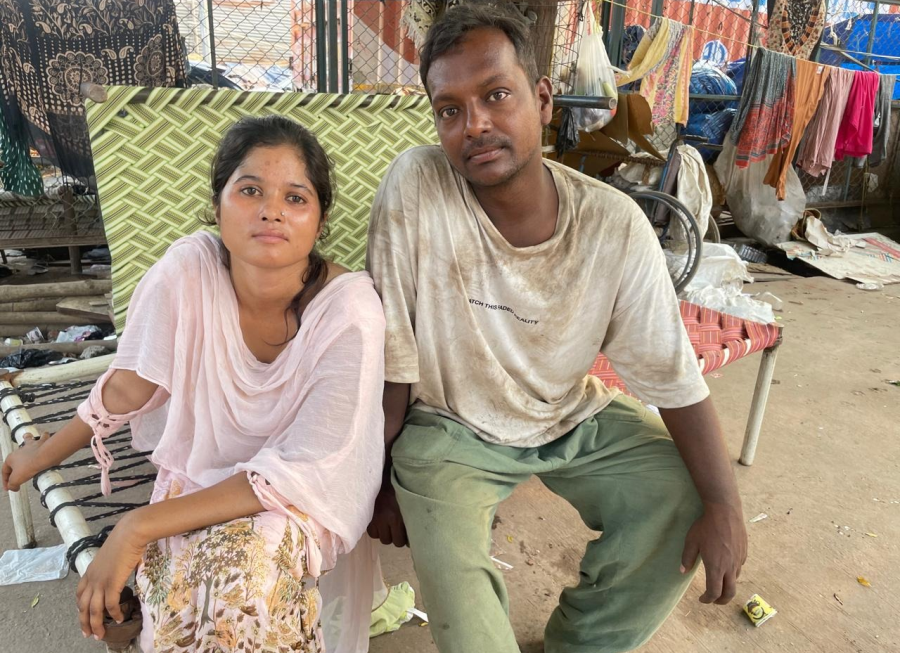
Sajra studied until class 8 in Araria district in Bihar. After meeting an NGO worker, she is attending computer classes in Delhi. She also hoped to go to college.
Sajra said she voted in the 2024 Lok Sabha election.
“I was so happy when my name was on the list. But today we got this notice, and now I’m scared. What if we don’t make it? I’m afraid they will remove us from citizenship,” she said. “There is already so much hate and discrimination against us. It is the only protection we have.”
Having come of age in the decade after the BJP came to power nationally and Muslims have faced a sustained campaign of violence and vilification, Sajra said she has experienced discrimination at school and in her everyday interactions with the world.
She said she has learned to live with a constant sense of fear.
‘They Make Us Feel Like Criminals’
“Is it a crime to be Muslim? I don’t believe in this Hindu and Muslim division. I believe in humanity,” said Sajra. “But we are made to feel very small. They make us feel like criminals. We always have to be on our guard.”
Nearby, her husband and sister-in-law, who had also received notices, racked their brains and argued over what they could do. Her husband said they had none of the 12 documents required and could not establish a link to the 2002 voter list.
“No, no, there is nothing we have”, he told his sister.
Then, turning to this reporter, Babloo, 35, said: “They say I have to prove I’m a citizen, when I have lived and worked here all my life. I could barely tie my own pants when I had to take care of my sisters—one was around my neck, and the other holding my hand.”
His father died when he was still a child. His mother first fed him and his sisters by begging and later by selling vegetables. Babloo said he started riding a rickshaw at nine years old, earning 20 paise, sometimes 10 paise. He also worked at a tea stall, where he earned Rs 1 a day.
He never went to school. He learnt a little from an NGO worker who he said used to come by, and from reading newspapers. His wife taught him to sign his name in English.
“Fine, they want to take my vote away, let them,” he said, sounding resigned. “I’m tired of this.”
But for Sajra, the fear runs deeper.
“If you are Hindu, and you lose your voting rights, they won’t torture you,” she said. “If you are Muslim, they will torture you.
“If you are Muslim, you are always sent to the back of the line. If you are Muslim, they don’t speak to you properly or employ you,” she said. “Now, we won’t even have basic safety.”
The Next Day
The next day, Sajra’s fears were realised.
Thumbing through the pages of the notice and her grandfather's voter card, Aadhaar card, and ration card, which she had stapled together, she said, “I had told you that we would be persecuted, and that is what is happening.”
Sajra spent a couple of hundred rupees on photocopies and transport to the voter registration office, where she waited for over two hours before being told none of her documents was sufficient.
“He said, 'How will he know that this person is my grandfather? He asked for 2002 proof,” she said.
“I felt so angry, so helpless. I don’t know what to do,” she said. “Where should I get 2002 proof? Poor people like us will suffer the most. People who are educated, people who have money and connections will all find a way.”
They had scrambled to find her grandfather’s documents the day before. His voter card and Aadhaar card had been issued in 2014 and 2024, both with an address in Araria, Bihar. They also had a ration card in her grandmother's name.
Her grandfather died in 2025. Her grandmother died in 2022.
‘I’m So Angry, I Am Laughing’
Tired and unhappy after her five-hour ordeal, she asked this reporter to read out the list of 12 documents printed on the back of the notice.
She replied “no” to the birth certificate and passport.
She asked, “Would my class 8 report do?”
Her husband, Babloo, had no documents to take. He went with just his voter card and Aadhaar.
“It was just a waste of a day. We spent so much time and money coming and going, and I lost a whole day of earnings,” he said.
Sajra had also missed her computer class.
Mimicking the officer’s remarks to his wife, Babloo said aloud, “‘How will I know this is your grandfather?’”
“I’m so angry, I’m laughing,” he said.
Watching his four-year-old play music composer A.R. Rahman’s iconic rendition of “Vande Mataram” on his mobile phone and singing along, Babloo said, “They are taking away our right to vote today, and we can’t do anything.”
“Tomorrow they will come with lathis, and say, ‘You are Pakistani and Bangladeshi’, and we won’t be able to do anything.”
Blinking back tears, he said, “Sometimes I feel sad to be in a country that does not seem to want me. I just want five or ten years of peace, and to know that my children are safe.”
‘Mentally & Financially Exhausting’
Despite repeated claims by BJP ministers and officials that the SIR would identify and remove Bangladeshis and Rohingya Muslims, as well as claims that it has done so, the ECI has not publicly provided any number of such voters identified through the exercise.
The SABAR Institute, in its analysis of Delhi’s SIR, found that more notices were sent to less prosperous areas, measured using night-time satellite light, with the five constituencies with the highest notice rates—Mustafabad, Matiala, Karawal Nagar, Deoli and Gokalpur—reaching 25.3% of voters, compared with 15.6% in the five lowest.
They found Muslims over-represented in 7 of 9 categories of notices. Though they make up 12.9% of Delhi’s population, Muslim names account for 51.5% of notices for “6 or more children linked to one parent”—four times their share of the population.
Ahamed said the “mental health aspect” of the SIR had not been explored.
He recalled a call from a 24-year-old Muslim who was “crying and crying” over fears that he would never secure a government job or could be sent to a holding centre for deportation. He spoke of people frustrated by having to repeatedly check on their pending appeals, and mothers worried that losing their voting rights could also cost them government benefits and children’s scholarships.
“It is mentally and financially exhausting,” he said. “People with social capital can come back to the process on a fast track, 5G speed, but for the poor people, it is modem speed.”
(Betwa Sharma is managing editor of Article 14.)
Get exclusive access to new databases, expert analyses, weekly newsletters, book excerpts and new ideas on democracy, law and society in India. Subscribe to Article 14.