
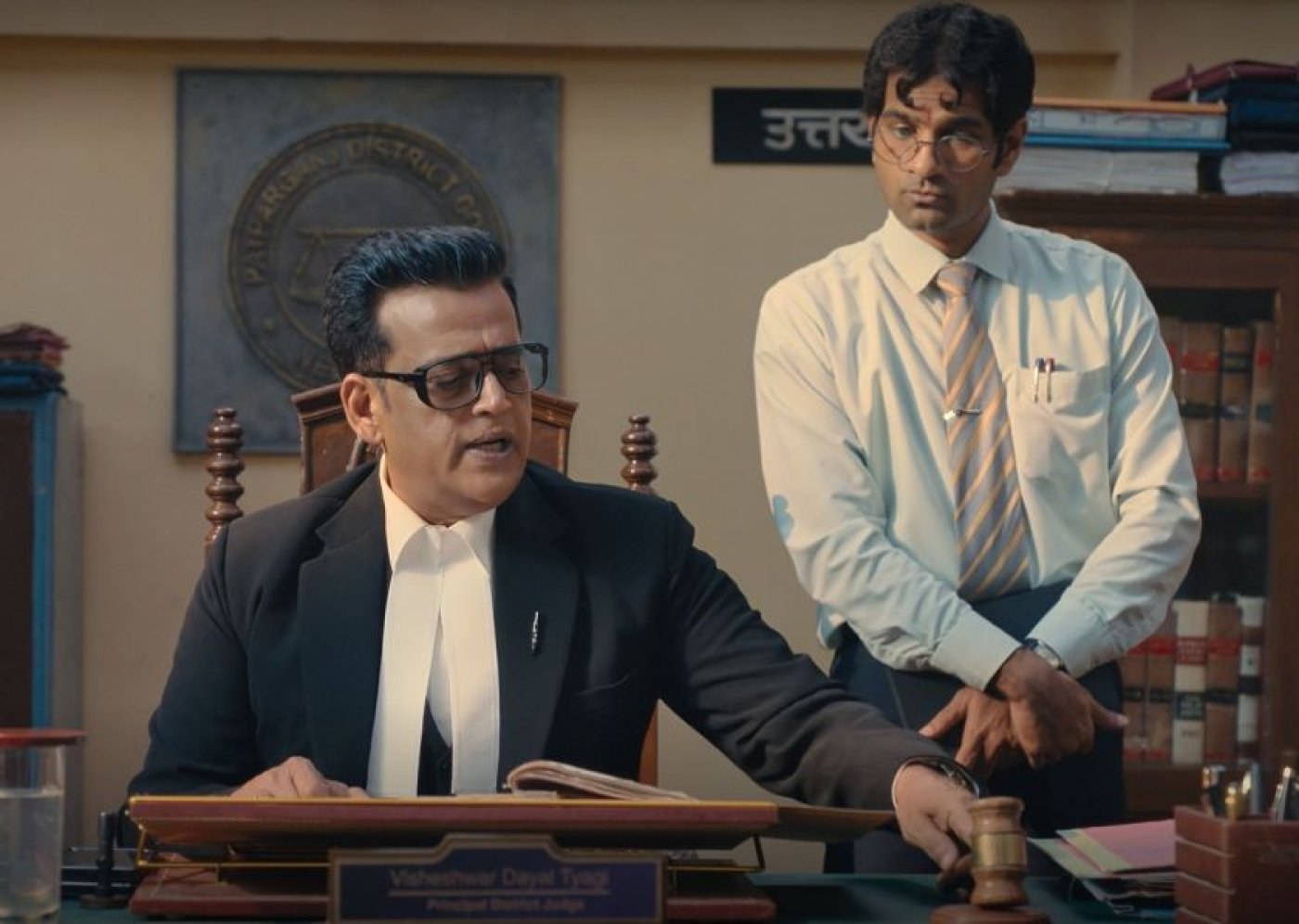
The scene opens in a courtroom in east Delhi’s Patparganj district court, presided over by the district judge, who is also the protagonist of season two of the Hindi-language Netflix show, Mamla Legal Hai.
A verdict of guilt has just been announced by him at the end of a trial against a 24-year-old boy accused of kidnapping and murdering two minor children—it is now time to determine the appropriate sentence.
The public prosecutor prays for the death penalty for the convict by considering the crime as ‘rarest of rare’.
The doctrine of ‘rarest of rare’ was introduced by the Supreme Court in the 1980 Bachhan Singh case. However, it is an undefined phrase, therefore, largely subjective.
On the other hand, the defence lawyer highlights the young age of the accused and prays for life imprisonment. His submission is sharply interrupted by the cry of the parents of the victims sitting in the courtroom, saying, “aur hamaare bacche toh isse bhi chhote the. (Our children were even younger).”
Visibly affected by both the nature of the crime, the demands of the victim’s family and the tender age of the accused, the trial judge, now unsure of how to piece them together to determine the sentence, seeks time to contemplate.
But what are his legal tools for such contemplation?
The Supreme Court in Bachhan Singh asks for a weighing exercise of aggravating and mitigating circumstances to determine the necessity of the death penalty. Moreover, it said, what also should be determined is whether an alternative to death as a punishment is “unquestionably foreclosed”.
Thereafter, in Machhi Singh,1983, the Court added to this existing framework, now specifying how the manner, nature, motive, magnitude of the act coupled with the victim’s personality need to be studied to ascertain the rarity of the crime.
Gradually, in 2022, the Supreme Court, in the case of Manoj, directed calling for necessary reports from the State that would aim to establish whether the accused is beyond reformation and a death sentence is the only resort for the court.
This essential crux of death penalty jurisprudence is cumulatively portrayed in the subsequent scenes—the judge is now sitting in his chamber, lawyers of both sides placing before him the circumstances of the crime, what seems to be following a Machhi Singh discussion—the former telling the latter how brutal the crime was and how premeditatedly it was done, while the latter arguing how this crime is not rare enough for the death penalty.
As the lawyers leave, Munshiji (a local senior lawyer) points out to the judge, “Our justice system believes in reform..”, to which naturally the judge quickly exclaims, “Then no one should get the death penalty but given an opportunity to change…”
To this he is reminded how the same justice system also believes that in rare cases, having no possibility of reform but rather a need to protect the welfare of the society, death needs to be granted…..”
And who will prove this pivotal aspect of reformation?
The jail officer (in who’s custody the convict was imprisoned), also present in the judge’s chamber, addresses this amidst the conundrum of the crime and the criminal. In a parting shot, he admits, “Sir, in my 30 years of experience with prisoners, I have never seen anyone beyond reformation.”
I am tempted to add again that the word "reformation", too, does not have a definition as such and toes the line of subjectivity. My experience of arguing sentencing before several trial courts has revealed how it is mostly understood through the prism of a prisoner’s “discipline” and “obedience” inside prison, along with commonly perceived versions of ‘repentance’ for the crime.
The ‘Collective Conscience Route’
Although equipped with adequate knowledge and information by now, the judge in the Netflix series still requires “marg darshan” (wisdom)—and goes to a senior judge.
The senior starts by reminding the junior how it is the State’s name in the place of the victim, as any crime is said to be against society as a whole and not only an individual and therefore, “society expects justice from a court”. The junior judge exclaims that a judge is also a part of society.
The senior judge teaches him that he needs to leave his personal values outside the courtroom and go beyond society to pronounce a “just” verdict.
The former hands the latter a pen, which he calls a “sword”, and leads him towards decision-making, which he calls a “battlefield”.
A dramatic set-up before the climax—pitch perfect acting by both, and the support of an elevating background music to touch the right emotional chords of the audience.
Now, I will dissect this as per the law.
A death penalty cannot be based on a judge’s personal will to hang a person. However, here comes another undefined phrase called the “collective conscience”, as introduced in Machhi Singh, that tied the judiciary’s responsibility to impose the death penalty to the expectations of an outraged public whose conscience demands it.
Therefore, throughout the show, the word “samaj” (society) and its “ummeed” (expectation) recur.
In reality, too, very often the collective conscience route allows a trial court to justify capital punishments, since the phrase has no real meaning, and could very well be used to justify a judge’s personal will.
Read my discussion on trial courts and the slippery slope of collective conscience here.
Rarest of Rare vs Mitigating Circumstances
Pronouncement: A few hours later, the judge finally declares death in the case. As he gets up to leave, he stops to look at the accused one last time. Now we see empathy in his face.
More so because the scene later ends with him sitting alone in his chamber, breaking down on a call with his father (the senior judge), repeating, “He was only 24…only 24!!”
Our punishment system inherently believes in reformation. Therefore, our jails are called reformation centres. However, as if a paradox, the death penalty too remains a constitutional form of punishment, justified in a case where the procedural safeguards are followed.
However, the inherent paradox of pitting aggravating circumstances of a crime against mitigating circumstances of the criminal, along with subjective ideas of a “rarest of rare crime” and “possibility of reformation of a convict”, often makes the decision to impose the death penalty arbitrary.
While there is the idea of expansively and liberally considering mitigating factors or considering the criminal rather than the crime, the subjective idea of “rarest of rare” may hinder such exercises.
While the idea of alternative punishment being “unquestionably foreclosed” exists, the slippery slope of identifying a collective whose conscience has been affected to an extent where the court is to assume a paternalistic role of avenging the harm caused and satiating the public, aids a safe departure from the criminal and a return to the crime. In fact Machhi Singh’s pointed list of circumstances around the manner, nature and motive of crime, the intensity of each being said to have a role in affecting the public’s wrath, merely adds to a judge assuming the position of that public’s representative.
Therefore, following this very confusion in reality, the characters of the show too frequently break into, “...as a citizen I am asking for the death penalty...” (told through the public prosecutor), “...our system believes in reform yet in rare cases, for the welfare of the society, allows for death...” (told through Munshiji) or “...the entire society comes to the court to ask for justice...” (told through the senior judge).
Amidst this imaginary “society” and a myth of its “collective demand” used by courts, there is a conscious departure from the pivotal question of the same society’s responsibility towards making a “criminal”, who is never born as that, and its accountability towards his reform.
(Senjuti Chakrabarti is a criminal defence lawyer, mostly having practised as a full-time legal aid counsel in trial courts in West Bengal and has argued sentencing in several death eligible cases)
Get exclusive access to new databases, expert analyses, weekly newsletters, book excerpts and new ideas on democracy, law and society in India. Subscribe to Article 14.