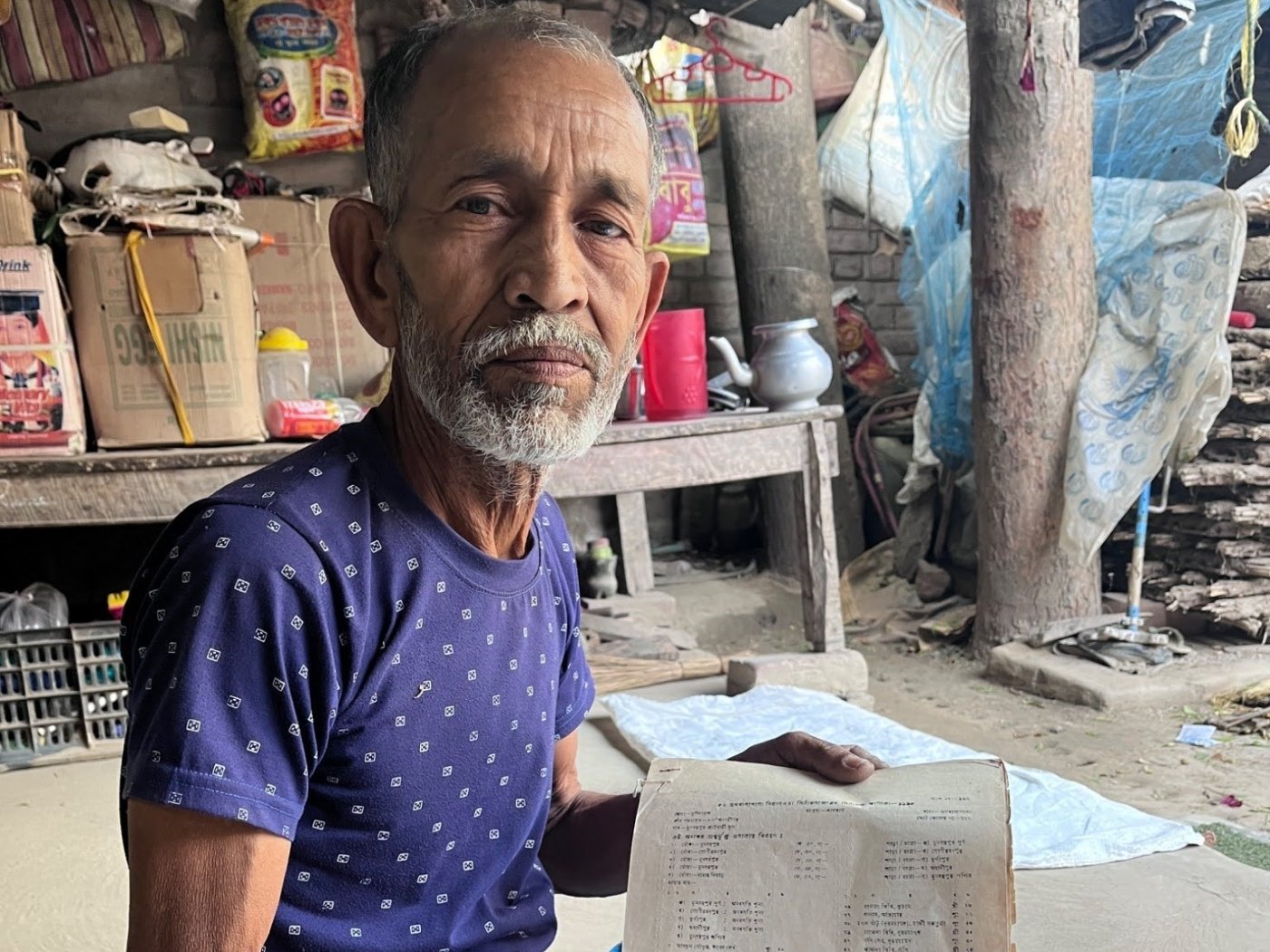
Murshidabad, West Bengal: “Of my five children, three are accounted for, but two have had their names removed from the electoral roll,” said a worried Rashid Ahmed, my long-time host and friend in the chars (sandbanks) of Murshidabad, a border district in West Bengal.
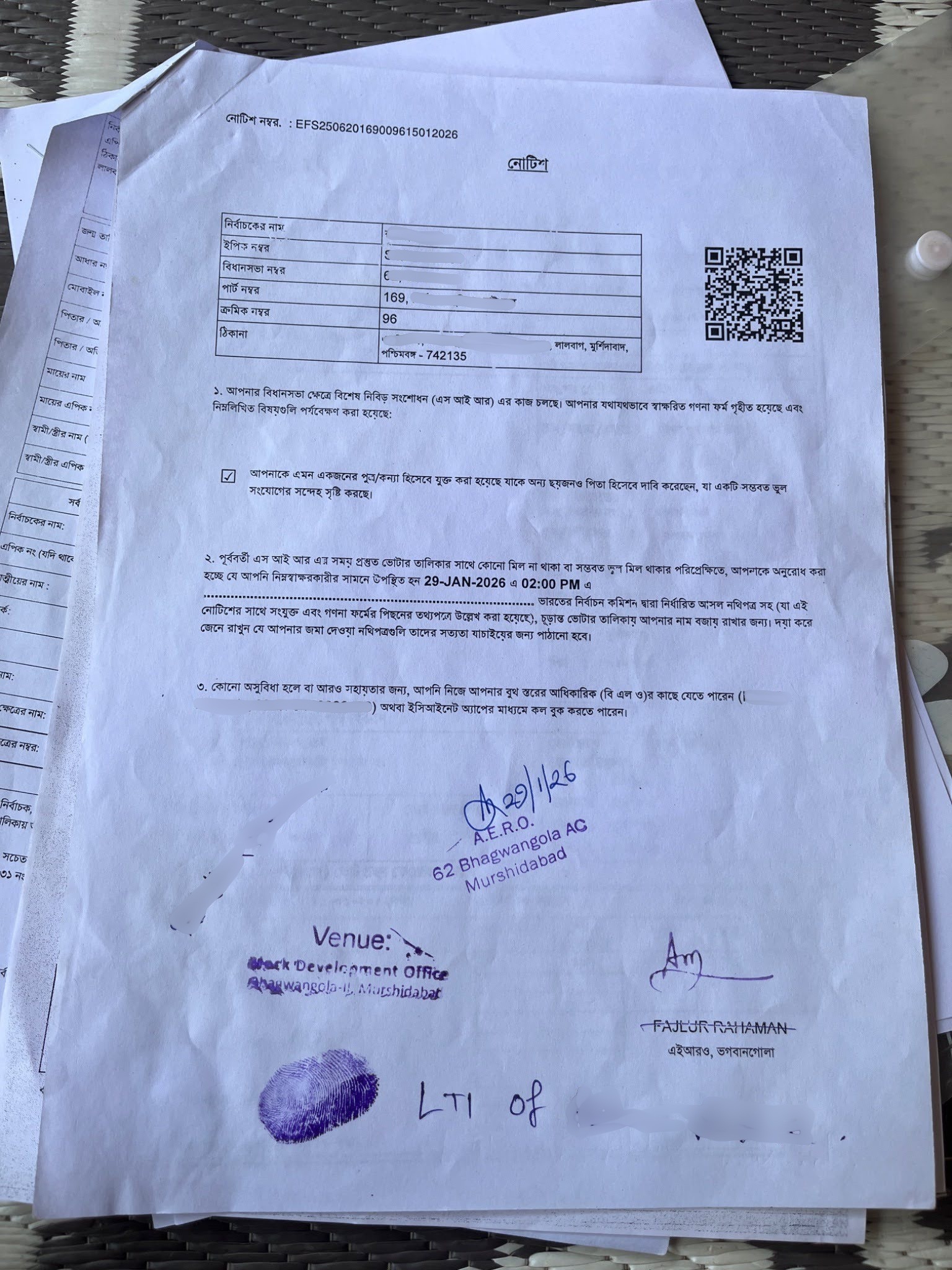
“A notice last November from the Election Commission claims I have more than five children and suggests I may be harbouring a Bangladeshi, so I was required to submit all my children’s documents at the hearing,” said Ahmed.
I had never seen Ahmed so gloomy.
In November last year, Ahmed received a notice from the Election Commission of India (ECI) that his children—three sons and two daughters—were placed under scrutiny.
On 29 January 2026, there was a hearing at the Block Development Office (BDO), where all documents of every child were submitted, but an online verification in March revealed that only three had made it to the electoral roll.
Two of his three sons had their names deleted, which meant they could not vote on 23 April in the 2026 State Assembly elections.
Authorities alleged that six voters had claimed him as their father, creating a discrepancy in his lineage.
The consequence of the recently concluded special intensive revision (SIR) in West Bengal, a large-scale voter verification exercise meant to identify eligible voters and remove ineligible ones, is the disenfranchisement of 9.1 million voters, or almost 11.9% of Bengal’s electorate, were deleted from the electoral rolls.
While Muslims constitute 34% and Hindus 63% of the total deletions, the figures are disproportionately high for the former, considering they make up only 27% of the state’s population.
Murshidabad, along with four other border districts—North 24 Parganas, Malda, South 24 Parganas, and North Dinajpur —among the districts with the highest Muslim concentrations in the State, account for 58.65% of the total electorate marked as under adjudication.
According to a 7 April report by The Wire, the highest volume of deletions, 4.55 lakh, in the judicial review of the under- adjudicated voters, occurred in Murshidabad, the district with the highest Muslim population in the state.
This is true across border districts with large minority populations: Maldah saw 3.25 lakh names under adjudication dropped, followed by South 24 Parganas at 2.22 lakh.
The three districts with the highest number of total electoral roll removals were the border districts of North 24 Parganas (1,238,309), South 24 Parganas (1,055,339), and Murshidabad (743,752), accounting for 34.15% of all voters deleted.
The Unfathomable Chaos Of SIR
In 2025, the ECI planned an SIR of electoral rolls in nine States and three Union Territories, including West Bengal, ahead of the 2026 Assembly elections.
The 2002 electoral roll is the official benchmark to which voters must link their or their parents' names.
The home minister of the country, Amit Shah, had publicly declared numerous times that several voters in the border states of eastern India were illegal immigrants from neighbouring Bangladesh who had obtained voter identity cards using falsified documents.
Unlike the annual summary revisions, which incrementally update the existing rolls, the stated objective of the SIR, according to Shah, is to “Detect, Delete, and De-register”.
Bengal, governed by Trinamool Congress and chief minister Mamata Banerjee since 2011, when they defeated the Left–front government led by the Communist Party of India (Marxist), has been on the radar of the Bharatiya Janata Party (BJP), Shah and Prime Minister Narendra Modi’s party, for a long time.
In West Bengal, the BJP recently witnessed a small electoral setback. In the 2024 Lok Sabha elections, its vote share was 39.1%, and it won only 12 seats, down from 18 in the 2019 general election, when it won 40.6% of the popular vote.
In the 2021 assembly elections, the BJP secured 77 of the 294 assembly seats in the state with a total vote share of 38.15%. This, though, was a large upward swing compared to the 2016 assembly elections when the BJP won only 3 seats with a vote share of 10.3%.
Mamata Banerjee moved the Supreme Court in January this year, challenging the validity and neutrality of the SIR, alleging that it was a ruse to disenfranchise minorities.
Nineteen appellate tribunals were set up in compliance with the Supreme Court's 10th of March order, yet little information is available about their functioning. Meanwhile, on 16 April, the SC invoked Article 142 of the Constitution to declare that those deleted can vote, if cleared by tribunals two days before elections. But questions have been raised about its feasibility.
The chaos unleashed by the SIR, the onus of which falls on the ordinary voter already marginalised by community, caste and gender, is unfathomable.
The scramble for documents began with the Citizenship Amendment Act 2019, which offered a fast-track to citizenship for all persecuted religious minorities from neighbouring countries, except Muslims, triggering widespread anxiety around evidentiary documents as a basis for citizenship.
This constant demand for documents, which continues even now, is not just a drain on resources but also a drain on time.
This temporality of waiting, whether queuing up at tribunals or downloading and uploading documents, not only drains one's resources and time but also erodes one’s sense of self.
To be questioned whether one exists and to continue waiting for an algorithm to confirm whether one does is a form of violence, converting pre-existing vulnerabilities into a juridical condition of non-existence.
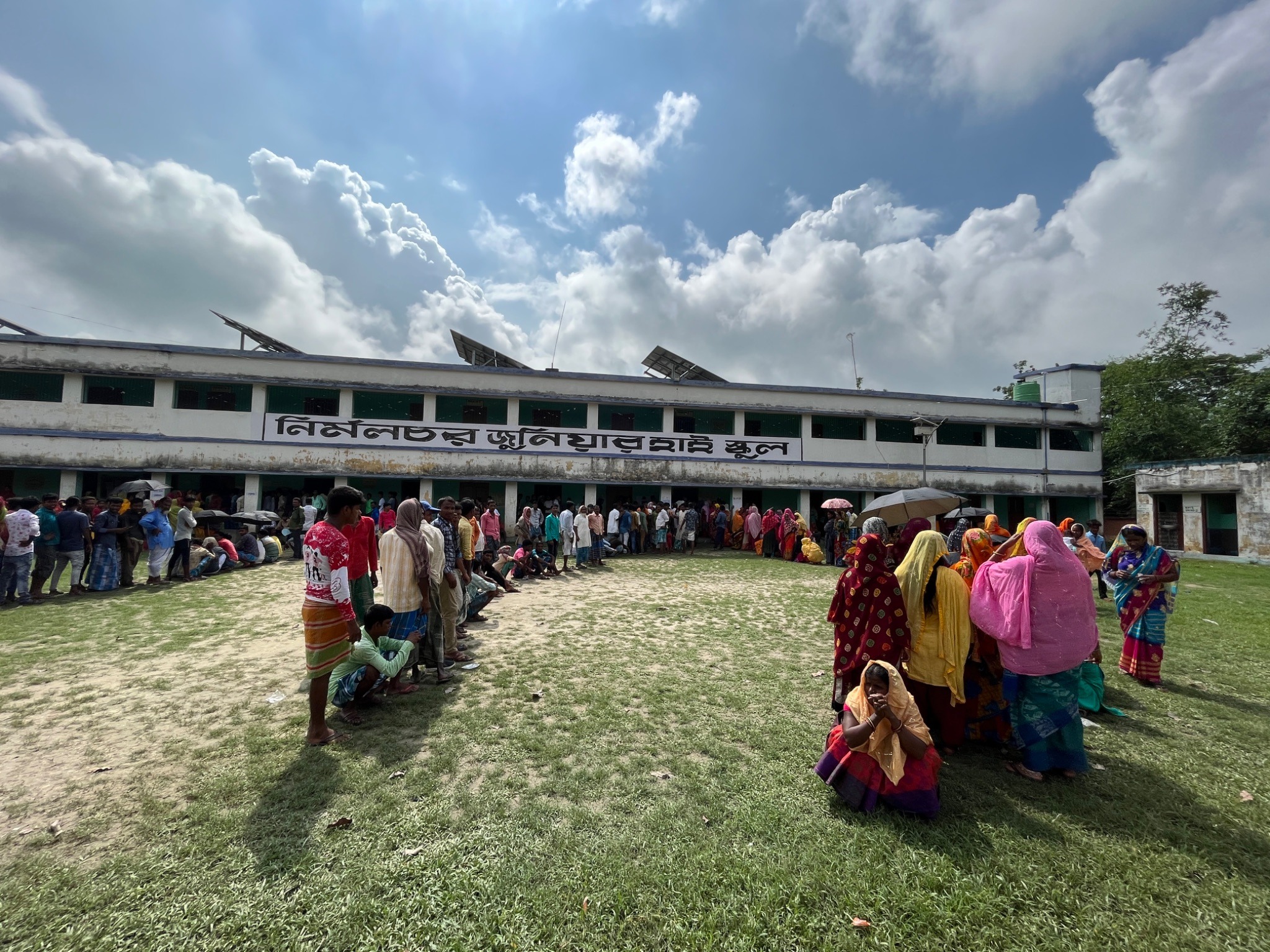
Inside Nirmal Char
In his late 40s, Ahmed owned 15 bighas (9.3 acres) of land adjacent to the India-Bangladesh border, of which 10 lay in the belly of the river, Padma.
Given the crackdown on the border by the Border Security Force (BSF) in recent years, which has cut people on the Indian side of the border, mostly Dalit and Muslims, off from the land they’ve farmed for generations, he chose to rely on the earnings of his three migrant sons, rather than farm his lands.
Chars in Murshidabad are sandbanks that emerge and submerge as the Ganga-Padma River accretes and erodes land, and Nirmal char emerged when the ‘boro bhangon’, or big erosion, precipitated by the operationalisation of the Farakka Barrage in 1985, led to the submergence of the Akheriganj Gram Panchayat, in a span of 12 years.
The sand bank left in the wake of the erosion is now a thickly populated human settlement that has seen rapid infrastructure development, including the recent installation of electricity poles, bringing power to an otherwise solar-powered village.
Ahmed said that 83 people were deleted from the list in Nirmal char, approximately 5.5% of the voters.
A Muslim majority population, particularly in the blocks adjacent to the borders, has historically witnessed communal skirmishes in the wake of partition, the influx of refugees from Dalit Hindus to Bihari Muslims, fleeing religious persecution and violence, particularly in the 1970s, after the Bangladesh liberation war.
The chars, with their shifting land and nomadic population, were often outside the reach of law and thus became the first site of refuge for those fleeing all kinds of persecution.
While Dalit refugees from Bangladesh often made this their first stop, during fieldwork, I often encountered stories of political refugees, petty criminals, and smugglers from Kolkata and nearby districts hiding in the swamps of deltaic Bengal.
This “suspect community” status, simultaneously produced by the river's refusal to be fixed and the state's determination to fix everything, has become a flashpoint in the charuas’ (people who live on the chars) grapple with legal-bureaucratic documentation.
The Six Children Myth
Ahmed showed me a 2011 census receipt and a panchayat document from the same period listing all five of his children.
However, his eldest daughter and middle-born son did not have birth certificates.
His wife, Ayesha Bibi, explained that their first child was born during a flood while they were staying with relatives on another part of the char, with no access to a hospital or health worker.
The same was true for their second son.
“Three months later, I went to the hospital to obtain birth certificates for both,” said Ayesha.
“We submitted all documents to the block development office, but after four years of processing, the case was rejected, and we were asked to file fresh documents,” she said. We gave up.”
“When we went to the hearing, there was a clear discrepancy in how all five children were treated. In retrospect, I understand that they had already made a decision to eliminate two,” Ahmed said.
“The three whose names were kept had all copies of their documents filed by the officers, and the documents of the other two were treated with indifference,” he said. “They waved them off, taking just a few, saying it was enough. I had a sense of foreboding even then.”
Strangely, of the two children who did not have birth certificates, one was included in the electoral roll, while the other was not, thus making the criterion of birth certificates as a basis for inclusion redundant.
Union home minister Amit Shah had been setting the tone for the 2026 West Bengal assembly election campaign with speeches focused on national security and border control.
In 2025, speaking in the state’s border districts, Shah accused the TMC government of facilitating illegal infiltration by issuing Aadhaar cards to Bangladeshi nationals.
Thus, it is no surprise that the SIR conducted in Bengal was different.
Whereas everywhere else, the exercise was conducted solely by electoral registration officers (EROs), who are state government officials, in Bengal, centrally appointed ‘micro-observers’ and ‘roll observers’ could monitor and even override ERO and assistant ERO decisions, especially in the absence of clear rules for resolving discrepancies.
Additionally, Supreme Court-appointed judicial officers were brought in to handle “under adjudication” cases, reducing the role of EROs.
The criteria of deletion were unclear.
Unlike previous times, when revisions of electoral rolls were made on the basis of absence during verification visits, death, or even duplicate entries, people found themselves deleted because of misspelt names, discrepancies between parents’ names or age and the voter’s name or age, and accusations of having six or more children.
These often did not take into consideration common practices such as different surnames between father and children, child marriage and early pregnancy, and name changes after marriage.
The fact that these minor discrepancies were being used as a basis for exclusion itself questions the stated motive of the SIR, which is to identify illegal migrants.
The ECI utilised flawed software to flag millions of voters based on "logical discrepancies".
Even the Supreme Court commented on the shortcomings of this process and said that it does not properly consider the socio-economic realities of West Bengal.
It is particularly poignant for charuas dwelling on the borderland, given their symbiotic co-existence with the river and their peripatetic mobility on the chars, which meant homes were built and rebuilt with every erosion, kinship ties, labour and trade routes that predated nation-states necessitated border crossing, and documents rarely matched lived realities.
Algorithms now produce the same exclusions as the geographic border, but through bureaucratic means that are harder to challenge and easier to naturalise as neutral administration.
Gendering SIR
Given the flaws in the algorithms used, it is unsurprising that women have emerged as a significant group excluded from the voter list.
The Kolkata-based non-profit Sabar Institute, which has been analysing and disaggregating data generated by the SIR, found that 61.8% of the voters who were deleted or placed under adjudication in West Bengal are women.
It has also been reported that the concentration of deletions of women voters was from the Muslim-majority districts of Malda and Murshidabad, but also, significantly, across Scheduled Caste and Scheduled Tribe groups, particularly in border districts.
Apart from clerical errors and the problem of transliteration from Bengali to English, continuity of names in various documents remained a challenge, particularly for women.
Women who discarded their family name for ‘bibi’, a common practice among Indian Muslims, found it harder to connect to their natal or marital families.
Additionally, given practices of early marriage in India, women who were ineligible to vote in their father’s home, and have now come of age, are faced with the difficulty of proving their citizenship with the 2002 electoral rolls as the basis for inclusion.
The Case Of Amina Bibi
As I sat in Ahmed’s courtyard, Amina Bibi, his neighbour, came to visit.
Amina was on her way to the panchayat office to ask them for ‘bongsho talika’ or a genealogy stamped and signed by the gram pradhan, the head of the village council, which she wanted to upload for the algorithm to reconsider her case.
She, alone, in a family of six, including four children, had her name struck off. The reason given that her name was not the same in all her documents.
Her birth certificate and school documents listed her as Amina Sheikh, but her Aadhaar card, PAN card, bank account, and Voter ID all listed her as Amina Bibi.
Amina, who is now in her late 20s, had married into Nirmal char from the neighbouring chars of Ranitala.
The distance between her marital and natal home (20 kms) can be covered in an hour by road, but depending on seasonal river flow, it can take much longer.
In the 2011 census, Amina lived in her father’s house, and her name was recorded there. But after marrying in 2013 at the age of 15, she moved to her husband’s home and was not included in the voter list until 2019.
“Women take their husband’s names after marriage. Doesn’t the government know this?” said Amina.
“My name was included in the census with my natal family in 2011. My parents have their names listed even in the 1995 electoral roll,” she said
“I have come to Rashid bhai to ask for a copy of the document to take to the panchayat,” said Amina “Of course, women have married on either side of the border, left the chars, returned after their marriages dissolved, and remarried. How can a machine detect all this?”
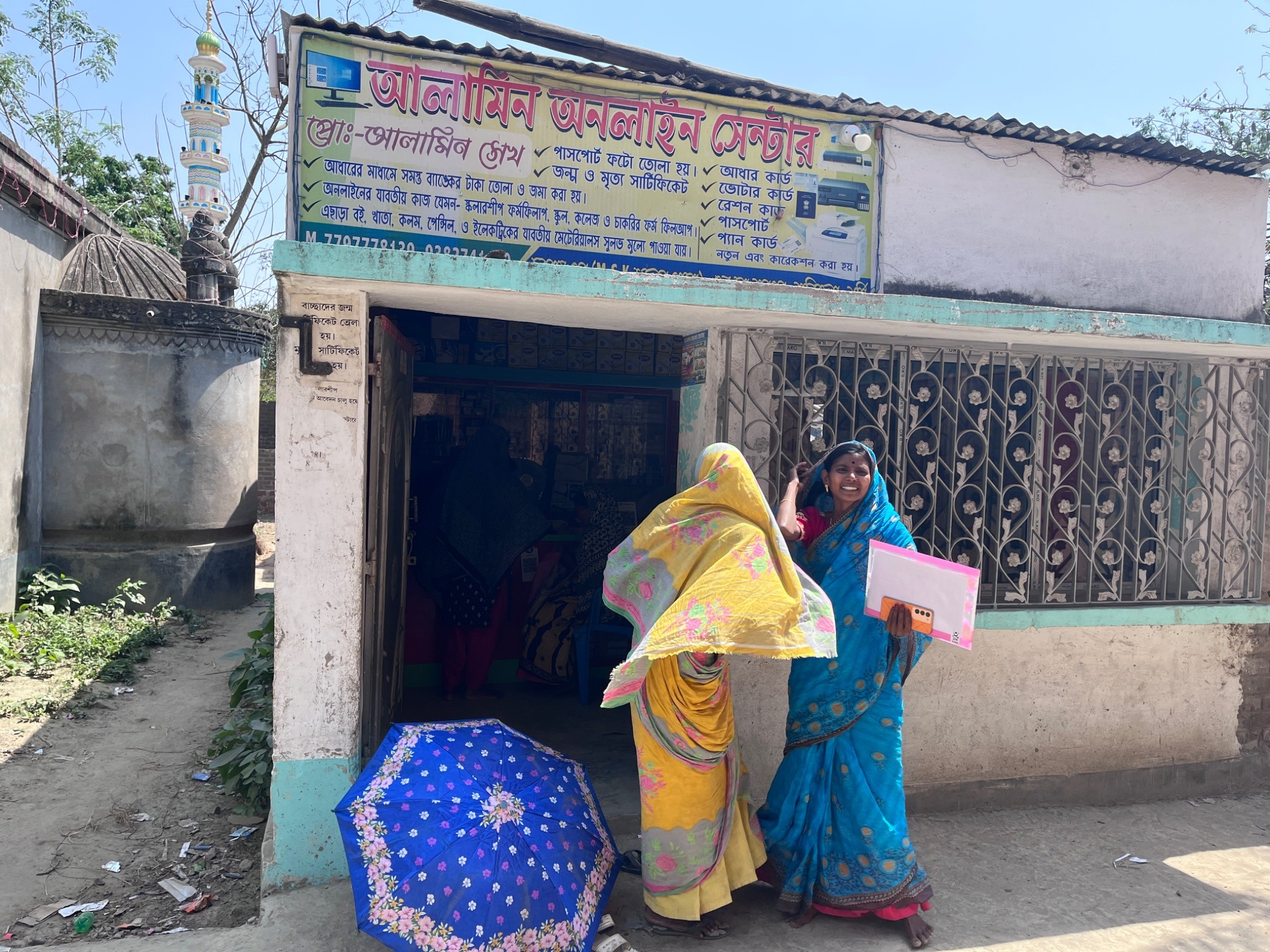
The Cost Of Citizenship
Both Amina and Ahmed rued the money they had been forced to spend on the SIR.
“Nothing is free. Every time I go to a shopkeeper to ask for some online verification, they charge me for even pressing a button on the computer,” Amina said.
“Every time I have to go to the BDO or panchayat office, I have to travel 20-25 kms, sometimes I just walk, " she said.
“I have spent more than Rs 3,000 on each child—just for printing, photocopying, uploading documents and travelling with the whole family to offices,” said Ahmed.
”Every time I have to close my shop,” he said. “Sales have gone down; people have lost hope.”
Amina had to go to her father’s home, 20 km away, to bring photocopies of documents meant to validate her existence, yet the algorithm rejected her.
Despair And Anxieties
As I dozed off at dusk in Ahmed’s courtyard, recovering from the day’s heat, snippets of conversations in the tea shop that ranged from despair and disbelief to hope drifted in my direction.
“Will they send us to the camp?”
“This is a political strategy to win elections. Everything will go back to normal.”
“Have you not seen what is happening in Assam? They can do the same to us.”
“I have all the documents, including land titles from my grandfather’s time. They cannot deport me.”
(Panchali Ray is associate professor of anthropology and gender studies at Krea University, India.)
Get exclusive access to new databases, expert analyses, weekly newsletters, book excerpts and new ideas on democracy, law and society in India. Subscribe to Article 14.