
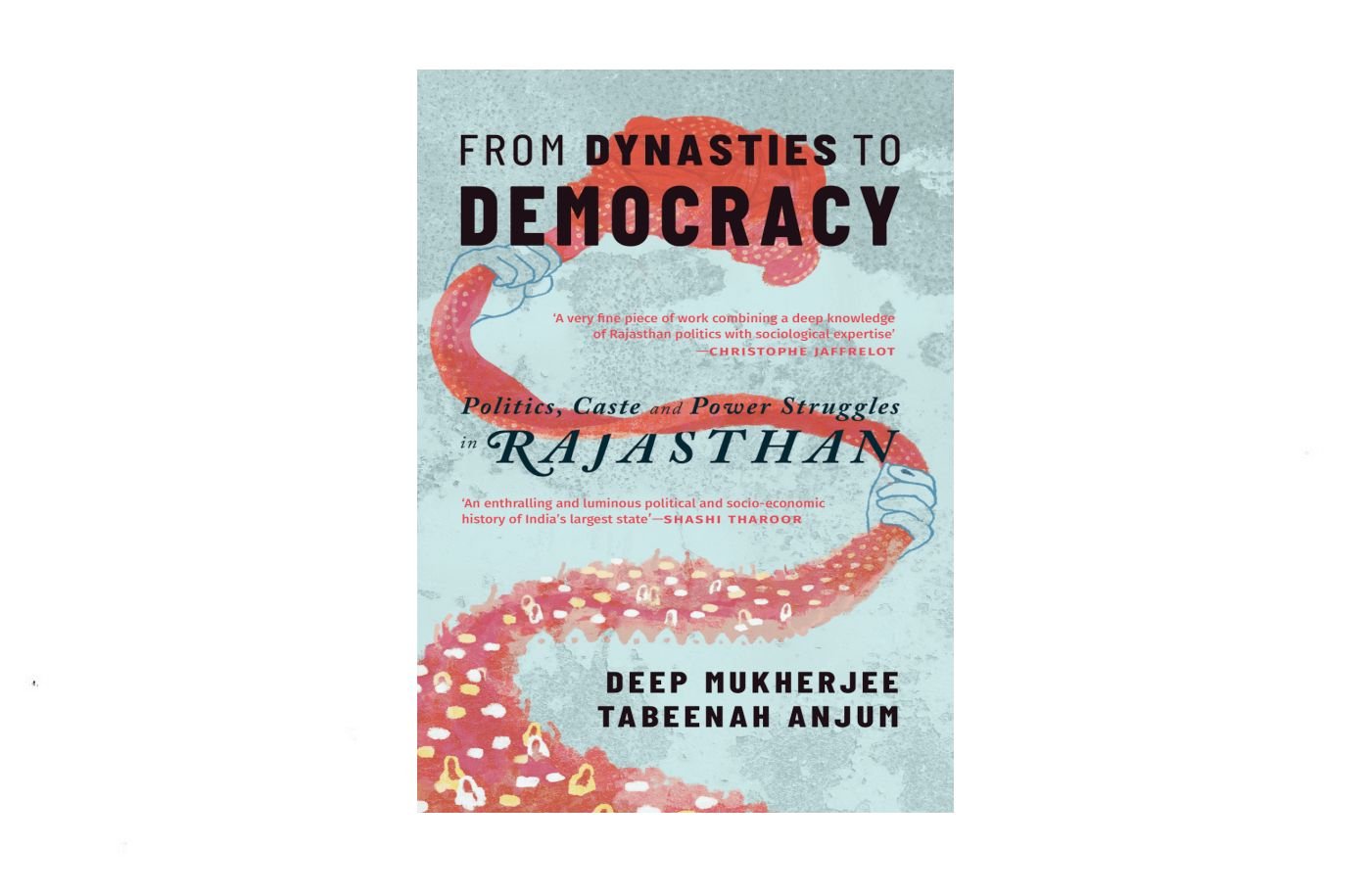
Rajasthan’s political story is often flattened into images of royalty and spectacle. From Dynasties to Democracy: Politics, Caste & Power Struggles In Rajasthan challenges that view. In this rigorously reported and sharply argued book, journalists Tabeenah Anjum and Deep Mukherjee trace how a society shaped by feudal hierarchies, caste power and princely privilege was folded into the apparatus of electoral democracy.
Spanning Rajasthan’s formation in 1949 to the churn of the 2024 Lok Sabha elections, the book maps the long arc of political transformation: the early stirrings of kisan sabhas, Dalit and Adivasi assertion, recurrent caste and communal violence, and the steady consolidation of party politics. Along the way, Anjum and Mukherjee explain the rise and reach of the RSS, the cyclical battles between the Congress and the BJP, and the internal rivalries that have shaped leadership, from Bhairon Singh Shekhawat to Ashok Gehlot, Vasundhara Raje to Sachin Pilot.
In a chapter on recurring communal tensions in the state, the authors recount the killings of Mohammad Afrazul in Rajsamand (2017) and Kanhaiyalal Teli in Udaipur (2022) to depict how everyday lives of migrant labourers, small traders and their families are caught in the cross-currents of polarisation and vigilante violence.
Democracy in Rajasthan has expanded in Rajasthan through the ballot, even while it has frayed on the ground, the book suggests. It shows how Rajasthan’s journey from feudal rule to modern democracy is neither linear nor complete, but marked by contestation, vulnerability and unresolved tensions.
EXCERPT
On the evening of 6 December 2017, a video shot on a mobile phone was circulated in various WhatsApp groups in Rajsamand before going viral on social media and being flashed across news channels. Its gory contents instantly caught the attention of the police. In the video, Shambhulal Regar, a tall, lanky man dressed in a red shirt could be seen hacking a middle-aged man to death with a shovel before dousing him with petrol and setting him on fire. The victim was Mohammad Afrazul, a migrant labour contractor from Malda, West Bengal. The video was filmed by Shambhulal’s juvenile nephew, whose unsteady hands recorded his uncle ignoring Afrazul’s pleas for mercy before violently lunging at him.
The day Shambhulal killed Afrazul marked the twenty-fifth anniversary of the Babri mosque demolition. Before his arrest on the following day, Shambhulal released video statements featuring an anti-Muslim diatribe and claims that he had murdered Afrazul to save a ‘Hindu sister’ who had been caught in the trap of ‘love jihad’. However, journalistic investigations on the day after the killing revealed that the ‘Hindu sister’ in question had nothing to do with the victim; in fact, it was Shambhulal who had been troubling her.
An unmade bed, half-peeled potatoes and a group of terrified migrant labourers greeted visitors at the small one-room accommodation in Dhoinda where Afrazul had lived. The area is home to a large population of migrant labourers, most of whom are Bengali Muslims from Malda and nearby areas. Mohammed Ziaul Haq, a resident of the area for the past decade, had been working hard to earn an income but felt his determination being snuffed out at the sight of Afrazul’s half-charred body. Within a few days after Afrazul’s death, Dhoinda was emptied of migrant labourers who fled, afraid for their lives.
Afrazul had chosen a life far away from his home state and his wife Gulbahar to ensure that his family did not have to worry about sustenance. After he managed to establish a successful business as a private contractor in Rajasthan, many of his acquaintances from his village arrived to join him. After his death, having lost their guardian, they were forced to return home. While Afrazul’s family mourned him at Saiyadpur, a border village in Malda, saffron-clad men gathered at a huge rally in Udaipur, more than a thousand kilometres away, heralding his killer as a ‘symbol of Hindu anger’. They also slammed the local Muslim community for taking out a procession to demand punishment for his assailant.
One of the most-discussed moments of the Hindu rally was when one of the protesters hoisted a saffron flag over the gate of the district and sessions court in Udaipur. Ganesh Vaishnav, a member of the Udaipur-based Shiv Sena, claimed that not cracking down hard on ‘love jihad’ by way of legal action was likely to give rise to more Shambhulals in the future as he was a symbol of what the entire Hindu community truly felt.
In Rajsamand, the first signs of approval for Shambhulal’s actions manifested in a WhatsApp group originally meant to streamline coordination between the district administration and citizens to further the goals of the Swachh Bharat Mission, the flagship scheme of the Narendra Modi-led BJP government to ensure improved standards of cleanliness and sanitation facilities in the country. A participant in the group – which also had then Rajsamand MP Hari Om Singh Rathore and MLA Kiran Maheshwari as members – posted messages applauding Shambhulal for his actions. After a news report on this WhatsApp group was published in The Indian Express, it was picked up by other publications, resulting in a mass exodus of members from the group. In the end, Prem Mali, the admin of the group who claimed to be a BJP worker, deleted it.
Already bogged down by the nationwide outrage over cow-related lynchings in Rajasthan, Vasundhara Raje’s government announced a compensation of Rs 5 lakh for Afrazul’s family, handing over the cheque to his son-in-law. But the support that poured in for the murderer from right-wing groups was telling. Days after the killing, Updesh Rana, a Hindutva supporter with more than 8 million followers on Facebook, vowed to come to Rajsamand to hold a rally in support of Shambhulal. While Rana was held by the local police in Jaipur, more than Rs 3 lakh was collected in support of Shambhulal’s wife, with over 500 people across India making donations.
A defining image of this polarized time in the aftermath of Afrazul’s death is from March 2018, three months after the incident. A colourfully decorated tableau made its way through the city of Jodhpur as part of a procession to celebrate Ram Navami. A man dressed as Shambhulal from the infamous viral video sat atop the tableau clutching a shovel, a spitting image of the accused, who had been jailed by this time. A poster attached to the tableau read, ‘Hinduon bhaiyon jaago, apni behan–beti bachao, love jihad se desh ko azad karana chahiye (Hindu brothers, wake up, save your sisters and daughters. The country should be freed from the clutches of love jihad)’.
Nearly five years after the killing of Afrazul, Udaipur found itself turned into a fortress. It was June 2022 and mobile internet services across Rajasthan had been suspended; senior state police officials were camping day and night near a small tailor shop in Udaipur’s usually crowded Maldas Street to ensure no one violated the curfew. The innocuous shop had become a centre of attraction for the press and bulletproof vest-clad policemen alike overnight. It was here that Kanhaiyalal Teli, the owner, had been attacked by two armed men carrying knives and cleavers, almost completely severing his neck from his body. A stream of blood drenched the street outside. The assailants had taken advantage of the bustling activity on the street to flee the scene in broad daylight.
The two assailants, Mohammed Riyaz and Ghouse Mohammed, had pretended to be customers looking to get a kurta stitched. While Kanhaiyalal’s attention was on taking measurements, they attacked, plunging their weapons into his neck. Just as Shambhulal Regar had done five years ago, the murderers then released a video confessing to the killing and stating their reason: Kanhaiyalal had disrespected Prophet Muhammad. They claimed that they had murdered the forty-eight-year-old tailor for sharing a post on his social media in support of former BJP spokesperson Nupur Sharma’s comments on Prophet Mohammad.
Sharma had made comments on the Prophet during a TV news debate, which had led to massive outrage that transcended national borders and caused several Gulf countries to register complaints with the Indian consulates there. The BJP had subsequently distanced itself from Sharma and suspended the leader. Kanhaiyalal’s family, however, denied that he had ever shared any post related to the Prophet.
The killing in Udaipur happened at a crucial juncture when Congress was already under fire over communal clashes that had become a regular occurrence in the state since April 2022. Much like Afrazul, Kanhaiyalal had worked hard to fend for his family since he had migrated to Udaipur from the nearby tribal district of Dungarpur, sometime in the mid-1990s. After working at local shops for several years, he had set up his own tailoring business on Maldas Street. While his two assailants were arrested on the same day as they were fleeing towards Ajmer, the Rajasthan government was deeply concerned about a Hindu backlash, causing them to promptly suspend internet connection all across the state in an unprecedented turn of events.
A day after the killing, the crowd assembled outside Kanhaiyalal’s house in Udaipur was furious. As it slowly grew in size, a slogan began to emanate from its midst: ‘Desh ke gaddaron ko, goli maaro saalon ko (Shoot the bloody traitors to our country).’ Inside the house, Kanhaiyalal’s wife Yashoda collapsed as his body was readied for cremation. His two teenaged sons, Yash and Tarun, choked on their tears as they told the media that their family had lost its sole breadwinner. The Congress realized that the murder of Kanhaiyalal could snowball into anti-Congress sentiments in the state if its actions against the perpetrators were not strong. The Gehlot government sprang into action – the CM himself visited the bereaved family to pay his respects. Over the next few days, he announced other relief measures for them as well, including government jobs for both of Kanhaiyalal’s sons, financial compensation and round-the-clock security to the family. The state government readily handed over the case to the National Investigation Agency (NIA), which arrested more people who were allegedly involved in the conspiracy. The two primary accused, Mohammad Riyaz and Ghouse Mohammad, were residents of Khanjipeer – a predominantly Muslim locality named after a seventeenth-century Dawoodi Bohra saint. Despite these steps taken by the state government, when Home Minister Amit Shah visited Jodhpur three months later, in September 2022, he criticized the Gehlot administration for the Udaipur killing.
When Kanhaiyalal’s body was being carried to the crematorium, a huge crowd – dressed in jeans and saffron bandanas – assembled despite the curfew, following his funeral procession on bikes. The slogans soon turned into pejoratives directed at Muslims, with the crowd knocking over a signboard in front of a mosque next to the crematorium. A senior police official remarked that it was impossible for them to attempt to control a mob of this size without risking a bigger violent outbreak, so they had no choice but to overlook the hate speech and vandalism. The next day,the police had to resort to a mild lathi charge to disperse a crowd after an episode of stone-pelting. What could have caused this, one might wonder? Turns out, the crowd was infuriated to see a hoarding featuring the Bollywood superstar Shah Rukh Khan.
For the second time in five years, the air of tension pervading Udaipur threatened to dismantle the communal fabric of this popular tourist spot.
(Excerpted with permission from From Dynasties To Democracy: Politics, Caste & Power Struggles In Rajasthan published by Macmillan.)
Get exclusive access to new databases, expert analyses, weekly newsletters, book excerpts and new ideas on democracy, law and society in India. Subscribe to Article 14.