
New Delhi: In April 2026, thousands of factory workers in Noida’s industrial belt walked away from assembly lines to demand higher wages and better working conditions, following similar protests in Manesar and Panipat.
Noida is one of north India’s major manufacturing hubs, with about 12,000 industrial units employing an estimated 1.3 million people, according to the district administration. Its factories produce garments, electronics and automotive components.
“The protests were spontaneous,” said Rakhi Sehgal, an independent labour researcher and trade union activist of more than two decades. “There were separate triggers in Manesar and Panipat in Haryana, which spread into Noida as well.”
The Noida protests spread to 80 locations after workers at a Honda scooter and motorcycle manufacturing plant in Manesar raised demands for higher wages. The agitation then spread to other automobile plants and nearby garment companies.
“The trigger for the protests in Noida was the agitation that had just taken place in Manesar, where the Haryana government announced a wage hike after 11 years,” Sehgal said.
“Wages were, of course, a trigger, but it was also this humiliation. The degradation of their identity. The cost of living—sparked also by the fuel crisis amid the war on Iran—was another factor,” she said. “They were coming to work hungry, and companies also withdrew canteen food in many instances. There were many strands of frustration boiling over.”
Workers across skill categories were earning Rs 11,000 to Rs 14,000, and more than 40,000 began protesting for higher wages.
Despite demands for a minimum wage of Rs 20,000, the Uttar Pradesh government introduced an interim minimum-wage hike, retrospectively from 1 April. Monthly pay for unskilled workers rose to Rs 13,690 from Rs 11,313, while semi-skilled and skilled workers were to receive Rs 15,059 and Rs 16,868 respectively in Gautam Buddh Nagar and Ghaziabad.
The hike quelled the protests. But the months that followed brought a government crackdown, with more than 150 people arrested and over 1,200 detained. Chief Minister Yogi Adityanath called the protests a “larger conspiracy to revive the menace of Naxalism” by “those elements” against Uttar Pradesh’s “growth and prosperity”.
A 20 August analysis of 222 bail orders by The Indian Express found that 188, or nearly 84%, had secured bail. The eight accused of spearheading the alleged conspiracy, however, remain behind bars.
The Contradictions
Two of the eight—25-year-old theatre practitioner and Delhi University graduate Aakriti Chaudhary and 65-year-old journalist and translator Satyam Verma—were also being held under the National Security Act (NSA), which permits preventive detention without trial for up to 12 months.
On 2 September 2026, the Allahabad High Court quashed Chaudhary’s NSA detention and called the State’s version a “concocted story”. She remains in custody in connection with 11 FIRs.
All eight have sought bail in the various FIRs against them, with some FIRs securing bail and others keeping them in custody.
The Allahabad High Court is hearing petitions seeking to club the multiple FIRs, as well as petitions relating to Chaudhary and Verma’s detention under the NSA.
Verma’s wife, Shakambhari, has also approached the Supreme Court challenging his preventive detention, while law student Yogesh Meena has approached the Supreme Court alleging police harassment.
Anand and Roy have moved the top court alleging custodial torture.
Lawyers for the accused, Kabir Ali Zia Choudhary and Manik Gupta, told Article 14 that the police did not provide warrants or inform the accused of the grounds of arrest when they were taken into custody, and that their families were not informed until they were produced before a magistrate.
Three women—Chaudhary, visual artist Srishti Gupta and factory worker Manisha Chauhan—were detained at Delhi’s Botanical Garden Metro Station on 11 April without, their lawyers say, any female police personnel present.
Section 43(5) of the Bharatiya Nagarik Suraksha Sanhita (BNS), India’s two-year-old new criminal code, says a woman cannot ordinarily be arrested after sunset and before sunrise except in exceptional circumstances, when a female police officer must obtain written permission from a first-class judicial magistrate.
And More Gaps
Discrepancies also appear between arrest dates recorded in police chargesheets and those in remand sheets, as well as between the locations recorded by police and the locations from which families and lawyers say some accused were actually detained.
For instance, Verma, a Lucknow-based former journalist who, according to friends, had not visited Noida in more than 12 years, was nevertheless accused of being part of the alleged conspiracy.
Lawyer Choudhary also pointed to an unusual gap in the court record. He said the orders from the Surajpur court in Greater Noida did not record the presence of the advocates who appeared for the accused or reproduce their arguments and written submissions, despite five lawyers having requested that their appearances be recorded.
“The most egregious thing is that all of us advocates who argued the cases have seen no recording of the presence of the advocates who appeared in the Surajpur court in Greater Noida,” said Choudhary the lawyer. “Five of us have requested that our presence be recorded. Moreover, none of the orders where bail was refused has stated what the advocate argued.”
The discrepancies form the backdrop to the cases of the eight people who remain in jail. Four chargesheets in FIRs 163, 164, 165 and 169 of 2026, out of 11 FIRs registered so far, contain disputed accounts of their arrests, locations and alleged roles in the protests.
Most importantly, the activists currently in jail were not present at the protest site when violence broke out on 13 April; four had already been arrested on 11 April. Yet they face charges including attempted murder and causing grievous harm to police personnel on duty.
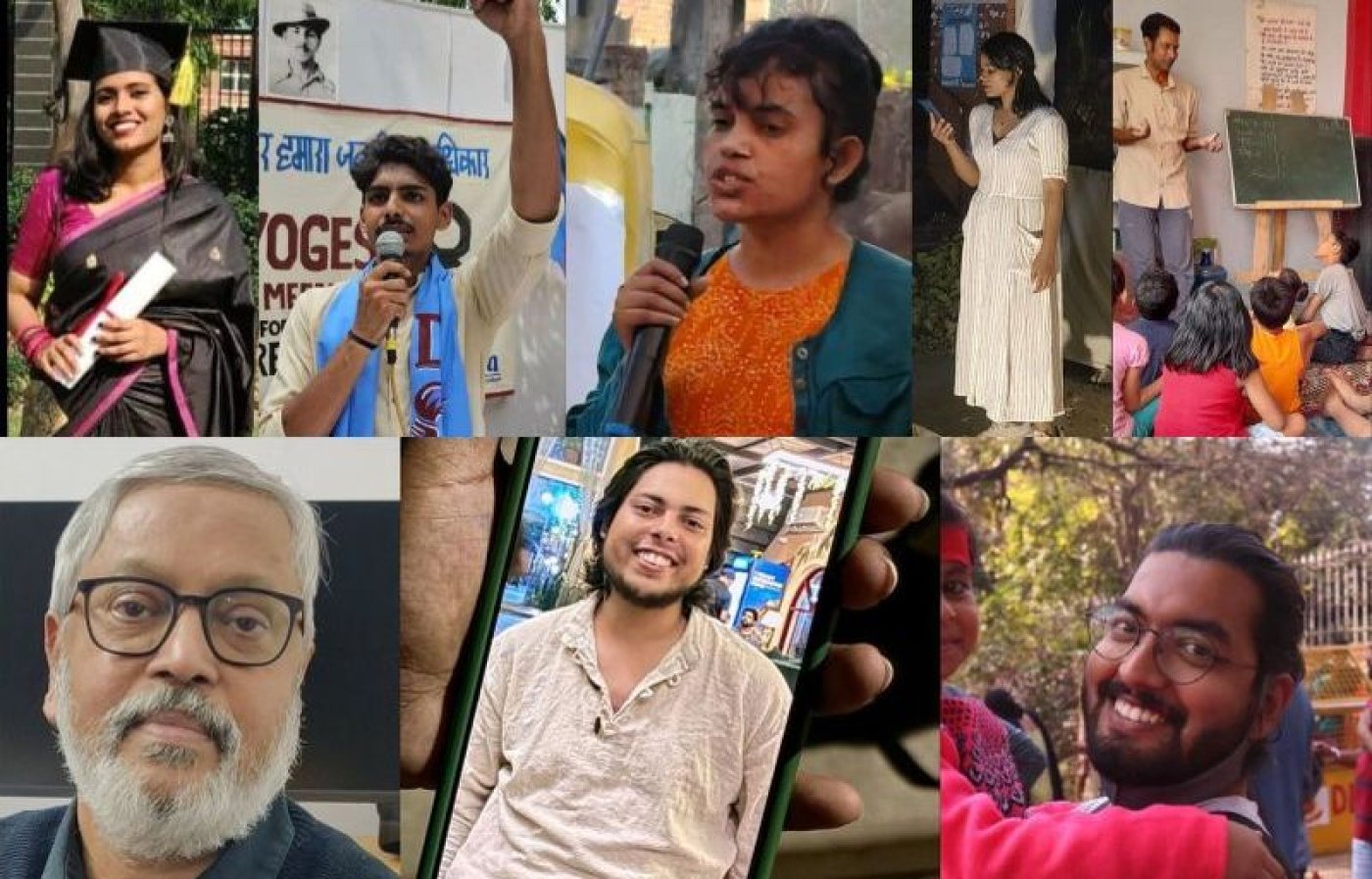
Here is a rundown of each case:
Aditya Anand: Software Engineer, Labour Rights Campaigner
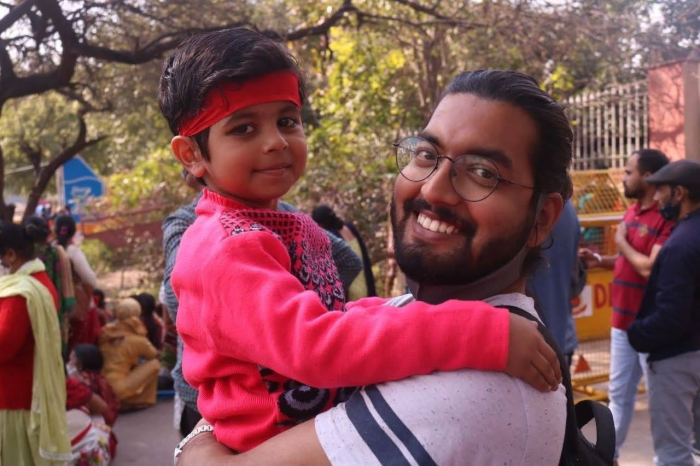
A BTech graduate and software professional from NIT Jamshedpur, 28-year-old Aditya Anand balanced his white-collar job with running a local children’s library and writing about factory life for the labour-rights publication Mazdoor Bigul.
Lawyer Ali Zia Kabir Choudhary, who represents Anand and the other jailed activists, said Anand’s protest speeches focused on workers’ legal rights and that recorded evidence corroborated his peaceful intent.
In its chargesheet for FIR 163/2026, police alleged that on 11 April, more than 1,500 workers blocked a road outside the Noida Special Economic Zone and delivered inflammatory speeches that incited violence. Workers were accused of vandalising property, pelting stones at police and threatening to kill them.
Anand’s brother Keshaw recalls him visiting the Noida agitation on 10 and 11 April to document the movement for Mazdoor Bigul.
“We have video footage showing him and Rupesh literally urging the crowd to stay calm, even leading them to take a pledge for non-violence,” Keshaw said. “Why doesn’t the police see that?”
On 11 April, the now-arrested Aditya Anand and Rupesh Roy addressed protesting workers in Noida and urged them to keep the protest peaceful. In the video, they can be seen raising their hands in a collective pledge and saying: “Hum apni yeh hadtal bilkul hi shaantipoorn tareeke se chalayenge. Hum kisi bhi tareeka ka hinsa nahi karenge…” (“We will conduct our strike in a completely peaceful manner. We will not resort to any form of violence…”). Source/ KESHAW ANAND
Later on 11 April, Anand joined co-accused Rupesh Roy, Srishti Gupta, Aakriti Chaudhary and Manisha Chauhan on a metro towards Botanical Garden. Police detained the group outside the station. Gupta went live on Instagram, showing plainclothes and uniformed personnel detaining her and her companions.
“Aditya managed to escape somehow,” Keshaw said. “It was like a kidnapping, absolutely nothing like an arrest. No women police were present, male police officers assaulted the women they were detaining, and there was no warrant nor grounds of arrest provided.”
Lawyers Ali Zia Kabir Choudhary and Kanwalpreet Kaur said the accused were taken to undisclosed locations in police vans and reached the police station only “two to three hours later”.
Anand, described in media reports (here and here) as a “mastermind”, was arrested by the Railway Protection Force at Tiruchirappalli station in Tamil Nadu on the night of 17 April. His brother said a procedural violation followed: after a Tamil Nadu magistrate denied transit remand, Uttar Pradesh police officials moved Anand across state lines.
Keshaw said Anand was uninjured when he arrived in Uttar Pradesh on 19 April. But when he was later produced before the Surajpur district and sessions court after being lodged in Luksar jail, his hand was severely swollen. On 8 May, Keshaw filed a writ petition in the Supreme Court alleging that his brother had been tortured in police custody.
Article 14 sought comment from Laxmi Singh, commissioner of police for Gautam Buddh Nagar, by phone and WhatsApp on the allegations. She did not respond. We will update this story if she does.
Anand faces charges including attempt to murder, voluntarily causing grievous hurt to a public servant, rioting, unlawful assembly, criminal intimidation and offences relating to damage to public property.
He remains in judicial custody in Luksar jail and is named in 11 FIRs.
Rupesh Roy: Autorickshaw Driver, Labour Activist
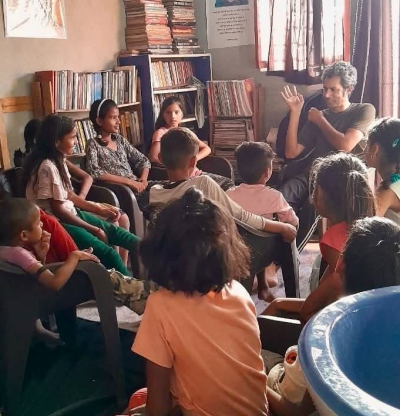
Noida-based autorickshaw driver Rupesh Roy, 44, administered the “Richa Global Noida” WhatsApp group, where workers shared protest updates. He was also a member of the Ekta Sangharsh Samiti, worked with workers and children in Noida neighbourhoods and campaigned for affordable electricity connections in slums where industrial workers lived.
Roy was picked up on 11 April along with Gupta, Chauhan and Chaudhary—two days before the 13 April violence he is accused of masterminding.
Keshaw Anand, who is coordinating a campaign to free the eight accused, said Roy remained silent in the WhatsApp group while Anand shared videos urging workers to maintain peace.
Anand also pointed to different arrest dates for Roy and 3 others in the police chargesheets and remand sheets.
Court filings contain another unusual detail: sub-inspector Beena Kaur was herself a member of the “Richa Global” group that police describe as part of the “conspiracy” and had circulated images of burning vehicles, according to the filings.
Article 14 contacted Kaur, who acknowledged that the number belonged to her before ending the call. Her presence in the group was corroborated by this story in The Wire.
Police sources cited by Roy’s supporters said Kaur was gathering intelligence. She has not faced the same action as the activists.
Roy earned about Rs 15,000 a month driving his autorickshaw. His wife works in a garment factory, and they have 2 school-going children. Since his arrest, the family has relied on relatives and friends.
His brother Madhuresh, also accused by police of fomenting violence, was allegedly intimidated by police but has since secured bail.
Roy remains in judicial custody and is named in 11 FIRs.
Aakriti Chaudhary: Theatre Artist, History Graduate
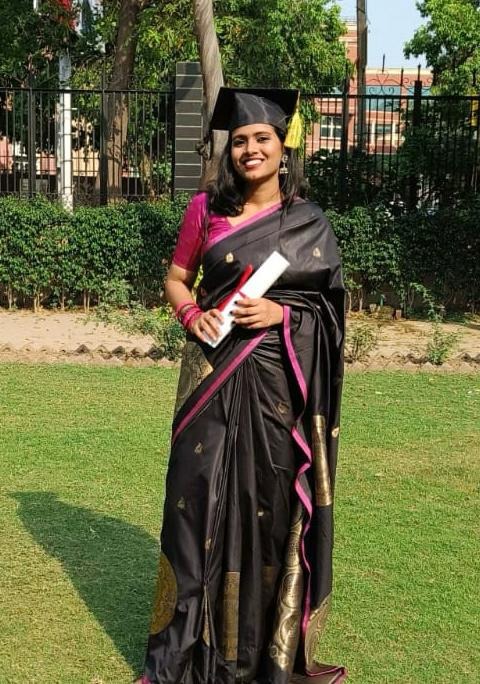
A historian by training with a degree from Delhi University, 25-year-old Aakriti Chaudhary is a law student, and theatre practitioner with the Progressive Artists’ League and Mazdoor Bigul. She has staged works by Bertolt Brecht, the influential German playwright, and Safdar Hashmi, the Indian theatre activist and playwright, and conducted workshops for children.
Police arrested her at Botanical Garden Metro Station in New Delhi on 11 April.
On 12 May, the National Security Act (NSA) was invoked against her, accusing her of inciting the violence that took place on 13 April. The NSA permits preventive detention without trial for up to 12 months.
Her lawyer, Ali Zia Kabir Choudhary, pointed to the central discrepancy: if Aakriti was arrested on 11 April, she could not have incited violence two days later. Her father, Arun, said police records themselves gave her arrest date as 12 April.
“How can my daughter, who was arrested on the 11th, be accused of violence that took place on the 13th?” he said. “And the police have even shown her date of arrest as the 12th of April.”
Article 14 sought comment from Laxmi Singh, the Noida police commissioner, on these discrepancies but received no response. We will update this story if she responds.
On 1 September, an Allahabad High Court bench of Justice Atul Sreedharan and Justice Achal Sachdev demanded video evidence from police to establish that Aakriti had instigated protesters to throw stones or set fire to vehicles. Justice Sreedharan expressed displeasure with the investigation and said the court would “impose costs” on officials if it found they had arbitrarily exercised their powers to prolong her detention.
On 2 September, the bench quashed her NSA detention.
Arun also disputed the police record of where Aakriti was arrested. He said the FIRs recorded the place of arrest as outside a police station, while video footage showed her being picked up outside Botanical Garden Metro Station. No women police personnel were present, he said, despite the legal requirement, and male officers arrested her along with Srishti Gupta and Manisha Chauhan.
Arun said his daughter called him on 13 May to tell him that the NSA had been invoked against her, but the family received no further details. Her lawyer, Ali Zia Kabir Choudhary, said she was produced in court about two weeks later, when they obtained a copy of the NSA detention order.
“We were not even given a copy of the NSA detention order. We only got a copy of the document after she was produced in court,” Arun said.
Section 8 of the NSA requires that the grounds of detention ordinarily be communicated within five days, and, in exceptional circumstances, within 10 days, with reasons recorded in writing.
Aakriti had completed a master’s degree in history at Delhi University, qualified for NET and was preparing for a PhD. She had also recently cleared the Delhi University law faculty examination and was studying in the first year of the LL.B program.
“Mujhe fakhr hai apni beti pe. She is very bold; she and her co-accused are the Bhagat Singhs of today. I am proud of her. She never did wrong, and she never tolerated wrongs against others,” her father said. “She would love working with the poor, doing theatre for the masses, and distributing books.”
Although the court has quashed her NSA detention, Aakriti remains in custody and is named in 11 FIRs.
Satyam Verma: Journalist, Translator, Bhagat Singh Scholar
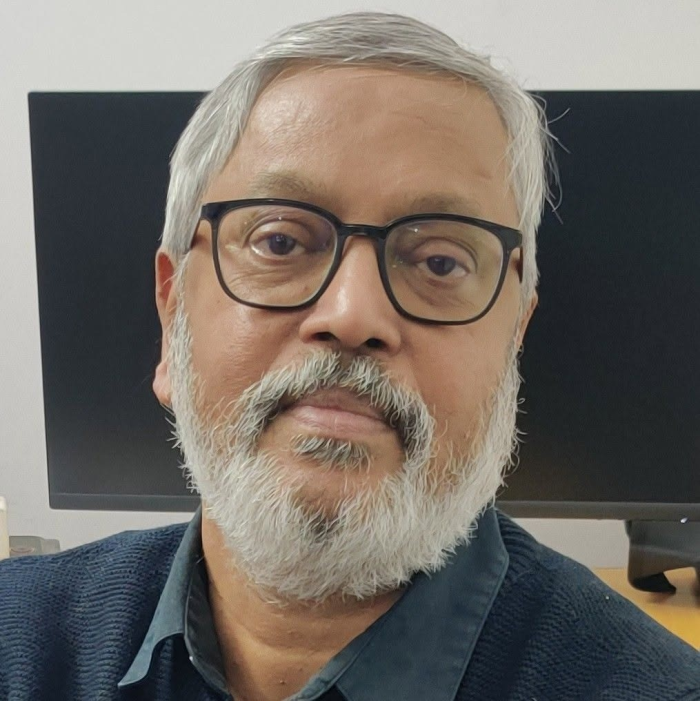
Satyam Verma, 65, worked with UNI Varta between 1991 and 2004 and has since been associated with Janchetna Books, Jagaruk Nagrik Manch and Mazdoor Bigul. He is a prolific translator and recently completed a book on Bhagat Singh and his comrades.
On 17 April, police arrested Verma at Lucknow's Jan Chetna Bookstore over what they claimed was his involvement in the Noida protests.
His lawyers, along with friend and co-publisher Katyayani, called this an illegal detention. They said that police from Lucknow’s Nirala Nagar station raided the Jan Chetna Book Centre and Library and took Verma away without an arrest memo, warrant, or seizure memo, then produced him before a Noida court two days later. They also claimed the arrest took place in Noida when he was, in fact, taken away from Lucknow.
Attempts were made via phone calls and WhatsApp messages to speak to police commissioner Laxmi Singh regarding the allegations of police lapses, but no response was received. We will update this story if she responds.
The NSA was invoked against him on 13 May.
Article 14 accessed a copy of the 170-page NSA document, and while most of it is in Hindi, one of the primary sources of evidence listed under ‘Annexure No. 3’ is entirely in English.
According to a July 2026 investigation by The Wire, under Annexure No. 3, Noida district magistrate Medha Roopam cited evidence copied from a right-wing Twitter account called ‘The Chronology’.
This includes photos of a pro-Palestine protest that Satyam had attended alongside communist leaders Sitaram Yechury and Prakash Karat, which the police annexed as evidence of a dangerous ideology.
Police had also initially alleged that Verma had received more than Rs 1 crore in foreign currency, including dollars, pounds and euros, but his lawyer Choudhary said that to date, the police had placed no evidence in court to support this claim. Choudhary said that money “received as regular payments for his work and accrued over the course of several years” was being distorted into an allegation of being funded a sum of 1 crore.
Verma's wife, Shakambhari, filed a habeas corpus petition before the Allahabad High Court, submitting CCTV footage from the Lucknow bookstore, which, according to the petition, contradicted the police record trying to show his arrest at a Noida police station.
Verma lives with diabetes, thyroid disease, and high blood pressure. His friend Katyayani also said that no medication was provided to him for “nearly 48 hours” after his arrest.
Verma remains incarcerated under the NSA and is accused in 11 FIRs.
The April 11 Arrests: Srishti Gupta & Manisha Chauhan
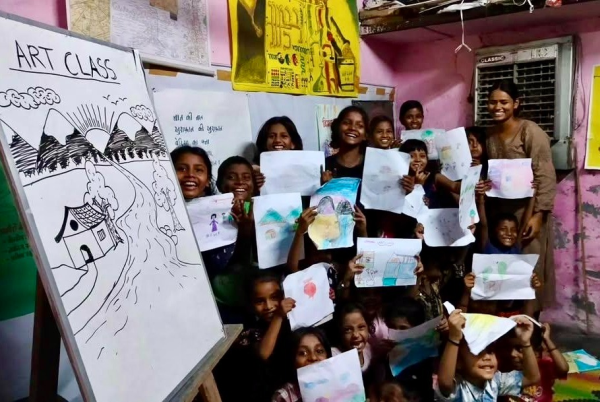
Visual artist Srishti Gupta, 28, documented her own detention on Instagram, showing both uniformed and plainclothes officers picking her up on 11 April.
Nearly five months later, while she languishes in jail, her friends and fellow activists campaigning for her release also put out incriminating video evidence of police officials making a fake “recovery” of her mobile phone and trying to plant evidence at her home.
Gupta, a Santiniketan graduate, went live from the Instagram account of Mazdoor Bigul, streaming how a plainclothes policeman and uniformed personnel detained her and three companions at Botanical Garden Metro Station.
Lawyer Ali Zia Kabir Choudhary said the police had not issued an arrest memo or warrant and that no women police personnel were present.
While no arrest warrant or even a memo was provided at the time of her arrest, police instead cited a “warrant of commitment on failure to find security to keep the peace”, dated 12 April and issued under sections 126 (allowing for security/execution of a bond to keep the peace), 135 (inquiry by a magistrate into the truth of information) and 170 (arrest to prevent commission of cognizable offences) of the Bharatiya Nagarik Suraksha Sanhita (BNSS).
It records preventive detention after she failed to furnish a Rs 50,000 bond.
In a sworn affidavit submitted in court, Gupta also claimed to have been detained along with Chaudhary, Chauhan and Roy on 11 April. In it, she said that none of them were shown an arrest warrant, detention memo, or written order; were not told the grounds for detention; and that neither their families nor people known to them were informed of their whereabouts. She also said that later on 12 April, she was witness to multiple police personnel “physically assaulting Rupesh Roy using fists and sticks”, and she and the women arrested were also made to feel like they could be subjected to similar treatment.Moreover, even though she was detained on 11 April, there are inconsistencies in her recorded dates of arrest in the police’s remand sheets and chargesheets (as is the case with the other three arrested with her). For instance, FIR 163’s remand sheet lists her date of arrest as 15 April 2026, while the chargesheet for the same lists it as 24 April 2026.
Similar discrepancies exist in the remand versus chargesheet dates in FIRs 164 and 165.
Now close to five months into her imprisonment, her case has also sparked international outcry, with hundreds of artists petitioning for her and Aakriti Chaudhary’s freedom.Her body of work as an artist also showcased her involvement with local communities and political engagement. Gupta’s friend Vinod Karki said, “Art is often only taught as a study. You make a portfolio, you study, you don’t step out of what is told to you. But Srishti was focused on bringing art to the community. We studied together in the Delhi College of Arts, and then she went to Shanti Niketan. That’s where she got more politically conscious”.
Gupta remains in judicial custody and is named in 11 FIRs.
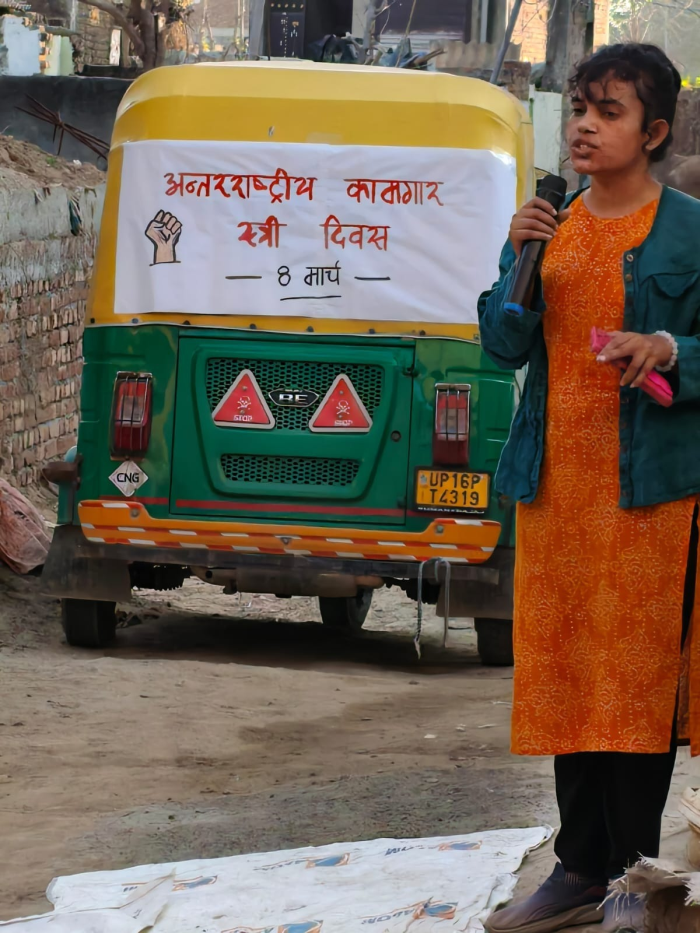
Manisha Chauhan, 25, originally from Bihar, was employed in Noida when police arrested her. According to their account, quoted here, police detained her on 11 April at Botanical Garden Metro Station alongside Gupta, Chaudhary and Roy.
Police have relied heavily on WhatsApp chats involving Chauhan, alleging that she helped mobilise workers ahead of the protests. The chats have not been made public. She is the only one among the eight whose activism consisted primarily of working in, and advocating for, the factories whose conditions drove the protests.
Chauhan worked in a factory in the Noida industrial area and managed to make Rs 22,000 monthly. Her father is over 60 years old and suffers from a hand injury, remaining financially dependent upon her.
Her lawyer also approached the Allahabad High Court seeking to club all 11 FIRs against her, emphasising that the prolonged legal process was itself a punishment and that the family’s constrained finances made it difficult to manage multiple bail sureties.
Chauhan remains in judicial custody and is named in 11 FIRs. The NSA has not been invoked against her.
Himanshu Thakur: PhD Aspirant, Student Organiser
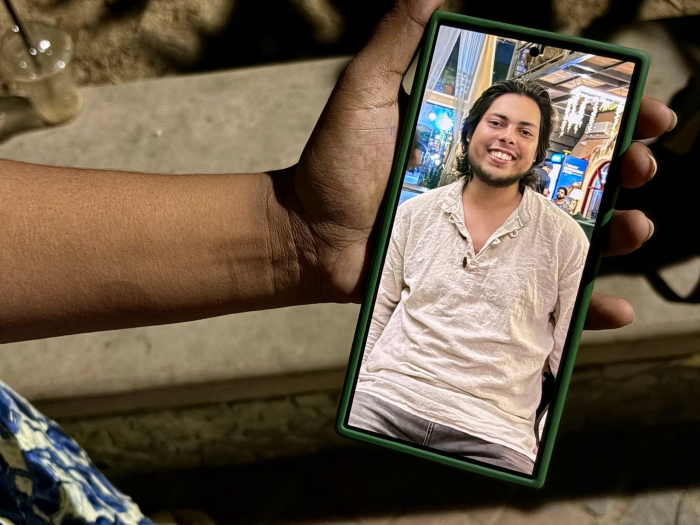
A history scholar from Delhi University, 24-year-old Himanshu Thakur was preparing for PhD entrance examinations when police seized him from his room in north Delhi's Shalimar Bagh on 18 April.
“He had just been scheduled to appear for his PhD interview at Jamia, and all of this happened,” his sister Neha told Article 14.
Neha said the family was left uninformed for more than a day and that officials seized his electronic devices without providing a formal seizure memo. Thakur was produced before a judicial magistrate more than 36 hours after police took him from his room, she said, and his family had no word of his whereabouts until then.
Neha also alleged that he faced physical abuse in custody.
“They took him to the Shalimar Bagh thaana (police station), and hit him with a police belt,” said Neha. “It’s not visible in his MLC (medico-legal report), but he told us this when we spoke to Himanshu.”
Upon contacting both the Shalimar Bagh police station via phone call and WhatsApp texts, as well as Noida police commissioner Laxmi Singh, neither responded to allegations of custodial violence.
Thakur was associated with the left-wing Disha (meaning, direction) students' organisation and had contested the Delhi University Students' Union election.
He remains in judicial custody and is named in 11 FIRs.
Yogesh Meena: Law Student
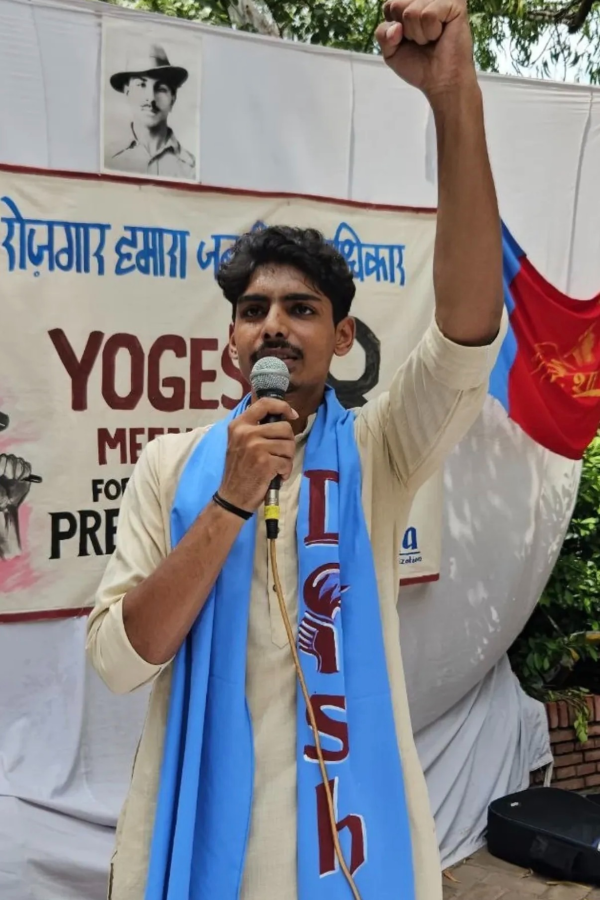
The youngest and last of the eight to be arrested, Yogesh Meena, 23, is a law student at Delhi University’s Campus Law Centre and an alumnus of Shri Ram College of Commerce.
On the afternoon of 30 May, Meena was walking past Ramjas College with his friend Sameer, an 18-year-old first-year student, when a vehicle pulled up beside them. According to supporters, some of those inside were in plain clothes and others in police uniform. They called Meena by name and forced both men into the vehicle without showing a warrant, arrest memo or identification cards.
Sameer also alleged that police hurled casteist slurs at him and Meena, referring to their respective Dalit and Adivasi backgrounds. Sameer was released a few hours later; Uttar Pradesh police took Meena away.
Meena’s arrest is linked to FIR 169/2026, registered at Noida Phase-2 police station on 23 April over incidents allegedly occurring between 10 and 13 April.
The police chargesheet alleges that Meena was “sending inflammatory messages” in WhatsApp groups. It includes screenshots showing that he sent voice messages.
His lawyer, Ali Zia Kabir Choudhary, pointed out that the chargesheet contains no transcript of the voice notes showing what Meena actually said. The screenshots, he said, merely establish that voice messages were sent.
According to Keshaw Anand, Meena’s messages in the ‘Richa Global’ WhatsApp group were instead “telling workers to stay alert from falling for police propaganda”.
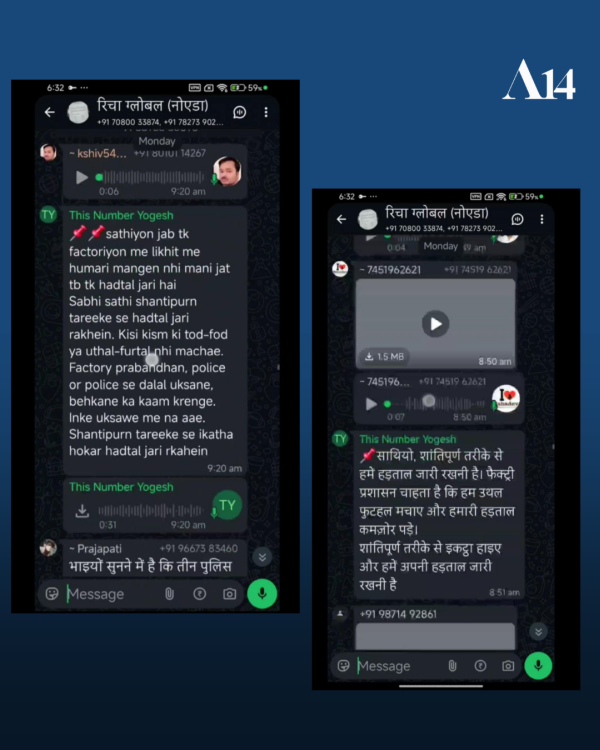
Meena had also highlighted the alleged abduction of activists from Botanical Garden Metro Station, Anand said, arguing that the messages were not inflammatory but “merely stating facts”.
He shared screenshots of Meena’s messages with Article 14.
Police also linked Meena to Anil Kumar, a senior police official’s driver whom activists accused of acting as an agent provocateur by entering workers’ WhatsApp groups and allegedly inciting violence.
In June 2026, however, a court granted bail to Kumar. The alleged link between Kumar and Meena remains part of the police case against the student. Kumar, whose alleged role has been cited in the case against Meena, is now out on bail while Meena remains in jail.
He remains in judicial custody, is named in 10 FIRs and has not been charged under the NSA.
Screen recording from the Richa Global factory workers’ WhatsApp group, which police have cited in their chargesheets as a platform where the activists allegedly incited violence. The recording includes a voice note from Anil Kumar, a driver for a police officer whom Noida police linked to accused Yogesh Meena, citing the alleged connection as one of the grounds for Yogesh’s arrest. It also captures Yogesh urging workers to maintain a peaceful protest.
(Sabah Gurmat is an independent journalist and writer based in New Delhi)
Get exclusive access to new databases, expert analyses, weekly newsletters, book excerpts and new ideas on democracy, law and society in India. Subscribe to Article 14.