
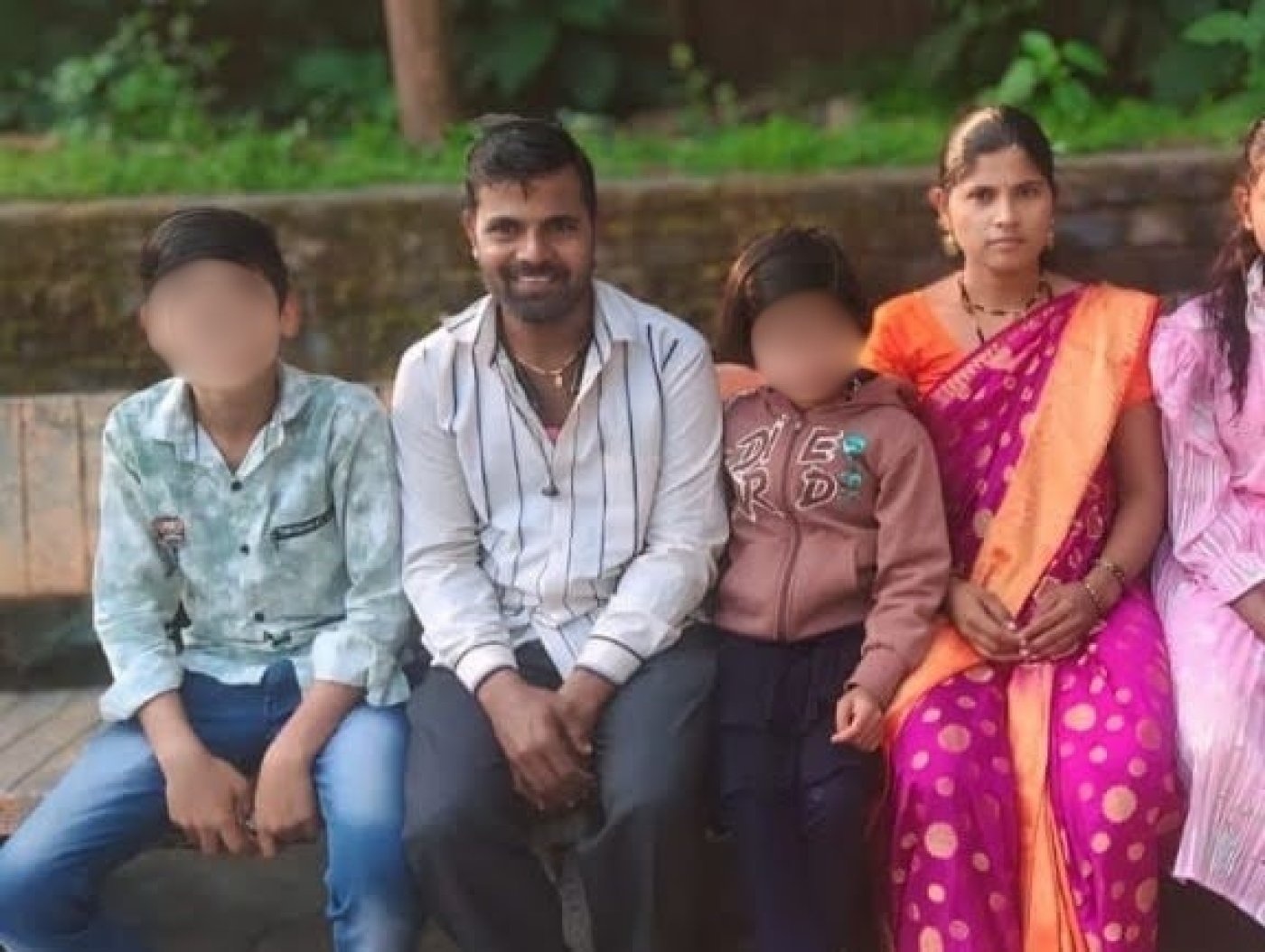
Washim district (Maharashtra): On 21 February 2026, Raju Kalapad, 40, was preparing for his eldest daughter's wedding.
His three-room mud house in Pangri Navghare village in Maharashtra's Washim district was full of relatives. The wedding was scheduled for 14 March, and the family was about to leave to buy gifts.
At about 10.30 am, with vehicles waiting outside, Kalapad told relatives he had some urgent work in his field.
He never returned.
Relatives waiting to leave for the wedding shopping grew anxious when Kalapad did not return from his field. A neighbouring farmer who had gone to water his crops discovered Kalapad hanging from a neem tree and rushed back to the village with the news.
“Their world collapsed in a matter of minutes—people who had come to buy gifts were left to see the lifeless body of their loved one—they ended up attending his funeral,” said Datta Shinde, a resident of the village.
Kalapad left no suicide note.
But villagers say the reasons became apparent in the days that followed.
Kalapad owned 2 acres of land but earned much of his income as a farm labourer, said a family member who requested anonymity. In the weeks before his daughter's wedding, he had approached several moneylenders for loans.
“He had asked multiple moneylenders for money so he could go ahead with the wedding,” the family member said. “Unfortunately, on that day, all refused.”
With the family devastated, villagers stepped in to ensure the wedding took place.
“People pooled in their resources, the local MLAs and former ministers chipped in, and the whole village took on itself to ensure the marriage took place with proper pomp and glamour,” said Shinde.
A Shift In India's Farm Suicide Crisis
Kalapad's death reflects a shift that is rarely discussed in India's now widely known and long-running agrarian crisis: agricultural labourers are now dying by suicide in greater numbers than farmers who own or cultivate land.
Data from the National Crime Records Bureau's (NCRB) latest annual Accidental Deaths and Suicides in India, released in May 2026, (ADSI) report shows that this crossover occurred five years ago and has continued since.
In 2024, the latest year for which data are available, 10,546 people in the farm sector died by suicide, fewer than in 2014. But of these, 5,943—or 56.3%—were agricultural labourers. Farmers and cultivators (the report uses the term interchangeably) accounted for the remainder.
A decade earlier, in 2014, agricultural labourers accounted for 5,650 of 12,360 farm-sector suicides, or 45.7%.
The turning point came in 2021.
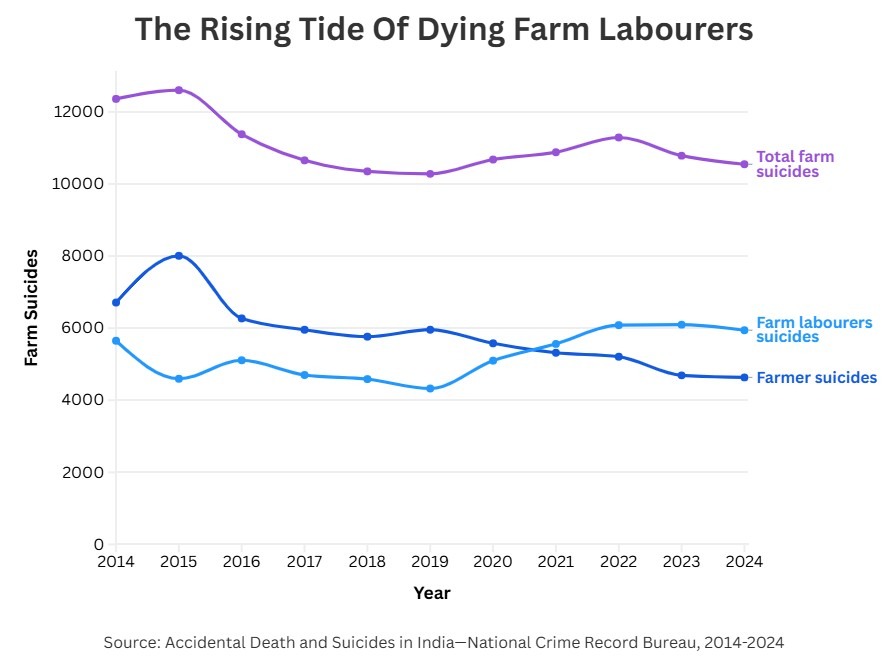
Of the 10,881 farm-sector suicides recorded that year, agricultural labourers accounted for 5,563 deaths, exceeding the number of cultivators by 456. Since then, labourers have consistently formed the larger share of those dying by suicide.
Researchers have consistently found (here and here) indebtedness to be among the strongest factors associated with farmer suicides in India. What the statistics do not reveal is that many small farmers increasingly survive by working as labourers on other people's land.
From Farmers To Labourers
The NCRB data reveal the shift from farming to making a living as labourers, but do not explain why it occurred.
One reason may be that the distinction between "farmer" and "agricultural labourer" is increasingly blurred.
As landholdings shrink across generations, many small and marginal farmers can no longer survive on farming alone. They supplement farm income by working as labourers on other people's fields.
Farm suicides have been among the most persistent indicators of India's agrarian crisis since the mid-1990s (here, here and here). NCRB records show that hundreds of thousands of cultivators and agricultural workers have died by suicide over the last three decades, with Maharashtra consistently reporting the highest numbers.
Former MP and farmers' leader Raju Shetti said the changing profile of those dying reflects decades of land fragmentation and falling farm incomes.
“The individual farmer’s piece of land has shrunk,” he said.
According to the Agriculture Census, small farmers operate between 1 and 2 hectares of land. Such holdings, Shetti said, are often too small to support a family, invest in modern farming techniques or absorb losses during years of low prices.
“This transformation of farmers into farm labourers is the culmination of constant land fragmentation among families,” said Shetti.
The trend is particularly visible (here and here) in Maharashtra's Vidarbha and Marathwada regions, where non-farm employment opportunities remain scarce.
“The farmer is unable to make ends meet—how will labour wages in the farm sector increase?” said Shetti, who argued that the rise in suicides among agricultural labourers reflects a deeper crisis in farming itself.
“Constant dip in returns but increased cost of production has destroyed the balance sheet of farmers,” he said. “Increased suicide among the farm labourers is an indication of that.”
Take soybean, Maharashtra's principal cash crop. Shetti said cultivation costs now approach Rs 20,000 per acre, while market prices hovered around Rs 4,500-4,600 per quintal for much of last year.
“With such meagre savings, how is one expected to live?” he said. “They turn to private moneylenders, and as debts pile up, they take the extreme step.”
Farming + Labour: Not Enough
Shetti’s assessment is echoed by Dagdu Wagh, 67, whose cousin Samadhan died by suicide earlier this year in Pokri village of Buldhana district.
“He had 2 acres of land where he grew soyabean and chana. But that was not enough—his family included his wife and his son, who had recently started a poultry business in partnership with someone else,” said Wagh. “He did complain about debts and low income, but we were not aware that the situation had reached the tipping point.”
Data from the Periodic Labour Force Survey for 2024 show that 44% of India's rural workforce continues to depend on casual labour and agriculture for survival, sectors marked by low wages, irregular work and limited social security.
For agricultural labourers, employment itself is uncertain. Daily wages range from Rs 500-600 for men and Rs 300-400 for women, according to local residents. Work is available during sowing and harvesting seasons, but often disappears for months in between.
“Agriculture does not pay, and if your holding is low, there is no other way but farm labour to make ends meet,” said Wagh. “But even then, most fail to make ends meet.”
Since 2021, agricultural labourers have consistently outnumbered cultivators among those dying by suicide. According to the 2024 NCRB data, 5,943 of the 10,546 farm-sector suicides recorded in 2024 were among agricultural labourers. In 2021, labourers first exceeded cultivators among farm-suicide victims, according to the ADSI 2021 report.
That more labourers died by suicide than farmers since 2021 may therefore signal more than distress among the landless. It may reflect a growing crisis among small cultivators whose farms are no longer large enough to sustain their families, forcing them into the ranks of agricultural labourers.
‘Is There An Option?’
“Is there an option?” said Bhimrao Kute, 36, of Antharwan Pimpri village in Beed district. “If we do not work as labourers, how will we survive? The 5 acres we have are not enough to help us survive.”
Bhimrao's father, Chandrabhan, 60, died by suicide in October 2025.
“Chidchida zala hota (He had become irritable), but that was understandable,” said Bhimrao.
Just before harvest, their soybean crop was hit by an unseasonal hailstorm—almost everything was destroyed. But Chandraban’s family did not suspect he was contemplating suicide.
“After all, my two other brothers and I mainly work as farm labourers to make ends meet,” said Bhimrao.
When news came that his father had died in the family's field, Bhimrao rushed there.
“It still is hazy what happened,” said Bhimrao. Later, while going through Chadrabhan’s papers, the family realised that the unpaid dues to private moneylenders may have pushed him over the edge.
“He must have been pushed to take this step because of that,” said Bhimrao. “If only he had discussed this with us.”
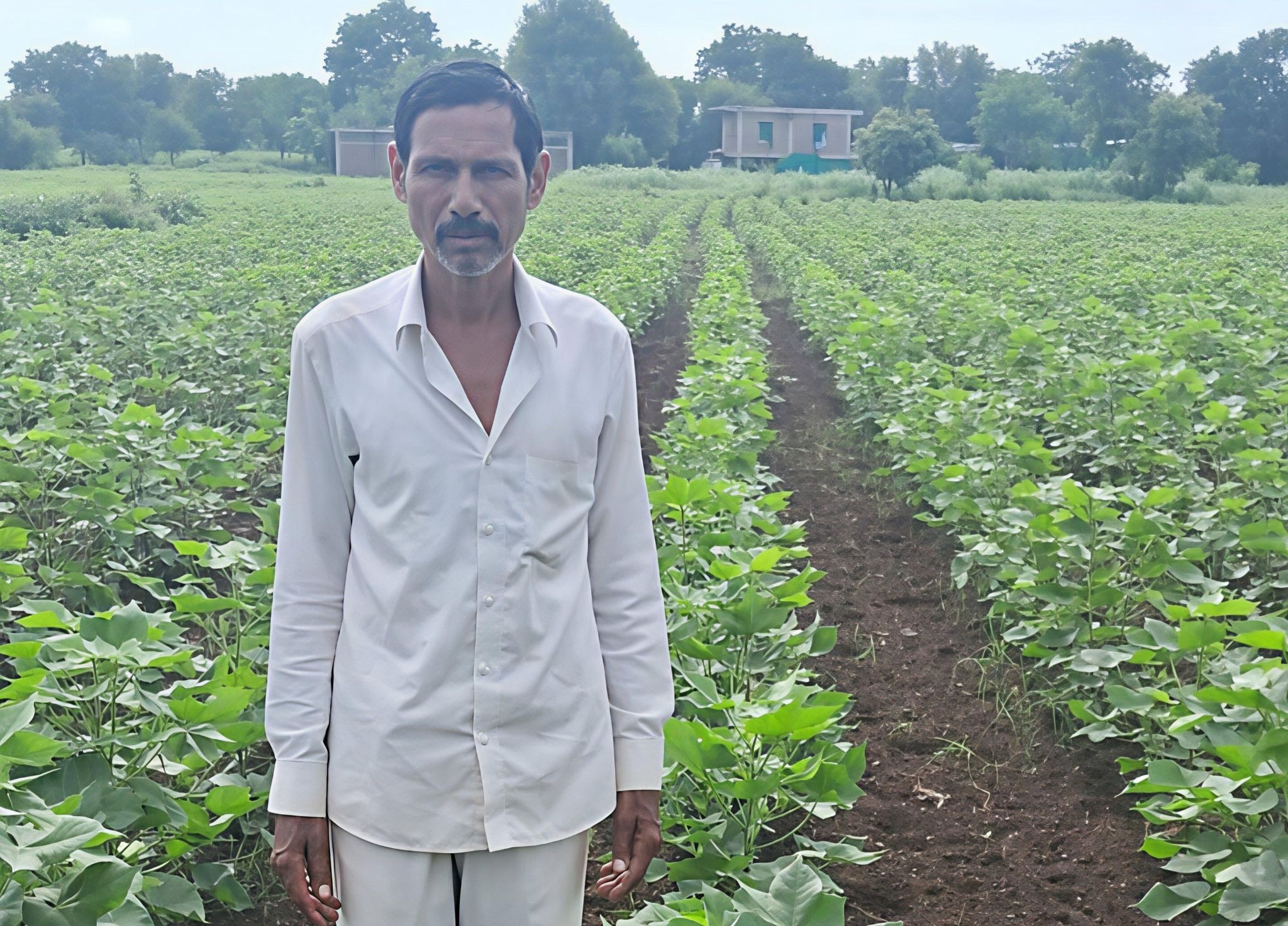
Bhimrao's story mirrors the transition identified in the NCRB data: cultivators increasingly supplementing farm income with wage labour.
“Once upon a time, our family had 50 acres of land, but now we are working on other people's fields to make ends meet,” said Bhimrao.
The decline was gradual.
Bhimrao's grandfather was one of four brothers, each inheriting about 12 acres. The next generation saw those holdings divided again, leaving Bhimrao's father, Chandrabhan, and his uncle with 6 acres each.
Today, after further subdivision and the sale of an acre to meet a financial emergency, the family is left with 5 acres.
“If there were other options, I would have taken them up, but it's either this or nothing,” said Bhimrao of his new attempt at staying afloat.
“Agriculture does not pay enough—if cotton and soyabean prices were good, we would have been able to tide over with 5 acres—but now I guess even 10 acres are not enough,” he said.
Manish Jadhav, a farmers' leader from Yavatmal district, said small farmers have been hit hardest by rising costs and stagnant returns.
“A small holder would be the worst hit—commodity prices have been low over the last few years, and the cost of production, including fertilisers and pesticides, has increased manifold,” said Jadhav. “Suicide is often the last resort for them.”
The Families Left Behind
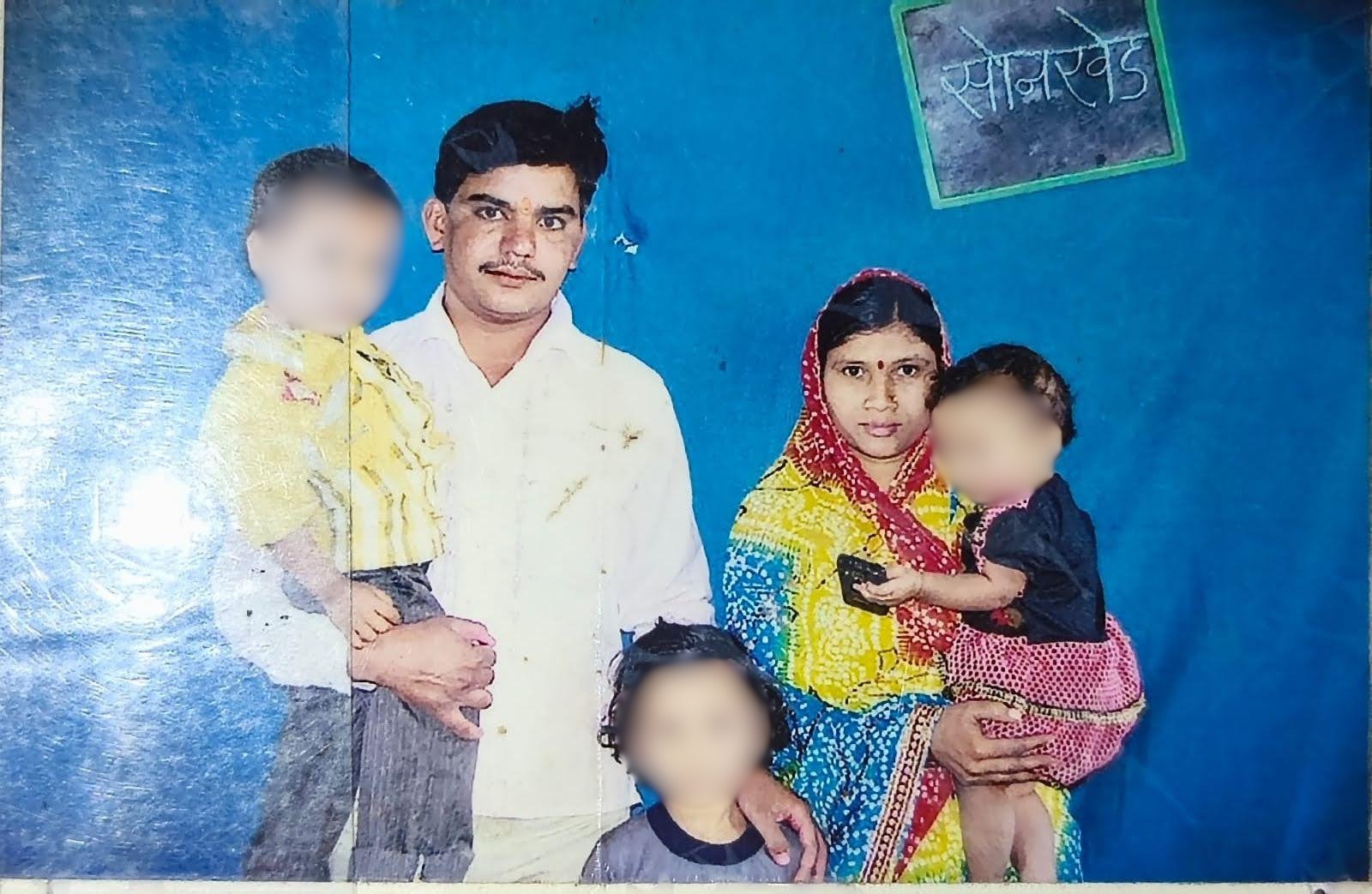
Every morning, 17-year-old Vinayak More leaves his village of Sonkhed in Nanded district to work for an event management company, earning Rs 6,000 a month.
His family owns two acres on which they grow soybeans and cotton. It is not enough. Vinayak More was six when his father, Shivaji More, took his life.
“To be honest, I have only faint memories of him,” said Vinayak More. “But my mother said he took the extreme step because of losses in agriculture. Over 10 years have passed, but our fields are still not making money.”
His mother is now an agricultural labourer.
About 200 km to the north in Khanalwadi village of Yavatmal district, the pattern repeated itself.
On 23 November 2024, Devidas Hari Rathod, 28, died by suicide.
“He was extremely irritable a few months before he died,” said Shankar Pawar, the village police patil or the village-level law enforcement officer. “There was constant bickering in the house, his wife told us later.”
“At first, people ignored this as just fits of rage,” said Pawar. “What they did not realise was that Rathod was deeply distressed at his financial conditions.”
Rathod farmed 1.5 acres of land and worked as an agricultural labourer.
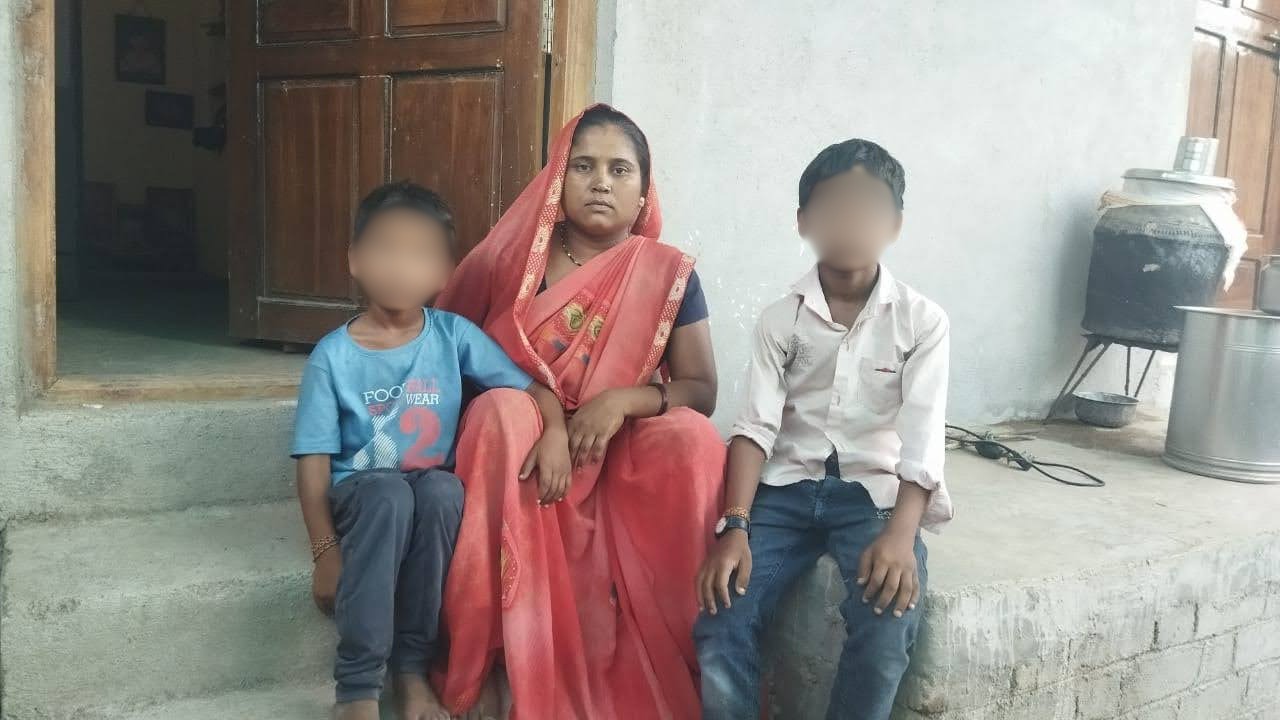
“He was generally reserved—working on his 1.5-acre field as well as on others as a farm labourer,” said Pawar. “Life was tough, but it was not unbearable for him. It was only after he died that we realised he was in deep debt.”
His widow, Mayabai, now supports two young children by working as a labourer.
“What else can she do?” said Manish Jadhav, a farmers' leader who works with families affected by suicides in the region. “With limited education and resources, that is the only work she can do to earn money.”
The experiences of the More and Rathod families reflect a broader reality across rural Maharashtra. The distinction between "farmer" and "agricultural labourer" is increasingly blurred.
As holdings shrink and agricultural returns stagnate, families move between cultivation and labour depending on the season, exposing them to the risks associated with both.
Debt, Climate Change & Falling Returns
Jadhav said farm suicides in Yavatmal are rarely the result of a single factor.
The district has limited irrigation, making farmers heavily dependent on increasingly erratic rainfall.
“Climate change is one of our greatest adversaries,” said Jadhav. “Every year, the monsoon comes with fresh challenges—either it pours during the harvest period, or there are prolonged dry phases. Without any certainty of returns, we are exposed to uncertainties,” he said.
“Every year, Yavatmal reports around 10-15 lakh people migrating out of the district for financial security,” he said. “Farm suicide is a sign of the deep distress in agriculture.”
Researchers have increasingly linked agrarian distress to climate variability (here and here). Erratic rainfall, unseasonal hailstorms and prolonged dry spells have become recurring features across Maharashtra's farms, particularly in Vidarbha and Marathwada, regions that have long reported, as we said previously, some of India's highest numbers of farm suicides.
The NCRB data show that Maharashtra has consistently recorded the highest number of farm-sector suicides in the country. In 2024, the state accounted for more than a third of all farm suicides nationally, with Vidarbha and Marathwada continuing to emerge as the epicentres of the crisis.
For Shetti, however, the immediate trigger remains economics.
Since 2021, soybean prices in wholesale markets have been below the government-declared minimum support prices (MSP), said Shetti. “But the cost of inputs has been increasing on a year-on-year basis,” he added. “Support in terms of government procurement has always been late to arrive.”
Official data show that while the union government has periodically raised MSPs, market prices for soybeans in several producing regions have often remained below those levels, forcing many farmers to sell at a loss or hold produce in the hope of better prices.
Meanwhile, the cost of fertilisers, pesticides, diesel and labour has steadily increased, squeezing already narrow margins.
“This year, when soybean prices rose, farmers had already offloaded their produce in the open markets,” said Shetti. “Accumulation of losses is the main reason for the distress in the farm sector.”
Gajendra Ahmedabadkar, a farmers' leader from Washim district in Vidarbha, traced the crisis to what he called policy failures.
He contrasted periodic write-downs of large corporate loans with the difficulties farmers face in accessing institutional credit.
“Multiple committees constituted to study the problem of farm suicide have identified that lack of finance is a major cause of farm suicide,” said Ahmedabadkar. “But banks still are reluctant to lend to farmers. This year is supposed to be a drought year, and banks should have started disbursing loans early, but nothing has happened on the ground.”
The concern finds support in official surveys.
The National Sample Survey Office's Situation Assessment Surveys have repeatedly shown that indebtedness is widespread among agricultural households, while small-holder farmers remain heavily dependent on informal credit sources despite decades of policy interventions aimed at expanding institutional lending.
Ahmedabadkar argued that climate change has compounded the crisis.
“Instead of standing with the farmers in terms of technology and mitigation, we are building roads and other infrastructure,” said Ahmedabadkar. “Somehow, the policy towards agriculture seems to be reduced to mere sops, but no effort is being made to address the structural plagues of the system. Till they are addressed, farm suicide will not slow down.”
(Partha Sarathi Biswas is a rural and agricultural reporter based out of Pune. He is also pursuing a post-graduate degree in sociology from the Savitribai Phule Pune University.)
Get exclusive access to new databases, expert analyses, weekly newsletters, book excerpts and new ideas on democracy, law and society in India. Subscribe to Article 14.