
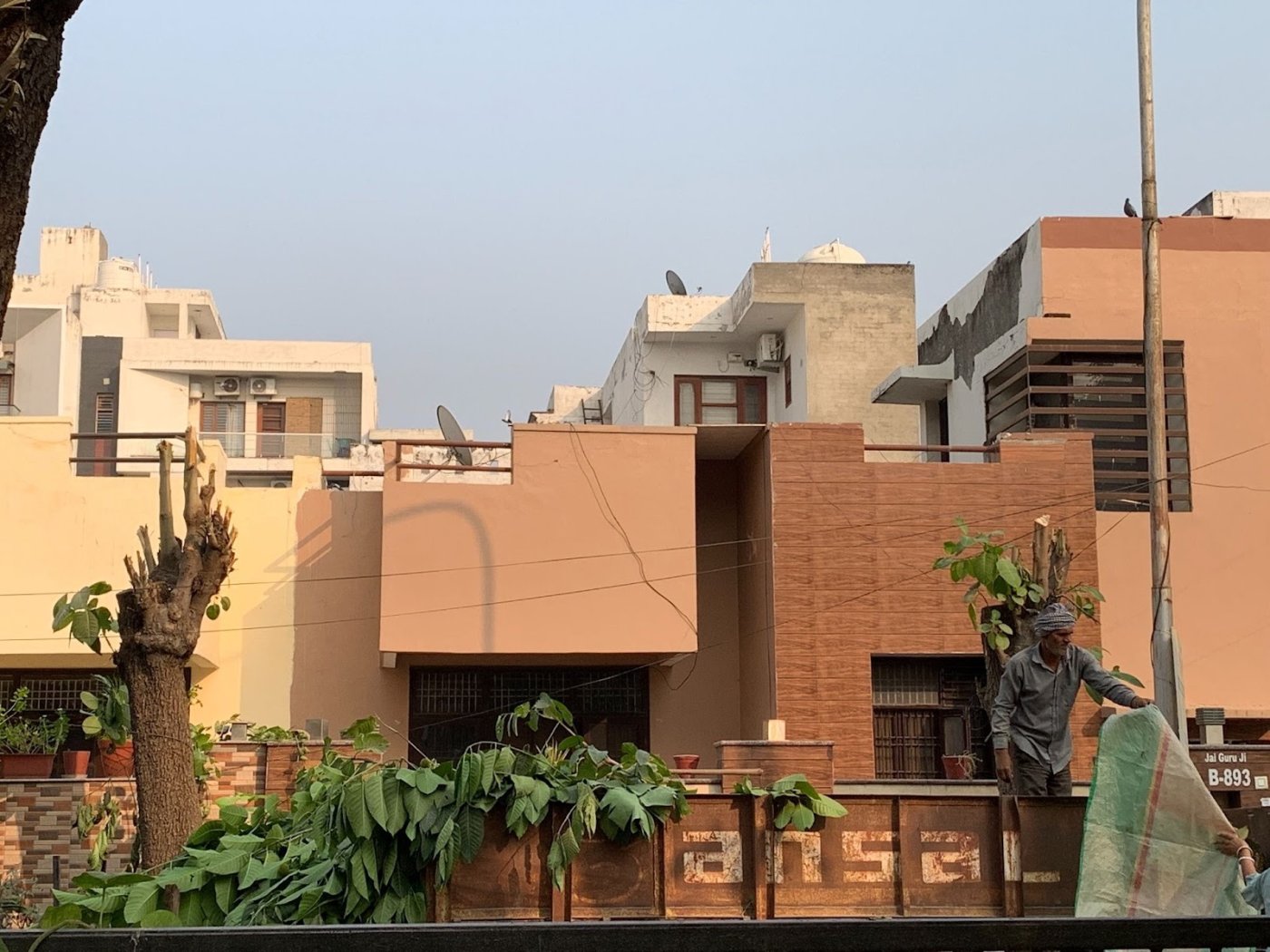
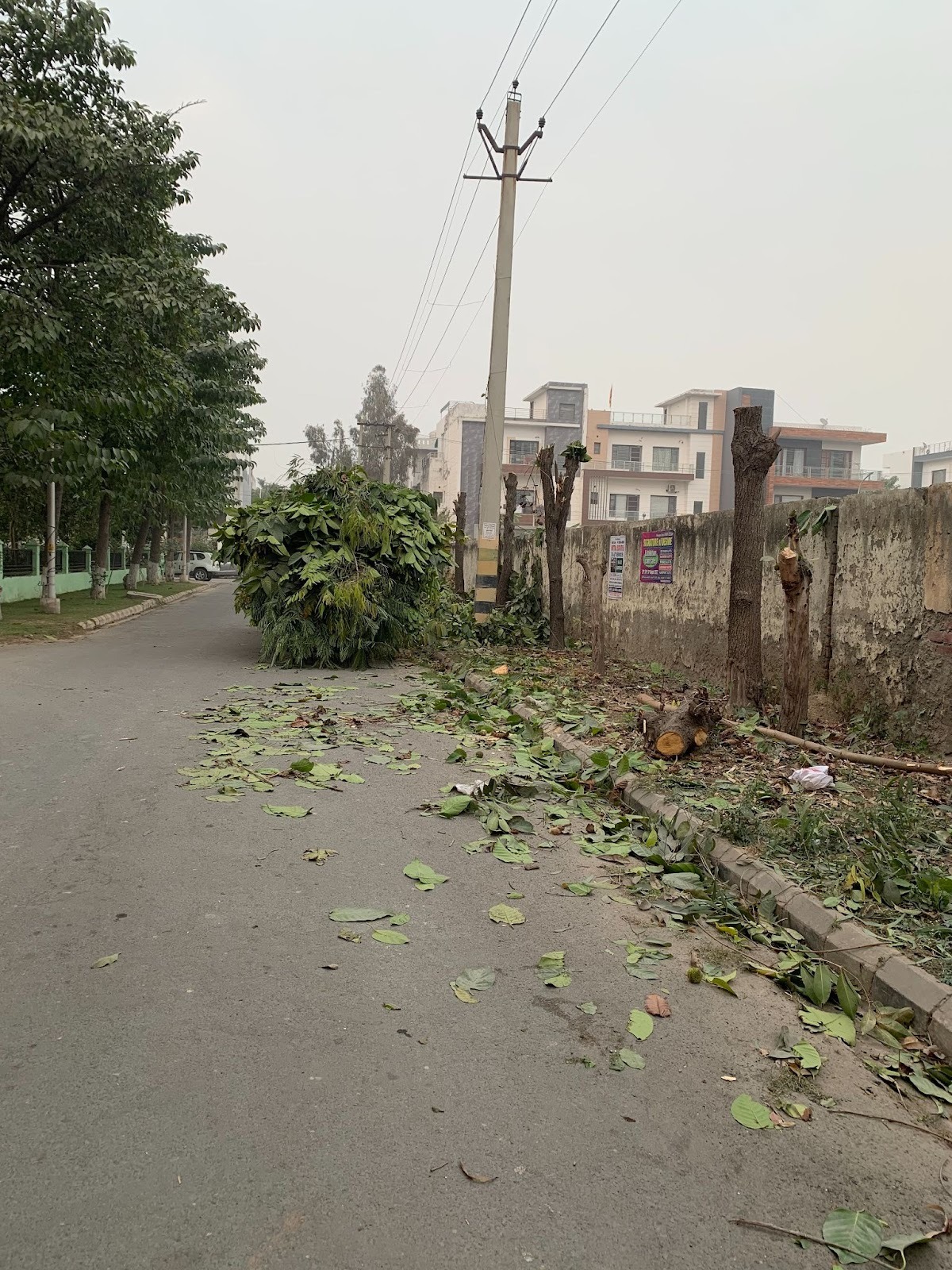
Haryana: On 19 October 2022, two men, with an axe and a ladder, started chopping down trees along the walls of a gated residential community in Haryana’s eastern district of Panipat.
A Taiwanese rain tree, on whose branches fresh pink fruit hung like bouquets, aged mulberries, pongamia, saptaparni, and over two dozen other trees of different species were brought down within hours.
The stumps would soon be uprooted and replaced by a pavement for the community being developed by Splendor Landbase Limited.
The Delhi-based real estate company, which goes by the name Splendor Group online, did not respond to our emails asking if they had sought permission to cut the trees.
Scores of other trees around the city would meet the same fate over the next three years.
Four of them stood outside Jagdish Kalra's residence, a businessman and self-proclaimed “tree-lover”.
As Kalra saw a 35-year-old peepal tree chopped up and loaded into a tractor full of trampled leaves, broken branches, and logs of wood, he felt he couldn’t take it anymore.
“On Saturdays, people would light diyas around its hefty old trunk, and now it lay in the trolley just because its branches were touching someone’s home,” he said.
Two days later, he approached the district collector, Virendra Dahiya, with his complaint.
The officer ordered the Haryana Shehri Vikas Pradhikaran (HSVP), the state’s urban development authority, to investigate. The HSVP passed the buck to the municipal corporation, saying the latter now had authority over his neighbourhood, Kalra said.
The municipal corporation passed the buck back, according to Kalra, citing the fact that the HSVP had developed the neighbourhood and planted the trees in the first place.
Over the next few months, Kalra went around in circles, knocking on the doors of every authority he could think of. No one accepted responsibility.
‘What Will You Get Out Of It’
Once, Kalra claims, a senior official told him: “Now that the trees have been cut, what will you get out of it?”
Kalra sensed the authorities were deliberately delaying the matter, hoping he would eventually give up. “But what they didn’t know was that I am a stubborn man,” he said.
In September 2024, he moved the National Green Tribunal (NGT) in New Delhi.
Local authorities in Panipat began investigating the matter on the NGT’s direction. The case is still pending.
Unlike its neighbour, New Delhi, where even pruning a tree requires permission from the forest authorities, Haryana, the state with the lowest forest cover in the country—at only 3.6% as against the national average of 21%, according to the latest Forest Survey of India report—does not have a statewide tree preservation law to protect trees outside designated forest areas.
Easy To Cut Trees
To protect trees outside forests, Haryana uses a British-era law that applies to less than half of its districts.
In other words, if someone wanted to cut down trees outside their home, in a park, or on a street in their neighbourhood, they could do so without attracting any significant penalty in most areas of Haryana.
The Haryana government, in August 2025, released a notification limiting the definition of forests, under which plantations, orchards and other forested areas outside government-notified forests will not be treated as forests, and will not be protected.
Due to the absence of strong tree-protection laws and an overall willingness among authorities to act, many civilians across the state are fighting and mostly met with apathy, corruption and even hostility.
“There’s no [specific] act in Haryana. The government has imposed a ban on felling certain tree species, but other than that, if you are trying to save a single tree, it’s very challenging,” said Prem Mohan Gaur, a Gurugram-based lawyer who focuses on environmental issues.
Due to this legal and administrative vacuum, trees outside forests are left without any protection and are being cut down.
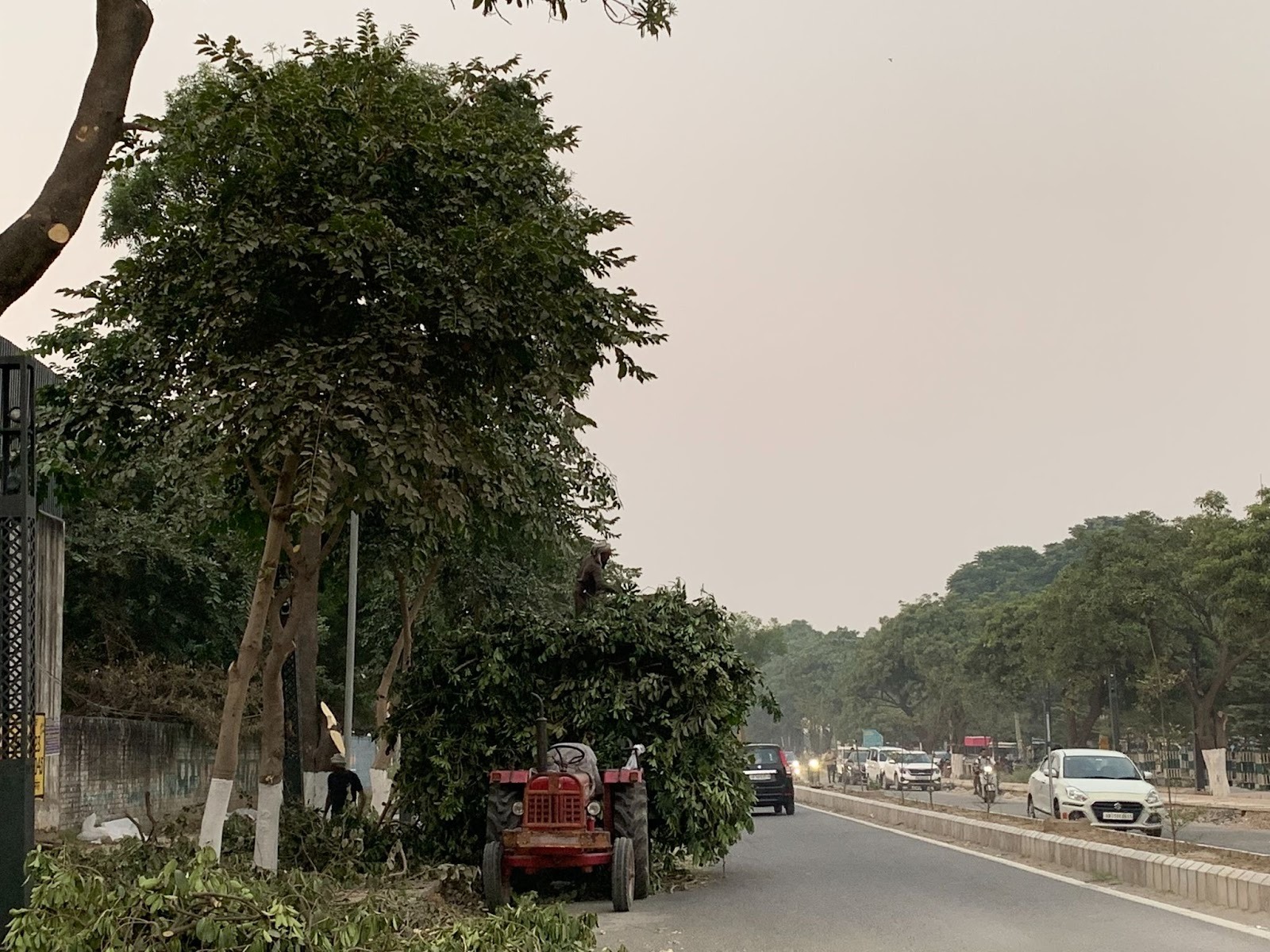
A report by the Global Forest Watch, a monitoring agency, found that in 2024 alone, the northern Indian state lost 12 hectares of tree cover, releasing almost 6 kilotonnes of carbon dioxide. Over the past two and a half decades, 440 hectares of tree cover have been lost.
This reflects a wider Indian trend: across the country, people have been protesting the destruction of green spaces to make way for 'development' projects.
In Jaipur, residents had protested for months, attempting to save Dol ke Baadh, a 100-acre forest area being razed to build a fintech park and a mall, while in Telangana, around 10,000 trees were felled in March 2025 for commercial use before the Supreme Court halted tree-cutting.
‘Trees Are A Nuisance’
While it’s well-known that Delhi has the most polluted air in India, eight of the world’s 50 most polluted cities are in Haryana.
In the months of autumn and winter, when the Air Quality Index, affected by industries, vehicles, farm fires, and firecrackers, rises dramatically over 500 and breathing itself becomes hazardous, most of the state’s 30 million people are left without access to high-quality air purifiers or masks.
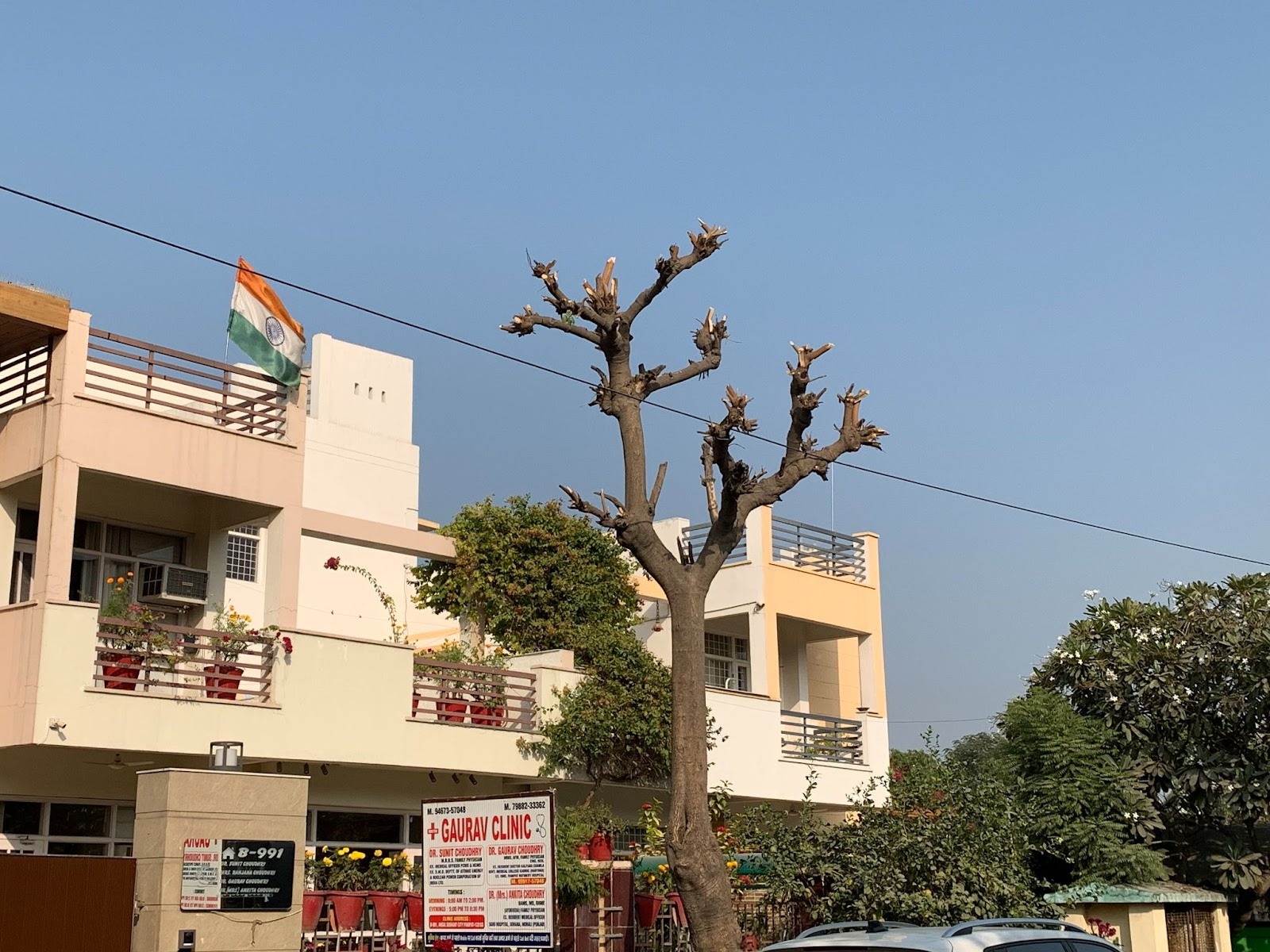
Between July 2022 and January 2026, Article 14 documented at least 16 tree-felling incidents in Panipat, an industrial city of Haryana, and witnessed the cutting of over 150 trees—some uprooted, some denuded, and some so heavily pruned that they are unlikely to grow back.
In the summer of 2022, in a gated community in Panipat, Ansal Sushant City, 11 trees were razed because their branches collided with aerial electrical wires.
In two other separate incidents, in 2022 and 2023, all the branches on 43 trees were cut down in the same neighbourhood for the same reason.
In November 2025, a group of Ansal residents had at least 17 trees outside their homes cut in half.
In the same month, lush, healthy branches of at least three dozen trees were felled in another neighbourhood of Panipat and the chunky pieces of wood were loaded onto a tractor and sold to the nearby crematorium.
Hansraj Anand, a member of the crematorium staff, confirmed he regularly buys wood from people in these neighbourhoods. While he did not reveal the exact price, a felled tree can fetch thousands of rupees, depending on its girth and the variety of wood.
“What’s wrong with cutting the trees? It’s like trimming your hair,” said Amit Goyal, a resident who also manages the infrastructure at a public park.
Several trees, inside and around the park, have been cut or heavily pruned over the last three years.
“It gets very foggy during the night, and we want to get a street light installed,” Goyal said, looking at a tree cut in half. “The trees would have hampered it.”
Ironically, most of the trees in the city were cut in autumn and winter, during the peak of pollution, because residents complained that the trees obstructed sunlight from entering their homes.
Ravinder Kumar, who oversaw tree maintenance in the Ansal community until October 2025, said that regular pruning would have taken much more time and effort when asked why the branches weren't trimmed.
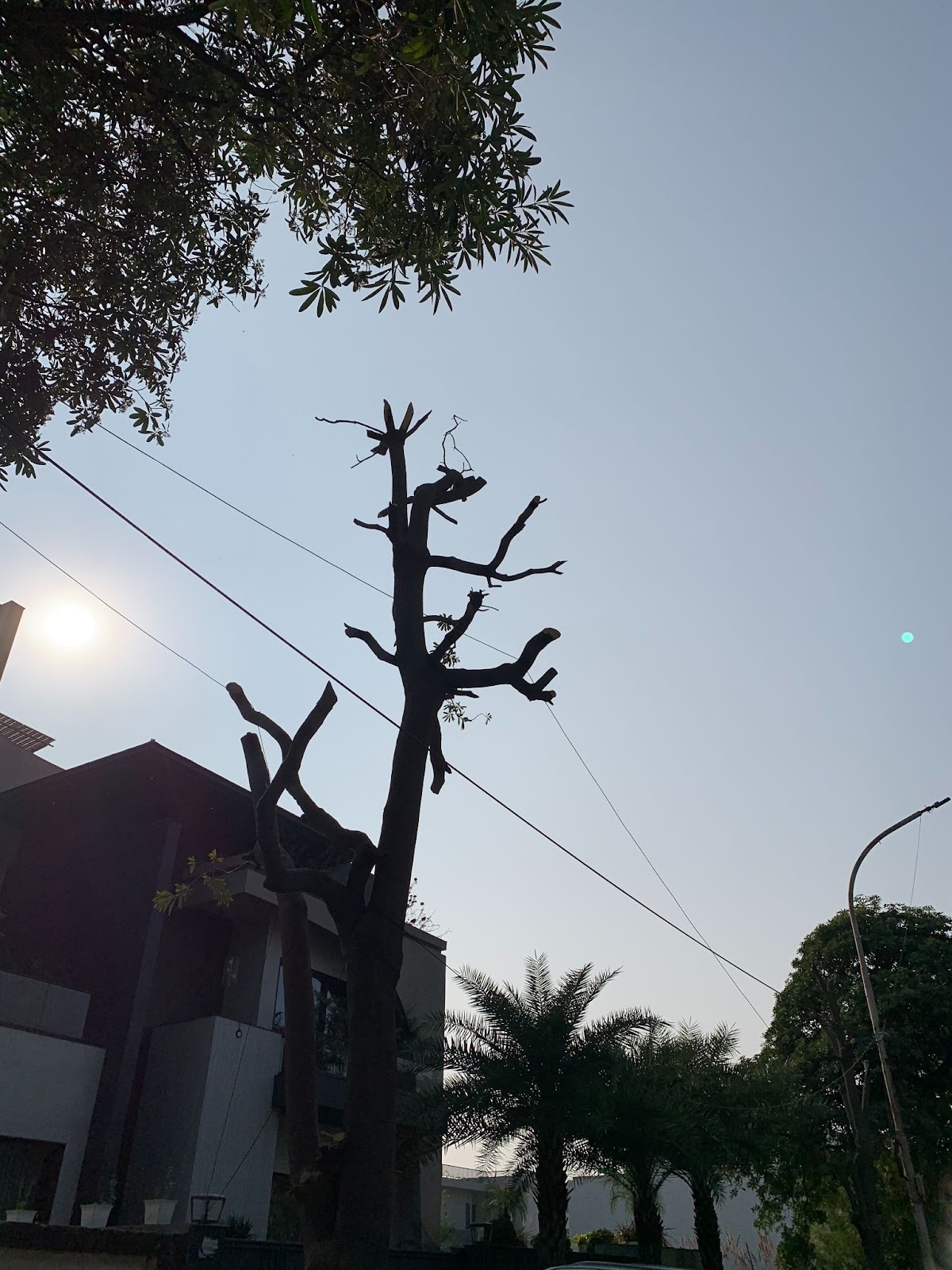
He admitted that many people have uprooted native tree species and replaced them with decorative palm trees and that “half of the green area in the neighbourhood has been wiped out” over the past decade.
Pia Sethi, a Gurugram-based ecologist, said that most tree species in Haryana she is familiar with do not even need regular pruning. “It’s just based on people’s whims and fancies. A lot of people seem to think that trees are a nuisance.”
It’s a trend seen across Haryana: in Panchkula, 15-20 trees were heavily pruned at the state’s irrigation department office in February 2025. “Is this pruning?” questioned Sumit Gupta, an employee at the department, showing me pictures of the denuded trees.
Even in areas where cutting trees is restricted under the Indian Forest Act, 1927, and the Punjab Land Preservation Act (PLPA), 1900, such as Nuh in southern Haryana, trees are regularly felled during winter to meet local fuel demand, according to Ibrahim Haji, a retired farmer involved in water conservation efforts.
In Bhiwani, one of the cities in the state where permission is required to cut trees, countless trees are frequently “gotten rid of” on private and agricultural lands, illegally, said Jitender Nath, a lawyer practising in the region. “Even if people do seek permission for big construction projects like highways, they are often required to plant more trees [instead of the felled trees], but that doesn’t happen.”
A British-Era Law
In 1900, when India was still under the British Raj, and Haryana was still a part of Punjab, the government introduced the PLPA to prevent soil erosion in ecologically sensitive areas.
Even after Haryana became a separate state in 1966, it continued to use the act for environmental protection in certain areas of Gurugram, Faridabad, Bhiwani, and some other cities.
Under section 4 of the PLPA, which only applies to 10 of the 22 districts of the state, residents are required to seek permission from the forest department to cut a tree.
The other 12 districts, including Panipat, lack tree-protection laws.
Experts say the act is not effectively enforced because authorities grant permission without properly inspecting the site or making a serious attempt to identify a more sustainable solution.
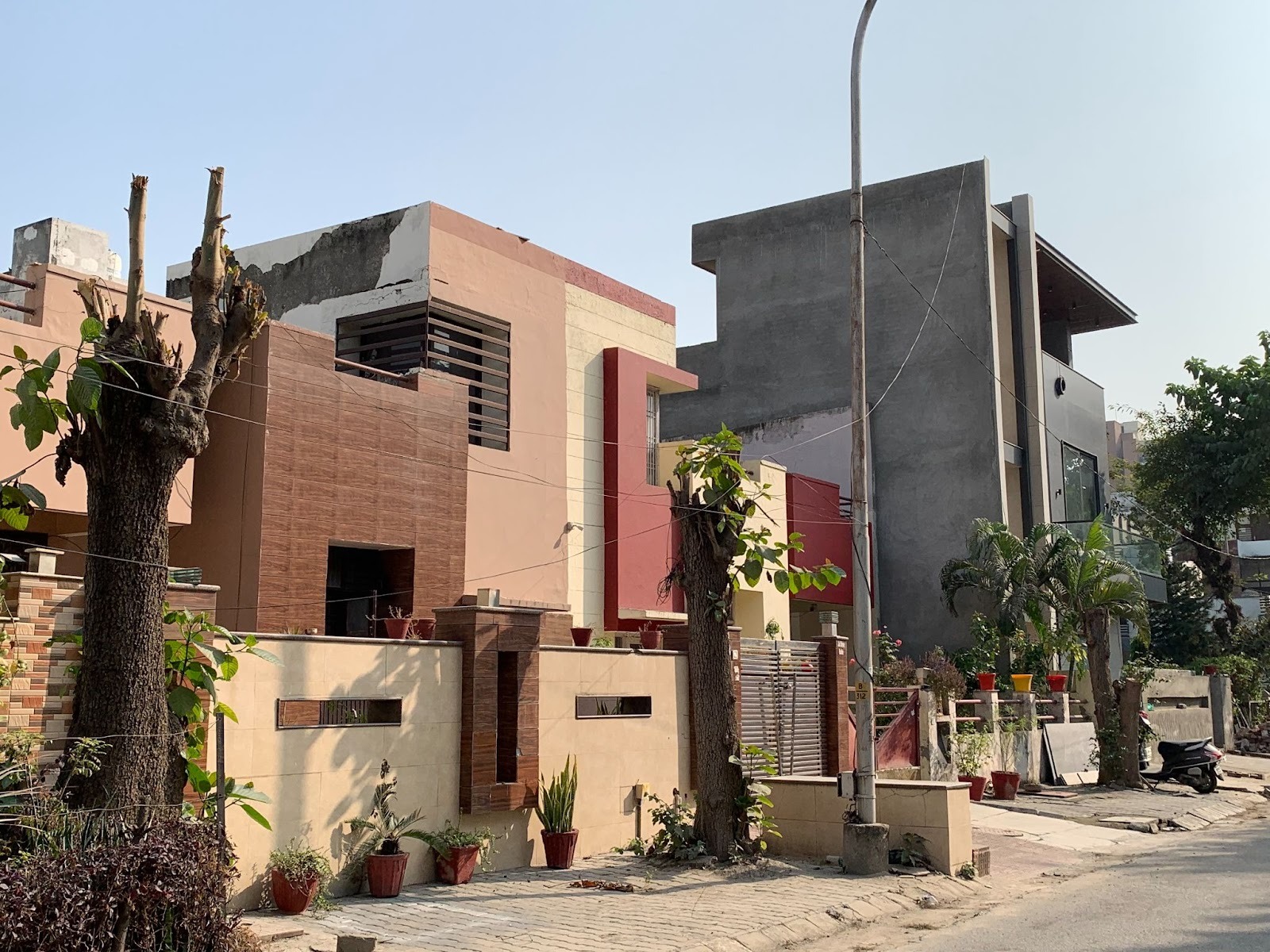
About a year ago, Sethi, the Gurugram-based ecologist, came home to see a few men sawing down the branches of a semal tree she had planted 20 years ago. The tree, they said, would be uprooted and transplanted, to allow her neighbours to construct a house.
“Under the pretence of transplantation, they hack the tree to bits and declare it dead. How can you transplant a massive 20-year-old tree? And what is the necessity?” she said, explaining that the construction could have easily been carried out by only trimming the branches.
After several visits to the state’s forest and horticulture departments, she finally saved the tree, but remains anxious about the depleting tree cover in her city.
“What I have found is that everybody is violating the norms,” Sethi said. “They are chopping down trees that could have easily survived, concretising every last bit of space.”
Some residents and activists also allege corruption.
When Satinder Duggal, a lawyer and retired defence personnel in Faridabad, sought permission from the forest department to cut a tree on his private land, he said a man claiming to be a contractor with Faridabad’s municipal corporation appeared at his doorstep with an offer: “Give me Rs 7,000. I will cut the tree and wipe off its remains; don’t worry about the paperwork.”
“This is how permissions are given,” said Duggal, who suspected collusion between the man and the forest and municipal authorities. He decided, eventually, not to cut the 50-year-old tree because the parrots that sit on it “would have lost their aashiyana (home)”.
Even if a breach is reported and proved under the PLPA, the maximum penalty defined under the act is imprisonment for up to one month, or/and a fine of only one hundred rupees.
“Isn’t it profitable for a person to make thousands of rupees by felling a tree and paying off a small fine?” remarked Lokesh Bhiwani, the founder of Stand with Nature, an activist group involved in organising tree planting drives in Haryana.
In 2022, the NGT directed the Haryana government to frame a policy to regulate tree-felling in non-forest areas, but concrete action is yet to be taken.
In October 2025, the tribunal acknowledged the rise in tree-felling incidents in Haryana due to the lack of a legal framework and mandated that no tree can be felled on private or government land without approval from the divisional forest officer.
But people continue to cut trees without facing any consequences.
An official at the ministry of environment, forests, and climate change, in New Delhi, said, on condition of anonymity, that they get “thousands of complaints” about environmental damage, including tree-cutting, from around the country.
“We pass them on to the concerned states, and there, nobody takes action unless someone goes to court,” said the official. “There’s no willingness to work… People are freewheeling in Haryana in the absence of laws.”
Between October 2022 and May 2024, I wrote three emails to Haryana’s forest department, detailing some of the tree-cutting incidents I had documented. Responding to one of them, Raja Ram Singh, the deputy inspector general of forests, directed the principal chief conservator of forests (PCCF) in Haryana to look into the matter, but no further action was taken.
Vineet Kumar Garg, the current PCCF, said, “The Haryana forest department is already in an action mode and we will soon bring in [a tree preservation] act, similar to that of Punjab and Delhi.” (Both Delhi and Punjab have laws to protect trees in non-forest areas.)
Haryana’s New Definition Of Forests
Manoj Tyagi, a farmer in the Hathwala village of Samalkha, a town located 72 km from Delhi, in the east of Haryana, claimed that 16,000 trees were illegally felled and sold by local authorities on community-owned land in February 2025.
After months of RTI requests and visits to higher authorities, Tyagi learnt from the forest department that the sarpanch (the head of the village council) and other authorities had sought permission to cut trees on six hectares of land but ended up wiping out the greenery on 24 hectares.
“Lakhs of rupees were swindled,” Tyagi said.
Armed with bundles of documents and dozens of pictures, he continues to appeal to the authorities—the district administration, the forest department, the chief minister’s office—but said he feels dejected.
“I have shown them all the proof; they just don’t act,” he said. “I might have to go to court.”
The district’s divisional forest officer, Vijay Laxmi, said she wasn’t aware of the matter but would look into it.
“There are very limited ways of saving trees in Haryana, but [in the existing setup], compensation can be an effective tool that can [discourage] people from cutting trees,” Gaur, the lawyer, explained. He cited a 2020 report submitted to the Supreme Court that estimated the monetary value of each tree to be 74,500 rupees per year.
In another 2022 NGT judgement that he referred to, the tribunal imposed a fine of two lakh rupees for each tree felled in an incident in Faridabad.
However, environmental activists and experts are more worried about Haryana’s determination to open the existing protected forests to further damage by individuals and corporations.
In January 2025, the Haryana government proposed a policy to waive tree-cutting permits for commercial projects.
In August last year, for the first time, the government defined the term “forests” as an area that occupies at least 5 hectares of land in isolation, or at least 2 hectares if it adjoins government-notified forests. It should also have a canopy density of at least 40%. This would exclude more trees from areas defined as forests, leaving them even more vulnerable.
“You cannot expect a place like Haryana, which is so close to the desert, and doesn’t have that kind of rainfall to have [this] canopy density, except in isolated spots like Mangar, or close to the Aravallis,” ecologist Sethi said. “The whole focus of the state is on real estate and eliminating the green cover.”
Neelam Ahluwalia, an environmentalist and a founder member of People for Aravallis, an environmental collective in Haryana, said that the government’s new definition will leave 79% of the state’s open forests and natural ecosystems, such as scrublands, grasslands, strip forests, and small groves, vulnerable to the real estate and mining industries.
“This will be a huge loss for Haryana state’s ecology as these ecosystems are unique biodiversity areas with rich flora and fauna,” said Ahluwalia.
In November 2025, the Supreme Court accepted a new, uniform definition of the Aravalli mountain range, which stretches from Delhi to Gujarat, proposed by the union environment ministry: a landform with an elevation of 100 metres and above. That, experts said, would have opened 90% of the range, including large forested lands in Haryana, to commercial use.
After it triggered protests across northern India, the court stayed the order.
Sethi is already observing the impact of the vanishing trees on the state’s biodiversity: in the disappearance of monitor lizards, rat snakes, swarms of insects, and bird species she once observed around herself.
“It is utterly frightening,” said Sethi. “The biggest irony is that if you can’t even protect one tree that is not obstructing anything in any way, how will you save [large] forests?”
And the few people, “those one or two individuals”, she added, who are trying to save the trees have to face the wrath of everyone, from fellow residents to the authorities. “You start feeling guilty about doing the right thing. It’s absurd.”
(Romita Saluja is an independent journalist based in Delhi/NCR.)
Get exclusive access to new databases, expert analyses, weekly newsletters, book excerpts and new ideas on democracy, law and society in India. Subscribe to Article 14.