
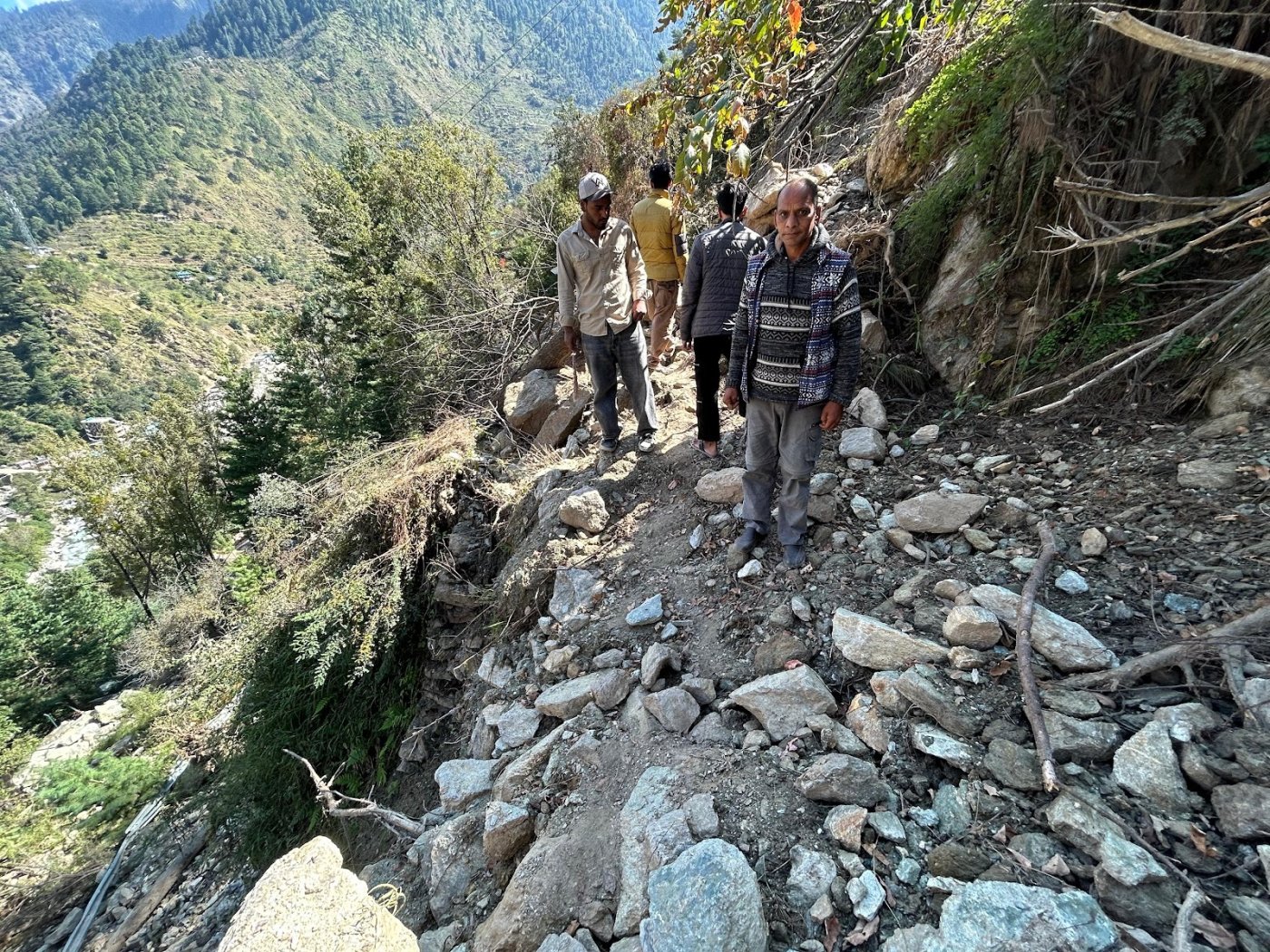
Bandal, Kullu, Himachal Pradesh: “For two days, we walked. If I had not carried her, my wife would have died.”
Slim and tall Ranbir Sharma, a 39-year-old farmer with a confident air, narrated how he struggled over mud, debris and new landslides, his wife clinging to him. It was July 2025 and the journey from Bandal, their village in Himachal Pradesh’s Kullu district, to Aut, around 30 km away.
At times, it took nearly three hours to cover a single kilometre.
Sharma’s wife, Subhadra, 30, was suffering from neural degeneration—progressive deterioration of neurons in the brain, spinal cord, or peripheral nervous system—and was in severe pain and needed a doctor.
But relentless monsoon rains had triggered landslides that buried roads and cut off entire villages. The disaster left Bandal, a small village of 120 people in Banjar valley isolated.
"I had never seen such destruction in my life,” said Sharma. “The cloudbursts destroyed the entire valley.”
The effects of climate change on the Himalayas are being ignored, turning predictable hazards into preventable disasters. Rapid warming (50% above the global average) is accelerating glacier melt and intensifying extreme rainfall, leading to flash floods and landslides, threatening lives and infrastructure.
Yet unregulated development, from homes to roads, continues in high-risk areas as forests that bind soil to mountain slopes are cut, pushed by government officials and endorsed by the courts, or court orders ignored by the government.
The latest violation concerns the Char Dham project, which aims to widen nearly 900 km of roads in an ecologically sensitive Himalayan valley in Uttarakhand to connect four famed Hindu religious sites: a government clearance, defying a December 2021 Supreme Court order, to cut 7,000 trees in a forest on unstable ground.
Veteran politicians Murli Manohar Joshi of the BJP and Karan Singh, formerly of the Congress, described the clearances as “illegal and untenable” and said they would “significantly increase the risk to human life and downstream settlements.”
Climate change raises the risk of these disasters, but poor land-use and infrastructure planning, and a lack of enforcement of building regulations, amplify the damage they cause.
With no road access and no medical help able to reach the village, Sharma had no option but to carry his wife himself. He carried her on his back for close to 30 km to Aut, where a motorable road begins. From there, he took a taxi to Mohali in Punjab, a further 220 km.
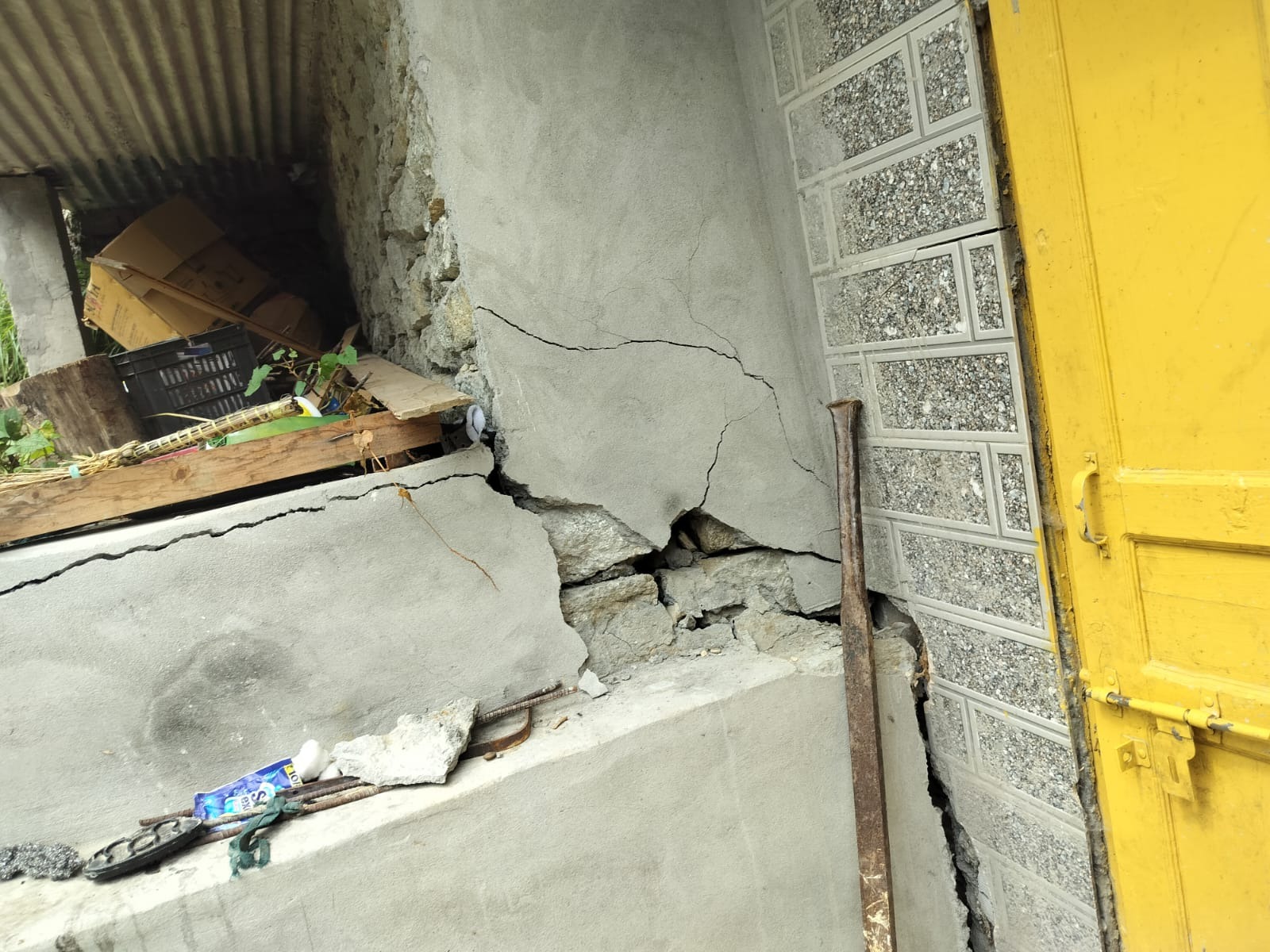
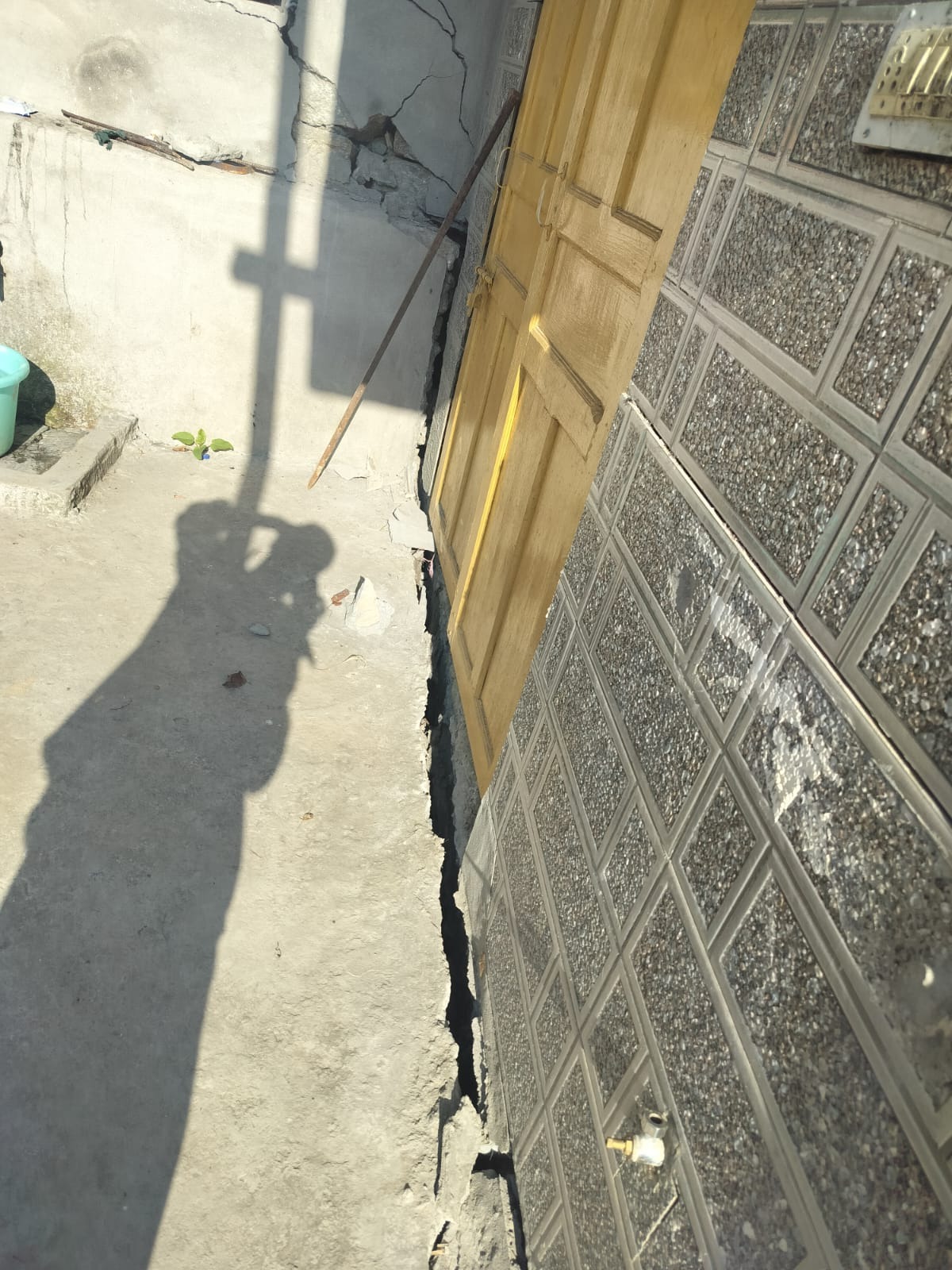
The residents of the 32 houses in Bandal village were not ready for the destruction wrought by the 2025 monsoons. Earlier in July, after weeks of continuous rainfall, they began to notice cracks in their homes for the second time.
Previously, cracks had appeared in their homes during the 2023 monsoons, although not as wide as this time. By the end of July 2025, the land Bandal began to slide, and cracks widened in homes, forcing their evacuation.
Soon, homes and farmland were washed away.
Many villagers had to migrate to relatives' homes elsewhere in the Kullu district. Those who could not were forced to live in tents in the destroyed village, stranded and without access to food, water, and healthcare.
A Devastating Monsoon
In 2025, Himachal endured the highest monsoon rainfall in 29 years, triggering widespread landslides, flash floods, and cloudbursts across the mountain state.
Between 20 June and mid-September, the official toll rose to 427 deaths, of which 243 were due to rain-related incidents and 184 due to road accidents.
Infrastructure suffered heavily.
More than 550 roads, including three national highways, were blocked by landslides and debris in various districts. According to the State Disaster Management Authority, 2,287 houses, 4,908 cowsheds, 584 shops and factories, 58 labour sheds, and 7048 other small structures were damaged or destroyed.
The devastation across the Himalayan region caused by the 2025 monsoons was unprecedented, with J&K recording 199 deaths and Uttarakhand 263 deaths from flash floods and landslides triggered by cloud bursts and rain over the year.
“We have never seen such rain in our lifetime. This is definitely climate change,” said Hemraj, 47, who works with the Himachal Public Works Department and goes by a single name.
However, the villagers did not blame climate change alone for the unprecedented destruction in their village. They pointed to the Himachal government’s inaction on an October 2023 report by the Geological Survey of India (GSI), India’s national scientific agency for earth sciences, after a landslide in the area during the 2023 floods.
Floods during the 2023 monsoons led to at least 330 deaths in Himachal. At least 1,500 buildings were destroyed, and cracks formed in a further 10,000.
In 2024, 34 people were killed in flash floods and landslides in the state during the monsoon, and 121 houses were completely or partially damaged.
The report examined the causes of the landslide and offered recommendations to prevent a recurrence. “If the government had taken the suggestions made in this report seriously, maybe our homes and livelihoods would have been saved,” Sharma said.
State Govt Ignores Warnings
A 2023 GSI report recommended lined drainage, retaining structures with weep holes, crack filling, construction restrictions, and a detailed site-specific study for Bandal village.
A second report by IIT Mandi, following the 2023 Kullu floods, made similar recommendations, including regulating construction, stabilising slopes, improving drainage, and conducting detailed geotechnical assessments.
When we visited the village in October 2025, villagers blamed administrative inaction for the devastation.
The Sukhvinder Singh Sukhu-led Congress came to power in Himachal in December 2022.
Article 14 contacted the chief minister's Office, the State Disaster Management Authority, and the deputy commissioner of Kullu, Torul S. Raveesh, via email and WhatsApp on 14 December 2025 and 17 February 2026 with questions about why the recommendations were not implemented, but received no response.
We tried to contact the authors of the GSI report via telephone calls and emails on 18 February, to the GSI, but did not receive a response. We will update this story if they do.
Ignored Reports & Recommendations
The 2023 report by the Geological Survey of India, authored by senior geologists Tripti Baba and Weneikhro Krome, both of whom work with the Indian government’s ministry of mines, identified several factors contributing to the landslides in the Kullu district and offered suggestions to mitigate the risk.
The geologists conducted landslide studies in four villages in Kullu, eight in Banjar, two in Manali, and three in Anni sub-divisions from 30 August 2023 to 9 September 2023.
They found a lack of drainage and retention structures, which led to devastating landslides in these villages.
According to the report, the soil on the hill where Bandal was located was prone to becoming waterlogged and weak during prolonged, heavy rainfall because the slope was composed of loose debris that absorbs water quickly. When this loose soil becomes saturated with water, the pressure inside the soil increases.
When this “pore water pressure” becomes too high, according to the report, the soil structure disintegrates and begins to move. Another cause, according to the report, was the slope's moderate to steep incline.
To prevent such landslides from recurring, the report suggested several measures. First, a “properly lined drainage system” must be built, the authors of the report said.
This means making strong channels that can safely carry rainwater away from the weak slope. If surface water is directed correctly, the soil would not become waterlogged. This would reduce pore water pressure and make the slope safer.
Second, strong retaining structures on both the hillside and the valley side of the road needed to be built. These structures would help hold the soil in place and prevent it from sliding. These structures must include weep holes, which are small openings that allow trapped water to escape. This is important because trapped water within a wall can build up pressure that may weaken the structure.
Another suggestion was to immediately fill all cracks seen on the slope. These cracks allow water to enter the ground easily. If the cracks are filled with waterproofing material at the earliest, it will stop rainwater from entering and further weaken the soil.
The report also advised against building any heavy structures on or near the landslide area. Adding extra weight can make the slope more unstable.
Finally, experts recommended a detailed site-specific study to fully understand the slide area.
Residents of Bandal complained that none of these suggestions were implemented.
“You can see for yourself that there is no drainage system, there are no retention structures,” said Ranbir Sharma.
Villagers also blamed contractors and officials for cutting trees and blasting rocks while constructing a road near the village in 2023.
A Second Warning
Another report on the 2023 Kullu floods, also published in October 2023 by the Indian Institute of Technology, Mandi, commissioned by the Himachal Pradesh State Disaster Management Authority and District Disaster Management Authority, Kullu, recorded that “cracks appeared in homes in Bandal village, and there was a risk of further damage to the infrastructure.”
The team from IIT Mandi also gave a list of recommendations, including strictly regulating construction along riverbanks, clearly marking floodplains, and preventing permanent structures in these zones.
They recommended that high-risk areas where relocating people is not possible receive engineered protections, such as embankments, retaining walls, and proper drainage.
The report also recommended that development should be “tightly controlled”—limiting construction on the steep and unstable slopes—that trees should be planted on the bare slopes to lower the risk of landslides, and that detailed geotechnical studies must be completed before new projects begin, adding, “New construction should be temporarily halted until assessments are done.”
‘Limited Willingness To Act’
Dericks P Shukla, founding chairperson and associate professor at the School of Civil and Environmental Engineering, IIT Mandi, was part of the team that visited Bandal in 2023.
Shukla suggested that, in such a large area, implementing any engineering solutions would be very expensive. So instead of mitigation measures, management measures should be considered.
He added, “When I met the locals, I told them that due to water seepage, the land will continue to slide and will form into a retrogressive landslide. I told them not to do construction on the land and, if possible, use plastic sheets to prevent water from seeping in.”
Shukla’s team had found that the mountain slope on which the village stood was already under substantial stress from unplanned construction, including the development of multiple homestays. Furthermore, prolonged and intense rainfall increased soil saturation, increasing the pressure on the mountain slope.
“While natural hazards themselves cannot be stopped or reduced, their consequences and risk can be mitigated through planning, risk assessment, and management interventions,” said Shukla.
“Measures that, in this instance, were only partially implemented. Ideally, vulnerable local communities should have been relocated to safer zones.”
Were two years enough time to do something about the warning? Shukla said the issue was not the time but the lack of priority.
“Time period is never the case, but fund availability and priority are the issues,” he said.
Pointing to a recent proposal to widen a 35-km road near Naggar, a town in the Kullu district, about 77 km from Bandal, at an estimated cost of Rs 5,621 crore, Shukla said that money was available but being spent elsewhere.
“Funds are there but are used in projects where the rich get richer, and the common man suffers,” he said, adding that preventive measures often remain neglected because “human life is not valued enough, resulting in limited willingness to act and warnings remaining only on paper.”
IIT Mandi’s Shukla, who led the team that prepared the 2023 report, claims that the village land will remain unstable for a couple of years.
In October 2025, he said, “From 2023 to 2025, the crack on the mountain has widened significantly, rendering any housing and farming dangerous in case there is any heavy rainfall. The slope will stabilise if there are dry periods for subsequent years.”
No Rehabilitation
Villagers not only complained about the lack of preventive measures but also about the government's inaction in the aftermath of the devastation.
“It has been three months since the rain stopped, and yet the work for repairing the road has not even started. There have been no efforts by the government to rehabilitate us,” said Hemraj.
Ranbir Sharma told Article 14 that some villagers whose homes developed cracks during the 2023 rains received between Rs 6 or 7 lakh for repair work from the state disaster management authority.
“Many of them used the funds to rebuild their houses, but this year all of those houses collapsed or were damaged,” he said. “This year, we have received no such help or compensation.”
On 9 September 2025, Prime Minister Narendra Modi announced financial assistance of Rs. 1,500 crores for Himachal following an aerial survey of the flood-affected regions.
Calls to the office of Himachal’s State Disaster Management Authority, responsible for compensation and rehabilitation, went unanswered.
Article 14 sought their comments via email on 14 December 2025. There was no reply. We will update this story if they respond.
A Bleak Future
In October 2025, two months after the floods, a land excavator was stationed at the site, but it was not working. Villagers said that it had not been functioning for months.
Repeated calls and messages regarding the aftermath of the floods and landslides, rehabilitation and relief measures, and challenges for Torul S. Raveesh, deputy commissioner of Kullu, and Ashwani Kumar, additional deputy commissioner of Kullu, went unanswered.
When we reached Bandal village, the villagers, once thriving farmers of wheat and vegetables, were working on a daily wage to clear the landslide debris from a nearby mansion belonging to a former royal family.
“All our crops, homes and farmland got destroyed in the rains and landslides,” said Kamlesh Sharma, a 45-year-old vegetable farmer. “It is only through this job that we are sustaining ourselves.”
Nearly a quarter of them were living in tents on these cold winter nights, while those who could move to their relatives’ houses were living with five to six people in one room.
The villagers' daily commute is through the landslide debris, which they said was dangerous because the rocks could fall at any time.
They said it took them a whole day to carry food and other necessities to the village on their backs, as there is no way for vehicles to reach it.
“It is challenging for us to carry rations because our whole day gets wasted. As daily wage labourers, we can’t afford that. But then, asking another labourer to carry our ration also costs us Rs 1,000 extra, which is too much for us. So, we are helpless,” said Kamlesh Sharma. “We have to pay Rs 2,400 for a sack of wheat flour, which costs Rs 1400.”
In July and August, there was no water supply in the village. “We depended on rainwater for our daily needs,” said Hemraj. He added that for these two months, villagers ate fried wheat grains because no help could reach them.
The school was also completely destroyed by the landslides, leaving the children without a place to study. The closest school to the village is in Banjar town, 11 km away.
Demanding rehabilitation for villagers to safer land, Ranbir Sharma said that most of their farmland had been washed away. Some of the remaining farmland was not suitable for farming because they were afraid it could be washed away in future monsoons.
“None of us plans to rebuild our houses because our previous attempts were unsuccessful,” said Sharma. “We don’t know what lies ahead for us in the future.”
(Kaushik Raj is a poet and freelance journalist. Srishti Jaswal is an award-winning freelance journalist.)
Get exclusive access to new databases, expert analyses, weekly newsletters, book excerpts and new ideas on democracy, law and society in India. Subscribe to Article 14.