
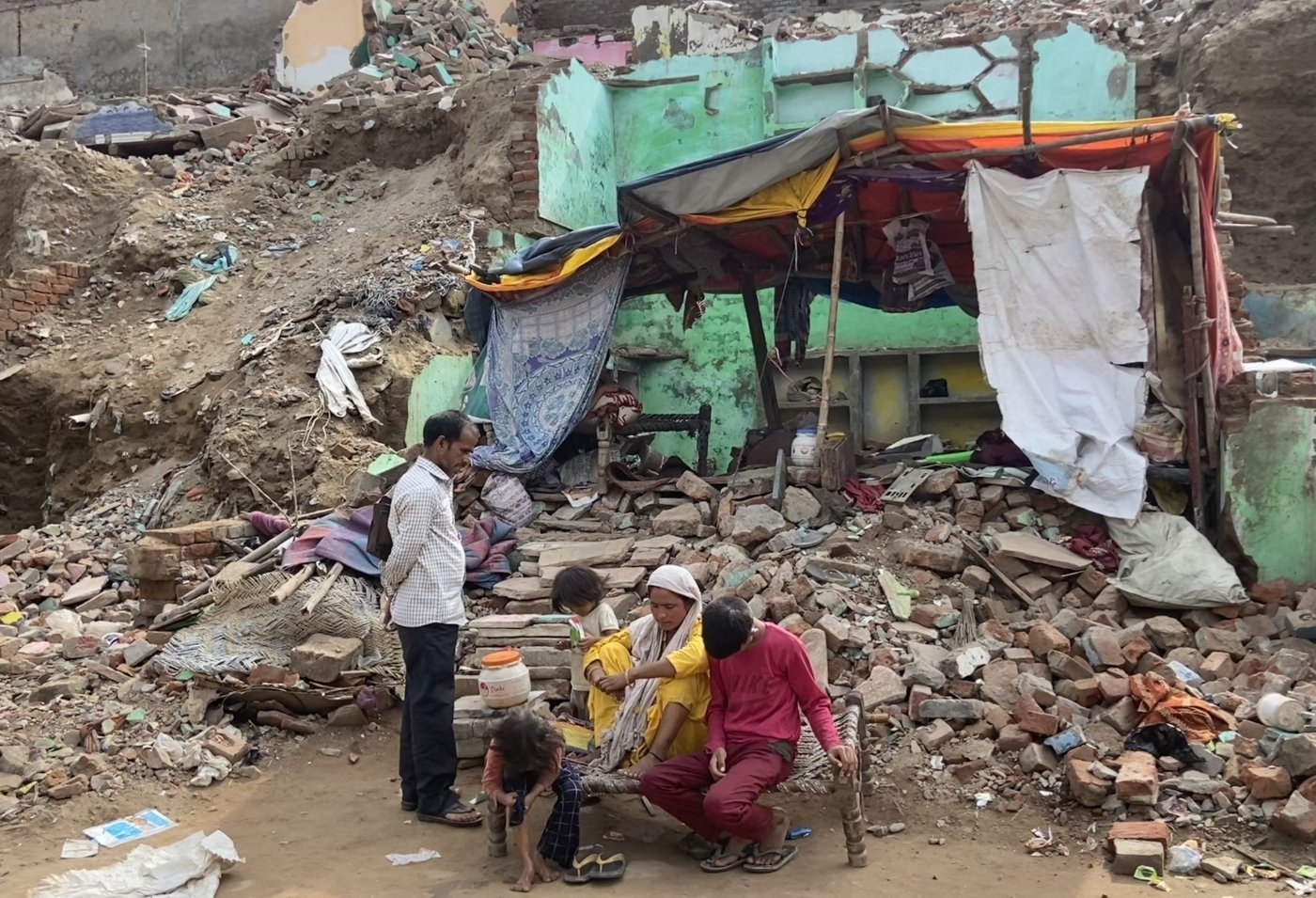
New Delhi: What began as a tool for demolishing criminal strongholds in Uttar Pradesh has evolved under Bharatiya Janata Party (BJP) chief minister Yogi Adityanath into a template for targeted demolitions, collective punishment of Muslims, and political theatre nationwide.
These demolitions, often defying Supreme Court orders on prior notice and rehabilitation, rapidly spread to BJP-run states, such as Delhi, Madhya Pradesh, Haryana, Maharashtra, Assam, Uttarakhand and Gujarat; to Jammu and Kashmir, where the union government dictates many policies; and, in the latest instances, to Congress-run Karnataka.
As columnist and Massachusetts Institute of Technology doctoral scholar Fahad Zuberi noted in May 2023, “The state has now manufactured a toolkit—targeted demolitions, forced displacements, and demographic engineering—not just to consolidate political influence and shape electoral outcomes, but to embed a persistent hatred in the public psyche. It is about crafting a collective Hindutva imagination where Muslims are systematically erased.”
Residents in Delhi’s Tughlaqabad slums, facing eviction notices and demolition drives in 2023, asked authorities: “They should inquire who the Muslims are and remove them, why us?” Many were Hindus and long-time BJP supporters.
Sushma Dutt, a local BJP voter, echoed the confusion to The Quint: “We are not Rohingya or Bengali Muslims. The government has issues with them. But why trouble us? If they want to remove Muslims, they should do that. We are Hindus.”
The message: the bulldozer was a weapon, not an impartial instrument of the law.
The UP Template
The template for this weaponisation can be traced to July 2020, during the police operation against UP gangster Vikas Dubey. Dubey blocked police vehicles with a bulldozer before his gang killed eight officers.
In response, Adityanath’s administration demolished Dubey’s sprawling home—using the same bulldozer that blocked the convoy—and broadcast it live on television. The police then shot Dubey in what appeared to be an extrajudicial killing.
Adityanath—a Hindu monk from a Shaivaite order dating back to roughly the 11th century—publicly celebrated these acts as a demonstration of law and order. Thousands of extra-judicial police shootouts were accompanied by demolitions of properties belonging to alleged gangsters, such as Mukhtar Ansari, Azam Khan, and Atiq Ahmad. The images of flattened homes and the theatrical destruction of property quickly became a popular spectacle.
Soon, the bulldozer morphed into a political mascot. During elections in early 2022, Adityanath embraced the nickname “Bulldozer Baba” after it was initially used as a taunt by his rival Akhilesh Yadav.
The BJP returned to power in March 2022 with a 41% vote share, and victory processions featuring cavalcades of bulldozers adorned with party flags. Hindutva pop music amplified the narrative, celebrating the bulldozer as a symbol of masculine, uncompromising justice. One popular song proclaimed:
“Bulldozer Baba chap rahe hai, mafia bhag rahe hai” (Bulldozer Baba is crushing them, the mafia is running away).
Punishing Muslims
The political theatre of bulldozers soon expanded to communal politics. In May 2022, protests erupted in Uttar Pradesh after insults were made to the Prophet Muhammad by BJP spokesperson Nupur Sharma. The administration responded with demolitions of Muslim homes, beginning in the town of Saharanapur.
Officers claimed they were punishing rioters, but most victims were ordinary Muslims.
In Kanpur, in June 2022, the home of Mohammed Ishtiyaq was razed because police suspected investment by a rioter in the property, and families like that of activist Jawed Mohammad faced arrests, detention of women, and live demolition broadcasts.
His daughter, Afreen Fatima, wrote in Time magazine: “Ever wondered what it is like to be a Muslim in the undeclared Hindu state that is India? To be constantly humiliated, demeaned, and brutalised? To have your soul destroyed by the state? And sometimes, your home, too?”
Fatima recounted how their 20-year-old home, legally owned with papers in order, was suddenly labelled “illegal” and destroyed, while state-aligned media celebrated the demolition.
The judicial community took notice. Twelve prominent judges and lawyers petitioned Chief Justice N V Ramana in September 2022, warning that the Uttar Pradesh government’s coordinated actions amounted to “collective extra-judicial punishment” and were “an unacceptable subversion of the rule of law”.
Yet for Muslim residents, fear persisted. As community leader Mohammad Rashid observed in August 2025: “Every time there is a dispute between a Hindu and a Muslim in Uttar Pradesh, the bulldozer is only sent to one side. This pattern is visible across the state, and it is causing fear among Muslims.”
Prime Minister Narendra Modi had endorsed this approach in January 2023, invoking Adityanath as a model for handling disputes.
“If the SP and the Congress come to power, Ram Lalla will be in a tent again, and they will run a bulldozer on the Ram temple,” said Modi. “They should take tuition from Yogiji, where to run a bulldozer and where you shouldn’t.”
Bulldozer Politics Beyond UP
The popularity of the bulldozer inspired copycats in other BJP-ruled states, including Madhya Pradesh, Gujarat, Assam, and Haryana.
Rameshwar Sharma, BJP member of the legislative assembly of Madhya Pradesh, famously parked a row of bulldozers outside his bungalow in March 2022 with a billboard warning: “Beti ki suraksha mein banega jo rora, Mama ka bulldozer banega hathoda (To those who endanger the safety of our daughters, uncle’s bulldozer—meaning, the chief minister’s—will become a hammer).”
In Madhya Pradesh, demolitions disproportionately targeted Muslims. A 2022 Newslaundry survey in August 2022 found that of 332 demolished properties, 223 belonged to Muslims. Many of these demolitions followed minor communal clashes, such as in Khargone, Mandsaur, and Dindori, or were prompted by interfaith marriages, alleged teasing incidents, or acts of violence.
In nearly every case, local authorities — never a court — determined guilt and ordered destruction, a pattern Amnesty International described in a 2024 report, “If you speak up, your house will be demolished: Bulldozer injustice in India”, documenting 128 punitive demolitions carried out without due process safeguards such as prior notice, consultation, or legal remedies.
Victims often had legal documents proving ownership, yet were forced to watch homes and shops flattened by bulldozers, often with DJ music or drums playing.
The human toll was acute.
In Dindori district, Madhya Pradesh, local authorities razed the house and three shops belonging to Haleem Khan—allegedly because his son had eloped with and married a Hindu woman—despite no conviction or due legal process. The demolition was captured on social media by officials and occurred amid communal pressure, not a court order, highlighting how administrative actions have replaced judicial oversight in such punitive demolitions.
Khan recalled to The Wire in August 2022: “They kept me in jail for days and bulldozed my house for my son’s love affair.”
In Ujjain, in August 2022, three Muslim boys accused of spitting on a religious procession were detained, and the father of one lost his three-storey home. In Raisen, after a Muslim youth accused of harassment faced retaliation, authorities demolished dozens of Muslim homes as collective punishment.
The trend extended to Gujarat and Delhi. In Khambhat, following a Ram Navami clash in April 2023, Muslim shops and warehouses were razed, while Hindu properties remained untouched. Similar actions occurred in Himmatnagar and in Jahangirpuri, Delhi.
On 20 December 2025 and 8 January 2026, demolitions, with those affected mainly Muslim, came to Congress-run Karnataka, when about 300 homes of mostly Muslim migrants were razed in the first case and about 60 in the second round. Both residents alleged no notice was served on them, and no rehabilitation plan was made in advance, as Supreme Court orders require.
In the December demolitions, many residents said they had lived in the area in the state capital Bengaluru for more than two decades. Kerala chief minister Pinarayi Vijayan said the Congress action mirrored “anti-minority aggressive politics implemented by Sangh Parivar in North India”.
“The action of destroying Fakir Colony and Waseem Layout with a bulldozer, where Muslim people have been living in the capital city of Karnataka for years, is extremely shocking and painful,” Vijayan wrote in a post on Facebook.
Demolitions in Delhi
It did not take long for the bulldozers to reach the national capital.
A similar communal clash erupted on 16 April 2022, when a Hanuman procession in Jahangirpuri passed in front of a mosque. Participants mounted sloganeering such as “Jisko is desh mein rehna hoga, Jai Shri Ram kehna hoga (Whoever wants to stay in this country, will have to chant Jai Shri Ram)”. They played loud music, provoking local Muslims and triggering stone-pelting and violence in which nine people, including seven police officers, were injured.
Three days later, bulldozers arrived. Homes and kiosks, mostly belonging to Muslims, were destroyed as people watched in horror. The North Delhi Municipal Corporation, led by the BJP, deployed nine bulldozers, requesting 400 police personnel and additional security to oversee the operation—part of a drive carried out soon after the communal clash in Jahangirpuri.
Lawyers rushed to the Supreme Court, pleading for a stay on the drive. The Court ordered a halt on 20 April 2023, but by then many properties of impoverished residents had already been reduced to rubble. Witnesses allege that bulldozers continued for about an hour and a half even after the Supreme Court’s order, in full view of television cameras—an act of defiance broadcast across the country.
CPI(M) leader Brinda Karat stood before the bulldozers, waving the Supreme Court order and stating, “They just bulldozed things selectively.”
Kapil Mishra, a Delhi BJP leader, replied: “If you want to throw stones, then don’t live in an illegal building.”
The bid to “beautify” the national capital ahead of the G20 summit in September 2023 gave one more impetus to the bulldozer's reign. This time, the targets were not only Muslims. A centuries-old Muslim shrine was razed, as the caretaker wept: “Tell me, did the pavement come first or this 400-year-old shrine?”
Third of a six-part series.
(Harsh Mander is a peace and justice worker and writer. Omair Khan provided research support. This work was supported by Diaspora In Action for Democracy and Human Rights.)
Get exclusive access to new databases, expert analyses, weekly newsletters, book excerpts and new ideas on democracy, law and society in India. Subscribe to Article 14.