
Almost 16 dowry deaths occurred every day in India in 2024. Yet on social media, dowry is increasingly treated not as a crime, but as comedy content.
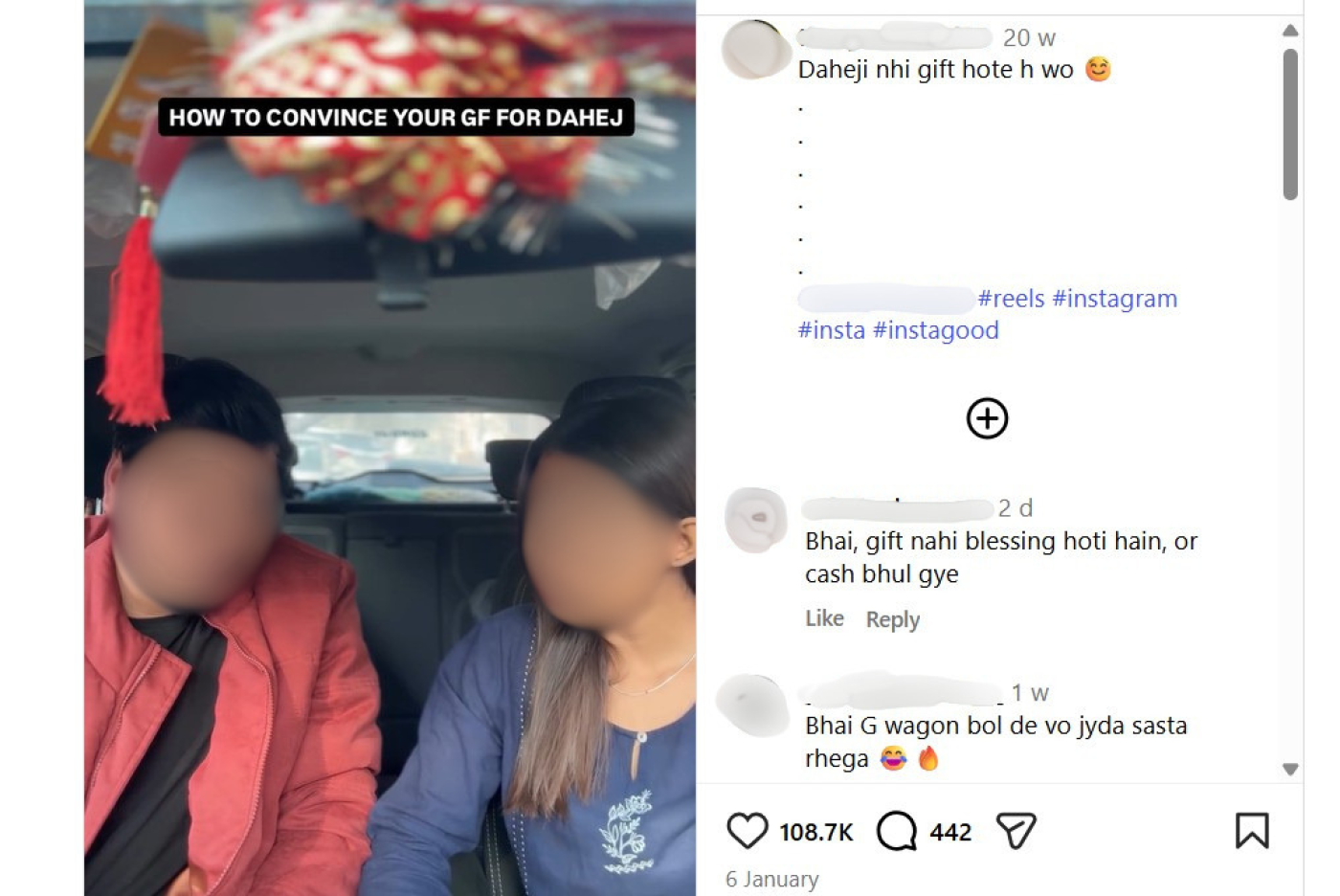
More than 5,700 women reportedly died in dowry-related cases in that single year, according to recently released national crime data. Yet, scroll through social media long enough and one is bound to encounter reels mentioning “gifts” from the bride’s parents, ‘comedy’ skits on how to convince your girlfriend to give dowry, or making thinly veiled references to dowry framed as harmless humour.
The persistence of euphemisms around dowry reflects society’s attempt to culturally sanitise an illegal transaction by embedding it within the language of affection, ritual and family honour. What was once concealed within private negotiations is now openly performed online, often without corresponding social shame.
Some reels go beyond euphemism altogether, openly discussing which cars would make the best dowry gift. In one widely circulated reel, enormous dowry amounts are presented as a comic spectacle, culminating in the line “bta bhai ab bhi love marriage karega? (Tell me, will you still have a love marriage?)”, which frames dowry as desirable social mobility rather than coercion.
Such narratives do not merely trivialise dowry; they reframe it as a marker of prestige, entitlement and familial success. The humour obscures the fact that these “gifts” emerge from a practice historically tied to coercion, financial extraction and gendered violence. Somewhere along the way, the internet appears to have forgotten that even giving a dowry is illegal under Indian law.
Other reels move beyond humour into outright justification. In one reel about “convincing” a girlfriend to agree to dowry in a love marriage, the practice is defended through the misleading claim that daughters are not entitled to their father’s property, reframing dowry as equality rather than extortion. Social media humour normalises the practice by stripping it of moral seriousness. The growing casualness with which dowry is discussed online risks recasting an illegal act as a harmless cultural norm.
The problem deepens because algorithms reward relatability and engagement. Social media platforms do not distinguish between socially harmful content and socially responsible content; they privilege what is shareable and boost engagement metrics. As dowry-related humour becomes increasingly repetitive and viral, an illegal practice risks being reframed as entertainment rather than violence.
The human mind is frighteningly adaptable. Repeated exposure changes perception. Humour, especially when endlessly circulated, softens moral reactions. It lowers resistance. It trains people to stop flinching.
The more such content is consumed, the more desensitised audiences become. Over time, people stop associating dowry with extortion, domestic abuse, abandonment, gendered violence and death. The violence fades from public memory, while the joke remains.
This shift in representation is not insignificant. Thousands of women continue to face harassment, abuse and death in dowry-related cases every year, yet these realities are increasingly absent from the digital imagination surrounding the practice. Instead, dowry is presented online in fragments stripped of context, where humour and familiarity replace moral discomfort.
This amplification loop of creating, sharing and engaging with dowry-related humour trivialises the violent and often fatal realities of the offence. Dowry is not merely an outdated custom; it is a structural form of gendered violence that reduces women’s dignity, security and worth to a financial transaction within marriage.
Humour creates moral distance. People are less likely to critically question something framed as comedy because it can always be dismissed as “just a joke”. That is precisely what makes such content dangerous.
Over time, this trivialisation risks undoing decades of legal and social messaging that sought to stigmatise the practice. When younger audiences repeatedly encounter dowry not as a punishable offence but as meme material and comic relief, the line between cultural familiarity and social acceptance begins to blur.
The persistence of dowry despite decades of criminalisation already demonstrates the limits of legal reform when cultural acceptance remains intact. Social media risks widening that gap further by normalising, aestheticising and rewarding the very behaviour the law seeks to prohibit.
When the social memory of dowry as a punishable offence begins to erode, what remains visible is not the brutality of the practice, but the joke built around it.
(Naina Jacob is a lawyer interested in gender, law and digital culture.)
Get exclusive access to new databases, expert analyses, weekly newsletters, book excerpts and new ideas on democracy, law and society in India. Subscribe to Article 14.