
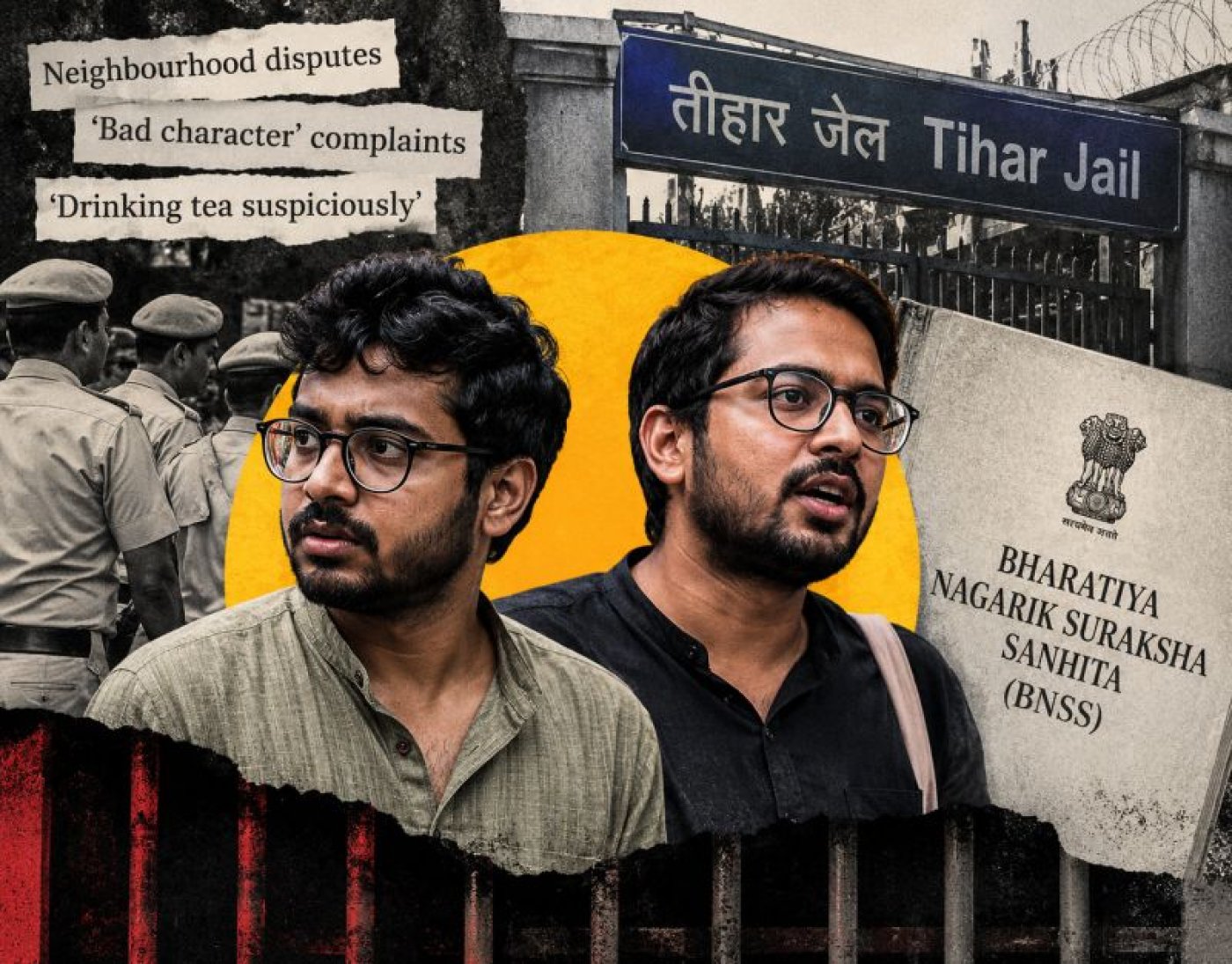
Sydney (Australia): On 14 October 2026, Cockroach Janta Party leaders Saurav Das and Ashutosh Ranka were sent to five days’ judicial custody in New Delhi’s Tihar jail. Their detention followed proceedings under the 2023 Bharatiya Nagarik Suraksha Sanhita (BNSS), after the Delhi Police detained them at the airport on 11 October and required them to sign bonds to keep the peace.
What makes their case notable is who ordered their detention.
It was not a judge or judicial magistrate, but an assistant commissioner of the Delhi police, exercising powers as a special executive magistrate. Another police officer, designated as a special executive magistrate, later extended their custody.
The provisions invoked in their case illustrate how these powers work. Sections 126 and 130 of the BNSS, in Chapter 9, allow a special executive magistrate to require bonds for maintaining peace and good behaviour. Section 170, in Chapter 12, empowers the police to arrest without a warrant or a judicial magistrate's order to prevent the commission of a cognizable offence.
In the National Capital Territory of Delhi, the police are vested with special executive magistrate powers and report to the union home ministry. As a result, police officers can initiate proceedings, exercise executive-magistrate powers, and order people into judicial custody.
The government presented the BNSS as part of its ‘decolonising’ criminal law project. But these provisions largely reproduce Chapter 8 of the erstwhile Code of Criminal Procedure (CrPC), 1973. Section 130 of the BNSS reproduces section 111 of the CrPC and Section 170 of the BNSS reproduces section 151 of the CrPC.
Courts have repeatedly criticised both provisions for misuse.
Other commentators have examined how broadly defined notions of ‘breach of peace’ and ‘good behaviour’ can be used against the right to protest, including in the cases of Das and Ranka (here and here).
I focus on a different question: what happens when police officers themselves exercise the powers of executive magistrates, with consequences for citizens’ liberty?
Reasoned Orders & Application Of Mind
The courts have repeatedly cautioned that these powers must be exercised with care. They cannot be used mechanically or at the magistrate’s whim or “without an application of mind".
In 1970, in Madhu Limaye vs SDM, Monghyr, the Supreme Court considered proceedings against a prominent socialist leader under similar provisions. It held that personal liberty could be curtailed only through due procedure, not at a magistrate’s whim. An order must do more than reproduce information supplied by the police: it must record the substance of that information and demonstrate the framing of opinion by the magistrate.
Courts have also required special executive magistrates (SEMs) to conduct a preliminary inquiry and record the statements of investigating officers and witnesses instead of mechanically accepting the kalandara/police report.
The requirements are not formalities. A magistrate must follow the prescribed procedure and issue written, reasoned orders at the relevant stages of proceedings. Courts have reiterated this in several rulings (here, here, here and here).
In 2018, the Delhi High Court revisited these safeguards in Aldanish Rein vs State of NCT Delhi. The case concerned a person accused of causing a nuisance and demanding money for drugs. The court found that the SEM had simply accepted the police report and sent the petitioner into judicial custody for a period of two weeks.
The Court responded by laying down safeguards, including protections ordinarily associated with judicial proceedings. It reiterated that a magistrate must apply his or her mind and form an opinion before taking action. Recording the substance of the information received is not a procedural box to be ticked; it is a safeguard for personal liberty.
The Court also directed that petitioners have access to a lawyer during remand and to legal aid. Notices outside SEM offices were to explain, in Hindi and English, petitioners' rights and clarify that the SEM was not a judicial magistrate.
Those detained were to be informed, in a language they understood, of the grounds of arrest and their constitutional rights. The court also called for continuing training of SEMs in natural justice and constitutional liberties.
Crucially, the court held that judicial custody under Sections 107 and 151 of the CrPC could not exceed seven days under any circumstances. The magistrate was required to review weekly whether detention should continue.
Failure to follow these safeguards can have consequences beyond invalidating the proceedings. Courts have also held that non-compliance can entitle petitioners to compensation and other legal action against the state.
A Long History Of Abuse
The safeguards are clear, but their implementation is another matter.
In 2008, the Delhi High Court, in Asha Pant vs State of Delhi, found that magistrates frequently issued orders in virtually identical language.
In another case, the Bombay High Court found that an SEM had effectively directed a person to sign a bond instead of issuing a show-cause notice and giving the person an opportunity to respond. The magistrate had failed to provide a proper hearing.
These powers have been used in cases ranging from neighbourhood disputes without giving petitioners incriminating material on which action was initiated to matters where criminal prosecution was already underway in court. Actions have also been initiated against journalists for their investigation or on insistence of local politicians for getting an apology. In one case, the alleged basis for action was sitting at a tea stall and ‘drinking tea suspiciously’.
These examples raise a basic question: how far can preventive powers be stretched before they stop preventing an imminent offence and become an instrument of routine policing?
In Ahmed Noormohmed Bhatti vs State of Gujarat, the constitutionality of the power to arrest under Section 151 of the CrPC, now Section 170 of the BNSS, was challenged. The court held that police could arrest under the provision only when they were satisfied that they could not otherwise prevent the commission of a cognisable offence.
The circumstances of Das and Ranka’s detention raise questions about how the court applied that threshold. The court extended their custody because it could not verify their sureties. They were released only after the court found the sureties satisfactory. Detention, ostensibly intended to prevent an offence, continued instead because the sureties had not yet been verified.
The distinction matters because a power intended to prevent crime cannot become a means of keeping someone in custody simply because the machinery of release has not yet been completed.
The Separation Of Powers
The deeper problem lies in the law's structure. Even when safeguards are prescribed, concentrating police and quasi-judicial powers in the same institution creates conditions in which those safeguards can be undermined.
The Constitution of India distributes state power among the legislature, executive and judiciary. The legislature makes the law, the executive implements it, and the judiciary interprets and adjudicates it. The separation is essential to prevent the concentration of power and protect citizens against arbitrary state action.
In Delhi, however, the police's exercise of BNSS Chapter 9 powers blurs that separation. Police can initiate proceedings and then exercise powers that determine whether a person will be sent to judicial custody, without the kind of independent judicial scrutiny that should accompany a deprivation of liberty.
Aldanish Rein documented the scale of the problem. The Delhi High Court recorded findings by the Delhi State Legal Services Authority that, between July 2017 and June 2018, 14 police officers acting as special executive magistrates received 14,529 kalandras, or police reports, and arrested 23,012 people exercising the powers under section 107/151 of the CrPC. Of those arrested, 6,944 were sent to judicial custody.
That is nearly one-third of those arrested under the provisions. Their cases originated with the police, and the executive-magistrate system also decided to send them into custody, with police officers exercising the relevant powers.
Police officers are not trained as judicial officers to conduct independent inquiries, evaluate evidence impartially and adjudicate competing claims. Yet the provisions allow them to perform quasi-judicial functions with direct consequences for personal liberty.
The police-supplied information risks being treated as sufficient in itself, rather than as material that must be independently examined.
A more fundamental problem remains: It is difficult to ensure independent scrutiny when the officer exercising quasi-judicial powers belongs to the same institution as the officers whose actions are under examination. Article 50 of the Constitution directs the state to separate the judiciary from the executive.
Judges have institutional independence and security of tenure; police officers remain part of the executive. They do not occupy equivalent positions in protecting citizens from arbitrary state action.
Courts have questioned this arrangement for decades. In 1985, the Punjab and Haryana High Court held that these powers should rest exclusively with judicial magistrates, given the trial-like nature of the proceedings.
More recently, the Madras High Court struck down the conferral of executive-magistrate powers on police officers, while the Rajasthan High Court objected to using these powers as ‘routine policing’.
The question is not whether the state should have the power to prevent imminent breaches of peace. The question is whether that power should be exercised through a system in which police officers can initiate proceedings, act as executive magistrates, and order detention, with inadequate independent checks on their decisions.
Repeated judicial warnings, a documented history of routine orders, and the consequences for personal liberty point to a structural problem, not merely occasional procedural lapses.
Safeguards matter, but they cannot fully address the problem if the same institution exercises powers that should be subject to independent scrutiny.
(Surbhi Karwa is a lawyer and graduate of the University of Oxford.)
Get exclusive access to new databases, expert analyses, weekly newsletters, book excerpts and new ideas on democracy, law and society in India. Subscribe to Article 14.