
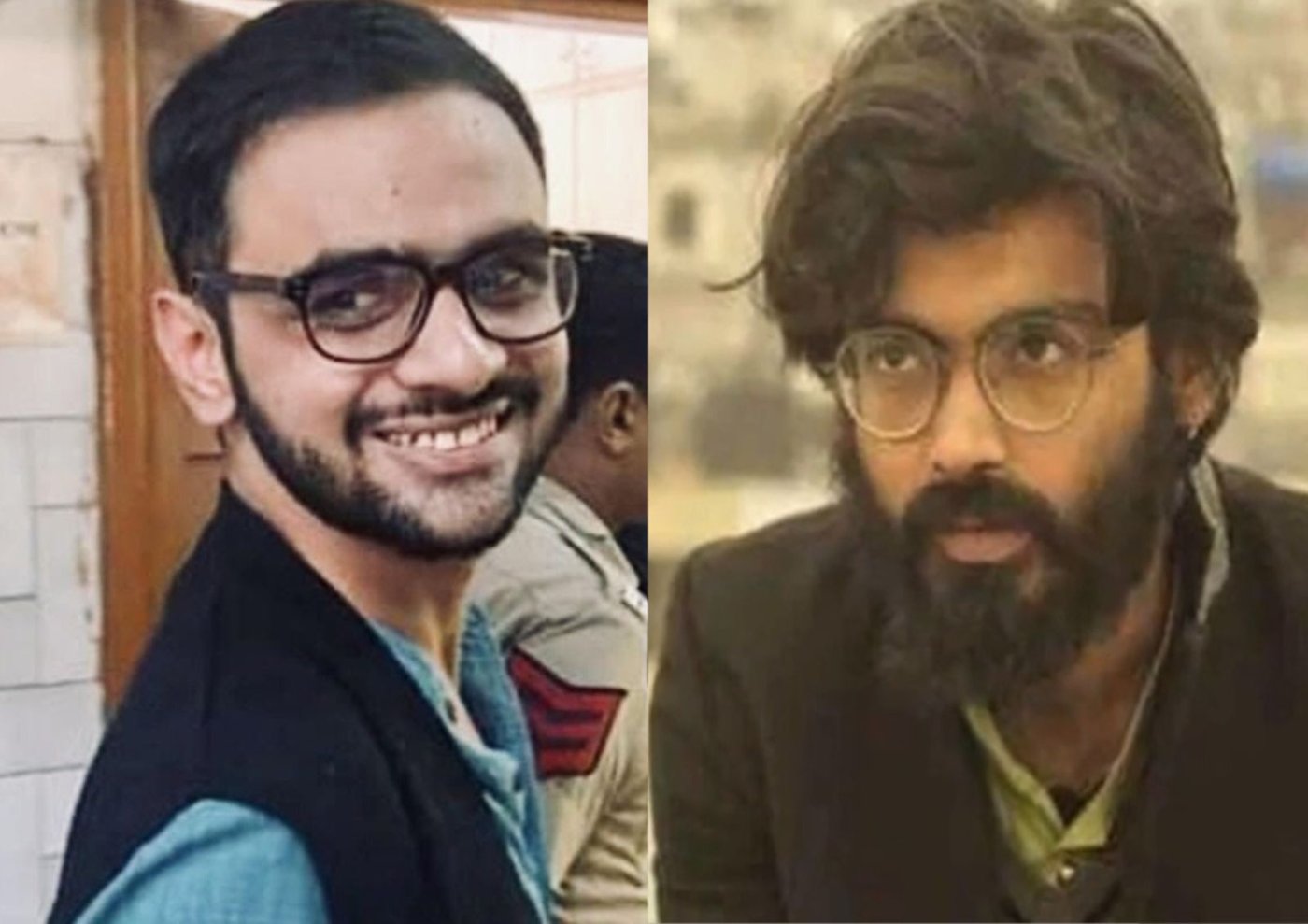
Delhi: Even though the State was caught lying, relied on a discredited witness, and hasn’t produced any physical evidence, the Supreme Court refused bail to Muslim activists Umar Khalid and Sharjeel Imam, who have been jailed without trial for over five years in what the police call the larger conspiracy case of the Delhi riots.
With no reason to find a prima facie case against them, and no credible threat to the police’s protected witnesses if they were released, it seems the Supreme Court is allowing the State to punish Indian Muslims indefinitely for speaking out against Islamophobia and persecution, and for voicing their fears.
Khalid, a PhD from JNU, and Imam, an engineering graduate from IIT Delhi, can renew their bail applications only after the examination of the protected witnesses, or in a year.
That means Khalid, 38, would have spent over six years in jail, while Imam, 37, will be approaching seven years, since he was arrested as early as 28 January 2020 for the speeches he gave against the Citizenship Amendment Act (CAA), 2019.
Perhaps it is not five years, but the passage of six or seven years for Justices Aravind Kumar and NV Anjaria to conclude that the accused have spent an unreasonably long time in custody without a finding of guilt, enough to constitute a violation of their right to life and liberty.
In an extraordinary observation in the bail judgement delivered on 5 January 2025, the judges said they were not persuaded that the “continued detention has crossed the threshold of constitutional impermissibility so as to override the statutory embargo” placed on bail under the Unlawful Activities (Prevention) Act (UAPA), 1967, India’s counterterrorism law.
This way of thinking has profound implications for other cases that rely on fabricated, dubious, or thin evidence. It also raises questions about the Supreme Court’s ability—or willingness—to follow its own more liberal, rights and justice-oriented rulings.
More recent judgments have tried to balance the stringent bail conditions of the UAPA with the right to life and liberty. They have allowed a “surface-level” review of the evidence and granted bail amid long delays, despite the seriousness of the charges.
The State’s lack of seriousness before the Supreme Court and disregard for the lives of the accused were evident when Solicitor General Tushar Mehta initially stated that the trial would conclude in six months, only for Additional Solicitor General S Raju to revise the timeline to two years a few hearings later.
The State’s bias is reflected in the language of its lawyers and the chargesheet, which leans more on rhetoric than evidence and legal arguments.
A good example is Raju’s remark before the Supreme Court that “when intellectuals become terrorists, they become more dangerous than those on the ground”.
It was a remark with no legal relevance, but the judges allowed it.
Even setting all that aside, this is a shoddy criminal case, poorly investigated and deeply troubling in its lack of seriousness. It reflects a shockingly low standard for the police force of the world’s largest democracy and fastest-growing major economy.
There seems to be little interest in uncovering who was actually responsible for the riots that killed 53 people—the vast majority of them Muslim—and far more eagerness to pin the blame on Muslim activists who were involved in the anti-CAA movement.
Even if one were to take the State at its word—that Muslim activists plotted to escalate the protests into violent chakka jams and provoke riots that ultimately left far more Muslims dead, there is nothing in this investigation that actually proves it.
The case hides behind a complicated conspiracy law that’s hard to understand, while the police turn ordinary activities of organising into something sinister and bundle together people who barely even knew each other—some have never spoken—as conspirators.
It isn’t just this case.
In many criminal cases connected to the riots, Delhi trial court judges have dismissed the police investigation in the harshest terms: “absolutely evasive”, “lackadaisical”, “callous”, “casual”, “farcical”, “painful to see” and “misusing the judicial system.”
Yet, none of the police personnel who filed these false cases have faced any punishment.
We reported on one case where the investigating officer framed nine Muslim men, even though Hindu men were the ones who had burned down a Muslim man’s restaurant.
Pointing to the many cases thrown out by lower courts, senior advocate Kapil Sibal, appearing for Khalid in the Supreme Court, said, “If this is what judicial decisions are recording about their conduct, then what authority does this organisation really have—beyond its motive?”
Nothing Qualitatively Different
Of the 53 people killed in the riots, three-quarters were Muslim. Of the 18 people facing charges of terrorism, 16 are Muslim.
On 5 January 2026, Justices Aravind Kumar and NV Anjaria granted bail to five co-accused, taking the total number released on bail to eleven, while rejecting bail for Umar Khalid and Sharjeel Imam because they were “on a qualitatively different footing”.
Other than the prosecution's assertions, there is no basis for claiming this or for finding a prima facie case made out against them and not the others.
Sharjeel Imam is arguably the least connected to the planning of any violence or to his alleged co-conspirators, having been jailed as early as 28 January 2020 for his speeches against the CAA, nearly six weeks before the riots broke out.
Nothing on the record shows that Khalid’s actions were any different from those of many others involved in the anti-CAA movement. It’s therefore difficult to see why he was singled out for arrest, while numerous others who attended meetings or exchanged messages in WhatsApp groups faced no action at all.
As Yogendra Yadav, a prominent political scientist, wrote, “If he (Umar Khalid) is in jail for saying the CAA was anti‑Muslim, I should be too.”
Imam, who has been in jail for nearly six years, has spent the longest time behind bars.
One of the five granted bail by the Supreme Court was Gulfisha Fatima, the only woman still in jail.
The 32-year-old MBA graduate from a low-income neighbourhood was jailed for five years and eight months without bail or trial.
Her bail plea has been pending before the Delhi High Court for three years since May 2022. It was listed 90 times before it was dismissed on 2 September 2025.
A Judge’s Regressive Stand
The Delhi High Court order by Justices Navin Chawla and Shalinder Kaur, which denied bail to nine accused, including Gulfisha Fatima, Umar Khalid, and Sharjeel Imam, cited a 2024 judgment by Justice Aravind Kumar, the Supreme Court judge who rejected bail for Khalid and Imam on Monday.
Kumar, a former Chief Justice of the Gujarat High Court, the home state of Prime Minister Narendra Modi, took a conservative, arguably regressive, view on bail under the UAPA, especially compared with other recent judgments that have tried to balance the stringent bail conditions of the UAPA with the right to life and liberty. These more liberal rulings have allowed a “surface-level” review of evidence, and granted bail even amid long delays despite serious charges.
However, Justice Kumar, in Gurwinder Singh vs State of Punjab, said that the conventional bail principle—“bail is the rule, jail is the exception”—does not apply to the UAPA and delay in trial does not alone justify bail.
In denying bail to Khalid and Imam, Justice Kumar echoes his past judgment, saying that the prosecution’s material has to be taken at face value, and delay cannot serve as a “trump card that automatically displaces statutory restraint.”
Justice Kumar also said that a terrorist act does not only mean death or destruction of property, but also acts which disrupt supplies or services essential to the life of the community, as well as acts which threaten the economic security of the nation.
In its final round of arguments before the Supreme Court, which was the last chance for bail in the foreseeable future, the State tried to widen the scope of the case, recasting it from one about communal riots into an alleged plot for regime change, the severing of the Northeast from the rest of the country, and the economic strangulation of Delhi and Assam.
These claims were never part of the case’s core allegations.
Instead of questioning the State about trying to widen the case, Justice Kumar appears to have bought into it.
Arguing for Gulfisha Fatima, senior advocate Abhishek Manu Singhvi told the court, “It was never the prosecution’s case that the protest was to bring about regime change. This allegation of a pan-India conspiracy is quite extraordinary.
“What kind of criminal prosecution are these generalities? The object of prosecution cannot be to keep me inside by hook or crook,” said Singhvi.
Why They Should Be Granted Bail
For the past four years, we have reported how the so-called conspiracy case is built on demonstrable conjecture, inferences, fabrications and the dubious testimony of secret witnesses to fit a predetermined narrative of blaming the riots on the Muslim activists who protested the CAA.
The WhatsApp groups they describe as central to the alleged conspiracy had dozens of members, any of whom could have raised the alarm if there had been wrongdoing at the time.
The so-called secret meetings were openly shared on social media and attended by many people, including some who later became secret witnesses. If there had been real wrongdoing, they could have raised concerns at the time. Instead, they came forward months after the riots, offering nearly identical accounts to the police.
There is nothing in Khalid’s speech that needs defending. He said Mahatma Gandhi’s weapons were non-violence, civil disobedience and non-cooperation.
This is the only speech the police use to call him the “mastermind” of the riots. It was given in Maharashtra on 17 February 2020, a whole week before violence broke out 1,500 km away in Delhi.
When the first information report (FIR) was registered on 6 March 2020, the police had access only to fragments of the speech circulated in a tweet by the head of the BJP IT cell with the message, ”Was the violence in Delhi planned weeks in advance by the Tukde Tukde gang?”, and amplified by pro-government television channels.
They only obtained the whole speech in July, five months after the FIR was registered in March 2020.
One key meeting that is supposed to prove the conspiracy appears to be made up. Still, the police keep citing it in different courts.
The police claim that on 8 January 2020, Khalid and two co-accused met to plan riots to coincide with President Trump’s visit. But it later emerged that the visit was not even a matter of public record at the time, let alone its dates.
A trial court judge in another case also tore apart the witness’s testimony for this meeting, granting bail to Khalid and a co-accused, and eventually discharging them altogether.
Khalid’s lawyers have pointed out that mobile phone location data showed the three men were never in the same place at the same time.
Imam was jailed six weeks before the riots even erupted.
Yet, instead of noting the lack of evidence against him, the judges seem to focus solely on his somewhat unpalatable speeches.
He has been reduced to a single line in which he called for mainland India to be “cut off” from the Northeast.
That too is arguably protected under the fundamental right to free speech—a right the Supreme Court has upheld even at the height of the Khalistan movement.
The courts have regressed a long way since June 2021, when the Delhi High Court, while granting bail to three co-accused, said quite categorically that chakka jams were not terrorism, no prima facie case of terror was made out, and the state had blurred the line between protest and terrorism.
Justices Siddharth Mridul and Anup Jairam Bhambani said that “shorn-off the superfluous verbiage, hyperbole and the stretched inferences”, there was no case made out under the UAPA and that “making of inflammatory speeches, organising chakkajams are not uncommon” when there is widespread opposition to the government.
(Betwa Sharma is managing editor of Article 14.)
Get exclusive access to new databases, expert analyses, weekly newsletters, book excerpts and new ideas on democracy, law and society in India. Subscribe to Article 14.