
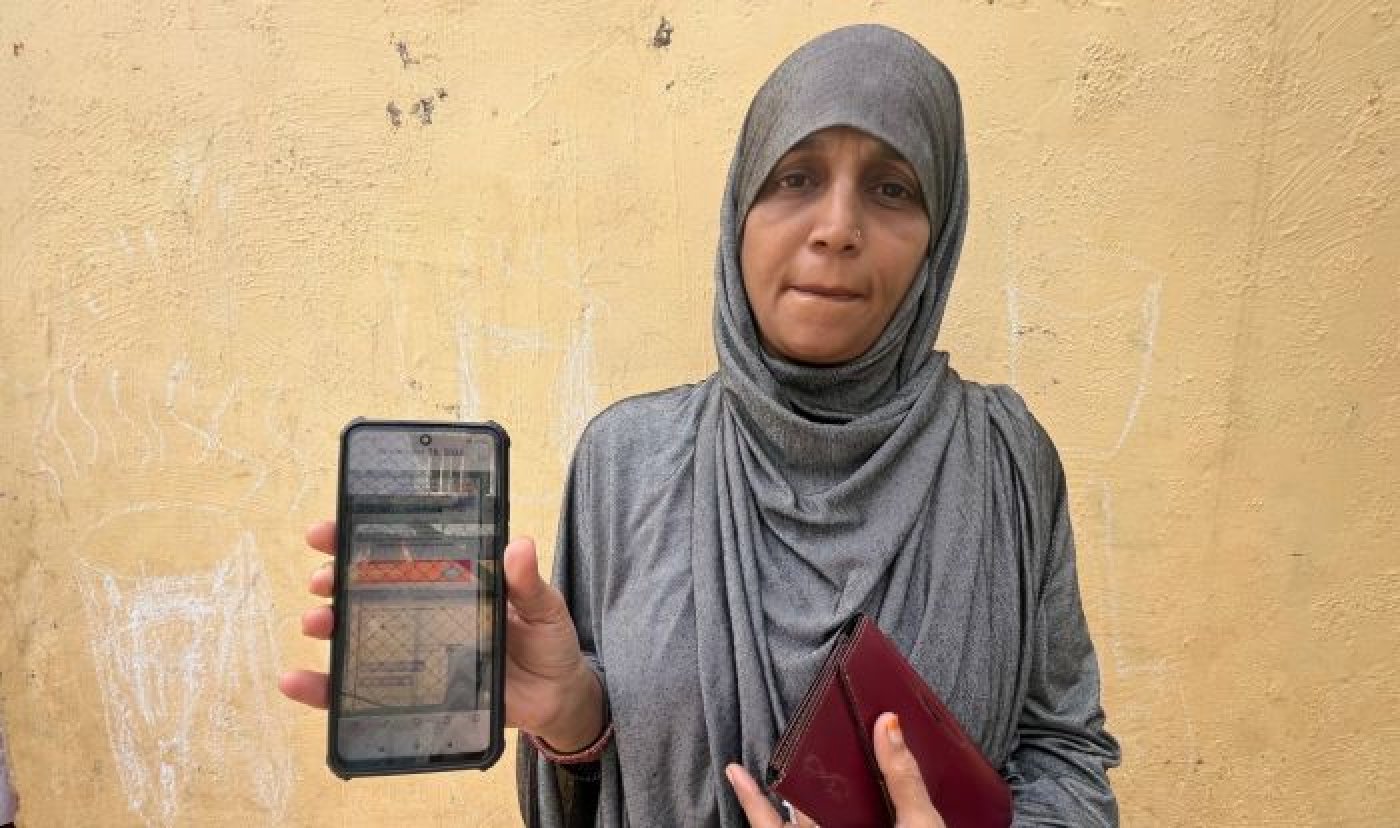
Mumbai: Noorjehan Ilyas Shaikh, 46, has never missed voting. If her family was on vacation at poll-time, they would always hurry back.
Confident that her inclusion in the electoral rolls during the ongoing special intensive revision (SIR) was a foregone conclusion, she checked the draft roll for Maharashtra several days after it was published on 31 August.
“The roll claims I am ‘permanently shifted’, even after I received a signed acknowledgement from the booth-level officer (BLO) that my SIR form is submitted,” she said.
Noorjehan Shaikh, a booth-level agent for the Congress party in Malvani, had received no notice about any discrepancy in her name or address or age. When she tried to reach a senior official through her BLO, she said the official responded that if she hadn't received a notice, she would simply have to wait.
“Public pareshaan hai (citizens are worried),” the confident and articulate mother of two told Article 14. “This wilful negligence by the BLOs is not seen in other areas.”
Across the dense slums in Old Collector Compound, New Collector Compound and Ambujwadi in Malvani, all localities with a large Muslim population, scores of residents have found themselves declared ‘absent’ in Maharashtra’s draft electoral roll despite having submitted SIR forms with their voter card numbers filled in, their Aadhaar details, a mapping of their names on the 2002 rolls and their parents’ voter card numbers.
“If there was an error, we should have got a notice,” said Mir Hasan Ansari, 50. “How can we have a form signed by the BLO acknowledging we submitted an enumeration form and then find ourselves declared absent?”
More than 21%, or one in every five, of Maharashtra’s voters from the previous rolls were excluded from the new draft electoral roll, “as their enumeration forms were not collected”, according to Maharashtra’s chief electoral officer (CEO).
The reasons—the voter was “absent / not found” at the place of residence, had shifted elsewhere, was dead, enrolled elsewhere, or was a duplicate entry. ‘Other’ reasons included refusal to fill and submit the enumeration form, the CEO said.
However, in bylane after crowded bylane on a sweltering October mid-morning in Ambujwadi, residents displayed acknowledgment signatures received from the BLO on copies of their submitted enumeration forms before they found themselves in the “absent, shifted, dead, duplicate, other” or ASDDO category.
With nearly 50,000 people, Ambujwadi’s brick-and-masonry homes rise close together, tin roofs jutting above narrow lanes in a settlement where generations of the poor have made a life for themselves in Mumbai. The largely migrant population has scrambled in recent months to retrieve documents and establish their bona fide status multiple times. The SIR exercise coincided with the Census and a prospective Slum Rehabilitation Authority (SRA) scheme, creating a cumulative burden of documentation and paperwork to establish eligibility and domicile.
“It appears that the BLO accepted the enumeration forms but failed to have them uploaded,” said Nackson Natke of neighbouring Madh, who was also deleted along with his son, while the rest of the family’s names were retained. Natke, now 67, said he has never missed an election since he turned 18.
“Now I was asked to fill Form 6, for first-time voters.”
Meant for enumeration of citizens recently turned 18 years of age or about to reach voting age, Form 6 includes a declaration stating the applicant is seeking inclusion in the electoral roll for the first time, and that his or her name is not included in the rolls for any Assembly or Parliamentary constituency.

“I am aware that making the above statement or declaration in relation to this application which is false and which I know or believe to be false or do not believe to be true, is punishable under section 31 of Representation of the People Act, 1950 with imprisonment for a term which may extend to one year or with fine or with both,” the form states.
“The BLO asked me to simply cross out that portion, sign it and submit it,” Natke said. He did.
Migrants Fear Being Forced Out
When the SIR enumeration forms were being collected in July 2026, Mir Hasan Ansari was in his native village in Nuaon, in Bihar’s Kaimur district, along the state’s western border with Uttar Pradesh, a hub of out-migration for decades.
After last voting in his native village in 2002, he and his wife visited the local BLO, found their names still listed on the roll, and submitted paperwork to have them deleted. “Then we returned to Mumbai and submitted our SIR forms here,” he said.
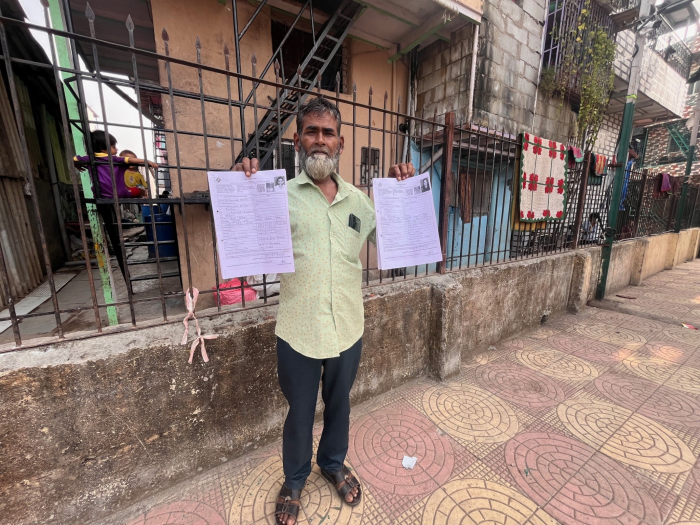
There was a spelling error in his name on the Nuaon voter list. “If there was an error or other discrepancy here, why didn’t we get a notice?”
A neighbour, half-joking, interjected that the Bihari couple would have to go to Bangladesh. “Uske liye bhi toh notice milna chahiye (that process also includes being issued notices first),” said Ansari, a worker in a plastic manufacturing unit.
For families who trace their origins to West Bengal, the deletions carried an additional anxiety.
A slightly built woman, Arifa Bibi Sardar refused to laugh at the deportation-to-Bangladesh jokes. In her fifties, she said there was no reason why her son Abdul Hamid Sardar, 28, was deleted from the rolls.
“He is also shown as absent,” she said, “but all our forms were submitted together.” Like most others, she had an acknowledgment on a copy of her son’s enumeration form, dated 18 July. Abdul Hamid was himself away at work, doing odd jobs at a bank.
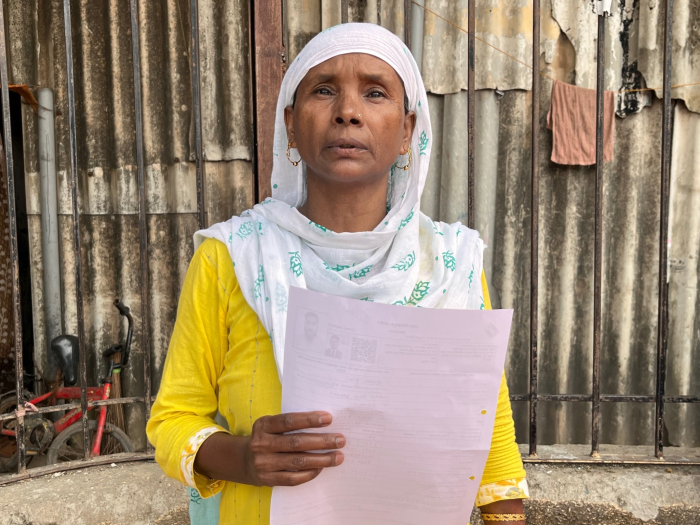
She and her husband, belonging to Swarupnagar in West Bengal’s North 24 Parganas district, have lived in Mumbai for 32 years, moving from Malvani to Ambujwadi over a decade ago for a cheaper rental home.
“Why is the government making us run around like this?” she said, eyes flashing. “Do they want to label us Bangladeshi?”
Majibunissa Shaikh of Sitamarhi in north Bihar has lived in Ambujwadi for two decades. While she made it to the rolls, her husband Lalmohammed Idris Shaikh, who had been able to vote in the 2024 Parliamentary and Assembly elections, was deleted in the draft roll, though both their SIR enumeration forms were submitted the same day.
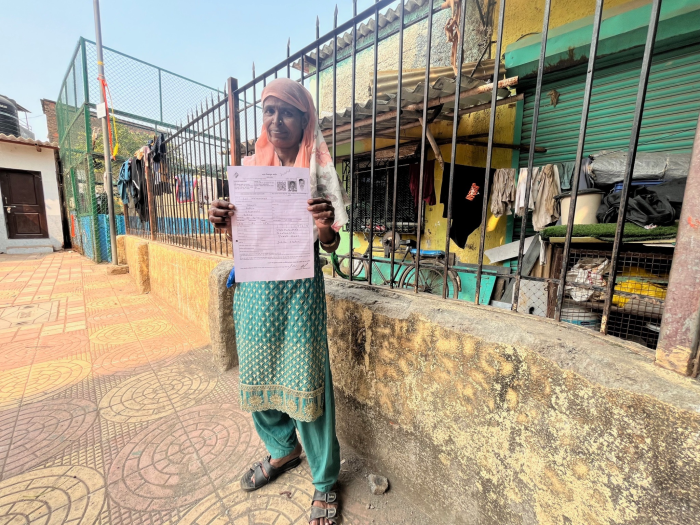
The omissions left the family worried about their citizenship. “Hum vote nahin kar sakenge toh yahan rehne ke liye darenge (If we can’t vote, we’ll be afraid about being allowed to live here),” she said.
Official Assurances Vs Ground Reality
In early October, responding to directions from the Election Commission of India to counter complaints of widespread exclusion from the rolls, the Maharashtra CEO's office promised that no eligible voter would be left out of the electoral rolls.
A series of measures announced included house-to-house visits to identify eligible voters missing from the draft roll, special registration camps at polling stations, and help desks for vulnerable groups, including workers, economically disadvantaged people, homeless persons and orphans.
Voters who received notices for ‘no mapping’ or ‘logical discrepancy’ during the electoral roll revision will not be required to appear personally. BLOs would visit such voters' homes to collect the required documents, the CEO’s office said. The assurances followed complaints about the scale of deletions and the difficulties voters faced in seeking resolution.
In Malvani, however, residents described a system in which reaching officials responsible for resolving their queries was itself a challenge.
“We requested the BLOs so many times to be present for just one or two hours daily at a local school,” said a party worker. Most BLOs don’t have time because they work regular jobs as municipal or government staff, they found. A few residents had WhatsApp chats with BLOs, in which the latter grumbled about having regular jobs in addition to the burden of their SIR responsibilities.
“Three or four BLOs have not been available from the beginning of the process,” said Natke, a resident of Madh.
Another resident whose sister’s name was deleted said that after repeated requests to his assistant electoral registration officer (AERO), he was asked to submit his documents to an officer whose display photograph on WhatsApp had him posing with the Mumbai North Member of Parliament from the Bharatiya Janata Party and union minister for commerce and industry, Piyush Goyal.
“How would we trust such a person to not be partisan in an area like ours?” he asked.
In Ambujwadi, Najosan Banu Shaikh, originally from Jaunpur in eastern Uttar Pradesh, claimed one official she spoke to asked for Rs 2,000 to restore her name. Article 14 could not independently verify the allegation.
“I might have paid up if it was Rs 500,” she said. Her name was deleted, placed in the ASDDO category, though she submitted her form. “Our names were deleted in Jaunpur, we made sure of that,” she said. “And now my name is deleted here too.”
The gap between official assurances and on-the-ground experience was compounded by practical difficulties.
Ambujwadi and Collector Compound are 6 km from the Liberty Garden municipal office. From Madh, it is almost 10 km. Residents said a trip to the office would cost half a day’s work and wages, so if they were asked to come back another day, many simply could not afford it.
“We requested the election officials to keep BLOs at the polling booths, the AERO could also be made to sit somewhere nearby,” said Natke. “Now we have just empty promises of door-to-door visits.”
A Question Of Identity
For Irfan Akram Khan, 35, deleting his name was particularly troubling because he is an orphan.
His father died of cancer when he was a year old, his mother a few years later. Both names are now deleted from the rolls. With no grandparents whose electoral records he can use to establish the family’s presence in earlier rolls, Khan said the loss of the right to vote felt like being uprooted.
“As an orphan,” he said, “what proves my identity now?” People view Muslims who don’t have voting rights with suspicion, he said.
His brother made it to the rolls after mapping the family’s listing in the 2002 rolls online before his father’s name was deleted, said Khan, who works at a pizza parlour.
Khan submitted his enumeration form offline and received an acknowledgement, but later found his name omitted, in the ASDDO basket.
His uncle, Mohammed Akhtar Hussain, 59, was also dropped from the draft roll, along with his wife, Farzana. Both voted in the 2024 elections. Both have now filled out and submitted Form 6, despite voting in almost every election over the past four decades.
Akhtar Hussain used to own a popular provision store near Collector Compound—almost everyone in the locality knows him.
Mohammed Akhtar Hussain and his wife, Farzana, show copies of Form 6 they filled out and submitted. The form is meant for first-time voters, but the couple said they voted in almost every election for four decades.
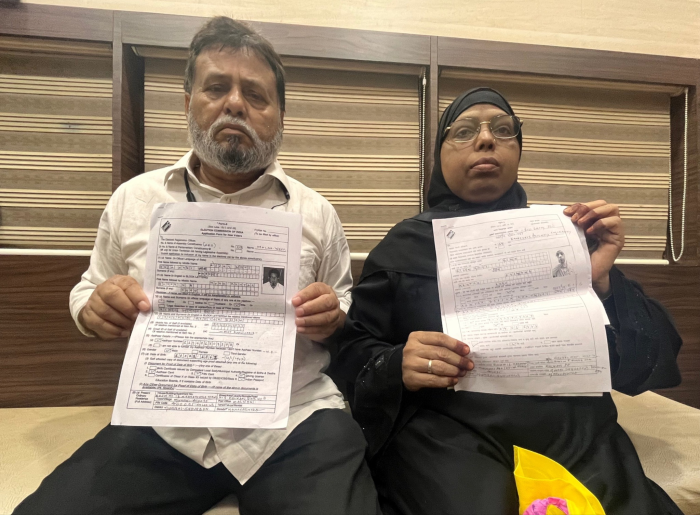
The family described a demolition of about 100 shanties in the vicinity earlier in 2026, when officers and politicians claimed residents could be “ghuspetiya” (infiltrators). “All these problems with the SIR are occurring on one side of Mith Chowki,” he said. “On the other side, there are no such problems.”
The Malad West Assembly constituency is loosely seen by local residents as divided into the more Muslim-dominated localities around Malvani, and the more Hindu upper-class localities at the other end.
The couple and their nephew were also asked to hand over the acknowledgement copy of their enumeration form when they approached the BLO to enquire about next steps, and were now worried that they were left with only a soft copy or photograph of their original SIR enumeration form.
Others found the SIR documentation demands added to already complex household struggles with official paperwork.
With his 17-year-old son set to appear for a key engineering entrance exam, Sameer Hasan Shaikh was already in the midst of obtaining domicile certificates to show his residence in Maharashtra for at least 15 years when the SIR enumeration forms arrived. He downloaded an extract from the ECI website showing their names in the 2002 electoral roll.
The rest of his family made it to the draft roll, but Sameer Hasan Shaikh was marked “untraceable/absent”. His wife Shaheen said she was terrified at political speeches calling millions of Indians “ghuspetiya”.
“How will we prove we are Indian if we can’t vote?” she asked. People are wary, she added, on account of having seen the widespread disenfranchisement in West Bengal ahead of the election there in the summer of 2026 and the earlier tensions during the Bihar SIR.
No Alternative & No Action
Shahnaz Begum, 27, was born in Bandra but moved to Ambujwadi in 2008. A product of a Brihanmumbai Municipal Corporation school, she said she had voted twice since getting her voter card made.
After being dropped from the electoral roll, she said establishing her eligibility may not be difficult, but the BLO had no solution besides asking her to fill Form 6. “I have all the documents,” she said, “but I am not a first-time voter.”
Shagufta Imran Mansuri, a resident of the Marve Road area in her 40s, was also omitted. Her husband had made it to the draft roll; a mismatch in her father-in-law’s name was corrected; and both her parents made it to the draft roll in Sewri, in central Mumbai. They also corrected an error in her mother’s name.
“So I was shocked when I checked the app and found my name was shown as being in the ASDDO category,” she said.
Mansuri had voted several times and had submitted her enumeration form on 17 August.
She said officials needed to examine responsibility for such deletions. ”The immediate response from officials is to ask people to fill Form 6, but there should first be an explanation of how the omission occurred, right?” she asked.
For Noorjehan Shaikh, the Congress party agent in Ambujwadi, the SIR chaos in the slum colony is part of a wider failure by BLOs to carry out their responsibilities.
“This wilful negligence by the BLOs is not seen in other areas,” she said, referring to the problems she had encountered in Malvani. She said BLOs often don’t receive phone calls, they don’t call back, and they are not available at any particular time in an office.
Married to an autorickshaw driver, the mother of two managed to get an error in one son’s name rectified. The second son will turn 18 soon.
“We know exactly what problems arise in the verification process,” she said about her work assisting citizens through the SIR. “We also know what problems are deliberately created.”
(Kavitha Iyer is a senior editor with Article 14 and the author of ‘Landscapes of Loss’, a book on India’s farm crisis.)
Get exclusive access to new databases, expert analyses, weekly newsletters, book excerpts and new ideas on democracy, law and society in India. Subscribe to Article 14.