
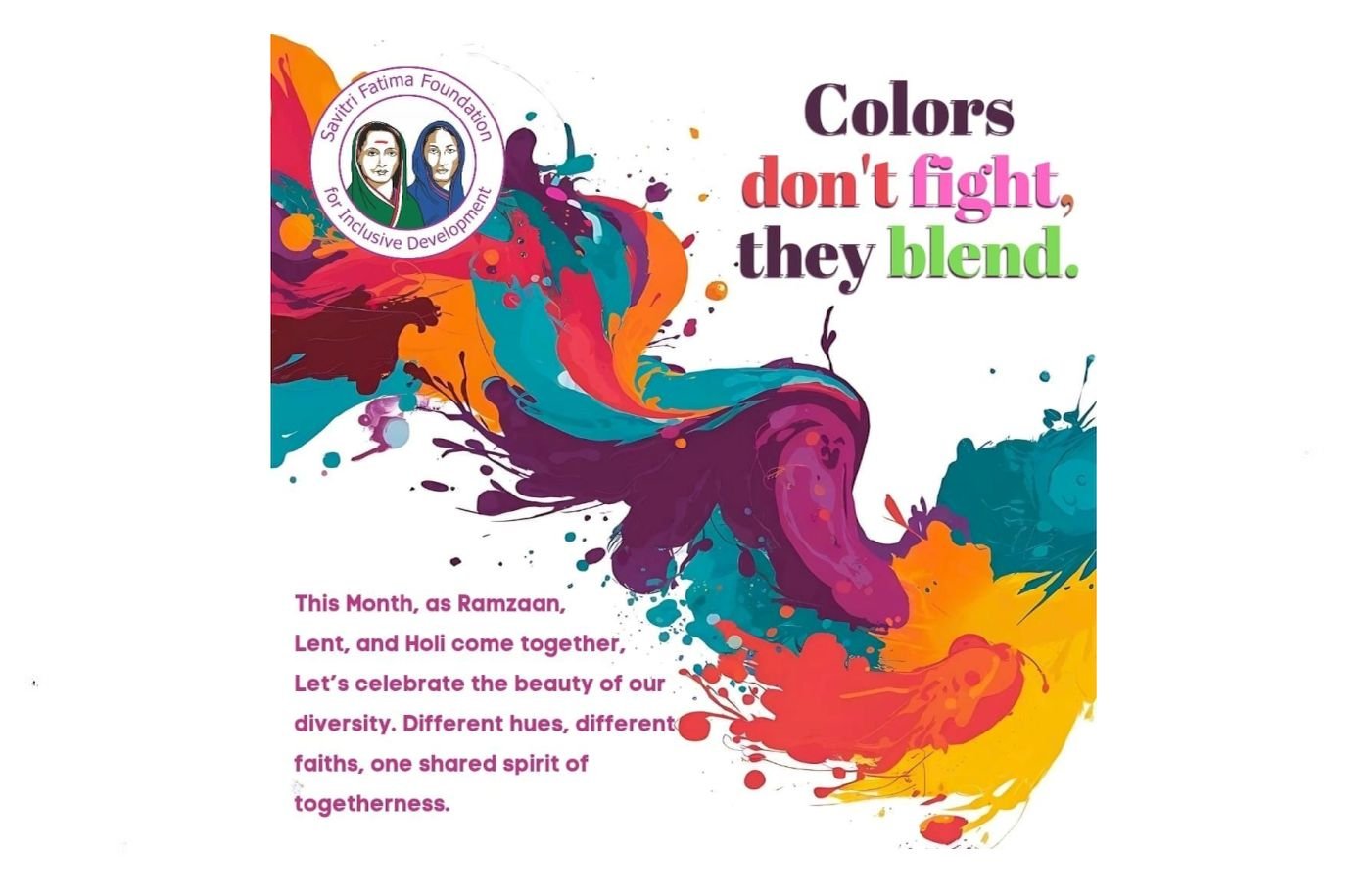
Mumbai: Next weekend, I will attend an iftar gathering. Not just any iftar, but a Rang-e-Iftar, a coming together of Rang Panchami and Ramzan, celebration and spiritual pause.
The invitation came from Sabah Khan, a friend and feminist activist who founded Parcham in a ghettoised far suburb of Mumbai called Mumbra in 2012 to challenge stereotypes about women, and particularly about Muslim women. This year’s gathering will be hosted by Guftagu, a local women’s collective that works on livelihood generation, but also on the more elusive leisure, joy and solidarity among women.
I attended Sabah’s iftar last year too, organised under her latest social initiative, the Savitri Fatima Foundation For Inclusive Development. In an extraordinary coincidence, it was held in my first alma mater, a quiet convent school tucked into a Wadala lane in central Mumbai, surrounded in those days by informal settlements.
At the 2025 iftar, the school’s nuns organised games so that strangers could get to know one another before breaking bread together.
A banner on the stage said, “Aisa Bharat Banayenge”, the India we shall build. Just before the food arrived, on a concrete stage where I had led countless morning assemblies three decades earlier, a young man came to the microphone. The quadrangle fell silent as his call to prayer rose into the evening air.
I had heard the azaan from a nearby mosque every single school day, and pretty much every day since, and yet this moment felt radical. Little had changed in the school building, but little was the same around us.
Barely 30 metres away stood the school’s grotto and its resident Virgin Mary. Beyond her lay the wall from where we heard screams and shattering glass one afternoon during the 1992–93 Bombay riots. In Class 8, I barely understood the portents of that violence, but I knew the times were not free of fracture.
That is why the azaan that evening felt so charged. The world outside is a great deal more brittle now, and an everyday occurrence was rendered extraordinary by the setting—in such polarised times, inside a convent school.
Rang-e-Iftar this year will likely evoke the same feeling.
Ram Navami will be here soon, a festival that in recent years has sometimes been marked by religious processions moving through Muslim neighbourhoods with weapons on display and incendiary slogans in the air.
Around other festivals too, tensions have spilled into confrontation. On Christmas Eve 2025, hours before Prime Minister Narendra Modi visited a church, groups of men armed with sticks stormed a shopping mall in Raipur, vandalising decorations and disrupting celebrations. Research by India Hate Lab, a project of the US non-profit Center for The Study Of Organised Hate, recorded more than 1,300 hate speech events across India in 2025—an average of over three a day—most targeting Muslims.
In such a landscape, gestures that once passed without remark begin to appear extraordinary. In Uttarakhand’s Kotdwar, Deepak Kumar intervened when activists harassed a Muslim shopkeeper over the name of his tailoring store. In Telangana, after a mosque was vandalised, a Hindu businessman publicly stepped forward to support its restoration.
Supporting a neighbour, standing up to intimidation, offering help after violence, all foundations of any functioning society, now acquire the aura of bravery in our times. The moral baseline has shifted so dramatically that decency itself appears exceptional.
Sabah and I belong to the last generation of Indians that carries memories of shared festivals that were quite unremarkable for being so. Encountered only as an abstract value, pluralism is dead on arrival; it was always through repetition, habit and memory that syncretism survived. An entire generation of Indians is now entering adulthood without that experience.
That is why gatherings like Rang-e-Iftar are more powerful than they appear.
They reset the moral baseline. When cross-cultural and inter-faith mixers let people experience ease and familiarity, they remind participants what should be normal, and how far public discourse has drifted from it. Such settings restore a sense of the ordinary, the ease of being together without anxiety, and in doing so, remind people that the distance between communities is neither inevitable nor natural. They also resist narrative capture.
When communities are viewed with suspicion and stereotype, mixed encounters reject those simplifications. People become harder to reduce to categories once you have shared a memorable meal with them.
Festivals are cultural and religious observances, but they are also social infrastructure. Particularly in India, festivals enable communities to visibly occupy public space, with music, colour and processions. Who occupies the street, who feels welcome there, who must retreat indoors, these are questions of power as much as celebration.
Rang-e-Iftar represents a counter-claim to that space, where people gather across faith lines not merely to share food, but to reclaim the idea that public space belongs to everyone, that coexistence is normal.
Sabah’s invitation offers one of the most tangible ways to experience otherwise abstract constitutional principles of fraternity, equality and the freedom to practise one’s faith without fear. Rang-e-Iftar will be an act of democratic repair, a reminder that coexistence was never radical, just ordinary life, and that what has been forgotten can still be practised again.
(Kavitha Iyer is a senior editor with Article 14 and the author of ‘Landscapes of Loss’, a book on India’s farm crisis.)
Get exclusive access to new databases, expert analyses, weekly newsletters, book excerpts and new ideas on democracy, law and society in India. Subscribe to Article 14.