
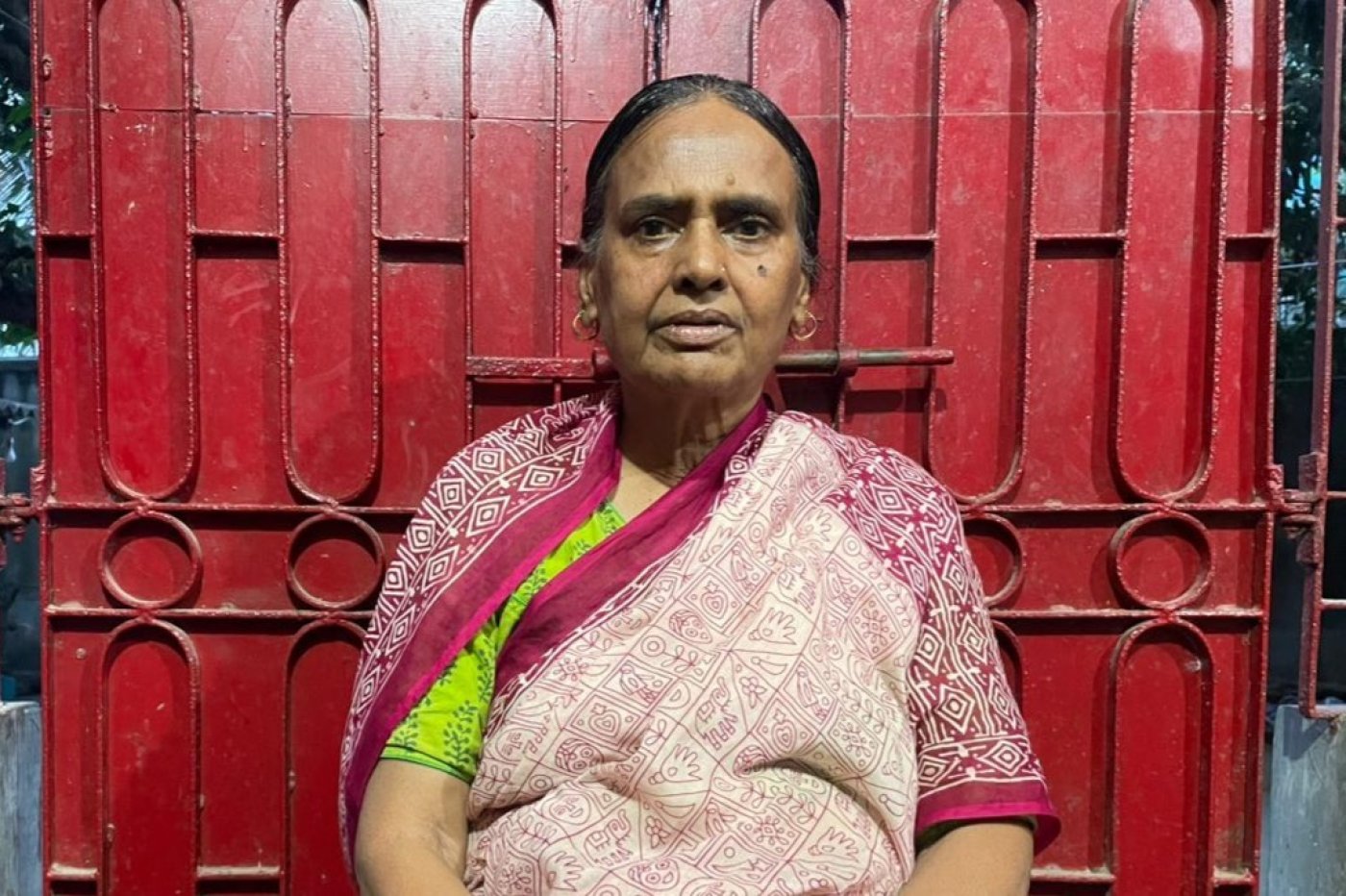
Kolkata: In 1999, Mohua Islam, 55, and Abdul Gani, 66, named their daughter Amrita Priyadarshinee. They never imagined that her name would lead to her inclusion on electoral rolls being questioned.
A gold medalist in biophysics, the 26-year-old, lively, thoughtful young woman, was preparing for government exams when the booth-level officer informed her in December 2025 that she had been summoned to a hearing.
The notice puzzled her. She had been a voter for seven years, voting in the 2019 and 2024 parliamentary elections and the 2021 state assembly election.
“I just want to understand why I was summoned,” she said. Priyadarshinee visited the hearing centre carrying every document she could think of. “I submitted my passport and Aadhaar card along with my father’s documents. Still, I was told my case is under scrutiny.”
“I kept asking them what the problem was,” she said. “No one answered.”
Her parents, Islam, a school teacher, and Gani, a retired professor, were also confused. “Naming her Amrita Priyadarshinee was simply a personal choice,” said Gani. “My wife also does not share my surname. Even if we named our daughter Margaret Thatcher, how could that be a reason to question her citizenship?”
Priyadarshinee also suspects the issue may stem from her not sharing her parents' surname. “When my parents' records are fine, they were not summoned, and I have been mapped through them, how could I be at fault?” she asked. “There are many people in the world who do not have surnames.”
Priyadarshinee is still waiting to learn whether she will remain on the voters’ list.
The booth-level officer, a designated representative of the Election Commission of India who works at the local level, offered a possible explanation. He suspected the problem might lie in the digital system used during the voter revision. “If someone does not share a surname with their parents, which is quite uncommon here, the AI system might flag the entry.”
Millions Of Voting Rights At Risk
Priyadarshinee’s story is not an isolated case. Across West Bengal, millions of voters have found themselves caught in similar situations after the state underwent a massive electoral revision.
Nationwide, 70 million names have been removed from a controversial special intensive revision (SIR) of voter rolls, as the project is officially called. The legality of the SIR is currently being contested in the Supreme Court, which is monitoring the West Bengal revision.
The revision has removed or placed under judicial scrutiny more than 12 million voters, nearly one in six electors in the state. West Bengal is the only state where 6.01 million voters remain “under adjudication”, meaning the election authority is still verifying cases before deciding whether to keep or delete their names from the voter list, even after release of the ‘final’ electoral roll on 28 February 2026.
Our reporting for the story uncovered four key patterns:
- Nine of 10 districts with the highest number of voters under adjudication have a Muslim voter population of 50% or more.
- Murshidabad, where Muslims account for 66% of the population, has the highest number of voters, 1.10 million, under adjudication. Similarly, Malda, 51% Muslim, has 0.83 million voters under adjudication, and North 24 Parganas, 26% Muslim, has nearly 0.59 million voters awaiting decisions.
- Women appear to have been deleted from the rolls at a rate 7.1% higher than men.
- Technological errors and bureaucratic inconsistencies appear to have trapped many legitimate voters in verification loops.
Across the state’s 23 districts, the electorate declined from 76.6 million registered voters to 70.8 million in the first draft released on 16 December 2025—a 7.6% decline. Two months later, the final roll recorded a further dip to 70.46 million, taking the overall reduction to 8.3%.
‘Detect, Delete, Deport’
India’s election process has come under increasing scrutiny over the past decade. An October 2025 Article 14 analysis shows three fault lines—tampering with electoral rolls, manipulation of the voting process, and skewed vote counting—fuelled by partisan misuse, opaque systems, and an Election Commission increasingly unaccountable following new legal immunities.
On 19 March 2026, West Bengal chief minister Mamata Banerjee issued a long post on X, repeating a now-common Opposition allegation that the Election Commission was biased, in this case by a purge across four days, beginning late night on 15 March, of the state bureaucracy, transferring 50 senior officials, including the state police chief and the home secretary.
“The manner in which the Election Commission has singled out and targeted Bengal is not just unprecedented—It is deeply alarming,” wrote Banerjee. “This is not administrative action rather this is political interference of the highest order.”
“The systematic politicisation of institutions meant to remain impartial is a direct assault on the Constitution,” wrote Banerjee. “At a time when a deeply flawed SIR process is underway and over 200 lives have already been lost, the conduct of the Commission reflects a clear bias and an uncomfortable submission to political interests, continuing to put the people of Bengal at risk.”
While those whose names have been deleted can apply for re-registration, voters under adjudication remain suspended without recourse, their citizenship in doubt. In January 2026, the Election Commission told the Supreme Court that citizenship checks were limited to voter registration, not deportation.
Yet, in Parliament, on 10 December 2025, home minister Amit Shah, defending the SIR, said his party intended to use it to “detect, delete and deport”.
On 21 March, as the Commission constituted 19 tribunals to hear “doubtful” cases under adjudication in West Bengal’s SIR, The Times of India reported that the “implications are much more than not being able to vote”.
“If the tribunals rule them as ineligible to be in the roll—essentially for being non-citizens—they will have to be confined to detention centres and deported to their country of origin,” according to The Times of India.
The Algorithm Problem
Many officials in West Bengal privately attributed the chaos of the SIR to the digitisation of electoral rolls.
For decades, electoral rolls were maintained through handwritten registers. During the SIR, these records were transferred into a digital system using automated software tools. The process was meant to improve accuracy; instead, in many cases, it created new errors.
“I think the main problem is the use of artificial intelligence,” Priyadarshinee’s booth level officer, who asked not to be named, said. “When manually documented data is transferred into digital systems, the software sometimes can not understand ambiguities.”
Rejanul Karim Tarafdar, 62, discovered that his name had been distorted by a technological glitch when he checked his entry in the electoral database.
Tarafdar had once served as the secretary of the West Bengal Madrasah Board and had helped oversee elections for nearly a decade. Yet his name appeared in the system as “Rejanul Karim Tarafdar pata Abdul Naim Tarafdar.”
The word “pita”, meaning “father” in Bengali, had been changed to “pata” and added to his name along with his father's name. The resulting mismatch triggered a verification notice.
Despite submitting his passport, Tarafdar found himself placed under adjudication. “I have conducted elections myself,” he said. “And now I have to prove that I am a voter.”
Researchers studying the data say such cases are not rare.
Sabir Ahamed, a public-policy researcher, called it “an algorithm of oppression”. He described entries where Abdul Jabbar became “Ahhh Jabbar” and Santu Das became “Sabji Das”.
“These are software errors,” he said. “But the voters have to suffer consequences.”
Booth-level officers say the system often prioritises textual matches over unique identifiers, such as electors’ photo identity card numbers, which rarely change.
“Many voters have their IDs under their pet names instead of their real names,” said Joshmina Khatun, a booth-level officer. “They (voters) believed it wouldn’t make a difference.”
Josmina explained that the electors whose name on the voter list do not match their official documents are most likely to be deleted because the deployed AI is not equipped to understand the complexity.
The result is that thousands of voters with minor spelling variations and nicknames have been flagged as suspicious entries.
“I am a privileged man,” said Tarafder. “But what are the poor and old from the far-flung areas of the state going to do? I know people in their 80s and 90s who just have their ration, voter, and Aadhaar cards with them. Are they going to lose their voting rights? Is this a plan to make them a D (Doubtful) voter?”
A person is marked a D (doubtful) voter when the electoral authority suspects that the individual may not be an Indian citizen. Their citizenship is then examined under the Foreigners Act, 1946, and their voting rights remain suspended. They are asked to prove their citizenship with documents; if they fail, they may face detention and deportation.
Assam is the only state in India where this category exists, since it was introduced in 1997 during the revision of the electoral roll.
As of 31 January 2025, a total of 0.166 million people have been identified as foreigners, while more than thirty thousand have been ‘pushed back’ to Bangladesh. 59 declared foreigners have been sent to the detention camps, 258 individuals are lodged in transit camps. The Gauhati High Court identified 81 people as Indian citizens, and released them.
Muslim Districts Under Scrutiny
The adjudication data reveals that districts with large Muslim populations account for around 58.6% share of the cases.
Murshidabad alone has about 1.10 million voters under adjudication. Malda follows with around 0.83 million voters, while North 24 Parganas has nearly 0.59 million voters awaiting a judicial decision. Together, these three districts account for around 42% of adjudication cases in the state.
Sabir Ahamed argued that the pattern is unlikely to be accidental.
“The districts which previously had a very low number of ‘unmapped voters’ are now showing the highest rate of discrepancy. Malda and Murshidabad, which had just 1.9 and 2 (%) of unmapped voters, are now at the top of the adjudication list,” he said.
“The discrepancies were introduced after the initial verification stage. When voters produced the required documents, they created a new category of ‘logical discrepancy’ to trap them.”
Additionally, a December 2025 report from the Sabar Institute, a think tank that aims to address social disparities, reveals that chief minister Mamata Banerjee’s home seat, Bhabanipur, where only 20% of the population is Muslim, accounted for 51.8% of the total number of ‘logical discrepancies’, as the Election Commission calls it. Yet, Muslims make up 56.65% of voters in the constituency currently under adjudication, 2.8 times the expected share.
Political analysts say this distribution carries serious implications. These districts have historically supported the ruling Trinamool Congress (TMC), with them winning 18 of 22 assembly seats in Murshidabad, 8 of 12 in Malda, and 28 of 33 in North 24 Parganas in the 2021 assembly election.
West Bengal’s electoral land map could change dramatically in favour of the main opposition party, the Bharatiya Janata Party (BJP), if under-adjudicated voters are unable to cast ballots, as the 2021 assembly elections saw seats decided in favour of the TMC by less than 3,000 votes in Murshidabad, less than 2,500 in Malda and less than 4,000 in North 24 Parganas.
Women Missing From The Rolls
Another pattern appears in the gender composition of the deleted voters: Women make up 53.6% of those removed from the rolls.
Rural women appear particularly vulnerable, with about 5.8 million women voters having been removed from the voter rolls, according to research compiled by the Sabar Institute, a Kolkata-based think tank.
In Murshidabad’s Suti and Domkal, and South 24 Parganas’ Keshinary, the share of women among deleted voters exceeds 65%, according to the Sabar Institute’s research.
The gender ratio in the electoral roll has also declined. In the 2024 parliamentary election roll, West Bengal had 966 women voters for every 1,000 men. In the revised roll, it has dropped to 964. Similar trends have been observed in other states where voter lists have recently been revised, including Bihar, Uttar Pradesh, and Gujarat.
Gujarat’s gender ratio declined from roughly 945 women per 1,000 men to about 938 in the final electoral roll while in the north Indian states of Madhya Pradesh and Rajasthan, the gender ratio dropped from 945 women to 934, a decrease of 5.97% in the total electorate, and from 920 women to 911, a decrease of 6.13% in the total electorate, The Hindu reported on 11 March, 2026
Only in the southern Indian state of Tamil Nadu did the gender ratio improve from 1034 women per 1000 men to 1044 women, while the total electorate declined by 11.5%, The Hindu reported.
Hazifa Khatun, 64, a former government office superintendent from Murshidabad, said she was “stunned” when she received a notice in late January.
“I worked for the government for 41 years,” she said. “Both my father and grandfather were government employees. How can my documents suddenly be suspicious?”
At the hearing centre, she said, she met hundreds of anxious voters standing in queues.
“People were in panic,” she said. “If someone like me, who has worked under the Election Commission, can be called for verification, what will happen to ordinary villagers?” Researchers say documentation gaps often disadvantage women during verification exercises.
Before West Bengal, another poll-bound state, Bihar, underwent a hasty SIR process—the drive started on 25 June 2025, with forms and documents due by 25 July for the 1 August draft roll, and claims and objections accepted until 30 August. Some voters said they did not have the time or money to even try to procure the required documents.
The electorate dropped from 78.9 million voters to 74.2 million with around 4.78 million voters deleted.
West Bengal, despite having a smaller electorate, recorded more deletions. But there are demographic similarities. In Bihar, districts such as Kishanganj, Purnea, Kathiar and Araria, which have large Muslim populations, recorded some of the highest deletion rates. The election that followed produced a landslide victory for the BJP-led National Democratic Alliance.
Administrative Pressure & Confusion
Many officials responsible for implementing the revision privately admit that they struggled to understand the scale of adjudication.
One electoral registration officer said that the volume of cases is overwhelming. “If there were 10 lakh cases, it might still be manageable,” the officer said. “But 60 lakh cases are beyond anyone's expectations.”
Booth level officers say they were asked to collect documents, verify multiple records and upload photographs of hearings within tight deadlines. Some believe the process moved too quickly for thorough verification. “We were working day and night,” said one official. “But the timeline was extremely short.”
Md Firoz Uddin Ahmed, a 43-year-old school teacher from Bhangar, South 24 Parganas, said the hearing notice that he received in late January asked him to bring his “real documents” for verification.
“Since there is no similarity with the previously published SIR roll, or an incorrect similarity, we urge you to be present with your ‘real’ documents to have your name in the final electoral roll,” the notice reads in Bengali. “Remember, your documents will be sent to check their authenticity.”
“The language itself sounds accusatory,” said Ahmed. “What does ‘real documents’ mean? Are they implying that people will provide them with fake documents?” Nearly 150 voters in his neighbourhood have been placed under adjudication, said Ahmed, most of them Muslim.
Ahmed, who has been voting since 2001, believes that his hearing and further adjudication were triggered for not having “Md” before his name in the 2002 SIR list.
“All my official documents have Md before my name,” said Ahmed. “I also corrected my voter card in 2007.”
South 24 Parganas has the fourth-largest share of voters (0.52 million) currently under adjudication. The 31-seat assembly constituency has around 20 seats where Muslim voters play a decisive role, determining the fate of candidates.
“I am really worried,” said Ahmed. “But my old parents are more worried. My father is an 80-year-old, and my mother is approaching 70. I have a colleague whose brother’s name got deleted from the roll, and the poor man was so depressed that he was contemplating suicide. Why did the Commission toy with such a sensitive issue like voting rights?”
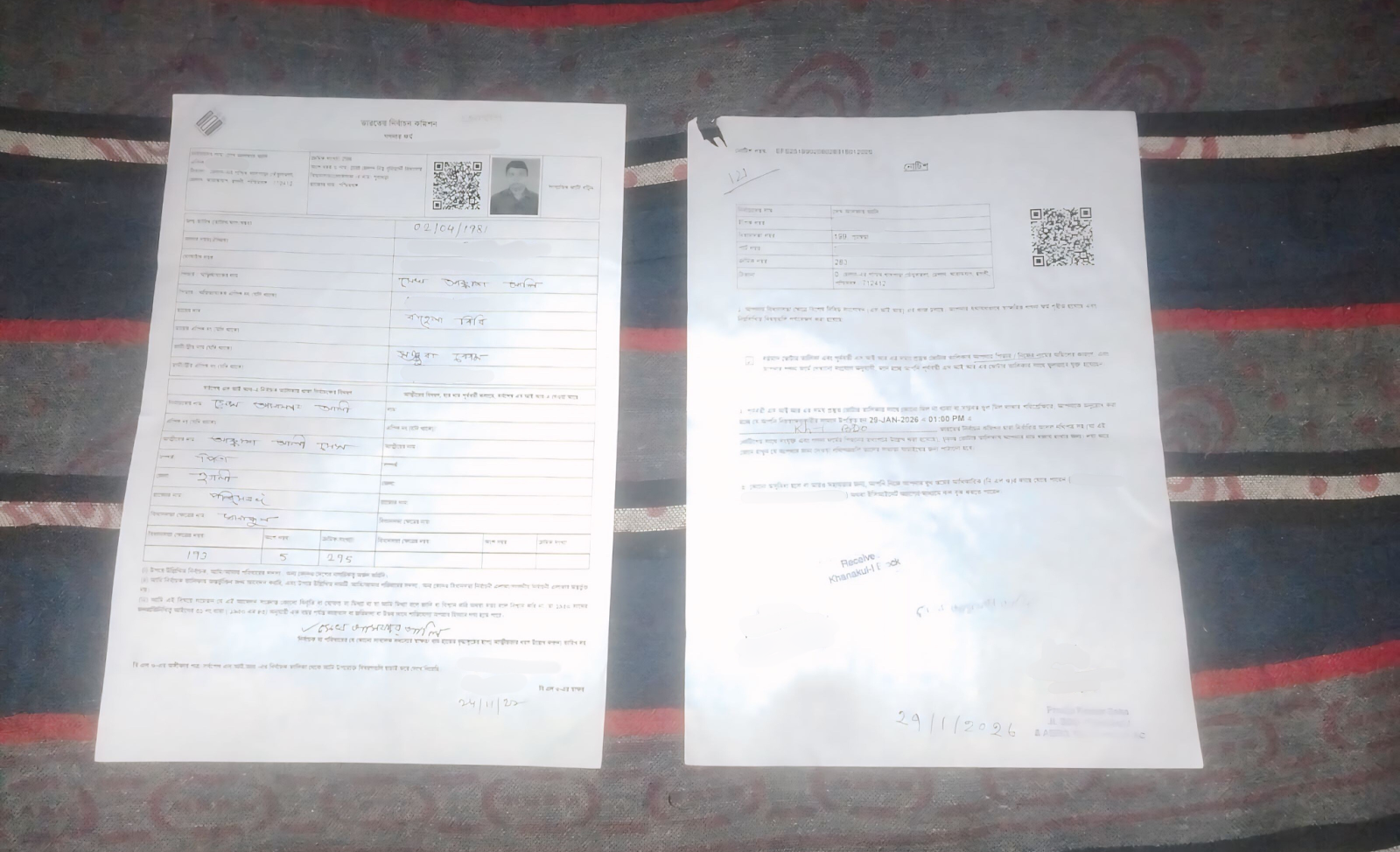
Lives Disrupted
Beyond statistics and political debates, the revision imposed a real emotional and financial burden upon the voters.
Sheik Afsar Ali, a 45-year-old tailor from a village in Hooghly district, travelled several hours from Kolkata, where he works, to attend his hearing.
He spent nearly Rs 1,000 on travel and photocopying documents. “For people like us, that is a lot of money,” he said. He also lost a day's wages.
Ali works in a tailoring shop and sends money home to support his daughters’ education. He said that around 400 voters from his village are under adjudication.
“They only made Muslims stand in the line,” Ali said. “Why are we made to suffer like this?”
The uncertainty has prompted regular citizens and activists to organise support networks. A citizens’ group called the ‘Sara Bangla Bicharadhin Voter Mancha’, or ‘All Bengal Under-Adjudicated Voters’ Forum’ was created to assist affected voters. It aims to provide legal help, collect data and raise awareness about the issue.
Imroz Reza, one of the founding members, said the group was created because voters felt abandoned. “Our immediate goal is to ensure that voters understand their rights.
The final electoral roll has been published,” he said. “But millions are still under scrutiny.”
If even half of them are eventually excluded, he said, the consequences could affect entire families. “When you include family members, nearly ten million people may feel the impact,” Reza added.
For many voters in West Bengal, the SIR has produced a strange situation: a final electoral roll that is not entirely final.
For people like Priyadarshinee, the wait has become exhausting. Her documents have been submitted, and the hearing is over. Yet the reason for her summons and her under-adjudication status remains unclear.
“All I want to know,” she said quietly, “is what mistake I made?”
(Sayantani Upadhaya is an independent journalist based in Kolkata.)
Get exclusive access to new databases, expert analyses, weekly newsletters, book excerpts and new ideas on democracy, law and society in India. Subscribe to Article 14.