
Bengaluru: On 19 January 2025, a Mumbai sessions court judge hearing the anticipatory bail pleas of nine Tata Institute of Social Sciences (TISS) students did not ask why the police had invoked a raft of absurd charges—rioting, unlawful assembly, promoting enmity, acting against “national integration”—against young people who had merely commemorated the death anniversary of G N Saibaba. Instead, he scolded them like errant children and warned them that their careers were effectively over.
Saibaba, a disabled former Delhi University professor, spent a decade in prison for crimes he never committed. The Bombay High Court and the Supreme Court eventually acquitted him, rebuking the State for its insistence on keeping him incarcerated. The students’ “crime” was to gather in October 2025 to remember a man who had been legally exonerated after being persecuted, his health destroyed in prison.
“You have a criminal record,” additional sessions judge Manoj B Oza told the nine students. “Now your record is with the police—not just here but everywhere in the country. You know that you have made a blunder so early before your career starts (sic). Your career is ruined.”
The police case itself arose from a complaint by TISS—once a crucible of critical scholarship on inequality and injustice, now refashioned in the restrictive creed of India’s ruling dispensation. Instead of questioning the State’s overreach, Oza amplified it, as so many in positions of power now tend to do. “How many of you are from outside Maharashtra?” said Oza. “You came to study in Maharashtra for all this? Your fathers know about the case?”
If Oza’s patriarchal tirade sounded extraordinary in ignoring the authoritarian overreach of the police, it was only the latest example of New India’s twisted jurisprudence, which criminalises protest and dissent, makes criminals of victims of hate crimes, protects criminals who commit hate crimes, and punishes officers or judges who try to uphold the law.
India’s criminal-justice system has steadily turned the presumption of innocence and constitutional freedoms of speech, opinion and protest on their head. In their place now stands a duties-over-rights, conformist and exclusionary orthodoxy, drawn from the ideology of the ruling Bharatiya Janata Party (BJP), its affiliates, and the State they are remaking in their image.
A rare acknowledgement of the majoritarian drift of the higher judiciary came last week from Supreme Court Justice Ujjal Bhuyan, who spoke at length at the State’s “striking intrusion” into judicial independence. “A constitutional court cannot say that because a view is subscribed to by the majority it will endorse it,” said Justice Bhuyan. “If one person’s view is found to be constitutionally valid, the court has to uphold it”.
“The judiciary neither has the purse nor the sword,” said Justice Bhuyan. “All it has is the faith reposed in it by the people. If that faith is breached, nothing will be left of the judiciary.” Yet, that is indeed the faith that is being breached. More judges and judgments now echo the country’s majoritarian turn. This judicial collaboration is not unfolding in isolation: It is one of many institutions enabling the death of dissent and democracy.
The week that went by revealed many examples, beginning with Kashmir, where the original template to stifle dissent was created. The latest authoritarian milestone was set as police illegally summoned four Kashmiri reporters for routine stories that reported the police profiling of Imams in local mosques. Three of those reporters were from powerful national newspapers, who offered belated and tepid support—unsurprising in a country where the mainstream media are either government cheerleaders or treat it with deference. As Suhasini Haidar, The Hindu’s diplomatic affairs editor, put it: “Kafka2026: Police detaining people for writing about police detaining people.”
To continue with the week that was, in Uttar Pradesh, Muslims were arrested for offering prayers in an empty house. A school for tribal children was demolished because it was a Muslim man who built it on his own land. In the same state, the Allahabad High Court transferred chief judicial magistrate Vibhanshu Sudheer, three days after he ordered criminal proceedings against police officers who shot a Muslim protester dead—an unmistakable warning to the dwindling number of judges who still take their oath of fidelity to the Constitution seriously.
Emboldened, encouraged and empowered by support and rhetoric from the highest echelons of government and the diffidence of the justice system to intervene, Hindu vigilante violence continued with impunity.
- A pastor in Odisha was forced to eat cow dung and chant Jai Shri Ram
- A Muslim was lynched in Odisha after he was discovered to be Muslim
- A Muslim was lynched in Jharkhand while legally transporting cattle
- Muslim homes, shops and a mosque were set ablaze in Tripura
- Threats were issued to Kashmiri shawl salesmen in Haryana, UP, Uttarakhand, Delhi, and many were forced to chant Jai Shri Ram
The thuggery by Hindutva’s stormtroopers is primed, as always, from the top. In electoral speeches in Assam and West Bengal—both states with large Muslim populations—the Prime Minister vowed to roust “infiltrators”, a common dog-whistle for Muslims. Referring to the demolition of their homes, and notices questioning voting rights and citizenship, Assam chief minister Himanta Biswa Sarma said of Miyas (a pejorative for Bengali-speaking Muslims), “We are giving them trouble… we will do some utpaat (mischief) but within the ambit of the law.” A day later, Sarma said that both he and the BJP were "here to harass Miya Muslims".
Unsurprisingly, with the courts standing aside and radicalisation spreading, hate speech witnessed an inexorable rise, with 1,289 speeches in 2025, or 98%, targeted at Muslims, either explicitly in 1,156 cases or alongside Christians in 133 cases, according to the latest edition of Hate Speech Events in India, an increase of nearly 12% from 1,147 instances recorded in 2024. As many as 88% of hate speech incidents were reported in states governed by the BJP, either directly or with coalition partners, and in BJP-administered union territories, rising 25% over 2024.
Sarma's counterpart in Uttarakhand, Pushkar Singh Dhami, whom the Hate Speech Events report called the "most prolific hate speech actor" of 2025 for 71 speeches with Islamophobic content and mainstreaming conspiracy theories against Muslims, said if "threats to Uttarakhand's future" were called hate speech, he accepted the title.
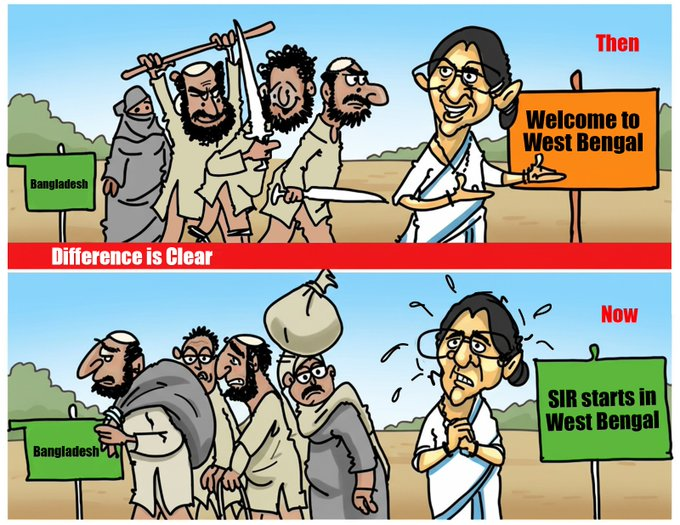
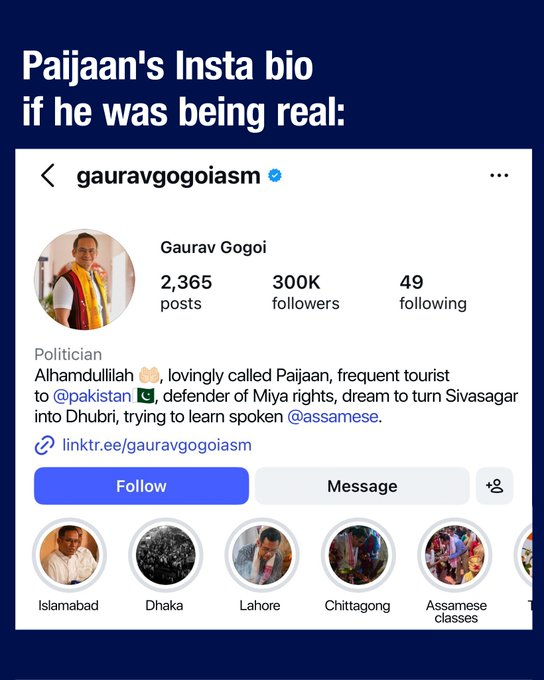
BJP social media handles, particularly in Assam, used AI-generated images and videos (here, here, here and here) to reinforce and amplify divisive tropes, Islamophobia and cast Opposition leaders as Muslim lovers.
This was an image issued by the BJP in West Bengal:
And in Assam:
With the country’s largest political party propagating virulent Islamophobia, and the government openly suppressing dissent and protest, democratic expression not in tune with right-wing ideology is a fraught endeavour, however mild. For instance, expressions of solidarity with Palestine, which India recognises and expresses solidarity with, are openly criminalised in not just BJP states but even those run by the Opposition, as Article 14 has reported. Bangladesh, a country once closely aligned with India, is now hostile, largely because the word “Bangladeshi” has been weaponised to delegitimise Indian Muslims and corral Hindu votes. The Election Commission aligns with the ruling party, and the ruling party borrows the Election Commission's authority.
Whether in Weimar Germany, in Erdoğan’s Türkiye, in Orbán’s Hungary, in the Emergency era and now Modi’s India, and the US, the land of the once-free and brave, experience has taught the world that the collapse of institutions is a powerful enabler and indicator of democratic recession. It is not surprising that students are told their careers are over for organising a protest, or that the Supreme Court keeps an Umar Khalid or Sharjeel Imam in prison for no good reason—except to lean into the prevailing wind.
(Samar Halarnkar is the founding editor of Article 14.)
Get exclusive access to new databases, expert analyses, weekly newsletters, book excerpts and new ideas on democracy, law and society in India. Subscribe to Article 14.