
Surat: “We don’t even know what the money over here looks like.”
Sweat poured down R*, 40, a thin migrant worker from Jharkhand, weathered beyond his age, during the sweltering 42-degree C heat of May, as he tried to build a rickety bamboo pier over one of the many ponds at a shrimp farm on salt-encrusted land outside the Gujarat city of Surat. He had not been paid, he complained, since he arrived at the farm in February 2026.
Travelling 1,500 km in a packed, unreserved train coach from his home in a village called Bano in the district of Simdega in Jharkhand, R is one of thousands of mostly young men who work on south Gujarat’s shrimp farm for between six to eight months every year, one of 200 million making inter-country migrations for livelihood. The economics of such migrations are easy to discern: Jharkhand ranks 31 of 33 states and union territories by per capita net state domestic product, Gujarat ranks 11.
Many of the thousands who slave on the shrimp farms find themselves entangled in conditions resembling captivity, according to a new study by my organisation, a labour rights nonprofit, to produce a commodity mainly consumed in Europe, China and the US.
The study, based on interviews with more than 350 workers, farm owners and supervisors at farms in the Surat talukas of Olpad and Chauriyasi, revealed uncertain payments with unclear deductions; no safety gear; long working hours; denial of minimum wages; few toilets; and surveillance and control of workers, creating a culture of silence.
While these conditions might not legally qualify as bonded labour, they are best described as captivity, with owners holding identity documents and workers relying on them for food, medicines, and healthcare.
Shrimp farms have proliferated in India since the early 1990s. After Ecuador, India is the second-largest producer of farmed shrimp, earning $5 billion in export revenue from frozen shrimp for the year ending March 2025. Frozen shrimp are India’s most valuable seafood export, nearly 70% of total dollar earnings.
Andhra Pradesh exports more shrimp than another other state. Gujarat is second, with about 7,000 ponds in Surat, Bharuch, Navsari, and Valsad districts, some run by owners, others on contract. From about Rs 77 crore in 2008-9, shrimp exports from Gujarat surged 10-fold to Rs 725 crore in 2023-24.
Desperation & Migration
In 2020, at the beginning of the Covid-19-induced lockdown announced by the Indian government, Y*, also from Simdega in Jharkhand, reached out to the Majdur Adhikar Manch (Labour Rights’ Forum) or MAM alleging that he, along with a group of workers from his village, were not being allowed to leave a shrimp farm in Olpad.
The legal support team at MAM spoke with farm owners and persuaded them to release the workers, ensuring that wages due were paid.
Distress migration from the contiguous tribal districts of Simdega and West Singhbhum in Jharkhand, and Sundargarh in Odisha, has been a longstanding reality for decades. Many who migrated reported being plunged into poverty after being displaced from their land by government takeovers for infrastructure and mining, the dwindling of livelihood opportunities, including the dismantling of the jobs-for-work programme, the Mahatma Gandhi Rural Employment Guarantee Act (MNREGA), and the lack of access to education.
The seasonal nature of migration renders workers invisible to the administration at both the source and destination.
Over 90% of the workers we surveyed were scheduled tribes, such as the Oraon, Munda, Kharia, and Ho, from Sundargarh, Simdega, and West Singhbhum. About 53% identified as Christian and 38% as Hindu. Around 60% of the workers we spoke to had less than 2 acres of land in their home village, which they said was not sufficient to sustain a livelihood.
Migration is, thus, a distress-driven coping strategy rather than a pathway to upward mobility.
‘Aaram Wala Kaam’
Workers are usually recruited directly by shrimp farm owners, who pay for train tickets to Surat, arrange pickups at the railway station, and transport them straight to the farms.
H* from Sundargarh said owners typically contact workers they already know and specify how many labourers they need. Those workers recruit other men from their villages. Nearly 75% of the workers we interviewed were men under 35.
Many had previously migrated to work in factories in Surat and elsewhere, but moved to shrimp farms because of punishing factory conditions: long hours on cramped, poorly ventilated shop floors.
Shrimp ponds must be monitored around the clock, given the high-risk, high-profit nature of the business. So, farm owners prefer labour that is permanently available—a demand met largely by migrant workers.
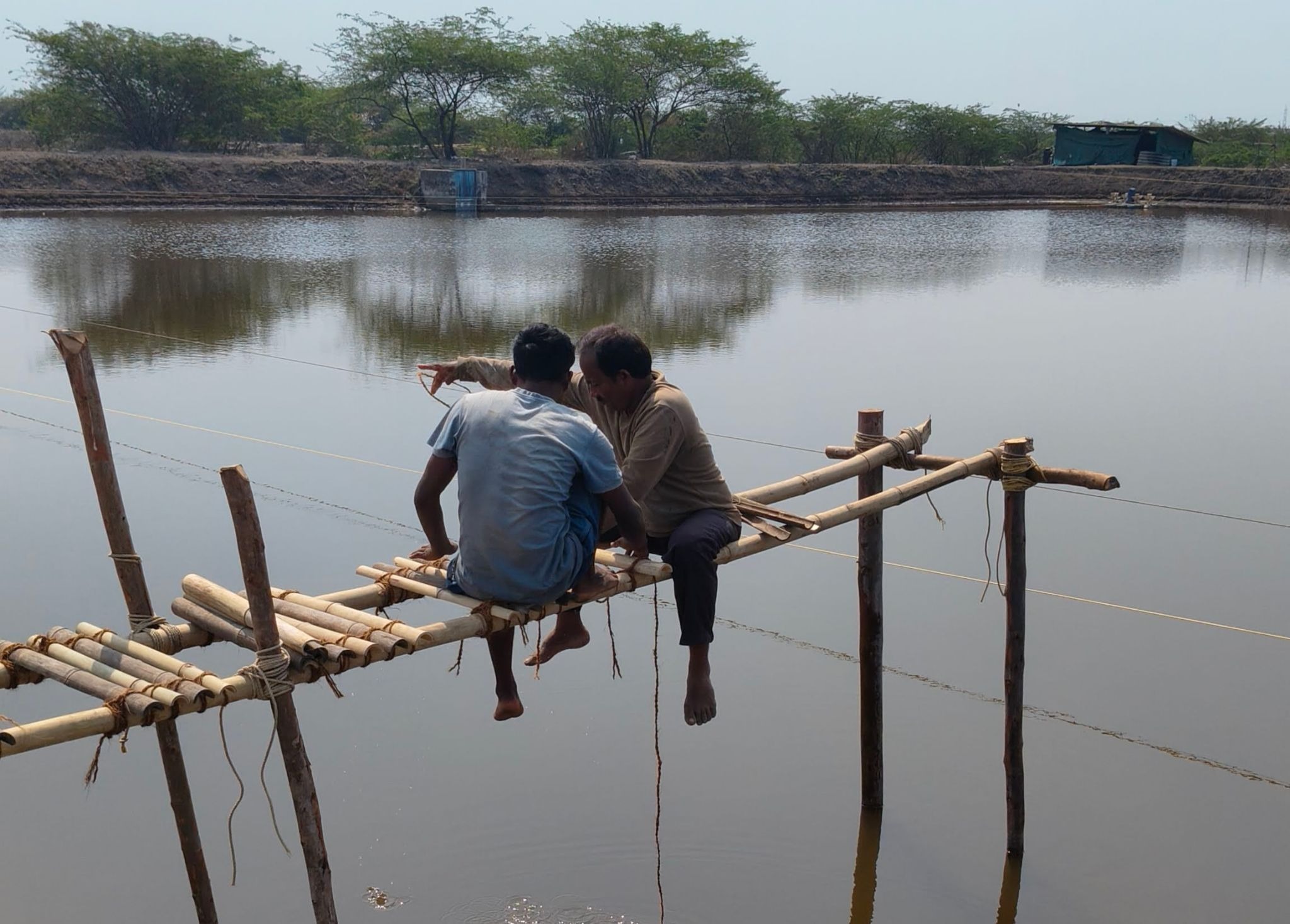
Owners said local workers were unwilling to live on the farms. Implicit in this reasoning is the assumption that “footloose” migrants, cut off from social support and bargaining power, can be made to work for abysmally low wages in jobs dismissed as “unskilled”.
One farm owner described shrimp-farm labour as “aaram wala kaam” (relaxed work), brushing aside concerns about training, occupational safety and health protections. In medical emergencies, workers depend on farm owners to take them to a doctor.
With no regular health check-ups or monitoring, there is little way to assess the long-term occupational health consequences of this work.
Risky Conditions
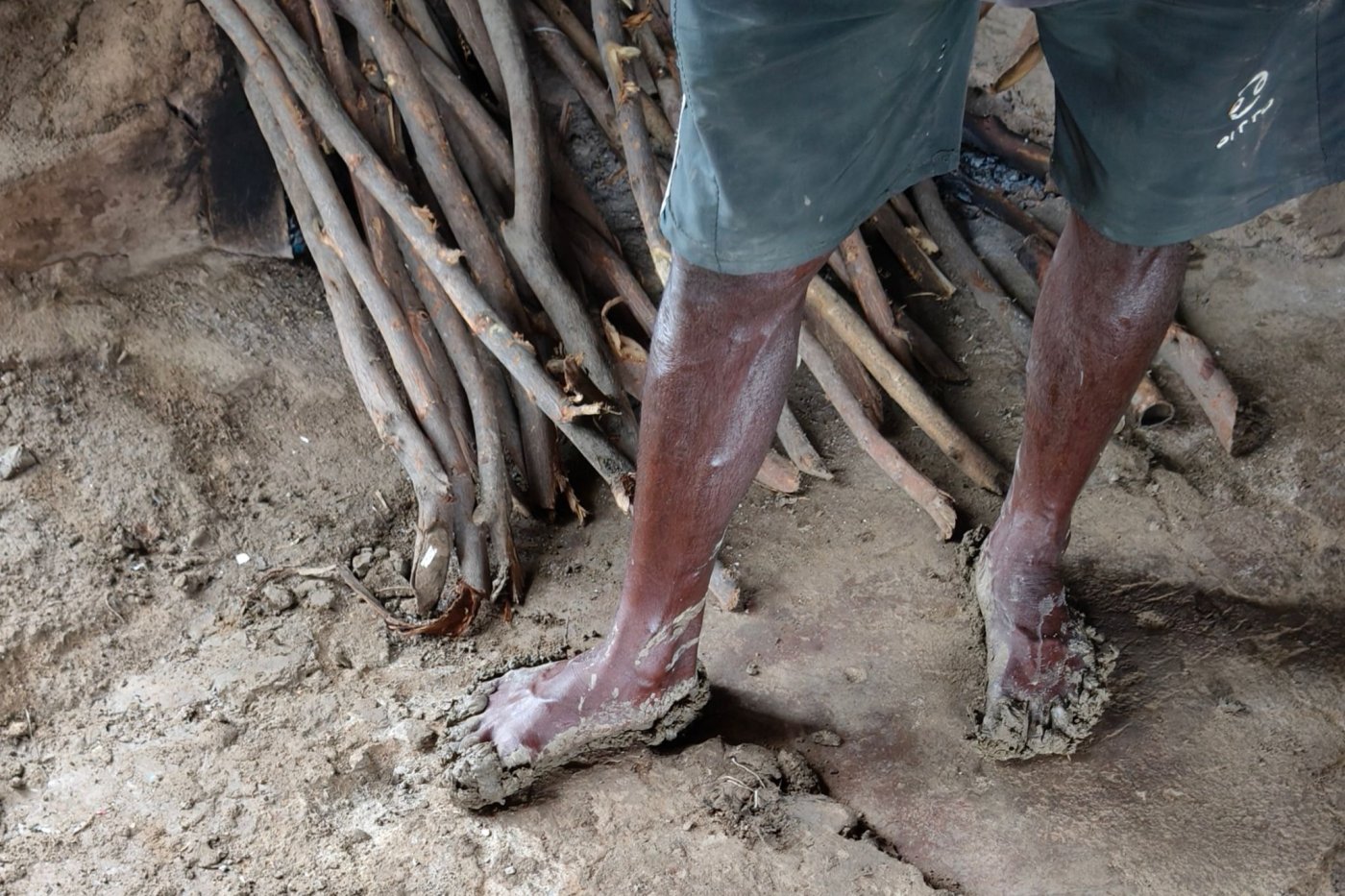
Workers circle the ponds four to six times a day to feed the growing shrimp, walking barefoot across marshy, slippery ground, especially after heavy rain. As mud cakes their feet, every step becomes more difficult.
They must also navigate exposed electrical wires running across the farms, connecting generator sets to the motors that power aerators supplying oxygen to the ponds. Many workers said they feared electrocution during the monsoon and recounted hearing of such accidents at other farms.
Despite these risks, more than 80% of workers said they had received no personal protective equipment. Safety, workers said, is treated by owners not as an employer’s obligation but as an individual responsibility.
When workers first arrive, they are tasked with preparing the ponds: clearing and levelling land, lining ponds, installing motors and aerators, setting up biosecurity systems and conducting sample testing.
They then fill the ponds with water and chemically treat it to create brackish conditions suitable for shrimp cultivation. Once the shrimp seed is stocked, workers handle feeding, operate aerators and monitor shrimp growth through the production cycle.
Typically, one worker is assigned to each pond, while a separate night-shift worker monitors clusters of four or five ponds. Members of the local Halpati community are usually brought in during harvesting. Nearly 97% of workers said they received no formal training and learned the work simply by observing more experienced labourers.
Delayed Pay, Broken Promises
S* travelled from Sundargarh with his brother and friends after hearing about the work through informal networks. Like most workers we interviewed, he had no documents to prove he had been migrating to shrimp farms for the last four years.
None of the workers reported signing written contracts or receiving paperwork that could hold employers accountable.
Workers said they were promised monthly wages of Rs 8,000 to Rs 12,000. At the time of the study, Gujarat’s statutory minimum wage for “unskilled” workers was Rs 489–500 a day for an eight-hour shift. Calculated over 26 working days, this would amount to far more than what shrimp-farm workers actually earned.
Instead, workers reported being paid roughly Rs 266 to Rs 400 a day while working 12-hour shifts, often without weekly breaks.
Wages were also routinely delayed. About 93% of workers said payment reached their bank accounts only weeks after they returned home. Owners justified this by saying workers did not need cash during the season because rations were provided. Workers, however, said that food costs were later arbitrarily deducted from their wages.
“If the owner promises Rs 10,000, he deducts Rs 2,000 for food,” said B*. “We don’t know the rates here, so we have to accept whatever he says.”
H* from Sundargarh said wages were renegotiated after workers arrived at the farm. “They said they would not pay the rate promised. They have tied us down,” he said. “We don’t know if we will ever get our money.”
The withholding of wages violates the Payment of Wages Act, 1936, which has now been subsumed under the Code on Wages, 2019. Owners defended the practice by claiming workers would otherwise “waste” money on alcohol or leave mid-season.
In Simdega, to which K* had returned and where he was interviewed, he said he was still waiting for wages from the previous season. When the MAM team contacted farm owners, they promised payment within days. Kailash then called friends who were also awaiting dues—some for months, others for as long as two or three years.
Surveillance & Control
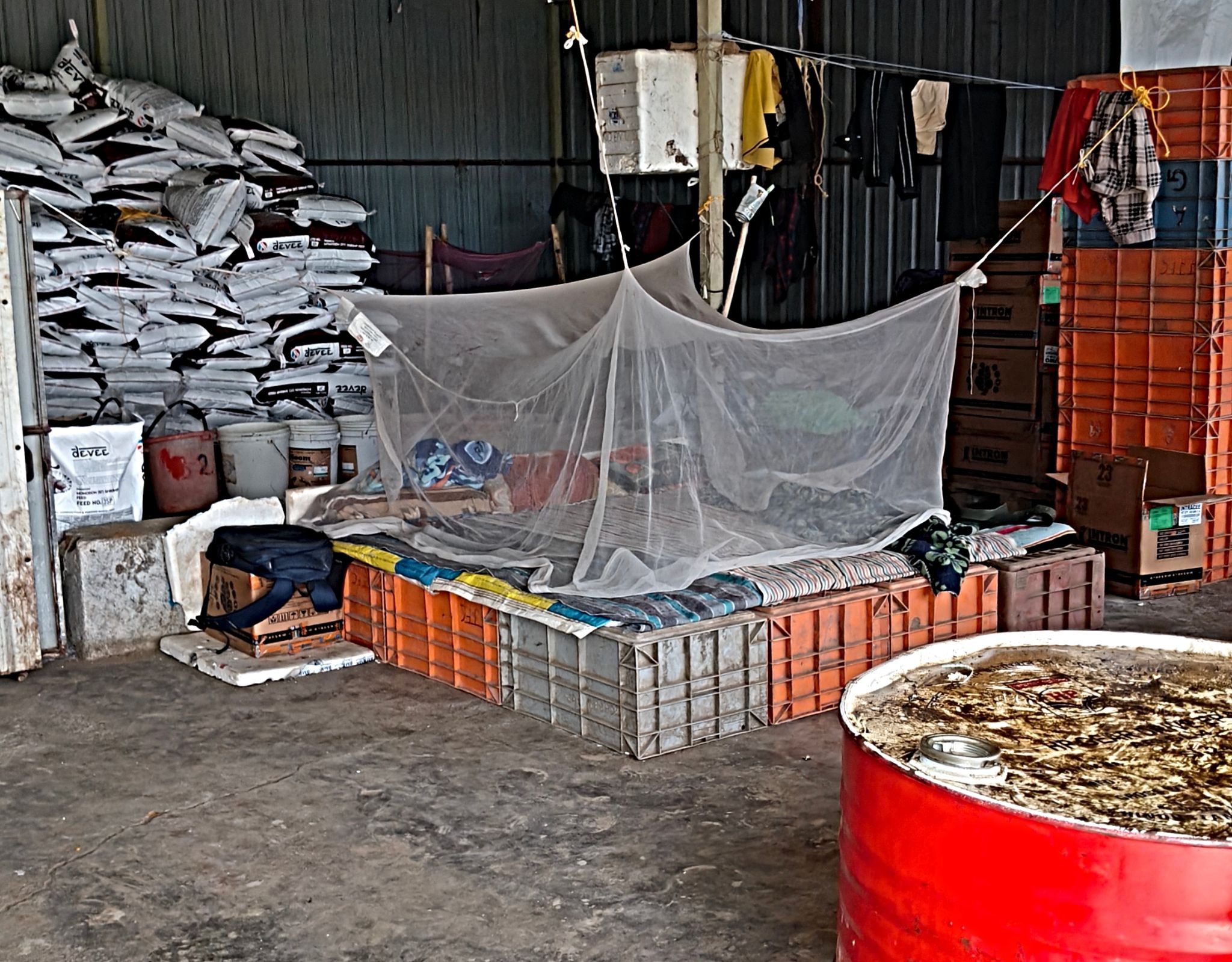
Workers live on the isolated farms for the entire production cycle, usually in temporary structures. Feed and medicine storage sheds double up as sleeping quarters, kitchens and resting spaces, erasing any distinction between work and personal time.
Most farms have no toilets or bathrooms. Electricity is unreliable and prioritised for running aerators, leaving many workers without fans even as temperatures in Surat cross 40 deg C. Water for all daily needs arrives in tankers and is stored in plastic containers.
Surveillance is constant. Cameras aimed directly at workers’ living areas alert owners whenever outsiders arrive. During one of our visits, workers immediately received a call from the owner ordering them not to speak to us. Owners often rushed to the farms to question our presence; some permitted conversations only under their supervision.
One owner in Olpad said the cameras helped monitor workers’ movements and repeatedly referred to them as his “children” in a paternalistic tone. He also kept workers’ Aadhaar cards for the duration of their stay.
Their status as migrants deepens this isolation. Cut off from local support networks and scattered across remote farms, workers have little opportunity to organise or even gather socially. “There is a church nearby, but when do we get leave to go?” said K*. “Only after the work season ends.”
At one farm, we saw a cross painted on a wall—a small sign of a faith that workers rarely had the freedom to practise.
Missing Accountability
Aquaculture farms in India are regulated by the Coastal Aquaculture Authority under the Coastal Aquaculture Authority Act, 2005, and its 2023 amendment. While the authority registers farms, frames operational guidelines and monitors environmental compliance, labour conditions remain largely outside its scope.
There are no clear standards governing wages, working conditions or worker welfare in coastal aquaculture.
Private certification and audit systems used by seafood companies offer little accountability. These mechanisms largely depend on employer-provided records, exclude worker testimonies and often function more as branding exercises for “sustainable” production than as meaningful labour oversight.
The State must recognise shrimp farms as formal work sites subject to labour regulation, including regular inspections, enforcement of minimum wages, worker registration, labour cards and access to social security benefits—all of which are currently absent.
Despite growing emphasis on supply-chain due diligence by governments, corporations and even civil society groups, these frameworks have done little to change workers’ realities. Meaningful accountability, workers and organisers said, can emerge only through sustained collective organising led by workers themselves.
The denial of labour rights is embedded within a production model built on low-cost operations and precarious labour.
“Now that we have come, we must stay for at least a year, even if we don’t like it,” said R*, as we left the farm. Asked whether he would return next season, he replied: “For me, my home is better.”
*All names have been changed to protect the privacy of the workers.
(Anamika Singh is a researcher working on issues of labour rights, informality, and migration. She assists unions in their organising efforts.)
Get exclusive access to new databases, expert analyses, weekly newsletters, book excerpts and new ideas on democracy, law and society in India. Subscribe to Article 14.