
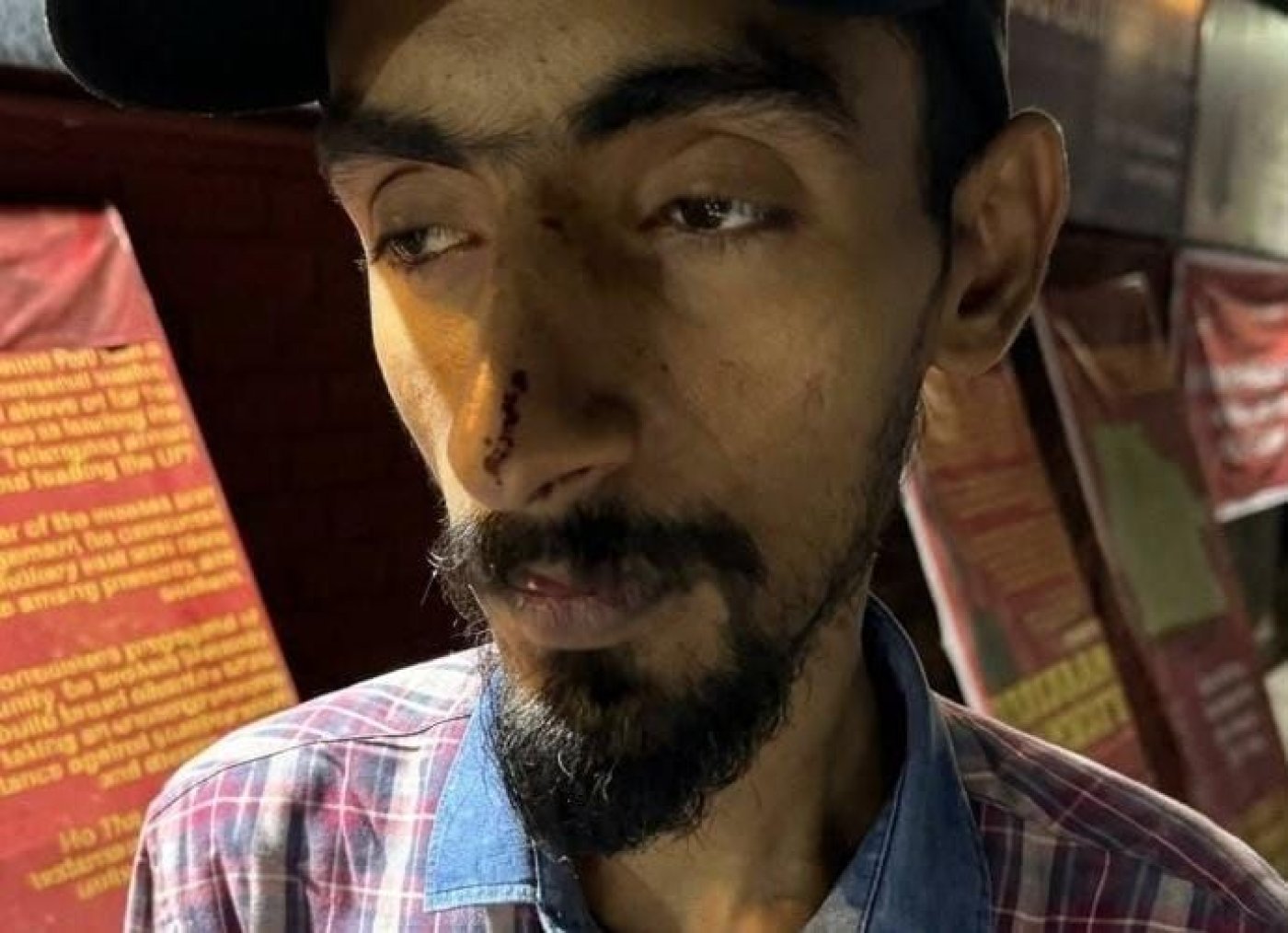
New Delhi: “They punched me in the face. They kicked me with their boots. I was on the floor. They were just kicking. They kicked me on my back. Then, on my genitals.”
This is how Arjun Unnikrishnan, 30, an activist with the NREGA Sangharsh Morcha, described being attacked by the Delhi police inside a police bus after he was detained on 11 October 2026 in central Delhi.
Unnikrishnan went there to join a protest demanding the resignation of Gyanesh Prakash, the Chief Election Commissioner of India's Election Commission, over a revision of electoral rolls that protesters say has been opaque, riddled with errors, and has wrongfully disenfranchised millions of voters, with 130 million excluded at last count.
Vishal Kumar, 20, a member of the All India Students’ Federation (AISF), a student organisation affiliated with the Communist Party of India (CPI), and a recent graduate of the Mahatma Gandhi Antarrashtriya Hindi Vishwavidyalaya in Wardha, Maharashtra, said he too was beaten in the same police bus.
He said police personnel struck him on the knee, dug their elbows into him and punched him in the face and stomach.
“There were about five of them in a line,” he said. “As you entered the bus, one would beat you and pass you on to the next.”
Article 14 tried to reach the Delhi Police by phone and email. There was no response. We will update this story if there is.
For two days, on 10 and 11 October 2026, Prime Minister Narendra Modi’s government has prevented protests at Jantar Mantar, New Delhi’s designated protest site. On the first day, authorities cordoned off large areas around the site with barricades, shut down Internet services and imposed prohibitory orders restricting public gatherings. Thousands of police personnel, including riot police, were deployed across the national capital.
As people attempted to gather at alternative locations, police detained them immediately, dragging and shoving protesters, including women and journalists, into buses.
After the Supreme Court intervened, internet services were restored, and people had greater freedom of movement on the second day. Yet police continued to prevent protesters from reaching the designated site.
The cycle of detentions continued.
Sitting On The Road
Unnikrishnan and Kumar said police detained them at Connaught Place, the historic shopping hub in central Delhi.
On 12 October, the area was swarming with police personnel and riot police, while a steady stream of buses carried away protesters attempting to assemble.
In separate conversations, both said they and other protesters were made to sit on the road “as if they were going to be shot”, while the police took away the phones of some of them, including minors in their teens, who, they said, were not protesters.
“They made us sit on the road, four to five rows. They were asking for mobile phones,” said Unnikrishnan. “A boy in front of me said, 'Why should I give it since it was not even a police station?’ The boy was so scared, but he also stood up to them for a long time. Then a policeman came and slapped this boy left, right, and centre.”
“Then, he gave his phone, and they took his password,” he said. “They were looking at his (photo) gallery, and they were laughing at this boy. He was thrashed and humiliated.”
“This process of asking for mobile phones went on for some time,” he said.
Both alleged the police deleted photos.
Unnikrishnan and Kumar said some “right-wing people” were also brought in, but they were not treated the same way.
Allegation Of Assault
They were then forced onto a bus that had “cell-like compartments”, each holding around 10 people. They estimated that some 50 to 60 detainees were on their bus. It was inside this bus, they said, that 10 to 15 were beaten by police personnel, who also hurled verbal abuse at them.
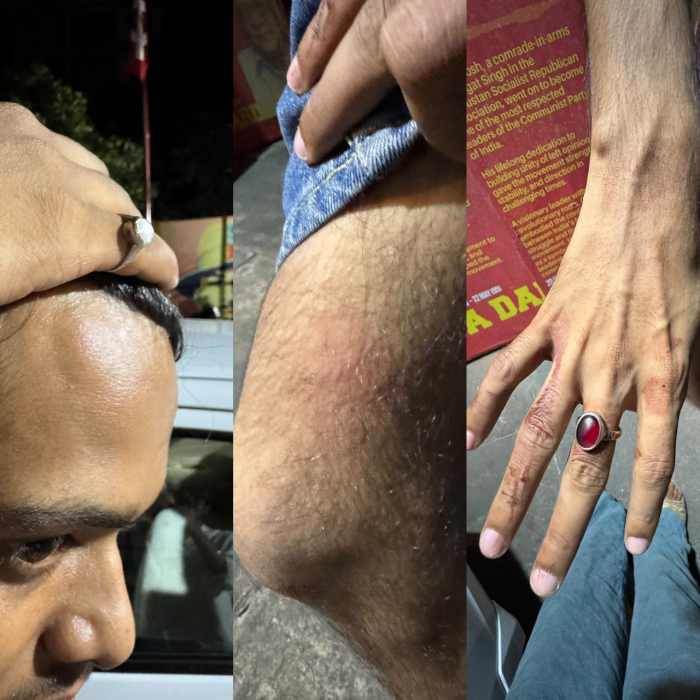
“There were around four to five cops inside, in camouflage uniforms. We were passed along, and each constable hit us, slapping, kicking, and hitting on the genitals,” said Unnikrishnan.
“It was like a butcher house,” said Unnikrishnan.
They said there were four minors in their “compartment”, and that they too were beaten up.
“Those minors were not even protesting,” said Unnikrishnan. “They were terrified.”
One person was beaten so badly that, Kumar said, his hand was fractured.
“People were crying, some out of pain, some out of fear,” he said.
Unnikrishnan has documented his allegations on social media.
A third protester, Tarang Balani, a 23-year-old customer success manager, confirmed the violence on the bus and said he and a minor were beaten up.
Gaurav Cyclewalla, a Delhi-based lawyer, said he attempted to file a complaint at the Chhawla police station, but the station house officer (SHO) refused to accept it, saying the detainees had come from Connaught Place and that the complaint should be filed there instead.
Cyclewalla said the complaint was subsequently emailed to the SHO.
Driven To The Outskirts
Police then drove them from one station to another before finally taking them to a detention centre in Pandwala Khurd, a rural area in south-west Delhi, about 40 km from Connaught Place.
They said they were on the bus with barely any mobile phone signal and the detention centre was in near darkness. They said they were given no food or water, the injured were not attended to, and they were not told when they would be released.
“We tried to figure out where they were taking us. Some of us had our phones. We tried to reach out to the outside world, but there was no internet, and calls were not going through,” said Unnikrishnan.
At the centre, Unnikrishnan said, “We collectively started shouting that there are four minors. The injured have not been attended to. After all that, they gave us some medical attention, set up a first-aid counter, and asked who were minors.”
Eventually, as news of the detentions spread on social media, lawyers travelled to the remote detention centre and began working to secure their release.
Many did not get their mobile phones immediately.
“They didn’t give us our phones back, and they kept telling us that u need to go to CP to get your phones,” said Balani.
Journalist M Rajshekhar was also reportedly detained at Pandwala Khurd.
‘Trapped Like Chickens’
Samayak Alone, a 28-year-old creative director, was also detained at Connaught Place. He was among the protesters made to sit on the road before being taken away on a different bus, which he said also carried women protesters and a minor.
“We were trapped like chickens in a cage,” said Alone.
“We kept going. We crossed CP, Dhaula Kuan, airport, Aerocity, Mahipalpur. Then we reached Dwarka Expressway, and we were getting extremely agitated. They kept going and going. We started losing network,” he said. “There was no water, no light. Then it was a rural area.”
They were eventually taken to a detention centre in Najafgarh, around 30 km from Connaught Place in south-west Delhi, in a semi-rural area.
Before that, Alone said the bus carrying them stood near the Chhawla police station for nearly 40 minutes, but they were not allowed to get off.
“It was like a jungle. It was sheer darkness. We had our phone torches on. But we also wanted to conserve battery,” he said. “People wanted a washroom. One girl said she had her period and urgently needed a pad and the toilet. But no one listened.”
(Betwa Sharma is managing editor of Article 14. Sabah Gurmat is an independent journalist and writer based in New Delhi.)
Get exclusive access to new databases, expert analyses, weekly newsletters, book excerpts and new ideas on democracy, law and society in India. Subscribe to Article 14.