
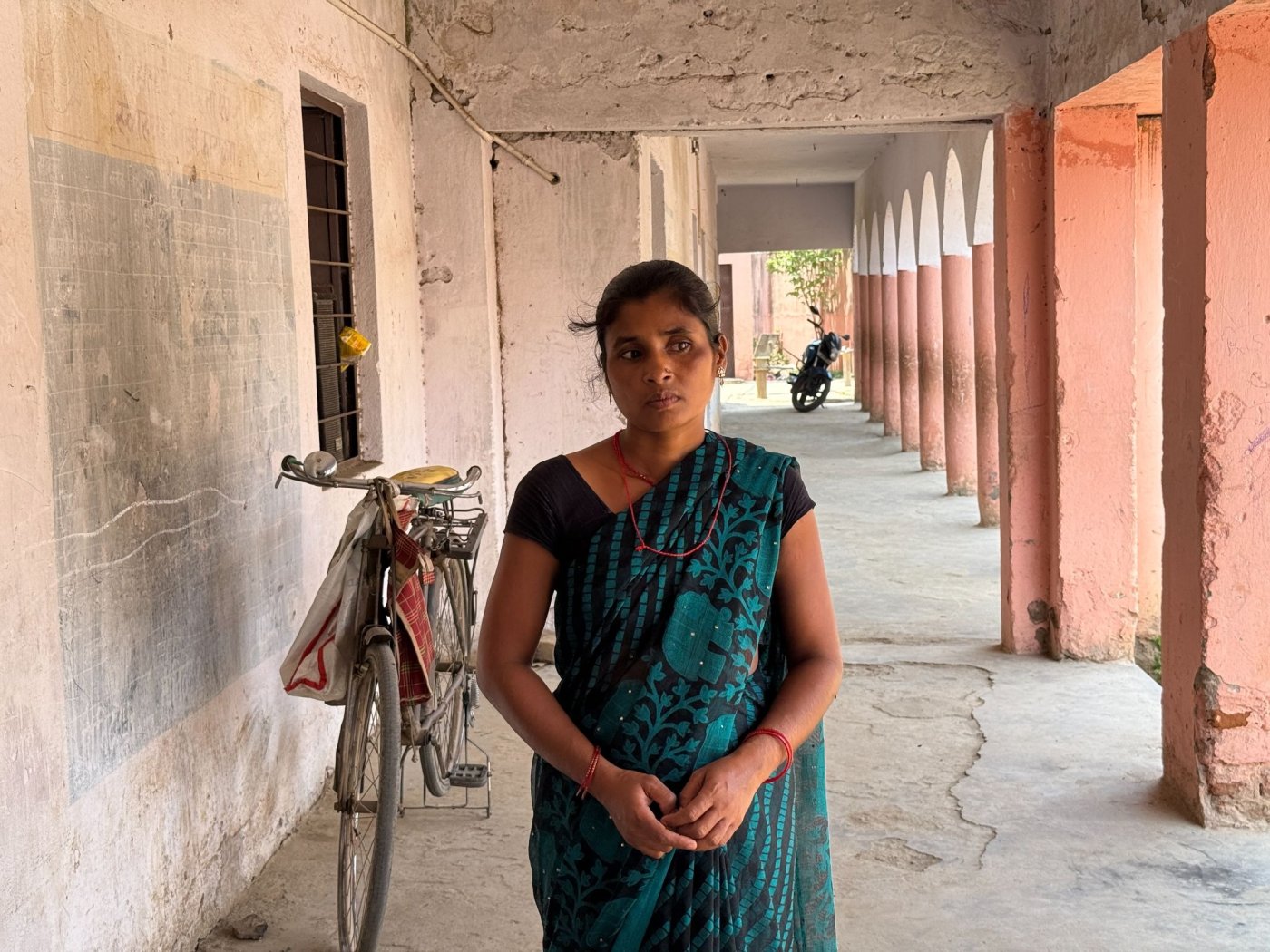
Patna: “Aisa karke naukri paogi (Is this how you get a job)?”
Ranjeet Kumar, a block resource centre official overseeing a government midday meal scheme, shouted at 31-year-old Madhu Devi over a speakerphone that belonged to the headmaster of the government primary school in Bihar, where Devi is a cook.
It was 19 May 2026 when Kumar also shouted at the then-new headmaster, Mohammed Zubair Akhtar, who had made the call to ask whether there was any progress on Devi’s application for the job she was already working.
The application had been pending for more than a year. Akhtar called Kumar after telling Devi that he had no intention of stopping her from doing her job, but the decision to confirm it was not his.
A worried-looking woman, aged beyond her years, Devi, accompanied by me, stood inside the headmaster’s office of the government school in the satellite town of Danapur, one of those rapidly prospering peripheries of an Indian city, in this case, the capital of Bihar.
The school, which runs classes 1 to 8, has five rooms, one of which is the headmaster’s office, with peeling paint and cement, and is located on a road sandwiched between the villages of Makhdumpur and Sarari.
Sarari is where Madhu lives, with its few hundred homes with their unpaved streets, rough houses and garbage lying just behind what is arguably one of the priciest stretches of land in India’s poorest state. Part of the Patna metropolitan region, Danapur is a tehsil (subdivision) dotted with under-construction elevated roads and malls, new, glossy salons and restaurants and a water park for the newly rich.
The majority in Sarari are poor, with some newly constructed homes and apartments of the affluent. The women find work there as cooks and maids, while men work on construction sites. Devi, too, has found work in the new high-rises because her government job isn’t really one.
Things seemed hopeful in November 2023 when a teacher referred her to Akhtar. Since then, Devi has been among the school’s four cooks, making vegetables, khichdi, the melange of rice and dal, chokha, a mashed-vegetable relish and dal for lunch for around 150 children. She works six days a week, from 11:30 am to 3:30 pm.
But she has never been paid for 19 months of labour, an underreported phenomenon in Bihar (here and here).
‘I Am Asking For My Wages’
Devi leaned against the headmaster’s office door, with her head lowered, her body trembling.
After the scolding from Kumar, Akhtar, too, turned towards Devi and, at the top of his voice, said, “Have you forgotten the help I sometimes provide you with Rs 500?”
She was not used to standing up to authority, but on that day, she did. Gathering her courage, Devi replied, “Humko aapka paisa nahin, humko anpi mehnat ka paisa chahiye (I don’t want your help, I want the money for my labour).”
Devi’s story is significant because it reveals the unchanging nature of governance and life for millions in a state with a new government—led this time by India’s ruling Bharatiya Janata Party (BJP).
Five years ago, Devi was widowed in the deadly second Covid wave when her husband—with whom she had a 10-year marriage and five children— succumbed to the coronavirus within three days of running a high fever and without access to treatment.
She was not yet an adult when she married, but Devi said her brief married life was happy. “He wouldn’t fight or drink,” she said, listing these as major achievements in a country where drinking and violence by husbands is a common phenomenon.
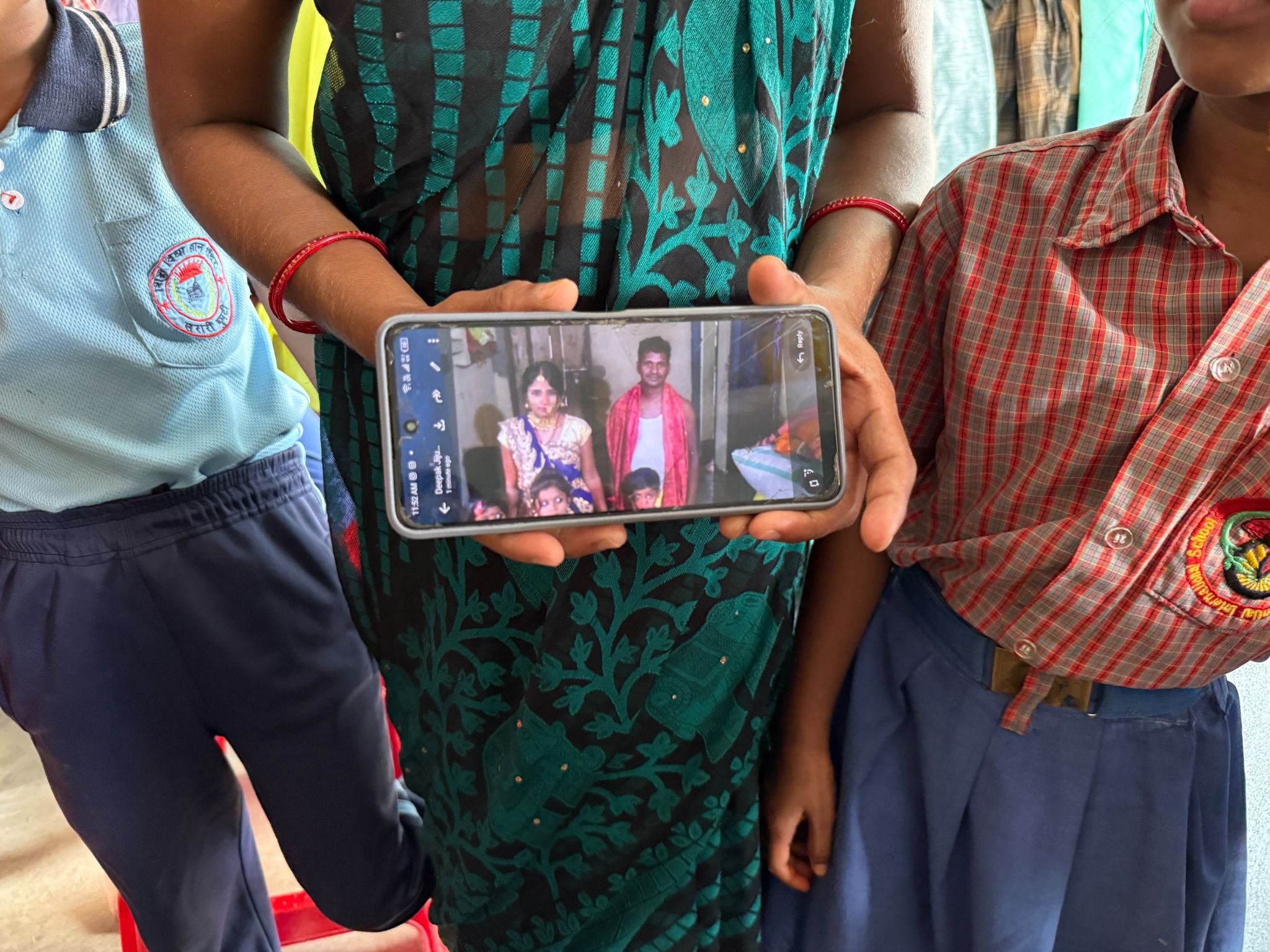
For the last two and a half years, she has continued to work every day, with only the hope that if she kept coming, she would eventually secure the cook’s job.
She is racing against time.
Last month, her younger sister Sita was married off. It is only a matter of a few years that her brothers Chandan and Kundan will be married too. Then her parents, Ramesh Shaw and Munni Devi, may no longer be able to shoulder the burden of raising her five children, aged five to 14.
Devi’s father, a 60-year-old tea seller, pays the school fees for her children, but he is ageing.
The Covid Nightmare
In the summer of 2021, there were two weddings in Devi’s family. The first was on 28 April in her in-laws’ family. The second on 3 May was in Sarari. She remembers those two weddings as the cruellest months of her life.
“The weddings had been scheduled during the first wave (of Covid), but were postponed to March and April of 2021,” said Devi.
By then, the coronavirus was wreaking havoc everywhere. People were dying in unprecedented fashion. Crematoria across the country ran out of space to accommodate the number of dead arriving.
“Since there was no lockdown in place, people thought that if it were truly serious, the government would have imposed restrictions as they did during the first wave,” said Devi, referring to the confusion created by the union and state governments' handling of lockdowns.
So, both families went ahead with the weddings.
“Baratis came wearing masks,” she said of wedding guests. She fell ill after the first wedding but recovered in a few days. The second wedding proved deadly.
On 4 May, after the bride was sent off early in the morning, Devi and her four children returned to her father’s home in Sarari. Her husband, Lal Babu Shaw, a contractor, collapsed on the cot with a fever. That day, the Bihar government announced a lockdown.
On the same day, Lal Babu reported a mild fever. The family went to Manoj Clinic, a shuttered shop run by an ayurvedic quack, who prescribed a tablet for the fever. By night, Babu’s condition had worsened; he had severe body aches, and his temperature kept rising.
Runaround & Regrets
The next morning, on 5 May, Kundan, Madhu’s younger brother, and her mother Munni Devi, held Lal Babu on the middle seat of a bike and drove him to a nearby doctor who ran a two‑room, shuttered shop as a clinic. After checking Lal Babu’s oxygen level with an oximeter, he said he could not treat him.
Then the duo took him to a doctor who claimed to have an MBBS degree. Seeing his deteriorating condition, the doctor refused to examine him.
They began wandering through Patna city on a motorcycle, Kundan driving and Lal Babu hanging on. After three hospitals refused to admit him, they had him tested at a diagnostic centre. In half an hour, he had tested positive for Covid.
They returned with the report, exhausted after a day spent pleading for admission. Lal Babu was now gasping for air. Near Sarari Gumti, a railway crossing close to Devi’s home, they got down and hired a Bolero, ferrying him to a nursing home in Bihta town, on the outskirts of Patna city.
“They gave him oxygen,” said Devi, “And within some hours, he died.” She had reached the hospital by then, leaving the children alone at home.
The family paid Rs 20,000 for the nursing home admission and oxygen, the equivalent of two months' income. Devi was one-and-a-half months pregnant when Lal Babu died.
Devi now lives with many regrets: that she did not know the fever would be Covid-19; that it would give her no time to do more; that no hospital would admit him; and that her husband would die gasping for air.
Child Bride To Covid Widow
Devi married Lal Babu in 2011, just after passing her Class-10 exam. She was 16. A year later, at seventeen, she gave birth to her first child, Ayush Raj. In 2014, she gave birth to a daughter, Tannu Kumari, while living in a village called Maddhupur with her in-laws, 20 min away.
Family members soon began telling her to conceive again, as they were worried because her son often fell sick.
“I gave in and delivered twins in 2016,” said Devi, “But they were girls.”
The pressure did not ease. The couple was urged to try once more for a son, and Devi conceived again in the summer of 2021.
Lal Babu was a thekedar or contractor, laying iron scaffolding across building rooftops in fast-developing Danapur.
“This was not a daily wage job,” Devi explained. “It was like an advance and delayed payment system for construction sites.” Though the money didn’t come in every day, Lal Babu had work on most days, except during the first Covid-19 lockdown, which lasted six months and shut everything around them down.
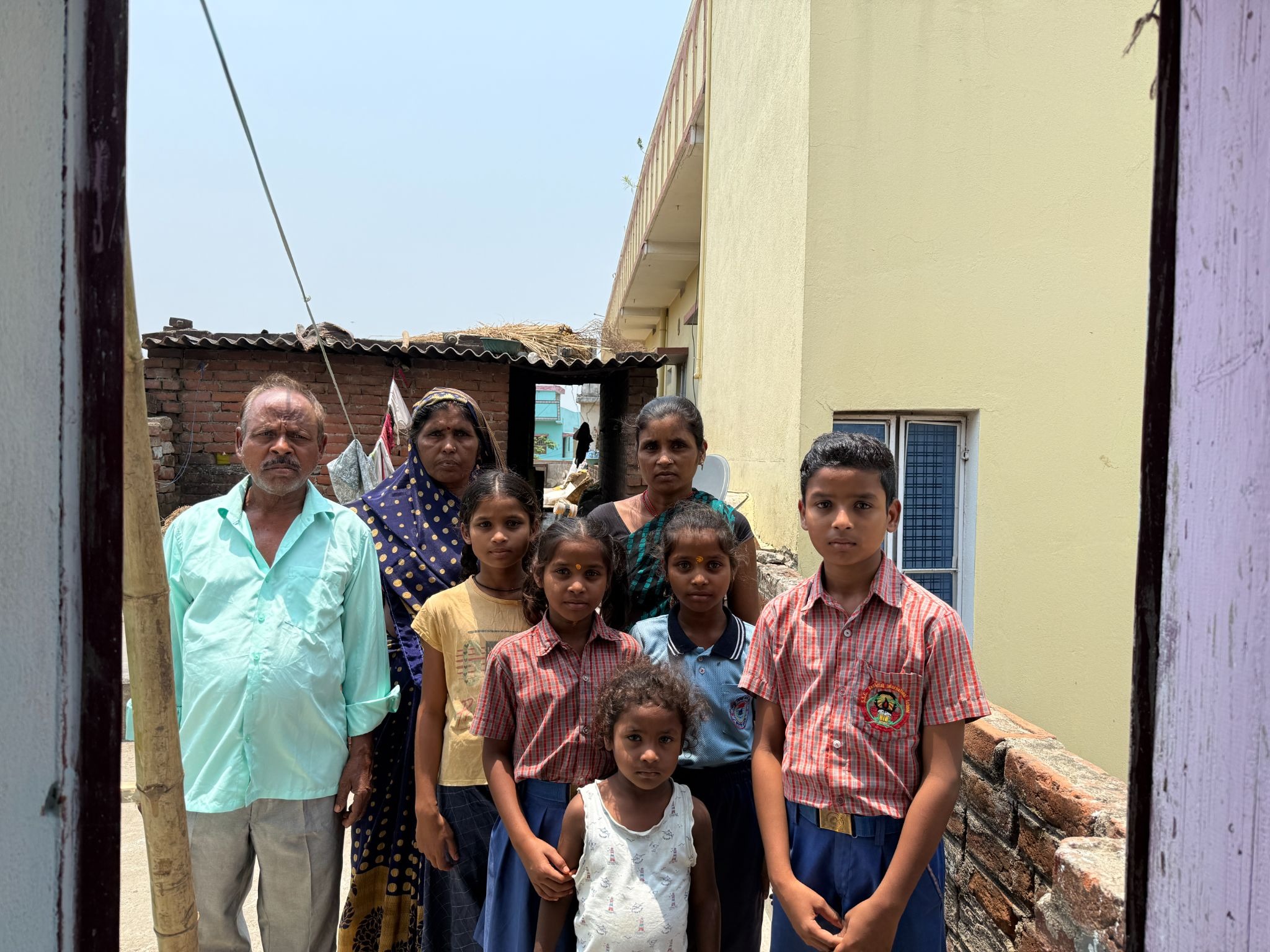
In the three months that followed her husband’s death, Madhu left Maddhupur and sought shelter in her parents’ home. It was here in Sarari that she delivered her fifth child, a boy, Divyansh Kumar.
Bihar’s Generous Aid
When Lal Babu died, Devi was pregnant and was raising four young children. She realised that her late husband had left her with no money.
By the time she learned that Bihar’s then chief minister, Nitish Kumar, had announced an ex gratia of Rs 400,000 for the families of Covid victims, it was the anniversary of her husband’s death.
Bihar was one of the first states in India to declare such relief. It was also the highest relief offered by any state government to the families of those who succumbed to Covid-19.
According to statistics from Bihar’s Disaster Management Department, over 16,000 kin of the deceased have been given Rs 4 lakh in compensation, amounting to Rs 640 crore.
Additionally, the families of the deceased have been given Rs 50,000 each by the government of India, for a total of Rs 80 crore.
In the subsequent years, many Covid victims’ families kept appearing at the janata darbars held by then Nitish Kumar, where he listened to grievances and ordered action.
“The last such compensation was given as recently as April 2026,” clarified Mohammed Nadeemul Ghaffar Siddiqui, joint secretary in the disaster management department.
“But for this, the aggrieved families had to either obtain court orders, health department recommendations, or district magistrates’ approval,” said Siddiqui. Asked whether the department was aware of Madhu’s case, he said it was not.
"But if it is brought through the channels mentioned above, the case relief might be released," said Siddiqui.
Madhu was staring at another round of trips and institutions once she learned that this state might provide her with some relief. She quickly searched for the evidence she needed to prove that her husband, too, had died of Covid-19. She only had his Covid‑positive test report.
Defeated By Procedure
Devi’s brother, Kundan, took her to the local block development office, from where she was referred to another office, and finally to an office called Hindi Bhawan, where the district magistrate was temporarily working out of.
At Hindi Bhawan, she was asked to submit her PAN card, her husband’s death certificate, the Covid‑positive report, bank details, her Aadhaar card and a certified family list issued by the circle officer. She submitted these documents to the disaster management department at Patna’s district headquarters.
“I kept travelling every three months, and every time they would say it might just take three more months,” said Madhu.
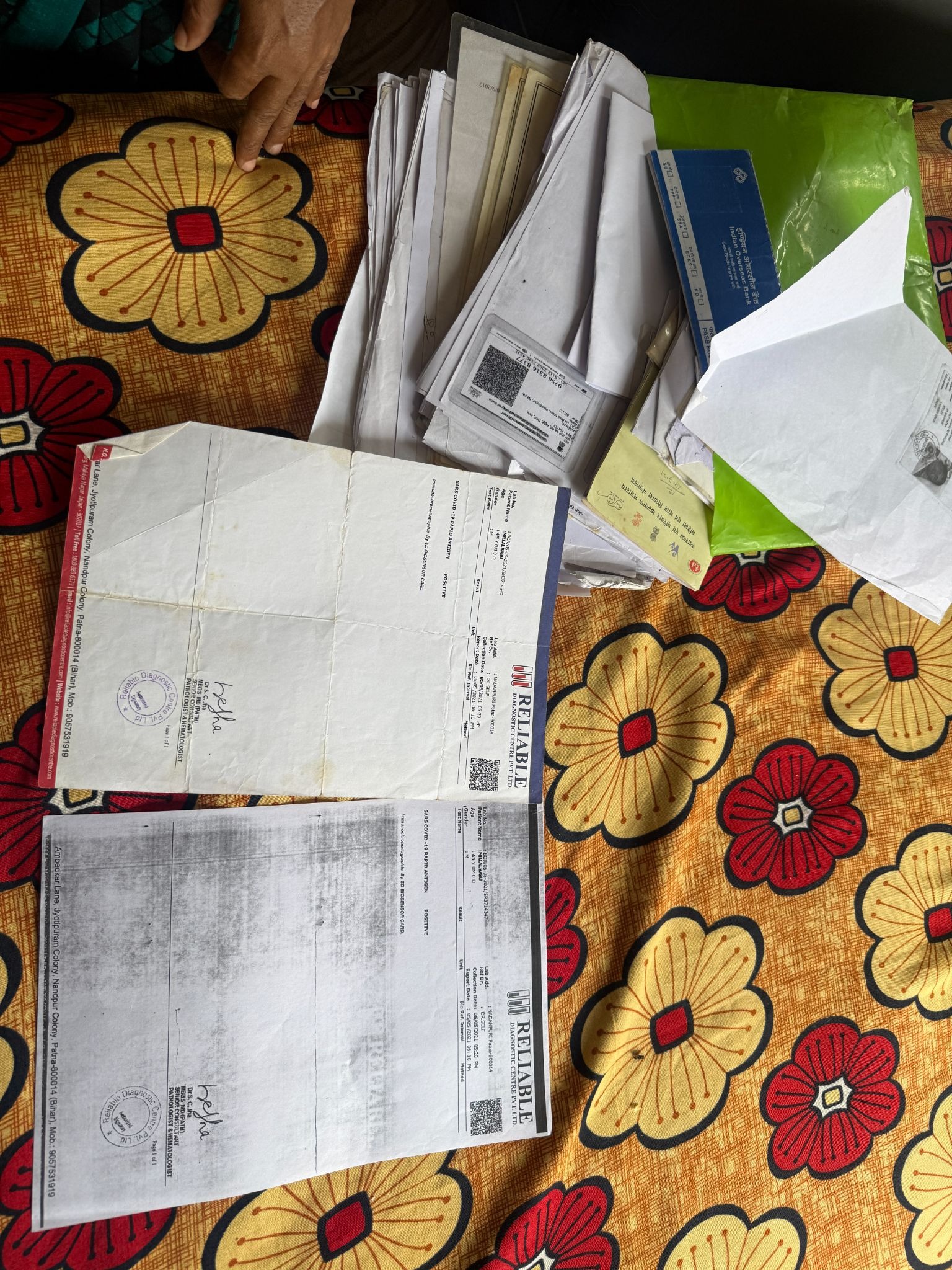
Devi does not remember which month or year she finally stopped making trips to Hindi Bhawan. She does remember what an official once told her, “Positive report ka koi mahatva nahin hai (a Covid‑positive report holds no value).”
After that, she stopped doing the rounds.
The compensation process had drained her mentally and financially. So, she began looking for work. This is when a local teacher in the nearby government school came for her rescue.
Devi appeared to be a perfect candidate for the midday‑meal cook’s job, ticking, as she did, the right boxes: a physically fit widow—the government gives priority to widows—under 40.
If she got the job, she would be paid Rs 3,300 per month. It would not be enough to raise five children, but it was something.
Rules & More Hurdles
Devi started as a midday meal cook without a joining letter or a salary receipt. Then the rules for hiring a mid-day meal cook became increasingly stringent, preventing her from joining altogether.
“Earlier, cooks were appointed at the discretion of the head of the school,” said headmaster Akhtar. “Now they have added requirements—a birth certificate to verify the candidate is under 60, and a medical fitness certificate to ensure hygiene and the absence of contagious diseases.”
After spending scarce cash on petrol for motorcycle trips to government offices to claim Covid relief, Devi faced another set of expenses: obtaining a medical fitness certificate and a birth certificate.
At the BRC (block resource centre), Ranjeet Kumar, the official, said they had also forwarded the application to “higher authorities”.
So began the cycle where one official blamed the one above him, leaving little clarity on whether Devi will ever be paid for the labour since 2023.
“She will only get the salary from the date she formally joins,” said Akhtar. “Why would the state pay from 2023?”
‘I Have To Think Twice’
Devi has not purchased a saree since 2021, the year her husband died.
“It’s just that I have to think twice even if I spend Rs 10,” she said.
The family “always managed” when Lal Babu was alive. “One month we might have Rs 50,000, in other months not a single rupee,” she said, explaining the uncertain nature of his contracting job, which operated through advances and delayed payments.
"Once my husband passed away, his decade-long work partner, Manohar Shaw, who owed some Rs 4 lakh to my husband, refused to pay a single paisa to me,” said Devi.
Today, food, education and other essentials require Rs 12,000 a month, which she does not have. Her father pays the children’s school fees, and her brothers cover household expenses.
Desperate, Devi started looking for other work in the nearby apartments that have sprung up across the area.
A month ago, in April 2026, she found employment in block C of the Agrani Apartments near her home, earning Rs 6,000 per month to prepare breakfast and dinner.
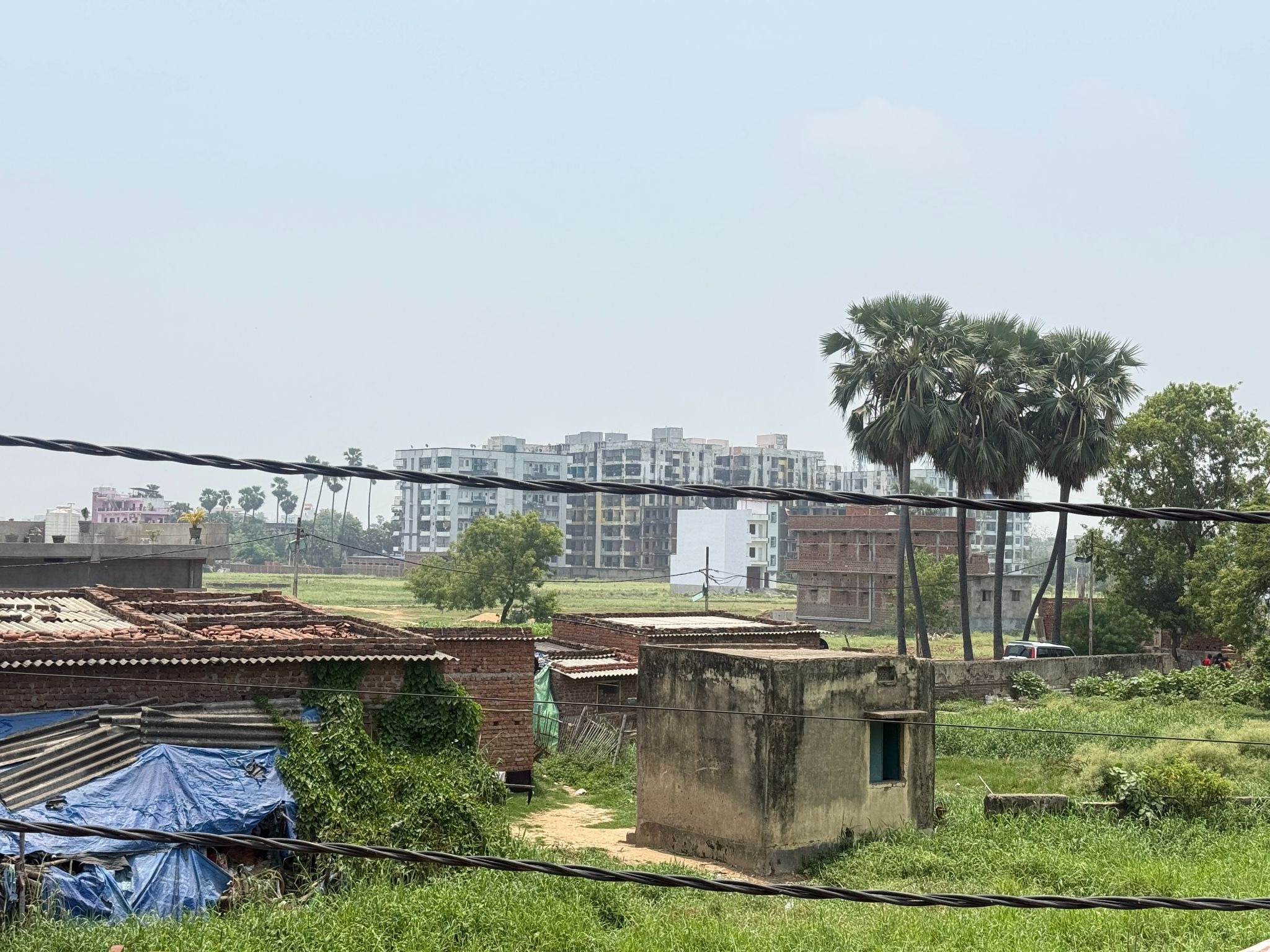
Apart from a four-hour shift at the government school, she works at a private home for two hours in the morning and two in the evening. Sometimes, it stretches to six hours. She has not yet received her salary.
Between the two jobs, she works eight to 10 hours. Her sister and mother helped her, but her sister is now married.
From the apartment, you can see a home painted baby pink with maroon stripes at the end of Sarari’s lanes. In a corner room on the first floor, Devi lives with her five children, surviving on a Rs 1,100 widow’s pension granted by the state three months after her husband died.
The house belongs to Devi’s father, Ramesh Shaw, and his three brothers, Kamesh, Ranjeet, and Gorakh Shaw. It has eight rooms spread across two floors and is occupied by 19 members of Shaw’s extended family, who belong to an extremely backward caste.
Each day, Madhu worries that the expiry date of her parental support is fast approaching. Her brothers will be married in two or three years, and she will have to cede the space in her parents’ house.
Her brother Chandan suggests an escape: that she migrate to Jodhpur, where he is a carpenter, promising to find her a job.
(Jyoti Yadav is a freelance reporter based in New Delhi and the author of the book Faith and Fury: Covid Dispatches from India’s Hinterlands.)
Get exclusive access to new databases, expert analyses, weekly newsletters, book excerpts and new ideas on democracy, law and society in India. Subscribe to Article 14.